Saturday, December 7, 2013

Floating Feathers and Easy Pickins' at Papago

It's that dreaded final month...people in curious clothes are rushing all over at absurd times of day to fill out their lists before it's too late. No no, it's not holiday shopping season (ok, that too). It's December, and all the Year listers are scrambling to boost their numbers before 2013 is expired. Whether it's another surprise chase or finally catching that elusive annual, birders are kicking it into high gear as the weather cools down and the sun hesitates more and more to rise. With so much going on at work and elsewhere, I'm afraid I've thrown in the towel for big chases in 2013 or trying to actively grow a bigger Year list. There have been plenty of great sightings this year and I have no complaints. In fact, just birding the local dives around Phoenix the other evening was all the more rewarding. It was calm; there was no requisite consideration of time or gas money. It's always good to get back to some seasonal basics every once in a while, especially before a new birding year begins...


The Papago Park ponds are now well-stocked with their predictable winterfowl, as are the other bodies of water around Phoenix. The birds are fairly acclimated to people and they're right out in the open. After many chases and photo-attempts on rare and skittish birds in hard-to-reach places, birding around town feels shockingly and sinfully easy. Of course, it doesn't award one many points on the Global Birder Ranking System, not like turning up a gorgeous Fork-tailed Flycatcher in Connecticut does, but these simple stops come with their own reward.


Instead of stopping to smell the roses, stop to wink at the Wigeons (don't bother smelling the Wigeons, it's uncomfortable for all involved). Pause and ponder their nice nose-whistling sounds and their awkwardly wide proportions.


Seriously, look at how wide and stable of a platform this duck is. You could play jenga on its back no problem. It's like the aircraft carrier of waterfowl.


It's been said a thousand times before, but the Ring-necked Duck, a very decent duck, is probably the worst-named bird in North America. Yeah yeah there's a ring on the neck, but it sure isn't a Ring-necked Pheasant. If we're going with the ring motif, maybe mention that it's the only North American duck with a (very prominent) ring on its beak? I mean, Mallards have ring-necks too...
Anyway, it's always a treat when these guys return en masse. I never get tired of photographing them. They're the perfect combination of accommodating but also difficult to properly and angularly expose. I think I nailed this gentleman though, if I do say so myself.


The females are a'ight, but even less noticeably ring-necked (still ring-billed though, er hem...).


And of course the backbone of every avian painter, except for Painted Redstarts, is the Canvasback. Last year there was a cooperative male at Papago. At first he was very skittish, but after a few weeks at the ponds he became more accustomed to the foot-traffic and I was able to get satisfactory shots. I'm hoping he returns this year to find a pretty, demure lady a-waiting for him.


Green Herons are one of those very cool, common birds that I never stop to appreciate anymore unless I'm otherwise making myself stop and appreciate such stuff--like wintering ducks. As soon as I see one hunting again, up close and without also wondering how much time I have to get to the next site, I'm reminded, "Wow, what a gorgeous bird. Where in the world do they put that neck!?"


Even with the purdy ducks now arriving, the Green Heron will likely stay the most colorful overall bird at the Papago Ponds, or if not then at least the coolest. 


And sometimes the most goofy.


I'll be getting back out into the desert this weekend after some Sagebrush and Bell's Sparrows, as well as any Thrashers that have arrived. Hoo knows, maybe even a Snowy Owl will turn up (ok, probably substantially farther north). 

Tuesday, December 3, 2013

High and Empty-handed with the Birds

There has too much inactivity on this site, or rather, not enough activity. At any rate, there certainly hasn't been enough rambling with some birds and junk thrown in the mix. I spent this past weekend up in the Denver area with some friends, enjoying a brief respite from work and trying to fit in some high-elevation birding on the side. Pine Grosbeaks, White-tailed Ptarmigan, Gray Jays, and maybe a Redpoll all taunted me in my sleep preceding the trip, but when I arrived at the mile-high city there proved to be little time and little cooperative weather for much actual, hard-nose birding. There are just so many micro breweries and other neat spots, plus we scored free tickets to a Denver Nuggets game...


Sloan Lake, right next to where we stayed for a couple of days, was awash with the many common varieties of brown, black, and white geese. The Canadas were to be expected--after all, it was a big park with a lake and nicely manicured grass--but I was surprised at the high number of Cackling Geese, who outnumbered the Canadas in many areas of the lake.


We have a few Cacklers turn up in Phoenix every winter, but I have not had the opportunity to photograph them before and Sloan Lake provided a welcome, easy opportunity. They didn't cackle really, but then it was a fairly quiet morning with little to cause a row.


There were some Flickers and Kestrels around the park, but other than these and the geese the only birds were Ring-billed Gulls who settled down into the grass like they were nesting on some remote arctic island instead of in suburban Denver.


Rather than driving directly back to Phoenix, we detoured for a day in Las Vegas to visit some other friends, which allowed for a bit of car-birding and, much more impressively, amazing views of the Rocky Mountains on a gorgeous drive through Colorado and Utah.


As we snaked across the Colorado River, I was able to pick out some Goldeneye in the run-off lagoons. We also had some nice looks at the ever colorful and entertaining Black-billed Magpies, but these specimens would not tolerate any sort of approach for photography. I probably set the trip back an hour trying to snap shots of these frustrating birds.


I was hoping to make some stops to scan for Ptarmigans or any birds that could be found in montane forests as we gained altitude, but the fog rolled in so thick and reduced visibility so much (not to mention the temperature) that seeing birds of any sort became a pipe dream.


The birds were taking cover, but this eerie, frigid landscape certainly held its own allure...just not one the human body could tolerate for very long outside of the car.


Even having seen more birds or gotten some satisfactory Magpie shots, I think the scenic drive would have been the highlight of the trip, at least as far as nature-ventures go. The descent into Utah was equally gorgeous, and I spent the next day recovering from a severely strained jaw that had been hanging open for entirely too long.

Friday, November 15, 2013

Light Birding and a Feat of Swallowing

This past Saturday a strange thing occurred. I woke up, got dressed, and went outside (in no particular order of course) and it was chilly! Mark the calendar: it was November 16th when autumn finally happened in Phoenix. By now, most of our summer visitors have gone and many of the snow birds have arrived, even if the temperatures are just starting to get their act together. I decided to head up to the Hassayampa Preserve for one last visit (there aren't many reasons to visit this site in the full-on winter months) and see if any late migrants or vagrants, like the Catbird and Black and White Warbler from three weeks before, were still dawdling in the lush riparian channels.


Truth be told, it was pretty slow birding. The overcast skies didn't clear up for the first several hours of daylight, and the bird activity was never anywhere near what is usually is for Hassayampa. Either everybody had already left, or they were sleeping in this Saturday. This Great Blue Heron was running behind too, and hadn't started his breakfast until half past nine.


Some breakfasts are more manageable than others. While trying to position and undulate the willing catfish down its throat, the GBHE often had to stop and dip his head back into the water, the substantial weight of the fish being too much for him to bear for more than a few seconds.


Of course, it's harder to eat or dance or dance-eat when people are watching, and in that restrictive sense I was being somewhat rude intruding on the Heron's morning mastication.


This wasn't his first rodeo. The champ swallowed down and seemed almost surprised with himself for doing so. Just as he managed to close his jaws, he may have realized how his gluttony had totally cost him his mobility, and that if I were a predator, I'd be getting an easy two-for-one meal myself.


In the Phoenix area we do not get an indicative first frost or snowfall to introduce us to the cold season. We get a precipitation of Kinglets. As the delicate, yellow leaves detach from cottonwoods and willows, even from palo verde and other desert scrub, so too drop the Ruby-crowned Kinglets. Of course, they don't simply drop. They flutter and bounce like a rubber ball, and chitter all the while.


In relentless, garrulous hordes they descend upon hapless Phoenix, bringing both a blessed rejuvenation of motion to the emptying canopies but also tiring the poor birder with their constant reappearances in proximity to other birds.


A handful of Brown Creepers and some Spotted Towhees were nice highlights at Hassayampa, but the nicest bird of the day came later in the afternoon. The resident Harris's Hawk population seems to have done very well this year, and I'll go so far as to say that they're also one of the best looking raptors in North America. STATEMENT.

Just Keep Pecking Away

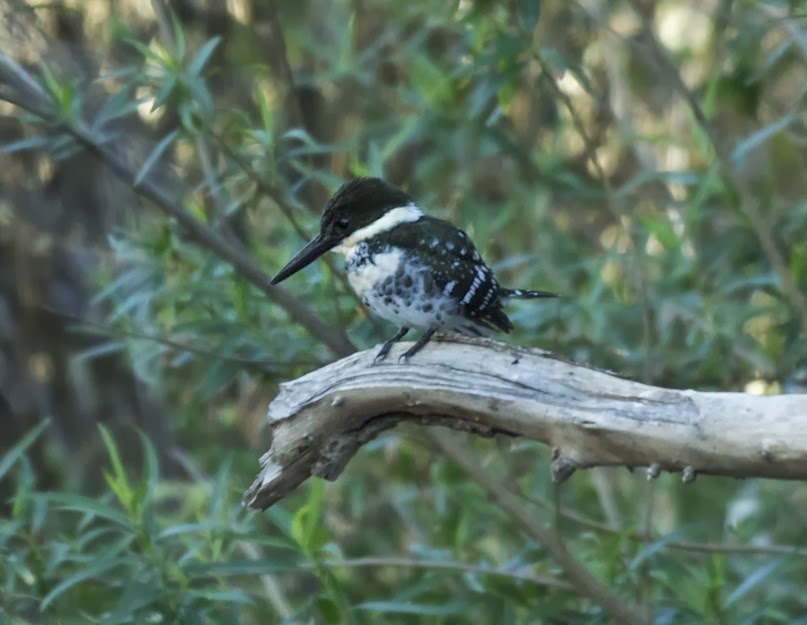
We left Tumacacori in high spirits after finding the Green Kingfisher so easily and getting such nice looks. We were even ahead of our loosely organized schedule as we headed north towards the Santa Ritas, so we decided to dally along Proctor Road and the White House Canyon picnic and to look for some lesser vagrants (lesser compared to an Eared Quetzal that is). 
A one-day Varied Thrush at Proctor Road was a bust, but persisting reports of a Red-breasted Sapsucker at the picnic area and a less reliable Evening Grosbeak were much more intriguing. Tommy and I had seen and photographed both of these birds already for the year, but as any witness can attest, they're too gorgeous to ever pass up, especially in Arizona. 


When we parked at the White House picnic area we were spoiled again. Another nice birder had already pinpointed the woodpecker, which was drilling sap-wells only fifteen feet or so away from the parking lot. It was absurdly time, like it wasn't even fair kinda tame, like it almost cheapened the sighting kinda tame. Almost, but not quite.
Understandably, he stayed on the shady side of his mesquite, and that didn't allow for his dazzling colors to have their full effect, but crikey what a bird! For his drilling persistence and despite his relative ease around people, I named him Daniel Plainview.


Throughout the morning we had been monitoring the listservs for any reports on the Quetzal. It was seen two days before by Laurens Halsey, a very well-known and respected bird guide in Arizona, but no one had been able to relocate the bird. Quetzals are a secretive species, and while this record in Madera was very believable, there were nothing but negative reports since the initial sighting. 

With the weather being nice and with us also having an urge to visit nearby Florida Canyon for its now-resident Rufous-capped Warblers, our patience in the Queztal hunt was not what it should have been. Every birder we talked to on our way up Madera Canyon to the Carrie Nation Trail--and there were a fair amount--was beleaguered. There was a constant stake-out by some half dozen birders around all of the upper canyon berry trees where the Quetzal might perch, and so after about an hour we decided just to call it quits and head next door for some better birding. Along the way though, the Woodpecker show continued. 
A female Arizona Woodpecker flew in and perched in the open at eye level--not the most common thing to see. Despite this being a staple bird of the Santa Ritas, it's not one I've been able to photograph very well and I was pleased to get more face time with this precocious little pecker. 


Yellow-eyed and Dark-eyed Juncos were also moving back and forth between their oaken perches and their leaf-littered foraging spots. It's a big messy family, but at the end of the day a Junco is a great bird with a great name. I'm always hoping to get a good face-to-face with an Olive Warbler in this area of Madera (near the Super Trail and Carrie Nation trail heads). That's how my first ever Oliver Warbler sighting occurred many years ago, but since then my sightings of the species have always been brief or obscured. It was only Juncos and Kinglets this time around, but that ain't so bad.


We couldn't turn up a Williamson's Sapsucker, but this accommodating Red-naped Sapsucker was a gorgeous consolation. This photo has a special place in my heart because it is not only the first post-able photo of the species that I've taken, but I shot in manual focus since my autofocus was on the fritz, and this is a big deal for me.


Unfortunately Florida Canyon was pretty dead; to be fair, we were hitting it around 1pm. We had very brief looks at the Warblers, though we helped point a Washington birder in the right direction in the mean time and, upon running into him later, learned that he got some amazingly close views. 
We left the Santa Ritas without getting our (longshot) target bird, but with some very nice hits on the side. We were also looking ahead to our planned pitstop in Eloi, Arizona, for Mountain Plover and Crested Caracara. 

The Santa Cruz Flats did not disappoint. We had nearly a dozen Caracaras perched near the corral on Baumgartner road and more than three dozen Mountain Plover on the sod farms off Pretzer and road 2750. These two birds are the essence of "locally common." They're very reliable in the winter months, but this is one of very few places in Arizona where both of these species are consistently seen. 


Even without the Quetzal, I added a lifer and three year birds on the trip. It was a nice coup de grace for what may well be my last trip down south for the year (Havasu and Yuma beckon next), unless that Queztal pops up again...

Sunday, November 10, 2013

The Greeny on St. Gerdie

With the 2013 Birding Year now drawing to a close, Saturday brought another tense, high-octaine no-holds-barred rarity chase. It was a day of destiny and disappointment, of fortune and failure. In other words, it was a solid day of birding. 
At 6:30am Tommy DeBardeleben and I returned to the Tubac/Santa Gertrudis Lane on the De Anza Trail, off the I-19 and about 30 miles north of Nogales, to look for a persisting Green Kingfisher. This would be a much-desired lifer for me, though it had not been seen at all during the previous couple of days, and we also needed to find it quickly so we could take plenty of time in Madera Canyon searching for an Eared Quetzal. 

Parking off of the I-19 Frontage Road, we walked down Santa Gertrudis Lane, checking in the massive pyracantha hedges and mesquites for wintering Sparrows and potential vagrants. Such goodies as Aztec  and Varied Thrush have turned up here before, though our best birds to start were a secretive Pyrrhuloxia and a few Rufous-winged Sparrows.


It's a short walk down the lane before the Santa Cruz "river" (it's a beautiful wash, but calling it a river is a bit grandiose), and here is where the birding gets really good. No sooner had we reached the bank than Tommy exclaimed that he heard a metallic clicking, a Green Kingfishery type of metallic clicking.
Almost immediately a small bird came darting by the stream, perhaps flushed by our initial intrusion.
The sun was not yet high enough to illuminate the wash, and the low-perching, seven-inch Kingfisher was tricky to pick out, but once we had a bead on the emerald beauty we were transfixed for the next hour.


We kept a respectful distance as she flew back and forth along the Santa Cruz creek, perching on various outcroppings and remnants of a barbed wire fence. The quietude and coolness of the early morning and the lush riparian setting brought a sense of great solace and solemnity. This rare and beautiful bird was perfectly in her element, and, somewhat unusually (at least for me) I didn't feel like I was intruding on that element at all, but was able to fully, neutrally observe it.


There were dozens of Lincoln's, Song, and Lark Sparrows also foraging along the banks, and a family of Black Phoebes constantly endeavored to out-perform the Kingfisher with their own displays.


Eventually Ms. Kingfisher chose a perch nearer the two of us, though she was always careful to keep the sun behind here and stay on the far side of the water. We never had the satisfaction of catching the morning sunlight directly on her, nor could we get sufficient light for sharp photos (much less in flight), but watching the plump bird daintily belly flop into the chilly water and pull out minnows was the sweetest of treats.


It was certainly a good omen--we found our first target in about five minutes and had spectacular views. We were able to point a few other birders in the right direction as we returned to the car, now with more time and morale for a treacherous trek in upper Madera Canyon.

Sunday, November 3, 2013

Ponds, Rivers, and Big ol' Puddles of Sh*t

Yes, yes, those water features provide some of the most variable and high quality birding in any state, even in states like Arizona that do not feature much water in the first place. I was originally planning on hitting up the Hassayampa Preserve today after hearing about Tommy D's great finds and seeing his great photos, but I got a later start in the morning and didn't have time for the drive. As such, it was back to the west side staples with trips to the Glendale Recharge Ponds and Tres Rios promising some reliable species and maybe a migrant or two.  


I ran into Muriel Neddermeyer on the east side of the ponds, and we decided to join forces for the morning. Suffice it to say, the west Phoenix birding world shook mightily at the news of this alliance, even if some nearby foragers didn't take much heed.


The southeastern basins had good water levels, a bit too deep for some waders but deep enough to hold the daily increasing waterfowl. We had all three species of Teal, Wigeons, and a few Pintails, in addition to hundreds of Black-necked Stilts, Dowitchers, Leasts, Coots, and some Avocets.


Since the water was too deep for most of the smaller shorebird migrants and I'd already picked up my Short-billed Dowitcher for the year, I wasn't overly scrupulous nor scope-u-lous in scanning the mixed flocks (this laziness is not something to publicly admit if one wants to improve on the GBRS, but some of us birders are not so ambitious, and prefer to keep our heads down). 


In the migrant department we did pick up a non-breeding Dunlin, which isn't the most excitingly colored bird to find but it's an uncommon one, one that makes the casual Phoenix (non-shore)birder scratch his or her head for a moment and think back to those pages in Sibley. Unfortunately the handsomer and rarer Black-bellied Plover was no longer present.


Raptor activity around the ponds was very solid, with Red-tailed Hawks, Peregrine Falcons, Kestrels, and Merlins all making an appearance. A Loggerhead Shrike on the way out rounded out the carnivorous category well, though few of these rapacious raptors stayed put for pictures. 


Of course, in a large drainage basin full of sunfish and carp, the Ospreys do quite well for themselves too, and we had several of these kleeping piscivores flying loops throughout the morning. 


That was it for the ponds, so next Muriel and I decided to try some west-side rivers. The Tres Rios concatenation can be dizzying to bird, with so much space and so many species all sounding off and darting around at once. That amounts to good birding though, and it's a guaranteed 50+ species spot, if you give it a good hour or two. With those sorts of numbers the statistical odds of getting some up close and personal sightings are ever in one's favor. 


There were White Pelicans flying overhead, which never cease to amaze me with their giant-ness, and Brown Pelicans floating down below. The Brown Pelicans are a much more recent, though now reliable, addition to the Tres Rios family. To my knowledge, this is the only site in Maricopa County, and perhaps any part of Arizona away from Lake Havasu or Yuma, where one can expect to see both North American pelicaniformes.


It is not the only place in Arizona to see Belted Kingfishers, nor is it even one of the better spots, but they are another staple of the site.


Muriel and I spent a fair portion of our Tres Rios time distracted by the brazen antics of this Rock n' Roll Wren. I was very glad to see this bird on a prominent boulder spillway dam, because this long wall of loose rocks has cried out for a Rock Wren inhabitant for so long and for so long had been lacking. 


Even among the relatively drably colored Wren family, Rock Wrens are still pretty bland, but they're also very hospitable, accommodating birds. I find them and Canyon Wrens to be, by far, the most delightful Wren species. They don't have the colors, but they do have the personality of a peacock.


They also really love rocks...a lot.


After some time at the Tres Rios rivers I was compelled to head back into Phoenix for a Sunday Thai buffet, but I still didn't feel quite satisfied with the day's sightings. As anyone who's driven south down 91st avenue can attest, there is a miasmic odor that permeates the air around the Broadway/91st avenue intersection. A series of cattle feed lots to the east are responsible, and I like to drive by some of the corrals from time to time in search of Yellow-headed Blackbirds or anything else that'll perch up on the rails for a photo. Adjacent to the feed lots is a large, throbbing, beating, growing pit full of raw sewage. Two drainage pipes maintain a continual flow from the cow pens into the pit, and this rank, festering stew holds a certain attraction for the birds, and thus birders as well.

Where do Black-bellied Whistling Ducks take their chicks for a Sunday funday? To the poo pool of course! C'mon kids, hop on in! The water is...fine.


This is the satisfied look of a fulfilled parent who knows it's been a job well done.


There were several dozen Black-necked Stilts around the the sewage ponds and three species of Blackbird too (Wallace Stevens would have been happy). Just look at that Stilt, daintily posed on its little floating island of excrement above the bubbly, frothy goodness that is the domain of Whistling Ducks.


I definitely kept the windows down for the whole ride back into town, but left the west side birding sites, as always, feeling satisfied with enough birding to make it to next weekend.