Showing posts with label Ferruginous Hawk. Show all posts

Monday, December 29, 2014

Empty-Handed Chasing and Swarms of Things

Over the past couple weeks I have been very bad about posting, but this is not because I fear you or hate you, dear reader. Rather, it is because I had nothing much to post. Being unable to make longer trips throughout the AZ, and not desiring to seek out non-lifer scope-view Scoters at Lake Pleasant, my birding options and motivations took a hit this December. More recently, there has been a Fulvous Whistling-Duck reported in west Phoenix, first in the Arlington area and then around the Tres Rios Wetlands. Many people have chased after this wandering bird, among the many miles of agricultural fields, canals, and run off ponds. A few have been lucky enough to find it; while I am resolved to continue after the new year, I have not been one of them. On the up side, chasing after this phantom duck has at least given Butler's Birds some post-able material, so we're back in business!

Nothing announces a return to better days like a Kestrel on a telephone pole huh? This could be classified as a "vintage" or "classic" shot. It could also be classified as "crappy" and "mediocre."


Birding the agricultural fields is always fun. You can stay in the car for the most part, and the bird views are largely unobstructed. Of course, when the birds keep low to the ground, it presents its own problems. Bald Eagles still stick out like dislocated ogre thumbs. What is that duck nearby you ask? Is that a Fulvous??? No it is not. That would have been sweet.


Winter time and smelly farm country are a winning combination for non-Oriole Icterid watching in Maricopa County. Some people spend their entire careers and lives watching Icterids but not Orioles. True enough, not all Icterids are made equal. Look at the regal pose of this Yellow-headed Blackbird, compared to the sniveling, pusillanimous Cowbird nearby. But that would go for Orioles too right?


Well, when I ask non-Oriole Icteriders why they do what they do, the response is usually, "Up yours, kid." In their defense, Orioles don't congregate like this. 


...Or this


...Or this


Everybody likes swarms of things, except perhaps for ancient Egyptians (I don't mean swarms of Ancient Egyptians, although that does sound like bad news too) and people with a fear of bees. For those fearful of you out there, here's a nice, solitary and quiet Wilson's Snipe, one of the non-swarmiest birds there is. Theirs is an anxious existence, but damn they have nice mantles.


The trouble with the Fulvous Duck is that in its foraging it moves around a lot, and it has a lot of options. I went out to Arlington where it was first seen, thinking all the while that if I were that duck I'd head east towards Tres Rios, where there are larger, protected wetlands. Sure enough, I dipped on the duck and it turned up near Tres Rios. Since then it's been seen at different watering holes. Knowing the regular spots were being monitored without success, I decided to check a few from days of yore. This was also a mistake, because most of those retention ponds, where I birded a few years ago, now look like this. This is not very good Fulvous Whistling-Duck habitat.


Another upside to patrolling canals and retention ponds along agr. fields, of course, is the Burrowing Owls. I understand that Burrowing Owls are one of the only reasons people stop by Butler's Birds, and like any grimy politician, I give the people what they want. Different Owls, different times of day, same pose and cuteness factors.


The rarity chase has thus far been unsuccessful, but some neat stuff has turned up. Check out this dark morph raptor; Red-tail would be the first bet but the eyes and beak also are reminiscent of Ferruginous to me, and dark morph Ferruginous is pretty rare (10% of population, I have read). If this bird would have flown, that would've clinched it one way or another, but of course this is the one raptor that stayed still (and Buteo Regalis should be so brave...)


Butler's Birds has migrated over to North Carolina for its annual, weekly winter sojourn, so the Fulvous Duck must wait a little while (and maybe for a TX return, alas), but in the mean time we're going for the all time Wayne County, NC eBirding record. It's 97 species before Jan. 1st or bust, 21 to go!

Monday, December 16, 2013

Smartbush Sparrows and Rusty Hawks in West Maricopa.

For whom did the Bell's toll? Not too long ago, it tolled for the Sage Sparrow. That once noble and singular species was callously and scientifically split into two equally noble species with slight differentiation and range overlaps. Such splits are usually welcomed by birders, as it means another potential tick for the ol' Life List, and maybe even a 'buy one, get one free' if both species were seen before being divided. Arizonans came off particularly well with the split too, because both species can be found co-habitating in the central area of the state (and elsewhere), though it takes some serious scrutiny to tell them apart.  


The Thrasher spot in Buckeye, some thirty miles west of Phoenix, is already a famous and well-visited site. It's perhaps the best site in Arizona to turn up Le Conte's Thrashers, and often provides Crissal as well as Bendire's and Sage in the right months. Since it also plays host to both species of the former conglomerate Sage Sparrow, it's equity has only increased with recent appraisals. Never mind that it's next to a nuclear plant!!!


Last week I undertook a mission to find and photograph both of the new species, plus anything else that was up and about in the cold scrub. I succeeded in half of the endeavor--finding both species--but failed in photographing the Bell's Sparrow, which is also the less common of the two in central AZ. With this spot already being so high on many birdingpal's lists, I'm sure I'll get another chance.


The Sagebrush Sparrow tends to have a more distinctly gray head and heavier streaking on the back and mantle. The particular specimen shown both above and below had darker streaking, though it stopped a little shorter than expected, but the gray of the head shown pretty distinctly against the browner back, and as such I'll call this a Sagebrush.


The malar stripe is one of the better distinguishing features. Sagebrush Sparrows feature a malar stripe that is the same color as (thus, not in contrast with) the head and it tends to be of a thinner width. Honestly, this particular specimen troubled me a bit because the malar strip seemed thicker than I expected, having looked and many pictures of Sagebrush vs. Bell's comparisons on the interwebs. The lack of contrast still points to Sagebrush for me. That being said, it's maybe a tiny bit darker, and could this even be a younger, less apparent bird??? I dunno, I hate this hobby...


Before heading out west I met up with New Mexico birdingpal Mark, who was in town for several days and wanted to have some photo opportunities with the Arizona annuals. After we scoured the scrub for a bit, also getting quick looks and Bendire's and Crissal Thrasher, we took the scenic drive down Salome Hwy to Arlington, stopping for many the raptor along the way, including a handsome Ferruginous Hawk named Rusty Venture.


In the (sadly) few photo-ops I've had with this species, both of mature adults and immature birds (which can be told apart by their juvenile sense of humor and pimply faces), I have noticed a consistent, serial-killer stare when in direct eye-contact. Look at that gleam...he's got murder on the mind.


The Thrasher Spot and Arlington drive offers some great looks at some particular, esoteric species, but doesn't offer a surfeit of species overall. Thus, any trip to the west side of Maricopa is best capped off with an hour at Tres Rios to bump the day list into the seventy or eighty species tally where it belongs. I don't exactly hang my head in shame when I say this is perhaps the best photo of a Belted Kingfisher that I've managed--they're a skittish bird--but I kinda do.


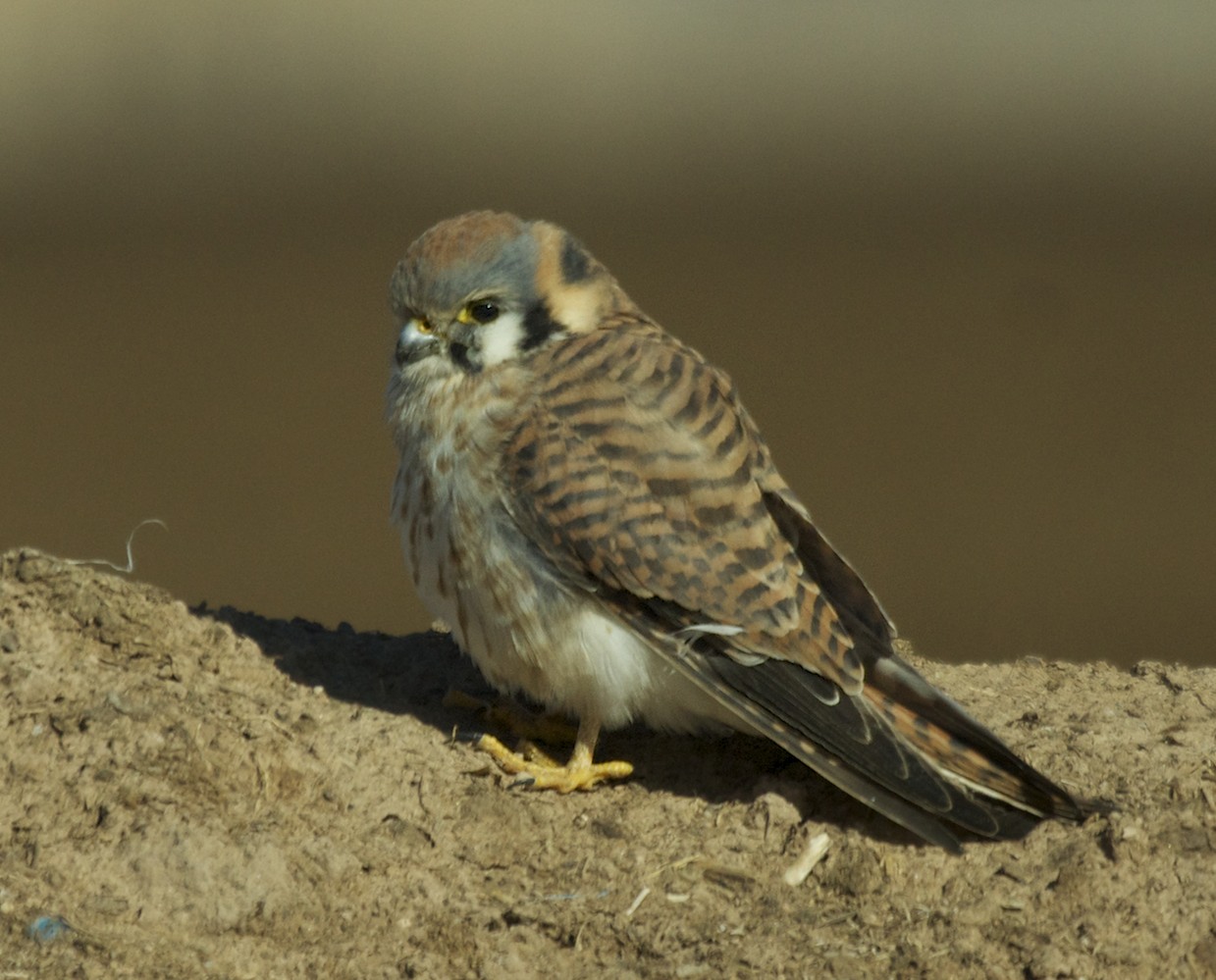
For the first time ever, Burrower's Row just north of Tres Rios was deserted. We did drive by a fellow who was rather brazenly discharging his shotgun at blackbirds on the telephone wires nearby, so this was perhaps keeping the wise Owls underground. The detour wasn't entirely for naught though, as this American Kestrel stayed perched alongside the road long enough for some nice shots. Apart from Red-tailed Hawks, this is the most common raptor in Arizona, but it's pretty rare for me to see them at eye level--a nicer sighting, in fact, than the Burrowing Owls on which I am already spoiled.


An American Pipit was also pipiting along the berm. They're kinda dull birds but they make me happy.


The cattle farm on Broadway was not quite as productive as on my last visit, when I delightedly watched a family of Black-bellied Whistling Ducks frolic in the bovine excrement ponds, but any beer enthusiast appreciates this blackbird.


And Yellow-headed Blackbirds are just objectively pretty no matter what sort of enthusiast you are.


I'll try again for the Bell's Sparrow in a few weeks. On a related note...if you have any thoughts on the above Sparrow contrary to it being Sagebrush, let me know. Hope to see y'all in the field some time.

Wednesday, April 17, 2013

Not Yet Rusty

One of my bird-related goals for the winter was to photograph Ferruginous Hawks, one of the largest Hawks in North America and, for my small amount of money, one of the best looking. They're an uncommon sighting in the agricultural fields west of Phoenix, and alas the only photo-op came with a juvenile bird, that neither had its rusty siding (described by the ferruginous name) nor its fully imposing beak. If there's one thing a birder and photographer must be able to do though, it's ditch those scruple in a ditch. It was cloudy and the bird was mangy, but it was better than a Stilt in the eye.


Even though this bird still has the soft, yellow gape of a juvenile bird, it clearly possesses the eyes and smile of a sadistic killer.
I know, at this point it's probably getting annoying how much I anthropomorphize birds with human characteristics and character flaws, but think about it this way. If you were an elegant triumph of form and function, like a Ferruginous Hawk, wouldn't you take great pleasure in living and hunting to the best of your ability. Everybody has that satisfaction, and he knows it's coming.


After about thirty seconds of eery perching, this one and only Ferruginous photo-op up and flew away. I'm pretty annoyed at myself that I didn't zoom out enough to get the whole bird in the frame, but when it comes to these birds I am certainly a rookie.


Perhaps I will see this bird again next year. He will have rustier sides and a more mature beak. And he will have blood under his nails...mwuahahaha!