Showing posts with label Brown Thrasher. Show all posts

Wednesday, July 8, 2015

Carolina Patches and Unfinished Skulking

Winter and Summer visits to the coastal plain of Carolina have now become a regular part of my annual peregrinations, and apart from the major pains that come with flying out of the east coast, this has been a welcome thing. Bird-wise this opens up new state and county lists to lazily track, and a very welcome new cadre of potential life birds. Perhaps most satisfactorily, it provides regular opportunity for closer encounters with bird species that are relatively rare or even non-existent in my home state. Even with the humidity and the biting bugs, they are sweet days indeed when all of these factors coalesce. 

Purple Martin is a bird I do not yet have on my AZ list. This isn't exactly embarrassing, but it's unimpressive, a real signatory that I am not part of the inner circle nor a particularly dedicated state-lister. PUMAs are legion in North Carolina, and they are much harder to expose properly than they are to find and appreciate.


It's a crying shame that most of the eastern (and North American) PUMA population resides now in subsidized housing. Purple Martins must be encouraged to show aggression and malevolence commensurate to their size against the competitive House Sparrows and European Starlings. To move beyond their artificial housing they must become more...uncivilized.
We're all counting on your and your ilk, sub-adult PUMA. Grow into a territorial monster.


PUMAs might be better-served if they learned to construct their own nests a-la Cliff or Barn Swallows. Then they would not be competing for cavities with the aforementioned feral blight species. Barn Swallows practice such yeomanry with near-continental success. In fact they seem to have too much time on their proverbial hands, such that adolescent birds can laze around and stare vacantly off into space without the need of getting a job.


And PUMAs could perhaps learn a thing or two of aggression for their smaller, long-tailed cousins, who bare fangs, as it were, even at the mighty Helios himself.


Another Carolina staple is the Brown Thrasher. These birds are common but often skittish, so any time one gets a close and personal sight it makes for a very happy BRTH day. We're pretty spoiled for Thrashers out west and in Arizona; 6 of the 8 North American species occur in Maricopa County annually. But as much as I love Le Conte's, and as much as I make fun of the East Coast's one-Thrasher policy, I must admit that Brown Thrasher is probably the best looking one of the pack.


One can pick up PUMAs and BRTHs around the yard throughout most of Carolina. Every region has its yard birds, and those are good ones. Walking around the rural areas, just past the well-manicured property lines, one finds the woodland/farmland liminal spaces and the scrub that delineates them. These areas also have their residents, and while it requires a bit more endeavoring to get good looks at Field Sparrow or Prairie Warbler than PUMAs, the pay-off is that much sweeter. 
From my observations, PRWAs in NC are not yet adapted to using toilet paper like those in Maine. Perhaps not coincidentally, handkerchiefs are also very popular in NC.


The coastal plain also offers a higher delicacy of bird, species that can be found elsewhere in the state but almost never without substantial effort and/or blood sacrifice. Much to my chagrin when hiking in the Appalachians, Pops got looks at a Kentucky Warbler while I was distracted by a Canada, and a female at that. That KY bird should have been the one, but instead it was nothing (to me, and therefore by association the entire world), nothing at all.
As such I had to spend a much hotter, muggier, buggier time at Howell's Woods--a great birding spot to be sure--to track down KEWA, which is a leading avian proponent of facial tattoos. This bird was very shy and secretive, and also stayed up much higher than I expected. I was only thinly satisfied with the encounter, but we shall meet again.


Birds of a feather flock together don't ya know. And as I was making up for lost time and lost sleep and lost blood (mosquitos) with the KEWA, his compatriot in skulk started singing from the other side of the trail. Swainson's Warblers are probably the most uninspiring warblers from a visual standpoint, but as is the case with most of the Old-World Warblers, this bird sings better than Andrea Bocelli, and also navigates much better in a shaded wood than the afore-mentioned maestro.


Swainson's Warbler was another semi-overdue lifer, one for which the blood-price had to be paid with a seemingly interminable wait in a dismal mosquito cloud for a mediocre photo. I have no regrets, but these sightings did still leave me longing for more and better time with eastern Warbler species.

Monday, June 23, 2014

Wipe Your Heels: Sweet Carolina Birding Pt. 1

The great ire over my great Texas post being great Bloggerized (erased) has almost subsided, and I think I'll be able to get back to those tales and photos soon (and will also try to re-write the preceding post to do those sites and birds justice). 
In the mean time, Butler's Birds has expanded to include North Carolina in its repetoire. While the Carolina trip is not geared towards birding necessarily--there are too many breweries and such--hanging in a place with such sumptuous bird offerings will result in some birding, even if it's a bit hung over.
Barn Swallows are the least common of the resident Swallows in central Arizona. In central/east Carolina, they are by far the most common. Never has a nest made of spit, mud, straw and poop looked so comfortable.


Of course, there are some noticeable differences birding in Carolina. There is water, a lot of water. It hangs in the air, it condenses on everything, and it seems to flow into and out of every wooded thicket between the Research Triangle and the coast. Subsequently there is dense vegetation where there are not tobacco and corn fields, and plenty of tall hardwood trees. In these woods one finds expected and unexpected things. 
A Blue Jay seems very fitting, clearly in its natural habitat...


...a pay phone is not so much in its natural environment.


There are also many under-birded counties in North Carolina (and many more counties in general). In Wayne County, where Butler's Birds is based for the next little while, the highest eBird total is 56 species, of only 16 or so registered reporters.
If some of the county listing dynamics are different, some of the birds are still the same. Killdeer abound near open fields, and also still insist on nesting in the most impractical of areas.
I had one nesting in a tiny, 5 square-foot parking lot planter at work in Phoenix. This one picked a gravel driveway to lay its four eggs.


Most importantly, new regions offer delicious new birds, fantastic visual and audio beauties such as this Fish Crow, which was conspicuously cawwing in its unique nasally way.


I do not think there are any records of Fish Crow in Arizona, whereas Brown Thrashers occur in small numbers at least every other year. Nonetheless, I'll pick this as the more exciting of the two. Good looking bird!


Both of these birds are welcome sights for the out-of-state interloper, but by Carolina standards they're pretty pedestrian. To get the birders' birds of Carolina (you know what I mean), one has to get out into this stuff, the pine forest/grassland savannah. 


The lower brush yields expected Wrens, Cardinals, and mournful Pewees. Young House Wrens are very crushable. Curiosity claims more House Wren lives each year than domestic cats (both meanings/interpretations intended).


Speaking of susceptible birds, Prairie Warblers are always good for a pish. They don't dwell in the low stuff quite as faithfully as the HOWRs, but they can be brought down with some enticing clicks and whistles. Unfortunately, this one was also one the other side of a stream and it was only curious so far.


Other birds that dwell in the intermediary heights, like the Prairie Warblers, include the flycatchers. Eastern Kingbirds are loud and energetic, a handsome and easy sighting on many the eastern birding trip, a bird that never bores.


Juvenile Great-crested Flycatchers are the total opposite. They just sit and space out, as if trying to blend in. This bird did not budge the entire time I observed it, and not having adult flight feathers is no excuse for being slothful and laconic. I have no feathers and still manage to shout and gesticulate wildly, especially when people are observing!


Follow the woodland streams closer to the marshy drainages and a sweet sugary call may also join the chorus. Another immature bird (an unintended theme) in this post: Prothonotary Warbler.


Farther away from the marshes, Eastern Bluebirds and Pine Warblers populate the pine and palm savannah (is that a habitat name?), and every once in again a Bachman's Sparrow will make an appearance. Poor Pine Warbler. They're very industrious, resilient, and adaptable birds, real go-getters, but they're just not very good-looking by Warbler standards.


As was frequently the case (and always is this time of year) the young birds of the species gave better looks than the older and wiser. Here's an immature Pine Warbler, told by its acne and petulant, rebellious attitude as well as its dumb jokes, and also everything else that's incomplete with its plumage.


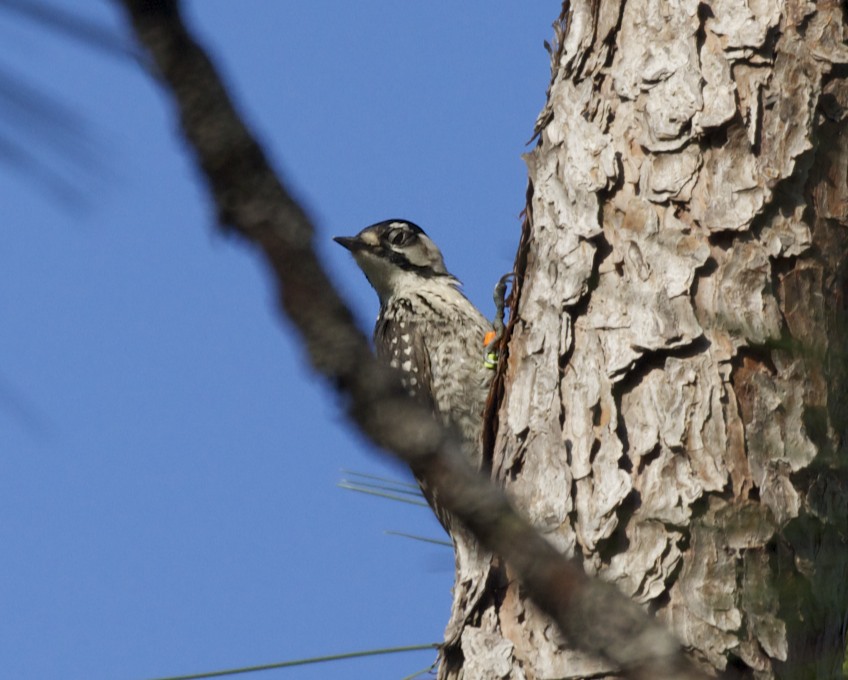
All of the Warblers and Flycatchers were photographed at Croatan Natural Forest, on the Millis and Pringle Road trails. The warblers were rewarding, but the biggest draw of this massive coastal forest is its local populations of Red-cockaded Woodpecker, many of whom are sporting jewelry. 


It was very cool to get prolonged looks at this American endemic. The bird itself is somewhat underwhelming, as far as woodpeckers go, but seeing a third endangered species in as many weeks brought an extra air of importance and satisfaction to the occasion. The birds, 5 or 6 in all, were very vocal and foraged actively when not busy chasing each other around their pine pedestals. 


Red-cockaded is an uncommon, somewhat bland woodpecker, but a special bird nonetheless. Red-headed Woodpecker is a fairly common, somewhat breath-takingly face-meltingly gorgeous woodpecker that is also a special bird--probably the one I have enjoyed seeing most on this trip, because nice male warblers have thus far denied me many good looks. 


If I were this dignified head-banger I would resent Woody Woodpecker being based on my visage. In fact, I'd become so totally vain that I'd resent probably everyone everywhere. GAZE!!! GAZE AND BURST OUT OF YOUR SKIN!!!


One final draw of North Carolina, one that has little to do with birds, is that it also hosts one of North America's best and most musical crustaceans. This fellow has been single for a long time. He ain't even ashamed.


With the right combination of brackish water, methane, and salt, these highly specialized critters can accumulate in numbers...


...very large numbers.


So hopefully some time in the mountains and local birding in Carolina will turn up some cool finds (and the very nifty possibility that I'll be a #1 county birder, with enough vanity to match a Red-headed Woodpecker and maybe contribute something useful to eBird for once). In the mean time there is much, much more to come from Texas, so it'll be alternating tropical birds with temperate, topical posts with temperamental.