Showing posts with label Gray Flycatcher. Show all posts

Monday, February 2, 2015

Bluffing Bandits and Foggy-headed Birding

Friday and Saturday were, once again, the setting for some pretty impressive deluges throughout the valley. This made Sunday, Superbowl Sunday, the only viable birding day this weekend. Bearing that in mind, and the fact that Glendale, AZ, was hosting the party, I decided to forego the temptation of chasing a Greater Pewee in west Phoenix. Greater Pewee is a great bird in Maricopa, especially in winter, especially in the lowlands where it was found. But between the weather and the traffic, I decided to chase on the east side of town and hitched my birding raft onto the Salt River. 

The Coon Bluff site is one of my favorites in Maricopa, combining interesting geology with some flowing water and a very healthy mesquite bosque. This habitat doesn't yield that many crazy rarities, but what birds it does have it has in abundance; they tend to be reliable, readily visible, and they tend to be awesome. Driving down to the river there was heavy fog settled in from the previous days' precipitation, and for the first hour or so my camera lens collected moisture enough to make it inoperable. As visibility improved, it revealed an eerie, primordial hollow that smelled wonderful. 


Coon Bluff is unofficially the Phainopepla capital of Arizona. They are, by far, the most numerous, vocal, and conspicuous bird around the bosque. For the most part, these birds are not overly friendly to photography, but with so many of them about the odds eventually pay off. The male below was perched eye level on the side of the road, of course before the fog was letting through much light. I have no good examples this time, but if you want to crush silky flycatchers, come to this place.


For sure, the Phainopeplas are a very impressive, abstract kind of cool, kinda like people that are very good at cooking oriental food or are very good at dancing to a specific kind of music. Another common aerial acrobat at Coon Bluff, the Vermilion Flycatcher, is a different kinda cool, like a trans-genre red corvette everyone acknowledges this bird is cool, kinda cool.


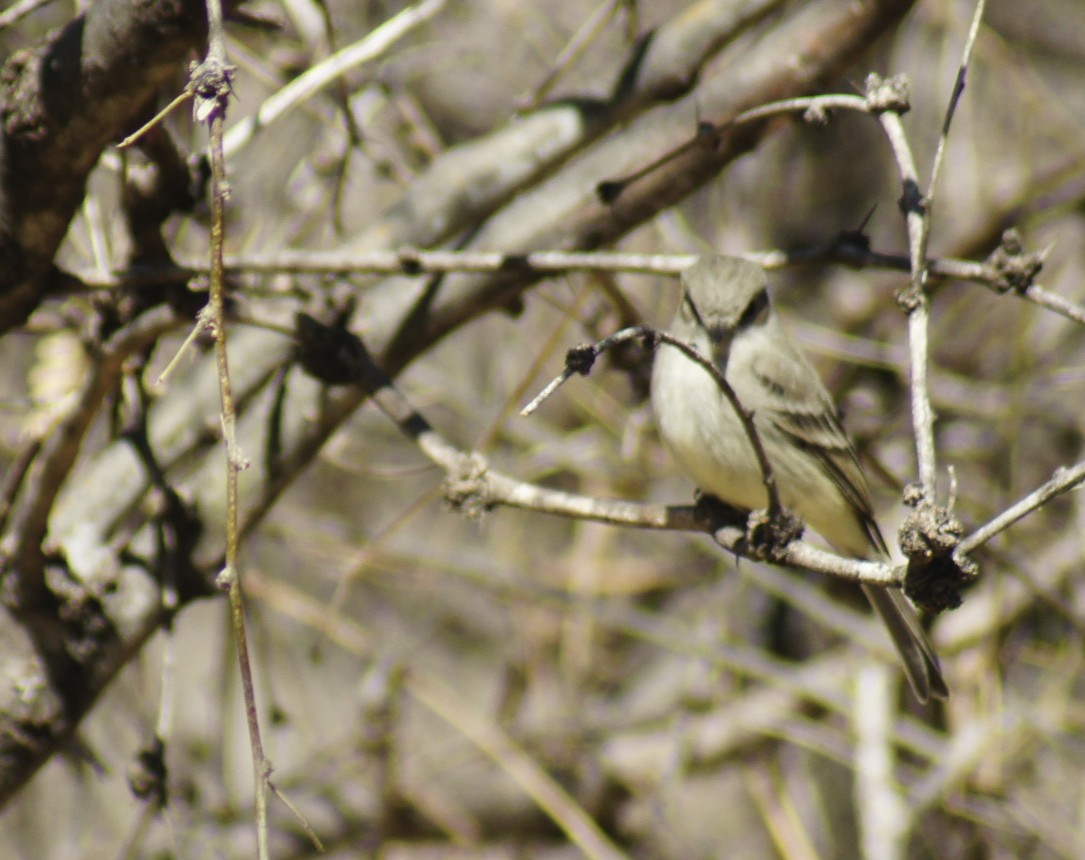
Then there is the Gray Flycatcher, the least eye-catching of these three. It tends to perch lower in the canopy and, in typical empid fashion, is pretty drab. But the simple fact that despite these proclivities they're willing to mix it up with their more aggressive and colorful neighbors is a testament to their fortitude. Since they make one work a little harder for the visual than the other two species, these tail-bobbing fiends have more mystique as well. I appreciate that they are willing to winter in the area. Waiting until spring for any empids would be nigh unbearable.


Do you ever go up to your perch in the morning for a nice preen and get the feeling, well, that someone is watching you? Someone robed in black, with red devil eyes and maniacal hair? This is but a day in the terrifying life of a Ladder-backed Woodpecker, and many other birds who must live near Phainopeplas. After all, those silky flycatchers nest in mistletoe; they do not respect personal space or boundaries.


Ladder-backed Woodpeckers do not have an expansive range, continentally speaking, and in some areas they're certainly more common than others (Coon Bluff being a common area), but in my experiences they are an extremely adaptable, hardy woodpecker with a very diversified lifestyle portfolio. I have seen them in mesquite bosque, cottonwood riparian, montane oak and pine, sagebrush, and even urban habitats. I suppose it's easy to move upward in the world when one comes equipped with one's own ladder.


I am mostly including this photo because I had not previously registered Brown Creeper at Coon Bluff. While we're at it though, check out the massive hallux on that guy.


Kingfisher activity is very good along the Salt River, which is also reliable for Mergansers and many species of duck nearer the Granite Reef dam. There was a Bald Eagle perched on the far shore, but these NECOs did not seem intimidated.


Coon Bluff has a few well known attractions. I was heading there to look for a Harris's Sparrow in the overgrown clearings amidst the bosque. This bird was discovered a week or so ago in a mixed flock. They're almost annual and this would only be a year bird, but I had no photos to date, plus it's a sweet sparrow.
This is not the attraction for everyone. Most hikers and naturalists in the area come for the semi-famous Coon Bluff "wild" horses (there's a heated, ongoing 'feral' vs' 'wild' debate). They like to graze in the area and, uh, hang out in the shade.


People in the area will often stop and ask if one has seen the horses--which are relatively easy compared to skulking sparrows. It coincided on Sunday that several of the creatures were lazing around the area where the HASP was last seen, which contributed a fair amount of extra vehicular and pedestrian traffic. Fair enough; they are pretty cool.


The HASP had fallen in with a group of White-crowned Sparrows and was being seen somewhat regularly, but this still meant sorting through a lot of different mixed flocks. You know that annoying thing when you're counting in your head and then someone interrupts you and you lose the number? It's kinda like that every time the different WCSP flocks kick up, mix around, settle down, and leave you scanning again from square one. 


Rummaging around in the morning yielded all of the nifty birds above and some other FOYs, but no rare sparrows. As the day wore on, I figured the HASP might have retreated farther from its usual haunt, given the extra commotion relating to the horses. As I headed further away, I ran into birder friend Gordon, who had seen the sparrow a bit earlier. With that bit of encouragement I continued away from the road, redirecting two more lost hikers who were hoping to find horses on the way.
As with the Sprague's Pipit the week before, it was crunch time with an 11:30am departure. I spotted a small flock of WCSP, mostly immature, and in their midst was the comparative demigod Harris's Sparrow. Another buzzer-beater!


Yes, there is horse scat in the foreground of all of these and many other photos. I'm pretty sure these horses fertilize most of the eastern Salt River valley, and now also my shoes and my left knee.


The HASP also continued the SPPI trend of leaving it late and providing poor looks at a great bird. These photos are not meritorious enough to enter the HASP fairly into the Butler's Birds Sparrow Judging contest, but some day perhaps he will make do what his WCSP companions never could, and take the crown.

Tuesday, March 19, 2013

Epic Bird Day: Patagonia

Last weekend my wife worked a double on Saturday, and all bird nerds know what it means when one's spouse or significant other is working on a weekend. It means Epic Birding Day! It was time to saddle up and get down to southeast Arizona for a rigorous day of indulgent bird-seeking. With it being early and unseasonably warm in March, expectations were high both for seeing lots of the southeastern residents and also for seeing some migrant birds that would be new for the year. I'll admit, I had the faintest optimism of seeing some Evening Grosbeaks that had been reported in Tubac two days prior.

So, heading south down the I-19 from the I-10, I first stopped at the De Anza trail in Tubac, and hiked along to Santa Gertrudis Lane. As expected, the Evening Grosbeaks were long gone, but there were still some great birds out in the early morning haze, including a new one for the 2013 birding year.


Woodpeckers were the first to great the timid sun. They were impatient and it took its sweet time in rising. When it was finally up, it had delayed long enough to let the clouds come in and dim the sky. There is an uncanny correlation between visiting great birding spots and getting overcast weather...
Anyway, the first minutes of clear skies were a head-banger's dream as Northern Flickers (3 above), Ladderbacks, and Gila Woodpeckers went to work in the mixed woodlands. They had Cottonwoods and mesquites to choose from. The Flickers liked the taller cottonwoods, while the Gilas stuck to the mesquite, and were thus, oddly, more photogenic.


Apart from some skulking Song and Lincoln's, it was a relatively sparrow-less dawn, but from ground level to mid level, my attention was enraptured by this mid-molt Vermillion Flycatcher. This poor fellow was at that awkward stage experienced by many the college freshman, when they molt into their mature adult beardage to show they're ready to breed.Yes, he's sporting the equivalent of the scraggily freshmen-year facial hair, and like the freshmen he won't be attracting many mature ladies this year, no matter how loud or obnoxiously he behaves. Hang in there bro; soon you'll be one in a vermillion.


The self-conscious Vermillion was hanging out along a little stream, and while trying to get different angled shots of the awkward Flycatcher, I noticed the silhouette of what appeared to be an inordinately large Say's Phoebe. After a minute the bird flew lower down into the tree where the back-lighting wasn't so debilitating, and revealed itself to be a first-of-the-year Cassin's Kingbird. Hazy photo, branches in the way...this guy must've been hanging out with Bigfoot this winter. 


There were plenty of Towhees and Cardinals, along with gangs of House and Bewick's Wrens, all rustling around the hedges of Santa Gertrudis Lane, whose large pyracantha bushes supported the Grosbeaks a couple of days before. It's hardly a consolation prize but hey, without Abert's Towhees doing their thing, scientists estimate that we'd all be living up to our waists in leaf litter, bugs, and old seeds. Abert's Towhee: the unsung custodian of the forest floor.


The De Anza trail was a very pleasant walk, but it was just an appetizer for the birding feast to come.This time around the main objective was Flycatchers. Patagonia provides the very similar Gray, Dusky, and Hammonds Flycatchers all within close distance of each other, and I was greatly wanting more time to study the Gray's and Duskies in addition to obtaining better photos of these two species.

In my experiences, the Gray Flycatcher is the most common/visible of the three. It perches and hunts from mid-level in the trees around Patagonia Lake (and anywhere it lives). There are some subtle variations that helps to separate this bird from the similar Duskies and Hammonds--short primary projections, non-contrasting wing-bar and tertial coloration and more of a gray band across the forehead--but for my money the easiest way (and hopefully still a consistent way) is by taking a look at the beak. This guy's beak is very long, in proportion to his head.


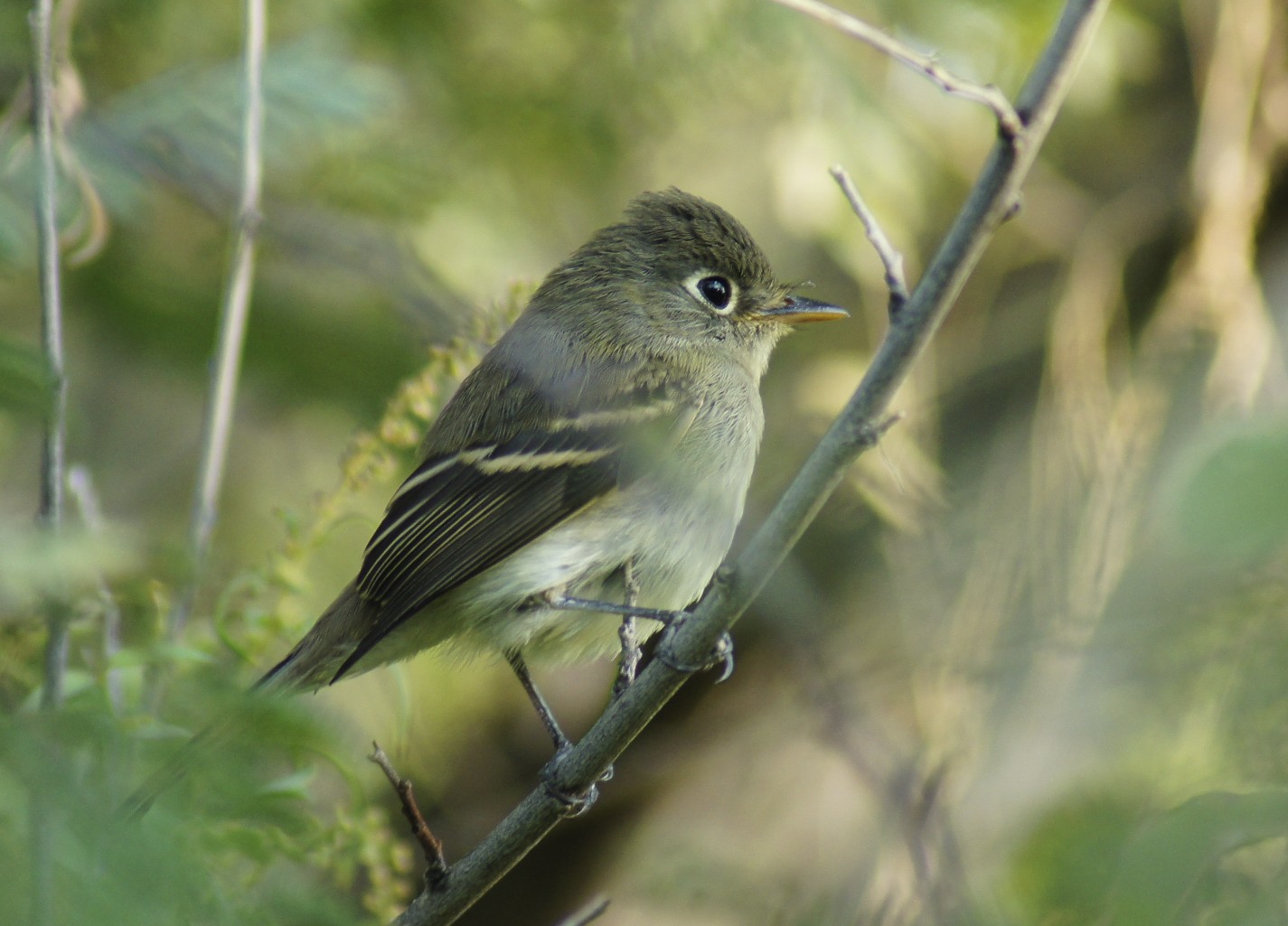
By contrast, this Dusky Flycatcher, which also tends to prefer lower, brushier habitat, has a stubby beak. The Hammond's has a stubby beak as well, but they tend to prefer taller trees and higher perches (this bird was foraging and photographed just a couple of feet off the ground, an elevation at which it stayed for the duration of my fifteen minute observation). Of the three birds, the Dusky has the most noticeable contrast between the head and back, and Hammond's has the longest primary projections, long like this fellow here.


Truth be told, the primary-projection business if iffy for me, as can be obscured by the bird's posture and movements. It seems like the odds are better for getting a good look at the beak length, but maybe others would care to weigh in on this observation. At any rate, I can't say I'm a glutton for punishment, but I do have a certain proclivity towards tormenting myself in the pursuit of these empidomax.
*The more-informed opinion on this bird is that it is, indeed, a Hammond's (Cheers Seagull Steve), so ignore everything I said.


Rooting around the narrow paths on Patagonia's east side, near Sonoita Creek, will turn up the vast majority of Patagonia's species, both in mixed flocks and as individuals. Common Ground Doves often travel in little bands but this solitary bird was the only one I saw. 


Commonly grounded, this Dove seldom gets to hang out with its friends on the weekend.

A conspicuous Canyon Towhee was trying to fit in with an un-abiding group of Abert's Towhees around the same area. It was surprising to see a Canyon Towhee near the comparatively lush, green undergrowth around Sonoita creek, especially as I did not see any when hiking around the move arid, elevated north side of the lake--the kind of terrain they usually prefer. Towhees are such butts to photograph, and the thickening clouds didn't help the situation. All the same, it's still satisfying to find something unexpected, even if it's not rare.


Despite being expected, common, and easily seen, the Bridled Titmouse is still a delightful bird. Chinstrap Beard Titmouse is a less eloquent name for this bird, but it would also be fitting. As far as black, white, and gray birds go (there are more than a few), these are one of the most stylish.


After several hours of rummaging around the bird-rich Sonoita Creek area, I finally resolved that the Trogon was a no-show for the day and decided to continue hiking around the lake (I hate to admit it, but it felt good to later read that nobody found the bird that day. Although I am sorry for others who spent time and money chasing it, I feel less incompetent now). For the most part, it seems like birders concentrate their efforts on the south shore and Sonoita Creek parts of the lake, ultimately with good reason. The south shore also has elevated desert chaparral frequented by Rufous variety Sparrows and other arid dwellers, so in terms of specialization there is no reason for the long walk around the lake.

Nonetheless, I set off, mostly just to content myself that I would have hiked all around the lake. The clouds continued to thicken, the bird numbers dropped off, and with each passing minute of the dreary afternoon the decision felt more and more rash. But while walking and musing along the northern shore, a delightful ball of saturated, sweet-ing yellow caught the eye. In the gloomy lighting and under gloomy skies, this first-of-year Yellow Warbler looked positively radiant. It also looked out of place.


He is likely wondering why he is so exposed, why this sycamore tree yet has no leaves.


Another conspicuous, first-of-year bird I found on the way back to the car was this resplendent male Broad-billed hummingbird. Even more exciting, I actually had an opportunity to view the impressive breadth of its bill. It's very bride.


For sooth, it's unfair how colorful this bird is. Luckily for birders, nature isn't always fair.


Speaking of unfairly colored birds, I swung by Fort Lowell Park in Tucson on the way back to Phoenix in the hopes of seeing a reported Yellow-bellied Sapsucker. I had some brief looks at the bird while it was high in a eucalyptus tree, but the real attention grabber, in addition to some people trying to have a wedding in the windy, rainy, chilly weather, was a brazen Vermilion Flycatcher. There were half a dozen such Flycatchers around Patagonia Lake, but they were all much more shy. He must have known that the lighting was too poor to get proper feather detail, and that his colors would be almost disgustingly saturdated. He definitely knew. Nature isn't fair.


It was an epic day of birding, and not just in the over-used, relatively meaningless sense of the word as it is employed today. In about nine hours of birding I saw around eighty species, a half-dozen of which were new for the year, hiked around Patagonia Lake, and found perhaps the world's cutest Muscovy duck. This bird is not countable to any ABA lists in Arizona, but seriously, I challenge anyone to find a cuter version of this normally disgusting bird.

If one has to pick just one site to plunk down and explore for eight hours, Patagonia is among the best in the state, though it is at its zenith a bit later in the spring. Patagonia is famous for its birding diversity and also because it has hosted an early Male Trogon along the Sonoita Creek wash for the last ten or so years. This secretive but reliable bird has been attracting people past the $10 per-vehicle charge for years now, though I have never seen it is this area.


It was a great trip, and best of all, I'll be back soon for the Trogon and some Black-capped Gnatcatchers, and I will be back with back-up, big back-up!

Saturday, September 1, 2012

To Catch a Flycatcher...

There are several genera of birds that are notoriously hard to identify. Here in North America, beginning and experienced bird-watchers alike (ok, mostly beginner) scratch their collective heads over Sparrows, and Gulls, Shorebirds and Flycatchers. Similar plumages and overlapping ranges make  it hard to pick apart certain species from some of these groups, and the field guides never seem to quite cover all the bases. For my money, the empid flycatchers are some of the most difficult.

Sure, Gulls are tough, especially in their intermediate/immature plumages. But once they're in their adult molt they're not so tricky, at least not for those with a bit of experience (not that I have much). The same goes for most Shorebirds when they're in their breeding plumage, so at least for part of the year they can be identified without too much headache--although it is a shame so many are up in the Arctic circle during that time. Sparrows are problematic too, and are usually the first difficult group that beginning birders have to tackle. But while their plumages are subtle and similarly colored, the Sparrows can usually be ID'd by plumage alone. This brings me back to the Flycatchers...those look-alike, act-alike flighty little buggers that don't really change their indistinct plumage throughout the year or ever take it easy on a fledgling birder. And so, more for my own review and edification than anything else, here's an inspection of some befuddling Flycatchers I've seen this year.

I first saw this bird in February around Patagonia Lake in southeast AZ and thought it was a Gray Flycatcher. Gray's and Dusky Flycatcher's look very similar, except that Grays have a slightly longer tail and the adults are a bit paler. I think I'll stick to Gray for this bird, but some nagging feeling says this could turn into a Dusky at any moment...or even something much, much more embarrassing.


Also around Patagonia I saw this Hammond's Flycatcher. Going just by general color and demeanor, a Hammond's can turn into a Dusky or Gray Flycatcher too, but luckily they have noticeable longer primary projections on their wings.


With other empids, the wings extend to the base of the tail, but the Hammond's has a longer reach relative to its body. Also, this one posed nicely for me, which makes it my favorite empid right now.


Here in Phoenix, the Pacific-Slope vs. Cordilleran war rages at the Desert Botanical Gardens every summer. Both birds can pass through the area during migration, and they're physically indistinguishable if they keep quiet, which of course they do. How many Gulls or Sparrows or Shorebirds are there that are literally indiscernible from each other unless you hear them call (Probably lots more than I am aware of huh?)?

I have seen these Flycatchers every time I've been to the Desert Botanical Gardens in the summer. Because the Cordillerans typically stay in the higher altitudes, the general opinion among the DBG regulars is that the Flycatchers at the DBG must be Pacific-Slope. However, it's pretty far inland for Pacific Slopes too, so it still doesn't seem any more likely to me that it's one or the other based just on their normal ranges. The Sibley's field guide doesn't show either coming into the Phoenix area much, but the Cordilleran's summer range, though normally at higher altitude, is nearer by. Sibley only shows the Pacific-slopes coming through central Arizona during migration. Empids like the one below can be found at the DBG throughout the whole summer, even on the same perches, which makes me think they're not just migrating through, but are actually sticking around for a few months. Given the options, it seems to me that the likelier bird is the Cordilleran, which at least is a summer resident in nearby parts of the state--even if I must contravene The #1 World Birder's 4th rule about trying to be a better birder.


After so much empid stress, it's nice to find repose with a few easier specimens. So the Olive-sided Flycatcher isn't actually an empid; it's a Pewee. I just included it here because I think they're very cool and really appreciate that they're straightforward to ID. These guys drip class, and you know they like to drink dry martinis, with a couple olives...


The bird photographed below is probably a Willow Flycatcher. I'm ashamed to admit it, but I have a hard time discerning these guys from Western Wood Pewees. The Wood Pewees like to perch up higher, whereas these Willows like the little scrub stuff near marshy water, case in point:


I'm wanted to call this guy an Acadian Flycatcher because it seemed too light all round to be Willow. When I photographed this bird in southeast Pennsylvania, it was within Acadian range. However, the Acadians are supposed to be high tree dwellers like the Pewees, and this fellow was working the low shrubs. Upon further review, I thought this might be an Alder Flycatcher, but honestly its face seems too light to match any of those birds really well. It seems to lack the darker lores of both the Alder and Willow Flycatchers, which brings me back to the lighter-faced Acadian... Suggestions?


Anyway, here's a definite Willow Flycatcher. However, it's not obvious from the photo, since the beak looks too orange and the head looks too crested/peaked--in fact he looks a lot like the ambiguous bird above. But unlike all the other empids I've seen this year, this guy let out a mighty "RITZbew" while I was observing. 


Many birders have gone half mad and half insane trying to sort these guys out. It's more crazy-making than trying to contemplate the cardinality of infinite sets that can be greater or smaller than each other despite all being infinite! When the empid finally calls, it is a sweet mercy. Now if only I could recognize their calls...