It's time for another exciting installment of everyone's favorite Buckeye/West Phoenix show, Terrible Photos of Terrific Birds! As is often the case, this episode takes place in the Trasher Spot, 50 miles west of Phoenix. I toured the sagely site a visiting Puerto Rican birder who was looking for a little Sonoran fix and some of Buckeye's famous chalky-white desert ghosts, the Le Conte's Thrasher (which is french for The Butt-Pain Thrasher).
This is one of my favorite sites in central Arizona, in fact the whole state, for a couple of reasons. In the first place, this plain of low-lying desert sage and scrub is easily navigable. There are no tall trees with neck-pain, bird-concealing inducing canopies. Furthermore, it can produce up to 5 different Thrasher species (one of the best genera of birds), depending on time of year, and both species of the recently split Sage Sparrow. Best of all, this site hosts Le Conte's Thrashers, which can be very difficult to track down as they tend to have very localized populations within their uninviting desert ranges, and this is one of very few birds to which southeastern Arizona cannot also lay claim. That's right, there is a good bird in the central part of the state that CAN'T also be found in the Santa Rita or Chiricahua Mountains!

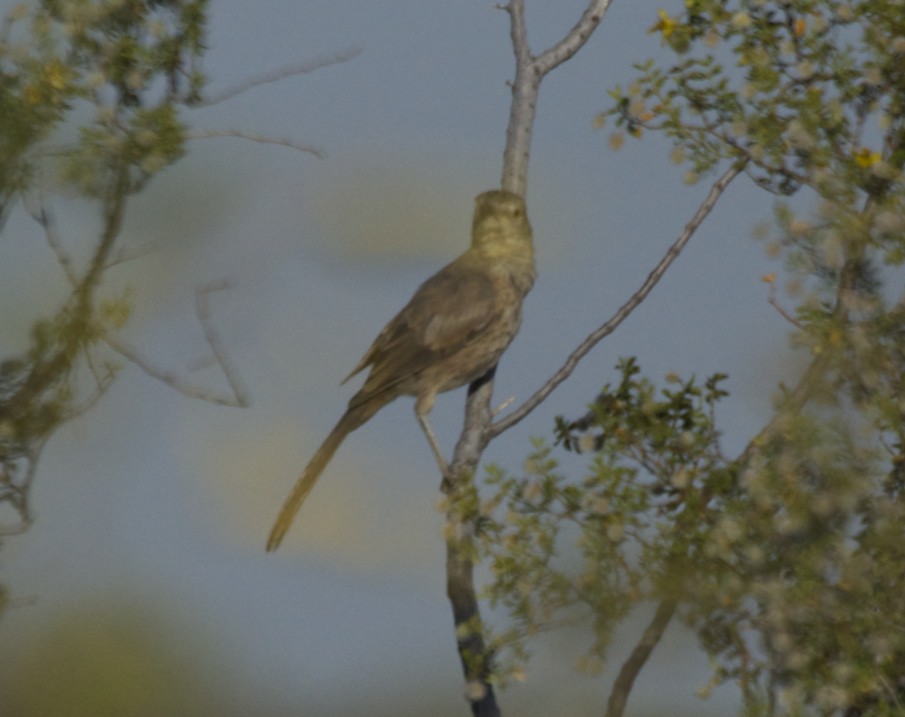
Unfortunately that good bird is a real pain for photography despite being a personal favorite. The Sage Sparrows have long gone and the Sage Thrashers have already moved through, but the Thrasher Spot was still very productive with its Big 3. We had 6 Le Conte's, in two groups of three, a pair of Crissal Thrashers, and 5 Bendire's all in about an hour and a half, and this was without vocalizations (they've all since shut up after this most early of springs). Some day, I will make a camouflage blind, go out into this desert, and mercilessly crush the Le Conte's Thrasher. In the mean time, I have to make do with such injustices, which I post both to my own degradation and to blearily illustrate my point:


It wasn't just the Le Conte's today. The cost of seeing all the birds is often paid in some other way. Here's a nicely posing Bendire's, obscured by proximal creosote branches. It was going to be one of those mornings.
Here's a heavily cropped Crissal Thasher, which I must shamefully admit is my best photo of the species. I'm serious about that blind. I'm going to make it this summer. It will be spacious, have nice panoramic views, have room for snacks, and be highly mobile, maybe situated one 4 of those rumba robots that drive around and vaccuum floors.
**If anyone has any spare rumbas they'd like to donate, please email me privately.


After a productive hour and a half at the Thrasher spot, which also turned up some lifer Brewer's Sparrow for my birding pal, we headed east through the Palo Verde agr. land for the daily dose of Burrowing Owls. If one ever ventures into the west Phoenix farmosphere and returns without roadside Burrowing Owl photos, one has not lived up to one's potential. This species is perhaps the greatest ambassador between birds and people, less filthy than Gulls or Pigeons and much wiser than Finches. This fellow was hanging out near a drainage ditch by someone's driveway, and another was perched on the roof.

Inevitably, our west-Phoenix tour ended at Tres Rios, the absurdly birdy wetlands that combine three riparian channels with desert chaparral and small sections of grassland. At the right time of year, skilled and dedicated birders can pull 100+ species here in several hours.
The only remaining waterfowl when we went were Ruddy Ducks and Mallards, and even with few attenuating raptors we still finished in about 2.5 hours with 81 species, and that was starting around 8:30am. That tally up is not a boast of birding ability so much as the capacity of this site.

It was late enough in the morning that the Osprey were already finishing up breakfast and contemplating lunch.
However, the key to Tres Rios' diversity--it's sprawling, well-watered, and wild habitat--also makes it a pitfall of sorts for photographers going after some really close-up, crushing shots. The birds here typically, though not always, perch high and flush easily. It's quite the catch-22, a catch-23, if you will.

I do not bring this up to solicit sympathy nor profess false modesty, but merely as a preface for another realization I had about my peculiarly adjusted behavior at this, or any other oft-frequented site.
There are many nifty birds I see every time at Tres Rios.
They're not really crushable either, but I could consistently take decent, blog-complimentary images of American White Pelicans, Egrets and Herons, two species of Blackbird, etc. But because I see these birds constantly, I don't bother. Instead, I take mediocre images of the Gila Woodpecker above, or the Spotted Sandpiper below, because these birds don't present themselves as frequently. In the moment, I have a greater attraction to the opportunity presented by these birds because that opportunity comes around less often. This also means I lower standards sometimes. If the picture below were of a Least or Western Sandpiper it would've been chucked immediately, but Spotties are kinda hard to crush (in fact, upon further rumination, I don't recall seeing them crushed much ever at all on the blogosphere). It's not the first time I've pictured the species, but this relatively crumby sighting was more significant than the 1,000 Blackbirds (take it, Wallace Stevens) who were much more aesthetically pleasing subjects. Few people would argue this in-range, in-season Spotted Sandpiper is cooler than flying-in-formation Pelicans, but after enough Pelican sightings, that's how it registers.

Which would be the better subject? Really I should just shoot both, shoot everything I can, shoot until the barrel overheats and melts shut, mwuahahaha!
Nah, that obnoxious soliloquy was just a personal chastisement for being snooty at the expense of my photography. Anyway, one Tres Rios sighting of particular note was this Lesser Nighthawk, parallel-perching in a dead cotton-willow and generally winning at hide-and-seek. Finding nightjars in the day time has to be the highlight of almost any trip, even if these would be a dime-a-dozen after 7pm.

We had several other FOY birds at Tres Rios and finished the half day with 92 species. It was a pretty solid Phoenix birding run, a reminder of the excellent birding to be had closer to home before I head southeast next weekend to be spoiled once again, and maybe forever.


