The Spotted Owls at Miller Canyon were a miss yet again, but like any good birders, we had a contingency plan in Patagonia. Sure, there are some other famous Patagonias in the world, but nine out of ten birders agree that Arizona's is the best. By heading southwest and then looping back up towards the Santa Ritas, we'd be able to spend several hours in this veritable birding mecca of southern Arizona, and that's really saying something for the area. We hoped to find a lifer Black-capped Gnatcatcher at Patagonia State Park, as well as the wintering Trogon that has been returning to parts of the Sonoita Creek off and on since the late 1990s. But before any of that we had to stop by and pay our respects to the Paton House, one of Arizona's birding landmarks.

For the last half-century this property has been maintained with its many feeders and bird attractions, providing some excellent, at-ease birding for those staying in town or just passing through. The current caretaker, Larry Morgan, is also a very knowledgable, experienced birder and is often flush with up-to-date information on recent sightings in the area.

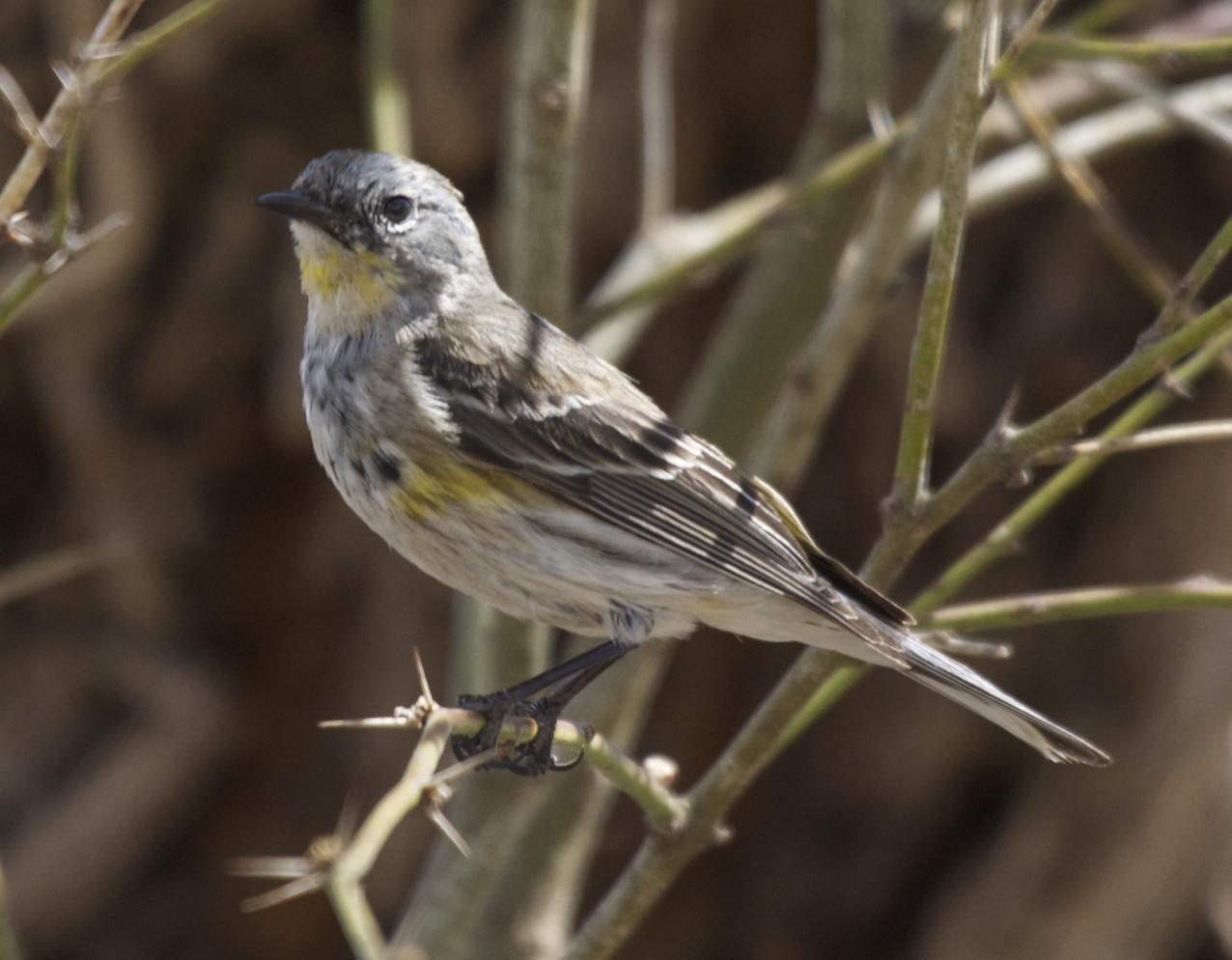
It was about midday when we arrived--hardly ideal timing--but we nonetheless had some very nice sightings, including first-of-the-year Lazuli Buntings, along with Pyrrhuloxia, White-winged Dove, and a million billion Broad-billed Hummingbirds. Naturally, the only bird I photographed was a ragged Yellow-rumped Warbler that wasn't even in its nice breeding plumage. Just gotta be different...
We missed the Scott's Orioles by only a couple of minutes, but had some brief, satisfying views of the Paton House speciality Violet-crowned Hummingbird, which has been reliably found here for the past several years. These white-fronted Hummers turn up elsewhere down south, but nowhere is so reliable for them as the Paton place.
Missing the Scott's Orioles still puts me in the peculiar position of having only seen Orchard Oriole in Arizona for the 2013 year. That is rather backwards and shall have to be remedied directly.
After a thirty-minute stake-out at Paton's, we proceeded towards Patagonia State Park, keeping all of our various sensors peeled--eyes, ears, noses, radar, potatoes, etc--and it paid off when we had a promising silhouette fly over the car and a nearby butte off the Highway 82. In hopes that the raptor would circle around, we pulled over to the side of the road, parking on the wrong side with doors hanging open and all concern for safety hanging with them.
Not only did our raptor swing around for another pass, but it was joined by a buddy, and I was treated to the best looks and photos of Grey Hawks I've yet managed. Abiding traffic laws is for chumps (**I'm a chump 99.5% of the time).
Getting to see these unique raptors was a real treat. They're basically hawks in evening suits, and they ooze more class than a Princeton course on viniculture attended entirely by Spanish aristocrats wearing french cologne and smoking Arturo Fuente cigars.
We got pinged by the somewhat steep entry fee for Patagonia, but as soon as we parked near the Sonoita Creek trailhead, east of the visitor center, we had more promising sightings.
By soaring high in the cloudy skies and keeping the sunlight on his back, a Common Blackhawk did its very best to disguise itself as an ubiquitous Turkey Vulture. Silly Common Blackhawk...your wings are too fat, and your tail band is showing!

The first portion of the Sonoita Creek winds through some mesquite bosque, which was particularly pleasant habitat with the recent rain softening and greening things up. In these low, scraggily trees lurked a potential lifer in the annual but ambiguous Black-capped Gnatcatcher. A male Black-capped Gnatcatcher can be told apart from the similar looking and sounding Blue-grays, but that would be just too easy.
After checking out some Gray Flycatchers and other mesquite lovers, we heard a Gnatcatchery
veeer, reminiscent but different from that of the Blue-gray. When we finally got some brief sightings of the bird, naturally it was backlit and clouded over, but I think we got enough to make the ID. Both female and male Black-capped Gnatcatchers have a proportionally longer beak and more graduated primaries on the tail, with a touch more black as well. It's hard to pick these plumage subtleties out in the field; luckily we got a few photos to examine in the dark room afterwards.
The Sonoita Creek trail and mesquite bosque open up to cottonwood riparian habitat as you head east of the lake, and here we had some more great birds such as Lucy's and Yellow Warbler, as well as Cassin's and Bell's Vireo. This certainly was not my nor Tommy's first time down the trail, and there were a half-dozen other birders in the area as well. However, the most veteran explorer of Sonoita Creek was actually our other target for the site.
While most Elegant Trogons wait until later Spring and summer to really press north into Arizona, a single male Trogon was been wintering along Sonoita Creek since, allegedly, the late 1990s. In a sense he's sort of the
Pater Familias of all the other Arizona Trogons that have followed in his footsteps, exploring further north into the Santa Rita Mountains and elsewhere. The documentation of this individual bird is as extensive as it is impressive, and despite
seeing Trogons elsewhere and visiting Patagonia many times, I'd never seen this particular bird.
About a half-mile from the lake, down the Sonoita Creek Trail and hanging out in the mid-level scrub...that all changed.
The brilliance of the male Elegant Trogon really can't be overstated. It is one of the most colorful, bodacious, and grandiose birds that occurs in North America. That doesn't make them easy to find either. Especially in the winter/early spring months, when these birds are silent, it comes down to luck and persistence. Scanning scrubby tree after scrubby for that green and red...eventually we spied this fellow sitting perfectly still and perfectly comfortable. It was silent; it was stunning; it was surreal.
Of course, we were only two of hundreds, even thousands of birders who have ogled this Trogon in the last dozen or more years, but that did nothing to dim the magnificence of the sighting, especially because in the silent wood, we were only twenty feet away from the bird, and we had it to ourselves.
Unsurprisingly, this old fella was used to people. He patiently indulged us as we filled our memory cards with face melting images. He showed all his sides, including the resplendent, shimmering back, and even took a break to catch and eat a caterpillar during the shoot--the action of which I unfortunately missed, but here you can see a bit hanging out of his beak.
It worked out splendidly well. We couldn't have asked for better looks of the bird, and we were close enough that the cloudy weather didn't corrupt the sharpness in the photos. It was just another day in the life for Mr. Trogon, but I daresay we were positively glowing.
After getting our private session with the HIs Elegance, we then had the pleasure of being able to share the bird with some other birders passing through.
There was an older couple who began recounting when they saw this very same (presumably) bird ten years before, a group of four younger birders (it feels weird saying that...) who started geeking out about it hard, and some folks visiting from Colorado who were not expecting such a sighting and were overjoyed. To be fair, we were expecting the sighting, and were also pretty ecstatic. Here's Tommy, with the Trogon in the background. The bird stayed so still, we could've taken family portraits with it.
It was only early March, but bird sighting/experience of the 2013 year? Very probably.
Still buzzed from the Trogon, we stumbled around Patagonia for another hour like drunken sailors aboard a drunken ship in an ocean of beer. The Sonoita Creek trail yielded a few more cool birds, and we scanned the mesquite for further sightings of Black-capped Gnatcatcher, since we did not feel satisfied with our earlier sighting at the time. Eventually we decided to swing by the Patagonia visitor's center and then head north to the Santa Ritas.
Much to my relief, the visitor center was open and had bathrooms. More pertinent to a bird blog, it also had Broad-billed Hummingbirds, along with a few White-throated Sparrows.
Even around 2pm, it seemed like the birds were out and everyone was having a great day. But while the people and critters of Patagonia all enjoyed the cool weather and were generally congenial, one sour bird sat and moped, perhaps contemplating some past insult or plotting a revenge.
Blarg! This was, without a doubt the grumpiest Green-tailed Towhee I have ever seen. Usually they're such chipper little birds, colorful on the outside and the inside. Not so with this misanthrope; he looked like that surly
Internet Cat's best buddy, if crotchety animals can have best buddies.
Before you ask, yes this bird haunted my dreams for weeks afterwards. It was too grumpy to even bother flying away. I was all smiles and taking photos, and it just kept staring and staring, letting the shame and loathing set in until I hung my head and backed away...
backed away...backed away.
The Green-tailed Towhee was a buzz-kill (not really), but once again Patagonia delivered with some the best birding I've yet experienced in 2013, and that was my feeling even before examining the Gnatcatcher photo too, so the life bird was just a bonus. I got to visit my best buddy the Trogon again, and see some other magnificent birds along the way.
It was almost a lethal overdose of birding. Luckily this all occurred during my spring break week, and I didn't have to work again for several days. Upon returning to Phoenix I had severe withdrawal symptoms and was incapacitated for some time. Visit Patagonia but be careful. It will ruin you.