The preceding day at Estero Llano Grande was one of the best birding days on this side of 2000; truly it would be a tough act to follow. However, we still had some LRGV residents to pursue and others that we had not yet satisfactorily seen. With Common Pauraque off the list, Groove-billed Ani was the next to take it's place as the LRGV's Most Wanted, and one of the best places to find this bird was at the Resaca de la Palma preserve east of Brownsville.
We arrived very early, before the park even opened, actually, and heard the birds calling in their strange way almost immediately, and very near one of the trail heads. Since we were hoping not to spend much time at Resaca, which is otherwise a neat place but without much we wouldn't see elsewhere, this was stupendous luck. However, it was still early and overcast, so even though this Ani wasn't exceedingly energetic, it was still difficult to photograph in any decent sort of way at 1/35fps.


Luckily Anis are pretty shabby (said affectionately, they're a favorite of Butler's Birds) and don't themselves mind a sloppy portrait. These birds have a bit of the tropical mixed with a bit of the prehistoric in them. While they do stray into Arizona every couple of years, it was nice to have the bird close and audible in its preferred habitat.

In fact, after a few minutes it was joined by another, and here's where things get weird. For you see, dear reader, there can form a congress of Loons, a bevy of Quail, a conspiracy of Crows, a flock of Seagulls, and a Raft of Ducks, etc. When two or more Anis get together, it is called a cooch.
This term was apparently developed by the infamous British ornithologist and explorer Sir Henry Caligula, who was later expelled, in disgrace, from the Royal Naturailist Society for refusing to abide by the small placards in the museum reading "Don't touch the displays" and who is also and independently responsible for the disclaimer that now appears on curling irons: "For external use only."
Another theory is that the term cooch was applied by an unambitious young birder in the early 1900s, whose two favorite things in life were couches (for sitting) and coozies (for beverage temperature regulation), and upon discovering a group of Anis, he simply defaulted to the greatest possible thing he could think of (a couch that kept beverages cold).
There is a third, counter-theory that this term also was developed because Anis like to tickle each other (coochy, coochy, coo), but this is generally dismissed by natural historians as being idiotic.
So thank you anyway, trashy TX strip-club billboards, but we got all the cooch we needed by 7am!
(Yes, this joke needed to be made. No, it's not in poor taste; Anis give one a pass).
I shudder to think what a group of Dickcissels is called.


Resaca de la Palma was also echoing with Cuckoo calls and its trees as well as its utility wires were adorned with Oriole nests, yet we saw none of these birds. We quickly moved on to the Sabal Palm Sanctuary on the same side of Brownsville, TX, and just missed a big, several-dozen strong movement of immigrants coming through the preserve (as we were exasperatingly informed by the attendant).
Sabal Palms proved to be another excellent birding spot, perhaps not as varied in habitat as Estero, but hosting a couple of other attractions, including large groves of the native Sabal palms.
At this point in the day, 7:30am or so, we were already enduring microbursts, so we didn't want to go anywhere we'd be stuck in the open with optic gear and drenched. Sabal Palms has some pagodas along its tropical paths, and also a feeder station, where I was finally able to get photographs of Long-billed Thrasher, which up to this point I'd seen often but always high and obscured while singing.


Here we also put White-tipped Dove to rest, another south Texas bird heard often and seen fleetingly in the thick woods, finally brought into the open. Seeing these weird Doves scurrying along skinny little trails and then magically disappearing into the dense foliage at nearly every other site we visited thus far and created a bit of mystique about them, but given the right incentive, or just a familiar place and sense of security, they'll behave much like any other Dove (although we never did get Red-billed Pigeon!). Crush you very much WTDO.

I've mentioned before my detestation for feeder shots as being the lowest common denominator of bird photography. It's not the idea of baiting the birds that I find troubling. After all, putting out food in a designated, habitat-controlled preserve is only another degree of human involvement anyway. It's just the actual aesthetic offense caused by plastic hummingbird feeders (and don't get me wrong, I've taken many, many such photos--sometimes that's all you get) or hanging boxes. But feeder stations work much like blinds, providing much closer view and study of birds than often otherwise possible, at least in a limited amount of time, and we didn't have blinds, just a bit of patience for the birds to move somewhere without too much 'hand of man' in the shot.
It would otherwise be, perhaps, many a year before I could get dandy images of Golden-fronted Woodpecker, a very damn dandy bird.


The Sabal Palms Sanctuary is also good for another LRGV resident that has little to do with the palms themselves and likely won't turn up at a feeder station. The water features at this preserve used to connect via estuaries with the Rio Grande, but the levels dropped enough that they broke up and were isolated into ponds, even lakes, if one is generous enough. The smaller Grebes like murky ponds with cover, Pied-billed and also, most best superlative of all, Least Grebes. I do not know what the term is for multiple Grebes (let alone Least). Let's just call this a Neatness of Grebes. The main pond at Sabal Palms had a nesting Neatness of Grebes.

These tiny tachybaptus Grebes were foraging very actively, even during the intermittent downpours, and gave much better looks than I've ever had at Pena Blanca Lake in southeast AZ, were they also have small population. When alarmed, these birds will dive and hide with only their beaks protruding from the water's surface, combining techniques of alligators and snorkelers. But they had no such need at Sabal Palms, where they were a/the top predator.


Along with Red-billed Pigeon, Fulvous Whistling Duck was one of the larger misses from the overall Texas adventure. But the Fulvous absenteeism was covered, to an extent, by their handsome Black-bellied cousins. When these fellows are flying overhead, they put the Seven Dwarves to shame.

A familial raft of BBWDs really upped the 'cuteness' scale, even after the cavorting Least Grebes. Nine ducklings and two handsome parents makes even the hardest of heart birders--a Birder Pharaoh, if you will--melt with feelings of warmness and fuzziness.


But the BBWD cutesy show got even more extreme with the microbursts. Here is Mrs. Belly playing parasol for all 9 of the chicks, while Mr. Belly stands stoically out of focus. The funny thing was Mr. Belly eventually ditched the log and flew off somewhere for the duration of the downpour. He returned afterwards (presumably, it could have been a different duck) and she snapped at him and scolded him away for a while. He was in the dog house.

We were camped out at the resaca (lake) blind for a little while, mostly because the continual cloudbursts discouraged trail time. When the rain finally subsided, some of the resaca's protruding dead trees made for nifty perches as the passerines sallied forth after the deluge.
Of course, having seen lifer Anis in the morning, another bird would show brazenly without solicitation. It would have been super crushable in better conditions, such a groovy good bird!

A flyover light morph Swainson's Hawk gave a brief hope of finding lifer White-tailed and what was first adjudicated to be a Tropical Kingbird (the conspicuously large beak) kept the tyrannid game going. In the comments below, none other than WBRS's #7 Seagull Steve defied convention, however, and returned that this is still a COKI, just a well-endowed specimen.

Of course, the birds weren't the only critters to get out in the open while they could. We hit up the trails, weather permitting, and recorded Buntings and other passerines on the larger loops, also finding a cavity with six large, brown-spotted eggs. Near some smaller ponds with heavy mesquite cover, a Green Kingfisher, documented Bigfoot style.

Right across from the tree with the nest cavity, which for reasons of dumbness I neglected to photograph and later research, we also had a nesting Buff-bellied Hummingbird, who either had great confidence in her camouflage or had reached the point of parenthood already where she just didn't care anymore. Her nest was hanging over the trail and this photo was at maybe 150mm, very close.

We never were caught out in the rain too badly, although a misplaced baseball cap did require some sodden searching, but some birds missed the ark and ended up looking like celebrities pictured on National Enquirer, just terrible!
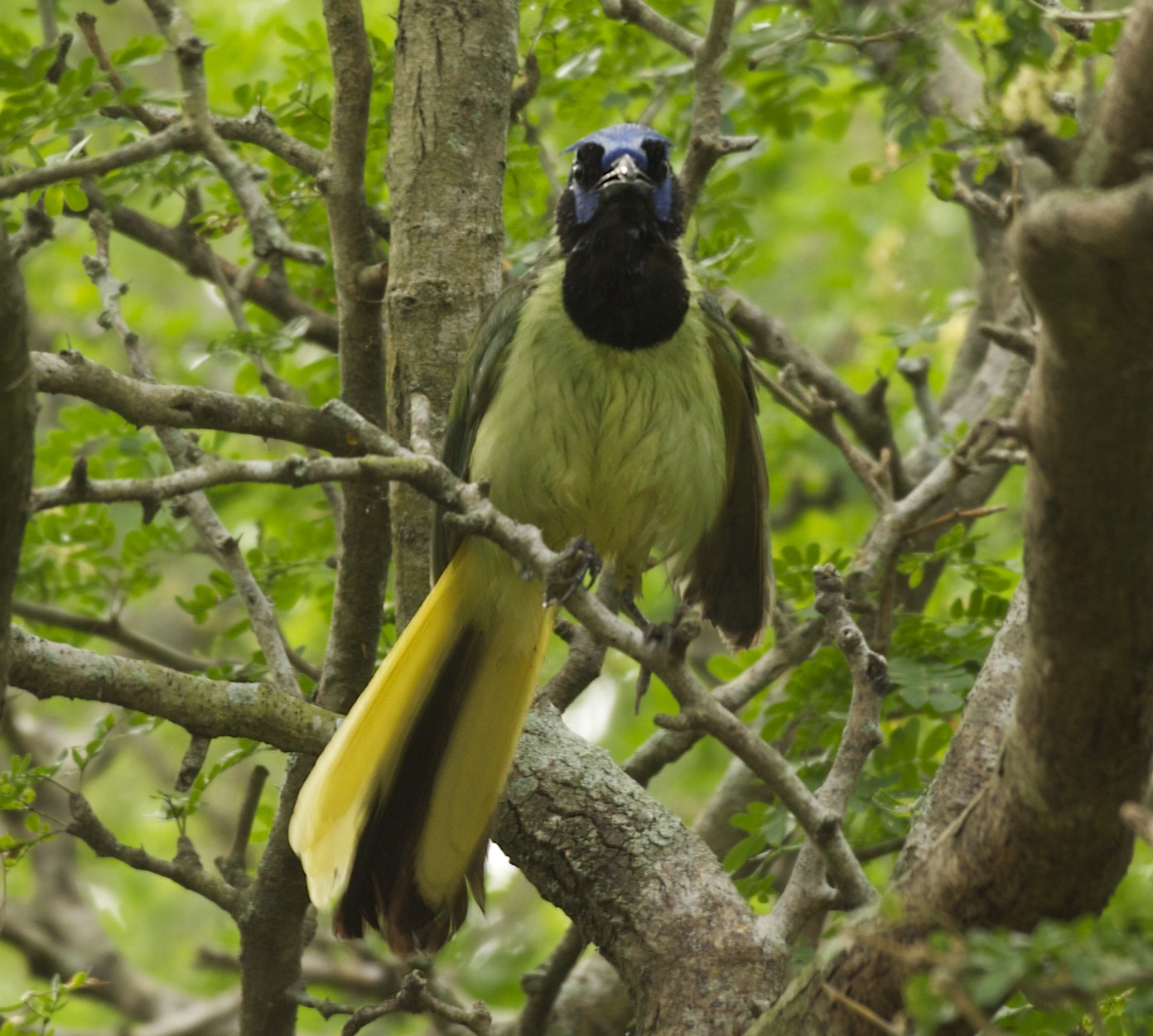

Green Jays were not a lifer but, for obvious reasons, were one of the most desired birds of the trip. They were always tough to photograph, as we didn't go anywhere that particularly lent itself to photographing them (I have memories from birding in the area 8 years ago, though I don't remember where at exactly--maybe Santa Anna--and there were near of dozen Jays around a feeder stations with an adjacent blind...what I wouldn't have given to remember that spot).
They're a pretty suspicious bird and not very accommodating, though no doubt enough time in the area will yield some solid shots of this gorgeous bird.
It never was the perfect shot, but this fellow finally got himself in order after the rainstorm and looked pretty dapper. We didn't get to see the Green Jays doing anything cool and clever, like using sticks and other tools to catch insects (which they do), but when you look this good, you don't have to be clever.

Probably the greatest value at Sabal Palms was that it supplied us with much improved looks at many species we had seen only briefly or unsatisfactorily. It was a great spot, for its purpose. Afterwards we headed farther east to South Padre Island, just in case anything cool was hanging around the bird center (there wasn't), before heading back north towards Corpus Christi.
Since we had some time to kill in the evening, we checked out North Padre Island spots, most of which were standard beach, but had some luck at Bird Island Basin. Along the way though, we had to make it through a very treacherous strip of beach highway. It was a single-lane road, hedged in with sand dunes and grasslands--you know the type if you've driven near the gulf coast, and there were no less than 3 traffic cops in a 5 miles stretch! Not only that, but there was this checkpoint on the road, apparently only constructed for traffic enforcement because there wasn't anyone collecting tolls for the State Park access. Ridiculous police state stuff, maybe people drag race here or something.

Anyhow, the slow-paced incursion down this strip of beach was richly rewarded when one of our turn-offs brought us by some rare trees emerging from the grassy dunes--surely a couple of trees in miles of grassy dunes would be highly desirable real estate for any bigger birds in the area.
We had dipped on White-tailed Hawk so far in the trip, but here was a nesting pair in the middle of nowhere, well-guarded by ornery traffic cops. This was a pretty clutch lifer as it was our last stop of the day, Mike was leaving early in the morning, and it was well north of where we expected to see these birds, though North Padre island (latitudinally equivalent with Corpus) is still within range.


Scopes would have been most welcome but we still had pretty decent views and caught many distinguishing marks. This is another bird I'm sure one can see often and well if spending significant time in the area, but with only busy and brief time down south and no specific area to look for this bird, we felt pretty lucky to come away with the Last-Gasp Hawk, as it shall henceforth be known.
Many exclamations and high fives were shared.

Also, there were Meadowlarks.

Next up, a missed lifer and a better consolation back around Corpus Christi.


