Showing posts with label Pacific Wren. Show all posts

Thursday, June 2, 2016

Oregon Rambling and Easy Summer Promises

Below is a picture of a Burrowing Owl shot in early May, which marks the last time I did any real birding. I am ashamed, full of apologies, etc., but you've heard this all before. After so long away what I can promise is this: there will be more and better birding in the future. Southeast Arizona is off-chart with vagrants right now and the weekend draws near.


Birding had to take a backseat this year, but it has not all been grindstone and drudgery. Recently I took a trip to Oregon for some much needed 'Away from Arizona' time. Despite all the best information and encouragement from Online Oregon Hubs Hipsters Birders and Reformed Bird-hater Jen, I could not make this into much of a birding expedition, but Oregon is still Oregon, which is one of the most beautiful states there is.


The first portion of the trip was on the east side of the Cascades in Bend. Geologically recent volcanic eruptions scarred this landscape in impressive ways and for once, finally, it's not considered rude to stare at or even touch a cool scar.
Ragged basalt was strewn like lithified ocean waves, with warped vegetation clinging on to life in between, or standing monolithic and twisted in death. It was gnarly.


We have much to be thankful to volcanoes for, including good soil, significant landmarks, and giving us reason to get interested in science as 5-year-olds. Among all these things, perhaps one of the greatest testaments to the destructive and creative power of volcanoes is Crater Lake an hour south of Bend. This caldera was created when 12,000ft. Mt. Mazama lost its temper like 15,000 years ago and blew off its last 4,000 feet. The resulting crater filled with rain water and receives only the most minimal snow melt run-off, thus maintaining its azure complexion that out-blues the sky itself.


The birding options east of the Cascades are tremendous, but alas I was touring with non-birders, and while chasing Greater Sage Grouse or White-headed Woodpeckers sounded great to me, spending more time in the Bend brewery scene appealed to everyone else. The tough part was I also do well in a brewery habitat, so really I didn't put up much protest.
The second portion of Oregon time was spent in Portland, which is also within reach of broad-reaching attractions where the birds cannot help but be included. Case in point, mighty Haystack Rock at Cannon Beach has dozens and dozens of pelagic species nesting on it and its neighboring rocks.


It's time for another edition now, alas, of terrible photos of cool birds, lifers and otherwise. Common Murres, Gulls, a few Guillemots, and Pelagic Cormorants clung (or in the case of the Gulls, nested comfortably) to the rocky facades, displaying determination and stoicism otherwise belayed by their cute (Murres and Guillemots) or awkward (all the non-gulls) movement.


There were even six Harlequin Ducks hanging out by the breakers. I would love to see these birds near nesting habitat on a rough mountain stream some day, but in the meantime this will have to do.


Best of all, there were Puffins! Puffin of any variety--in this case Tufted--are probably second only to Owls in terms of broad appeal to humans. We picked out 4 individuals on Haystack and enjoyed watching them bullet around the rock in the evening. Small confession, I actually super like the second photo of the dynamos against the large blurry backdrop, but I can't really explain why.


Beach time is always exciting. It guarantees good birding and, even if Oregon beaches in late May are too chilly to host all the scantily clad beautiful people we usually go to the beaches to see, they do host lots of dead jellyfish, which are also good.
Apparently this was a banner year for velella sail jellies getting beached what with the el nino winds and all. We also found another large jellyfish, which remarkably I resisted the urge to wear as a hat.


The hiking in Oregon is crazy good. In Arizona, if one wants to walk among the spruce and fir trees, one must get above 8,000 feet. In Oregon hemlock grows in the neighborhoods, and the hikes themselves are like treks through the rain forest (but much piny-er).


Wilson's Warblers were a common sound and uncommon sight around the lower Mt. Hood trails. They continue to be a sort of photo-nemesis for me, but it was pretty cool to have them vocalizing so much.


Pacific Wrens were also very commonly heard and, weirdly, commonly seen. when they are in a singing mood they can be pretty accommodating.


With all due respect to TLC (is that very much, by the way?), when in Oregon I WILL go chasing waterfalls. Mild apologies for the photo dump here, but these cataracts are all from one 7 mile hike on Larch Mountain.


Other notable wildlife included lots of banana slugs, both cow-speckled (means they're ripened) and regular un-speckled (means they're going to taste bitter and grassy).


By trip's end the lack of crushes and clear looks was getting bothersome so I snuck out early, hoping at least to get some Chestnut-Backed Chickadee shots at the Audubon Center. Alas, it did not open until 9am, at which point I needed to mosey to the airport, and they took in all of their feeders (yes, I was getting desperate). So, pelagics aside, I think my favorite bird was this Swainson's thrush that was calling before sun-up.


Was the lack of birds in this post frustrating for you too dear reader? Worry and war not much longer, because the Santa Rita Mountains are blowing up right now with Pine Flycatcher, Aztec thrush, and Golden-winged Warbler (also, you know, like Trogons and stuff). For sake of you all, you two readers who still bear with me, I will try to go see these birds on Sunday. Proust!

Friday, March 21, 2014

Heard it through the Grapevine

The Prescott area, about an hour and a half northwest of Phoenix, is home to some diverse birding habitat situated between 2,000 to 6,000 feet. The higher elevation draws in plenty of birds that are far less common in Maricopa County, and it also offers a general reprieve from Phoenix birding which can, like anywhere, get repetitive. On Friday I went chasing up Grapevine Creek in the Bradshaw Mountains after an annual AZ vagrant, the Varied Thrush. I have dipped on this bird three times before, so it's becoming a bit of a nemesis for me and a beautiful one at that. 


The sparse mountainside habitats may not look like ideal habitat--and truth be told they aren't for Varied Thrush--but the the real treasure offered at Grapevine creek is the shady riparian wash nuzzled in between the hills, with water, shade, juniper, and fir trees.
The dirt road up towards the creek becomes inaccessible by vehicle a good mile or so from the creek trailhead, which forces the intrepid birder to traipse through elevated desert chaparral. This unique habitat, comprised of desert holly, saltbrush, scrub oak, juniper, and manzanita, offers up its own birding delights, and this was just as well since--spoiler alert--the Varied Thrush remains an inchoate nemesis. 

The morning walk along Grapevine road, though very chilly, was filled with emberizid noises. Black-chinned Sparrows were the main culprits, but White-crowned, Rufous-crowned, and Black-throated also made their contributions, as did a plethora of Spotted Towhees.
A little pishing and a little playback can get all kinds of things stirred up in these bushy surroundings. The whole neighborhood was buzzing and among all the Sparrow happenings I almost missed a pair of Crissal Thrashers (not photographed, of course) gathering food for a nest.


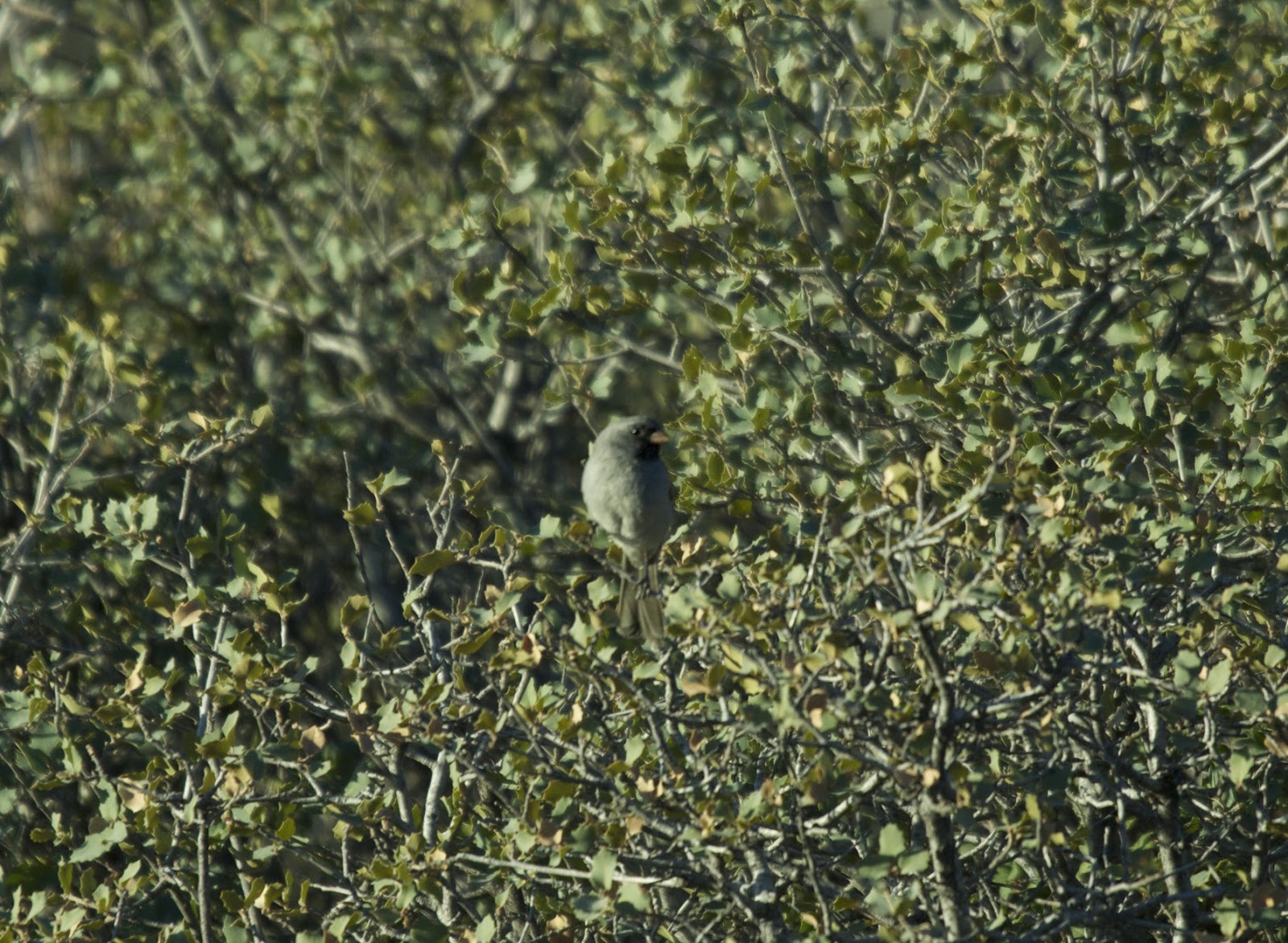
I picked up my first 2014 Black-chinned Sparrows just last week near Mt. Ord, but during a time crunch. While waiting for the sun to crest the mountains and illuminate the creek trail I was able to crush them more properly along Grapevine road, much to my satisfaction.


The Black-chinned below (not crushed, just circumstantial) is perched on one of my favorite chaparral scrub bushes, manzanita. What? You don't have your own favorite chaparral bush? Lame.


The manzanita have rich verdancy in their evergreen leaves and a smooth, reddish bark running along their gnarled branches. They show resilience, color, and texture in a remarkable way, especially amidst the predominantly homogenous, grayish-green backdrop of their surroundings.

Nearer the creek and in the shaded valley between the Bradshaws, ponderosa pine and juniper come to dominate the scene, with scrub oak and the occasional fir trees, as well as cottonwoods also growing nearer the water. From looking down into the bushes one must look up into the busier canopy. Bushtits and Kinglets bounce from limb to limb, creating a false impression of how numerous they are with their raucous, kinetic behavior. They make up the basis of solid mixed flocks that Goldfinches, Chickadees, Titmice, and Vireos also join, while White-breasted Nuthatches and Brown Creepers lurk on the periphery and wallflower Hairy Woodpeckers wait for an invitation (or not).


Hutton's Vireos are kind of a dull bird, but they have my undying appreciation in the month of March for being something admittedly kingletty that is not a Kinglett. They were very vocal in the scrub oak along the creek trail, showing more personality than their generic appearance otherwise indicates. 


The Varied Thrush was seen a fair way up the Grapevine trail, about 4 miles of hiking total, around a white fir grove. Due to a combined ignorance of this trail and what constitutes a white fir grove, I am not satisfied that I was searching in the right places. I was further impeded by my own clumsiness, which resulted in me dropping some equipment in the creek and having to greatly expedite my search so I could get home and stick it in rice.

As such, the Varied Thrush chase did not get underway to full satisfaction, but Grapevine Creek has some great potential as a birding spot. The changing habitats alone provided me with 40+ species in about three and a half hours, and the creek itself offers the right settings for an uncommon and delightful little bird.


Big tangles and brush piles along the water aren't just appealing to rodents. All the while walking the creek I had eyes and ears pealed, eventually picking up that anticipated call note of a Pacific Wren, the little bird with a big chip on its shoulder, struggling to forge a separate identity from Winter.


These Wrens can be as amazingly gregarious and they are amazingly small. It almost flew up and landed on my foot when I was pishing, which resulted, rather cruelly, in me being unable to properly focus on the oddly proximal bird before it again vanished into its twiggy labyrinth.


Grapevine Creek isn't the most easily accessible hike--several miles of choppy dirt road and some occasionally steep/loose hiking, but it certainly is birdy. That's also true of many other trails in the Prescott area, even though this site is closer to anyone heading north from Phoenix. 
No luck, again, with the Varied Thrush. I'll just have to quit being lazy and go find my own some time.

Wednesday, March 21, 2012

Sudden Sedona Syndrome

If you live in the Phoenix area, you'll get it eventually. Maybe it's the rush-hour traffic. Maybe it's the absurdly hot March afternoons. Maybe it's just driving past the same billboard one time too many. For one reason or another, you'll be struck with Sudden Sedona Syndrome, the overpowering desire to escape from the city and lose yourself up north in the mysterious red rocks.


Only an hour and a half away, Sedona is one of the most lauded day-trip destinations in the state, and for good reason. The scenery and hiking trails are among the most beautiful in the country. There is an abundance of wildlife and the crisp cold air stings your nose with a forgotten purity. No wonder then that extraterrestrials often make Sedona one of their favorite destinations, or so some of the locals believe.

I got Sudden Sedona Syndrome this past Saturday (ok, we had actually been planning the trip a bit ahead of time). We enjoyed the lovely four mile hike into the Oak Creek west fork trail, seeing nearly two dozen bird species and soaking in the gorgeous red canyon. The steep, rocky walls and tall pine trees keep much of the canyon shaded throughout the day, and lingering snow can be found at points along the creek throughout much of the year. Birds like the American Robin and Dark-Eyed Juncos love to forage right along the melting line of snow, where they can dig into the moist earth.


In addition to Robins and Juncos, we also saw some lovely Nuthatches, Mountain Chickadees, Acorn Woodpeckers, and Steller's Jays. Adequate lighting for photography was a rare thing, but this was nice in a way as it forced me to pay more attention to those common birds that weren't afraid of the spotlight.  This pair of Robins flew tirelessly back and forth between the muddy creek bed and their nest, no doubt working within a tight timeframe.

Only the finest ingredients go into a Robin's nest...oh the things parents do for their young.
 Although the Robins stole the show, there was no shortage of side acts. It seemed like Oak Creek was swarming with chattery House Wrens all determined to bluff and bluster their neighbors into quiet submission.


With so many bossy House Wrens sounding off, this tiny Pacific Wren was quite content to keep silent.
It ran along its log and took delicate sips of water, trying to attract as little attention to itself as possible. With the Pacific Wren only recently being split from the Winter Wren, this was a new bird for me! We were fortunate to eventually hear it sing, which helped confirm the tricky identification.


The Brown Creeper is another shy denizen of the scrub oak forests. We saw several throughout our hike and they largely paid us no mind as they went about their business of gleaning insects off the tree trunks. It can be very easy to overlook these camouflaged creepers, but sit in any wooded, well watered area and they turn up pretty soon. They're the surreptitious spies of the forest, the sneaky sentries watching you from the woods...


Our little Sedona trip was a great escape from the city. Just as we were heading back to Phoenix the storm clouds moved in, dumping a foot of snow on the red plateaus and following us south to bring a little rain into the desert. There is no known cure for Sudden Sedona Syndrome, but a trip up to the big red rocks once or twice a year is enough to keep us city dwellers going, at least for a little while.