This is the closest I've come. I actually had the bird in focus, but of course there's a heavy shadow obscuring the face.
Tuesday, July 19, 2011
Wilson's Warbler
I've had repeated run-ins with this Warbler now in Arizona as well as California. I still have been unable to get a better picture, even though this bird is common during migratory periods and is not overly shy. For the moment, the Wilson's Warbler is my official nemesis. Every Ahab needs his White Whale (or little yellow bird).
House Wren
Wrens are tidy little birds, and always seem to have some great task at hand. The House wren is the most widespread, but is still an uncooperative subject for the greenhorn photographer (myself).
California Quail
Quail = just really great birds. They have beautiful plumage, little Renaissance caps, are the cutest chicks, insist on running when flying would be far better, and are delicious. The California species are more scaled than their cousins, but have a very similar and very ornate face.
Oak Titmouse
The Oak Titmouse is, like, totally, only in California, bro. Apart from its white eye-ring and semi-pointed tuft, it's fairly non-descript. They can be found, predictably enough, hanging around in oak trees. They lack the black forehead and rusty/rosy sides of the tufted titmouse, and instead have a lighter gray mask.
Western Bluebird
Although it closely resembles the better known Eastern Bluebird, the Western Bluebird has a comparatively smaller range, but does sport a little more blue on the chin. The rufus belly extends up to the bottom of the beak on the Eastern variety. They're a funny bird in that they seem to have very inconsistent behavior by region. When I saw them in San Jose, CA, they were very tame and stayed very low to the ground (unfortunately those were the pre-camera days). Now when I see them in Arizona they prefer the highest canopies of the cottonwood and willow woodlands along the Arizona rivers. Very rarely they'll come down, still keeping a safe distance, and allow for some brief photography.
House Finch
House Finches are everywhere all year round, but with their red rumps, ruddy faces, and cheerful behavior, they're some of the more welcome of the family extremely common. They pose well too.
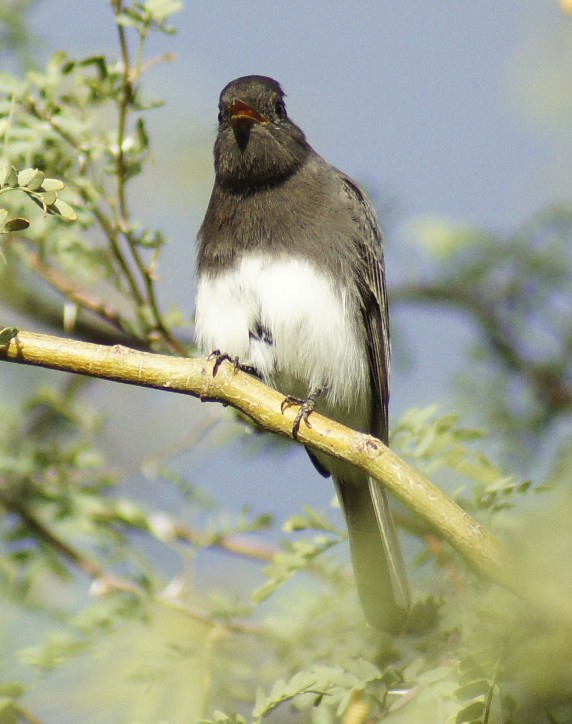
Black Phoebe
The only black-breasted flycatcher in North America, the black phoebe is perhaps the most conspicuous of the larger flycatchers (although it is not itself very large). Their range is restricted to the American southwest, California, and Mexico, though they inhabit this area year-round. They tend to hang out near water and are not averse to man-made environments, but in my experiences they're still pretty shy.
Nuttall's Woodpecker
Nuttall's Woodpeckers are some of the smaller members of the Picidae Family, and their range is limited exclusively to California. They have the sort of black and white zebra striping all over their back and wings, and are the only such woodpeckers to be found West of the Sierra Nevadas. Some bird books show the red spot located towards the back of the head, but other pictures confirm it to be on the forehead, as was my observation here:
Spotted Towhee
The salted, western counterpart of the Eastern Towhee, the Spotted Towhee has large fiery eyes and a healthy smattering of white spots along the wings. I sometimes confuse them with black-headed grosbeaks. I'm not sure if I actually snuck up on this guy here, or is he was just a little bit slow.
California Towhee
Like the Canyon Towhee, the California Towhee has a sort of mottled beard extending down its chin. It did not retain the cinnamon cap of its cousin, but is still very lively and seems to prefer the skipping and bouncing to walking.
White-Breasted Nuthatch
The largest and most common nuthatch, the White-breasted has no eye stripe and little coloration on its underparts. Even so it is a very pretty bird, and observing their behavior is always a treat. It is very remarkable to see them perch upside down on a tree, though difficult to photograph, and their spiffy little red spandex shorts of some of the more fashionable undergarments in the avian kingdom.
Getting the Heeby Jeeby Grebeeees
The last thirty days of birding have been loaded with Grebes. It all started with a pair of charming Least Grebes down at Lake Pena Blanca in mid February, and ended with the unexpected but unmistakable sighting of a Horned Grebe at Sahuarita Lake on March 15th. Prior to the summer of 2011 I had only the Pied-Billed Grebe on my life list. Since then, I've had the pleasure of seeing it and all six other North American Grebe species. I cannot say I was expecting to see all seven Grebes this year (or necessarily ever). I definitely was not expecting to see them all in Arizona.
The Pied-Billed was my first Grebe, so it seems appropriate to start with him (also, its about my only clear Grebe photo). |
Although we get plenty of winterfowl in the Phoenix area, we're usually short-changed on Grebe species. But for the last month or so the western-most section of the Tempe Town Lake has been loaded with these slender swimmers. Phoenix area birders have been very fortunate to see Eared Grebes, Clark's, Western, Pied-Billed, and one very unusual Red-Necked Grebe all in the same body of water.
I photo-documented the Eared and Clark's Grebes, albeit quite blearily, as a part of the red-eyed bird alert last week:
The Western Grebes are the most visible of the Tempe waterfowl. They seem to be more confident and active, often diving, fishing, and displaying in the later afternoon. It's only appropriate. After all, they are the largest and mightiest of the North American Grebes.
The Least Grebe occupies the other end of the spectrum. They are diminutive both in stature and personality, though they are still thrilling to observe.
The single Red-Necked Grebe has been the big attraction in Tempe town lake. It's one of only a few recorded sightings in the Phoenix area, and for good reason. Look at the bird's range map (courtesy of Cornell Lab of Ornithology). There's really no reason for it to be anywhere near the Sonoran Desert.
As luck would have it, the sightings were occurring just 5 minutes away from where I work. With the exception of the bolder American Coots, the birds all stayed well away from the pedestrian bridge over Tempe's grand canal. The prospect of picking the Red-Necked out of a mass of distant, folded up waterfowl seemed daunting as first. However, the Red-Necked liked to hang out with the more conspicuous Western Grebes, and this made the surveillance area more specific. Once the area was narrowed down, the Red Neck's smaller frame decurved bill, and ruddy neck allowed for a straight-forward identification.
Here is by far the rarest bird on Tempe Town Lake. See how he conducts himself with much pomp and circumstance as he...investigates...swamp grass. Perhaps he was sent here from the far north, conducting a southwestern aquatic botany survey for the Society of Scientific Grebes. I've heard crazier migration stories anyway...
He got his samples and I got a cool new bird, as well as a red neck of my own.
Now that I had some great views of the Red-Necked Grebe, I figured my winterfowling was done and my attention moved on to other birds. It was a great bit of luck then that my family and I decided to check out Sahuarita Lake while making a day trip to Tucson. We were disappointed to find out that is was actually a small, man-made pond surrounded by houses in a little master-planned community. We were expecting a more rustic seen with lots of marsh and riparian birds, but this was just the standard neighborhood fish pond. The joke was on me though, for there in the center of the little lake, insulated by eight or nine American Coots, was a shy and solitary Horned Grebe.
Another unusual visitor to Arizona, the Horned Grebe can be told apart from the Eared Grebe by the lack of black on its neck and back of its head. The Horned Grebe made the Arizona birding listservs, but for the last several days I had not been paying attention. It was a great surprise then to find this gem and round out my list of North American Grebe species.
I'm amazed by the birding opportunities offered in urban/suburban environments. Of course, nothing beats hiking out in the wild, and I doubt the Least Grebes will ever turn up within city limits. Nonetheless, I found six out of the seven Grebes in urban ponds or lakes. It has been a great month of birding, one of good accomplishments and great aesthetic satisfaction.
Western Grebe
The Western Grebe is the largest North American grebe, but is only noticeably different from its cousin, the Clark's Grebe, in a slightly greener bill and the extension of its black cap down over the eye and up to the cere, and the two can often be seen intermingling.
Although lots of range maps don't show them straying too far from the coastal states, there's a regular supply of Western and Clark's Grebes in the Phoenix Area, and they're regulars at the Tempe Town Lake.
Northern Cardinal
While the (male) Cardinal is the only North American bird whose entire body is red, excluding his mask, the cardinal's image perhaps suffers from over exposure. Many is the frustrated birder who sees a flash of red and pursues to only re-confront his red comrade. That the cardinal has a half dozen different calls and has a range over the entire continental United States doesn't help his subtlety either. In my opinion, the female is prettier, with her brown and red intermingling making for a more interesting appearance. They're both beautiful birds though, and it's a treat to see them in Arizona.
This handsome fellow was singing in the late evening light. That orange glow caught his red plumage nicely while his crest swayed with the breeze.
Gray Catbird
Like thrashers and mockingbirds, the catbird is a mimid with a diverse range of imitations. However, it's also generally agreed amongst experts that he's the worst mimid of the group, which may explain his humble plumage. Still, with his black cap and rusty rump, the casual catbird is fine company on any occasion.
Purple Finch
Distinct from the House Finch, the Purple Finch does not really appear purple, but its crimson hood encompasses the entirety of its head, unlike the House Finch's more mottled coloration. Its non-winter range is also restricted to the American Northeast, and it never strays very far west of Texas inside the U.S.
Black-Capped Chickadee
A small and bubbly bird with one of the most recognizable calls, the curious chickadee is always a joy to find. With good reason, it's one of the most identifiable and recognizable mascots for both the birding world and the coniferous/boreal forest of North America.
American Robin
The most common and recognizable of the American thrushes, the Robin is nonetheless a pretty bird with outstanding posture. It seems totally appropriate that this was the first bird I ever photographed.
Subscribe to:
Posts (Atom)