Before this weekend, I had predetermined to undertake a most grueling task, one which could well prove unfulfilling and, more than likely, unsuccessful. For 2014, I set more limited birding parameters for myself. I decided to make some trips to wrap up my state list, picking up those tricky southeastern species (still need Baird's Sparrow, Short-eared Owl, White-eared Hummer, Short-tailed Hawk, Mexican Chickadee, Sinaloa Wren) but otherwise spend most of my weekends birding around Maricopa and maybe turning up some good finds closer to home. I've been feeling rather guilty lately about my very meager contribution to the birding listservs and general ornithological culture. Granted, unlike many of the retirees, I'm only getting out to bird once a week, at most, but it still has been too long since I turned up some good discoveries, found my own rare birds, etc.

Somewhere in this dilapidated mess of bok-choy there may, in fact, be a good bird.
So, that rambling anecdote amounts to a half-assed explanation of why, this weekend, the Butler's Birds machine (which is currently sporting quite a bit of duct tape on its fender) rumbled out east onto the Rousseau Sod and Agricultural Farms. I had not seen a single listserv report for this site since the beginning of autumn, and I have a perverse weakness for sleuthing through the little brown birds that can be found in these imitation prairies. The targets were Longspurs, a genus of which I have absolutely no photos, and, foremost, a Sprague's Pipit.

No, of course this isn't a Sprague's Pipit perched on the bok-choy. This is an American Pipit, one of many hundreds of near-identical birds that would be subject to heavy and heavy-breathing scrutiny.

This fellow was the first candidate for Sprague's Pipit, given the brightly colored legs. However, on actual inspection (meaning, looking beyond the first, quick, pre-binocular/photo inspection) the legs aren't pink, and even if the face is pretty plain, the breast and flanks are too heavily blotched, relative to Sprague's. Plus there's not much streaking on the head. Only a simpering fool would really have even given this bird a second glance. Or not, I dunno.
I must confess to another motivation in this excursion, one which will no doubt baffle any normal person, or any person whose nerdy proclivities (and I think we all have them) don't incline him or her towards birds. For that matter, this confession may even confound many the birder in the audience.
I really like Pipits. I salivate at the prospect of peeping on Pipits. I kreen and kroon, and slam on the brakes. I will crawl through the dust, and even eat the dust if need be, or by accident, or just to try it, if it will get me good looks at Pipits.
To expand on this minor obsession a bit, this applies to any Wagtail, but the American Pipit is the only one we in AZ have got. Combine their infectious tail-bobbing with their subtle, intricate, and infinitely diverse plumage, their prodigious hallux, and the fact that they're pretty fearless compared to most other LBJs, and you've got a real champion of the economy of style.
To expand on this minor obsession a bit, this applies to any Wagtail, but the American Pipit is the only one we in AZ have got. Combine their infectious tail-bobbing with their subtle, intricate, and infinitely diverse plumage, their prodigious hallux, and the fact that they're pretty fearless compared to most other LBJs, and you've got a real champion of the economy of style.

This Pipit, of course, was in no way a candidate for Sprague's, for all of the same reasons mentioned with the bird above, plus it has obviously dark legs.
In addition to pandering towards my perverse and painful Pipit proclivity, the Rousseau Farms also afford some easy safari style birding. Birding from the car doesn't always provide better photos ops, but it's always more comfortable in those winter mornings.
Savannah Sparrows are a very appropriate bird to photograph while safari-style birding, all the more so because they usually would not tolerate an approach on foot.


"To hide a tree, use a forest," as the old proverb goes. In a field full of broccoli, there is no better protected perch than broccoli. RWBBs are repositories of ancient wisdom.

Most prairie type birds, raptors excepted, lead a pretty humble, unassuming existence. But the comparably ostentatious Horned Lark conveys a clear sense of superiority. Its perches, its struts, its call notes...they are all saturated with the highfalutin self-assurance that it is, on any given day, the prettiest bird on the Arizona prairie. Some day, I pray, a Red-throated Pipit will show up and rain on their parade. On that day I will ride over in an ambulance, preempting death by subsequent cardiac arrest.
In the mean time:


Here is a very normal looking Red-tailed Hawk, which is unusual only because there doesn't seem to be much unusual about him. Big, grungy, and successful all over north American...the Red-tailed Hawk is what so many death metal bands never could be.
Red-tailed Hawks and American Kestrels littered the utility lines with expected frequency. A couple Prairie Falcons, by far the most skittish of Maricopa Raptors in my experience, also made appearances.
An intermediate Red-tailed Hawk made for a refreshing sight. Of course, we can't rule out that this bird is the production of some Swainson's x Harris's x Red-tail hybirdizing eh?


"You speak nonsense and heresy sir! Good day!"
Floating weirdly close to this Red-tail, in a weirdly otherwise uninhabited canal, weirdly without spooking and flying off like all the other canal-dwelling Mallards and Coots did during the day, was this weirdly lone Canvasback drake. He was just chillin', cold as ice and cool as a cucumber.

The Red-tailed Hawks were the biggest bullies on the block, but they weren't the most numerous raptor, especially away from their precious utility lines. I counted 13 Northern Harriers, 6 more than I counted RTHA, and of these 13 there were 8 males, which seems a very high distribution.

If the Red-tail rules the power lines, this Silver-backed Harrier, undoubtedly, rules his green onion field with an iron talon. He played a game of thrones with the other Harriers, and eventually expanded his territory into the neighboring, peaceful alfalfa with ruthless wingbeats.

Many Harriers were, predictably, harrying above the open fields. Some also stayed closer to the irrigation venules and often flew down the channels, perhaps concealing their movements from potential prey or rivals. Their target was only two meters wide, at the end of the trench, so they had to use proton torpedos...
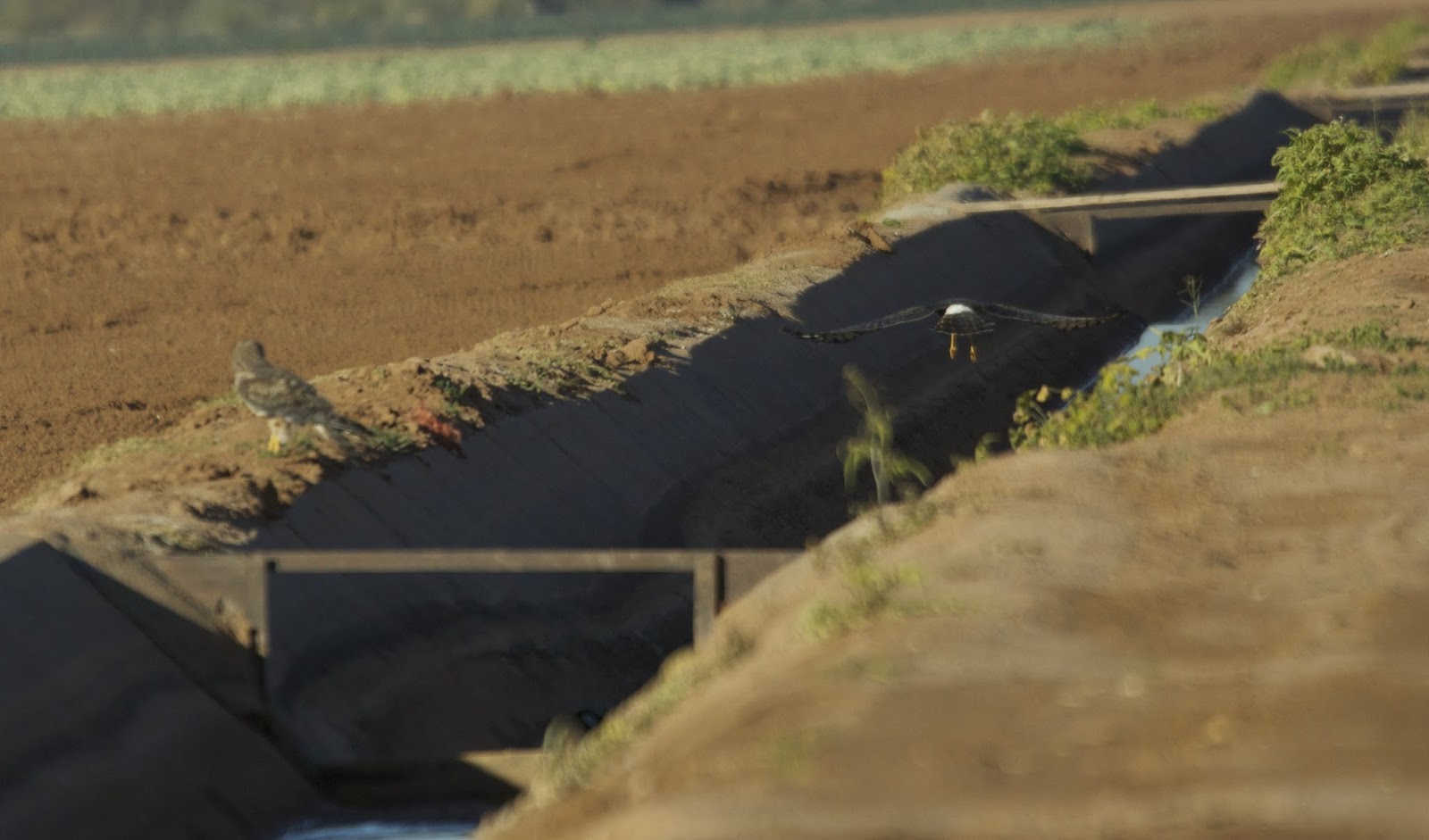
None the hunting Harriers were successful, from what I saw, and even though I must wait and bide time until I get that much-coveted Harrier close-up (or go to Antelope Island in Utah), I enjoyed taking some scene shots of the prowling birds with purple mountains majesty in the background.

Yes yes, I know, raptors are great, but it's time to get back to business, back to the reason we're all here, the reason birders get up in the morning. The little brown birds and their onerous identification separates the men from the boys, the women from the boys, the boys from the babies, and the cafeteria birders from the hardcore nitty-gritty put-that-Pipit-in-your-mouth-to-analyze-by-taste birders.

Taste is not required to parse out that this a clear, even handsome, specimen of American Pipit
Many of the Pipits were busy foraging, keeping low, but not invisibly low, to their sod fields or other preferred pastures. Some were also busy preening, or just smelling to see if a shower was in order.


He knows that one of the 573 Pipits out on the sod fields is kinda bug-eyed and doesn't quite fit in. He know's it's one of those weird Sprague's, the ignored, awkward distant cousin at the family reunion. But he will not say where.
This is not the first time I've put some heavy crush on American Pipits, and it will not be the last. To those of you who are being good sports and and just enduring these boring brown bird photos, thanks for hanging in there, we're almost done.

Actually, that's not true. There are several more Pipit specimens to examine, but you can take an intermission here with this brazen Say's "I perch where I want" Phoebe.


This guy is an Am. Pipit, for sure, but I just want to point out that he has a gigantic, bulbous head.
The Pipit below, also an American, was a bit of a puzzler for a little while, until I was able to get closer looks. He seemed to be feeding differently from the other Pipits, darting forward and backwards in a hectic fashion, and his tail bobbed not-a-once. While his back exhibits some very light streaking, its nowhere near the darker scaling one would expect on a Sprague's Pipit. Bummer.

Here is another Say's Phoebe, because they're bodacious birds, even if common, and because he landed like three feet away from me, just begging to be made famous (chose the wrong blogger/photographer for that).

So, finally, here's my best candidate for Sprague's Pipit, and of course it's a power line bird, so many of the distinguishing features are obscured. I should say right off that the spotting on the breast looks too large and dark for Sprague's, and the white malar stripe is probably too pronounced for Sprague's as well, so not exactly off to a great start. Additionally, the back, top of head, and legs are all blocked.

And yet, something still seems kinda...Spraguey about this bird. It wasn't perching like the other Pipits and its lower breast and belly were very clean. Its eye seemed larger and more bug-eyed than American (a good sign) and the supercilium was wider and blends with the orbital ring more than on the other Americans I saw. The beak also seemed thinner and pointier. That all being said, it's not enough for a clean ID, not even close. I did not report this bird to eBird nor on my list, and so the Sprague's search continues. Readers may thus consider this time in the field, much like time spent reading this post, to have been poorly spent, but I'll contend it was a lovely morning with plenty of enjoyable, if predominantly beige birding. Lacking a solid ID on the Sprague's wasn't the greatest possible ending to the day, but it was the most likely, and, most bestest of all, I have reason to go back pipiting again.


