Showing posts with label Yellow-Breasted Chat. Show all posts

Sunday, May 27, 2018

Tubac Succor: Birding Alive and Well

Southeast Arizona is regarded as one of North America's premier birding hotspots. This is known. The Catalina, Santa Rita, Huachuca, and Chiricahua ranges, as well as other "Sky Islands" offer continuous habitat for many tropical species that otherwise would not stray into the ABA area. But this year the lowlands and riparian corridors in SE AZ have been holding their own as well, turning up some nice vagrants with migration and also holding down some fantastic, long-staying ABA codes, the kind that people on Big Years spend outlandish money to go see. 

Sinaloa Wren (1+ individual) and Rose-throated Becard (1-2 pairs) are both established as nesting along the Santa Cruz river in Tubac this spring. Rufous-backed Robins have also been over-wintering (over-springing?) and are still being seen off and on in the area. Throw in breeding Gray Hawks, Kingbirds, and the possibility of an errant Green Kingfisher and one could forget all about Madera Canyon.

In these tangles...legends are made.

Also as a bonus, you can be on the ground birding in Tubac within 2 hours of leaving Phoenix, not bad by birding-commute standards. B's Bs Sr. and I headed down to try for the Becards and whatever else came with time permitting. Even the parking area off of Bridge Road was absurdly birdy. We logged between 20 and 30 species, half the day's total, in the first ten minutes while crossing the bridge. Flycatcher numbers in the early morning were especially remarkable and made it hard to keep eyes on the prize. 


Also remarkable was the tameness of the local javelina, and the size of the local bullfrogs. Neither of these things would prove to have further relevance to the day however.


This was also my first time being out and proper birding in proper habitat this spring, which meant this was a time of reacquainting with Tanagers and Chats. While I did not do much crushing on this trip (more on guide duty), it was a fillip all the same. Has anyone else noticed how good Chats are at sounding like 4 other kinds of birds? 


Thanks to some extremely detailed directions from the AZ listserv (thanks Tim Helentjaris), we located the Becard nesting spot quickly. It was a massive and messy structure, not what I was expecting at all for this type of bird (which shows what I know).


The cottonwoods in this area were among the tallest I have ever seen, and even knowing we were in the right spot, it took a long time to find anything. If I were a Becard, I would build my dream home here too...though there are a lot of peeping toms.


We finally latched on to the female, getting some pretty nice looks and structural comparisons for this tropical false flycatcher with the Brown-crested and Dusky-capped Flycatchers in the area. However, the male Becard never showed that morning. We stayed for a few hours, as did several other birders whom we ran into later in the day, and they reported that despite playing tape the female stayed silent and the male never materialized. Both birds have since been photographed so I guess we were just rusty (Ferruginous) or unlucky (Plumbeous?). To bird is to suffer, sometimes.


The female Becard was still Class-A and gave me the best looks I've yet had of this species, but we also lost a lot of time--prime time--in the waiting. When we finally capitulated and traipsed to the general area where the Sinaloa Wren and Robins had been seen, the birding activity had severely dropped inverse to the temperature, and we did not pull any more target vagrants. Thick-billed Kingbirds swopped in with consolation, however...giant, front-heavy, awesome consolation.


There was also a Swainson's Hawk doing a nice Peregrine imitation (or perhaps a Peregrine doing an even better Swainson's impression).


Damn. I really need to work on my photography--the quality has taken a nose-dive the last several posts. I am ashamed. I am not sharing this looking for platitudes, just saying that I see it to...gotta find that ol' bar and raise it up again. At least there's still one foot in the field.

Sunday, May 12, 2013

Remember (to bird) the Alamo!

For this year's North American Migration Count (NAMC) I headed out to Alamo Lake in La Paz County, about 2 and a half hours outside of Phoenix. Fed by the Big Sandy, Santa Maria, and Bill Williams Rivers, Alamo Lake is a reservoir like many of the others in central Arizona. It's sizable, pleasant, and also a bit sterile. Its ample waters and its lush riparian habitats combine to make some great birding, and some excellent rarities, in the form of Mew and Lesser Black-backed Gulls, already turned up at the lake a few months ago. 
As of May 11th, with many of the winterfowl now departed but for a handful of Teal and Mallards, the Western Grebes are now the dominant force on Alamo Lake. It took about two hours to count 274 of them.


Ever elegant, the Western Grebes are always a treat to see, especially with a couple Clark's hidden in the flocks, and they were accompanied by smaller regiments of the not elegant American Coots, and the in-between elegant Eared Grebes.


In the Alamo NAMC waterfowl department, a Common Loon was the highlight, even though it dodged away before I could photograph the thing. I spent a fair portion of time kayaking around the La Paz portion of Alamo Lake. The Western Grebes were problematic on their own, timing their dives  and disappearances to perfection. We spotted the Loon while loading into the water, but by the time I was sea-ready it had disappeared, and thus I am still without photos of any Loon species. Only these more static onlookers remained.


It was unreasonable to hope that now, in mid-May, the Lesser Black-backed or Mew Gull would still be around the lake. It was preposterous. It was reckless. It was irresponsible. Just a tiny bit...I hoped anyway. Needless to say, vagrant Gulls of that magnitude were not to be found this time around and this time of year, but towards the end of next winter I will certainly be larus looking at Alamo. In the mean time, I had to make do with the usual stuff--Ring-billed and Franklin's Gulls--plus a nice, full cycle California Gull.


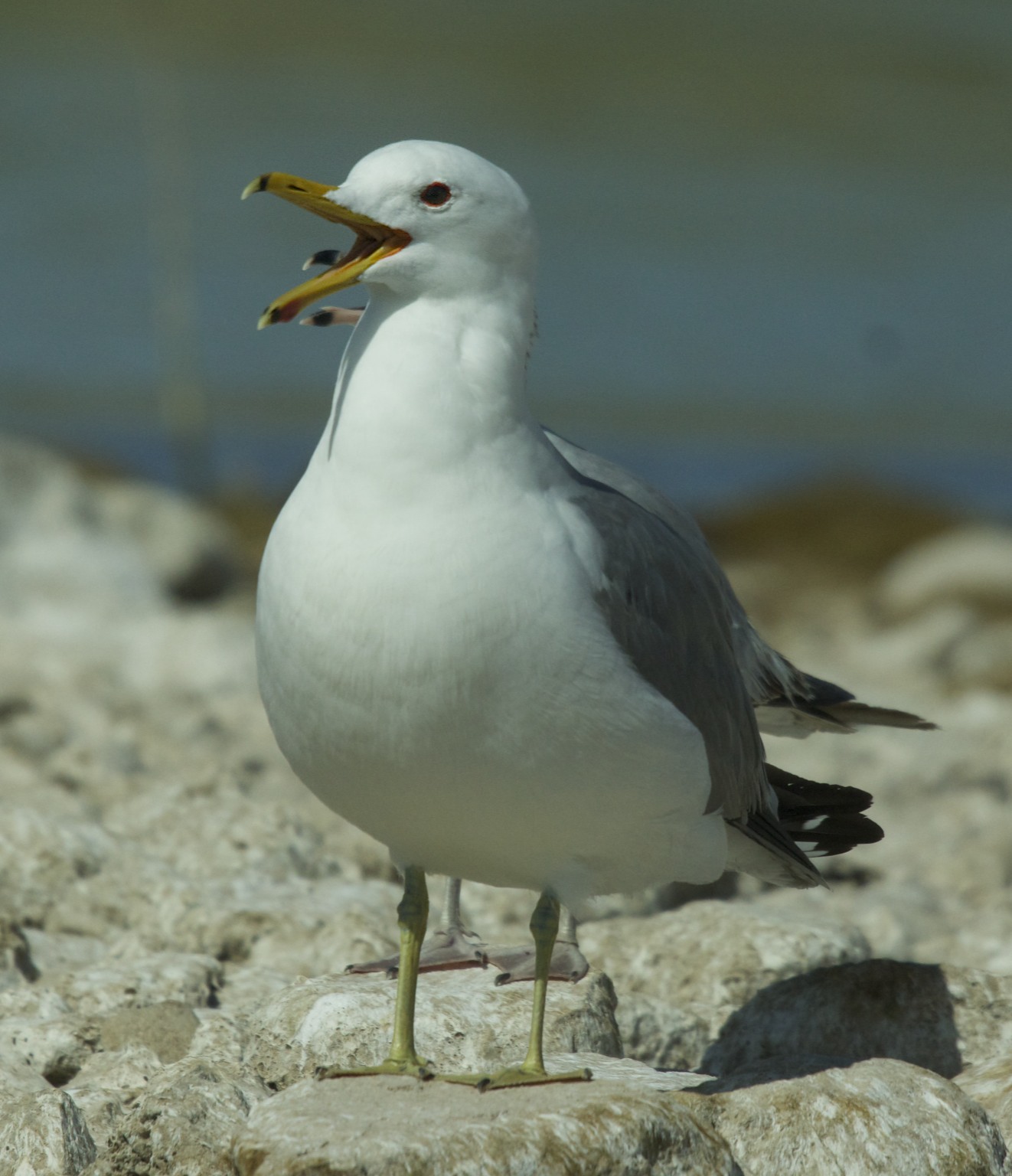
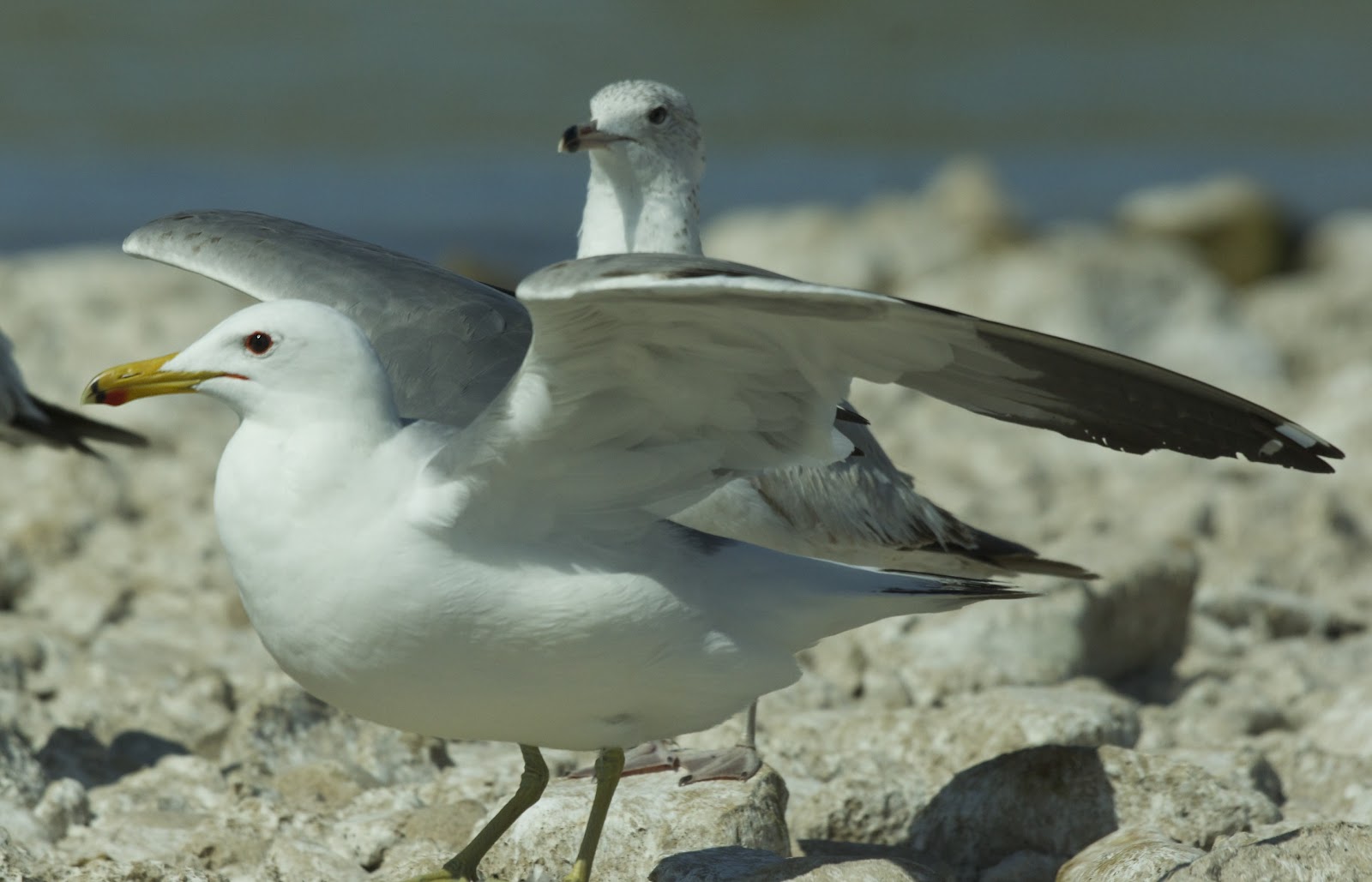
Though eBird flagged it as a rarity, the California Gull didn't come as a great surprise. They sporadically turn up in Phoenix during migratory months, and Alamo Lake matches any of the central Arizona water features. What made this sighting particularly nice was that, after first spotting the Gull on a distant fly-by, it landed pretty close to the kayak, was still on the La Paz side of the lake, and was in a mature plumage, unlike everybody else around him.


It ain't an Ivory Gull, nor even a Black-headed, but hey the state bird of Utah is no slouch. He was the biggest, baddest gull in Alamo, the Davy Crockett, if you will, and he bossed the subservient Ring-bills around quite magnificently. 


In case you're wondering, yes, the California Gull is giving the Ring-billed a piggy-back ride. He is a magnanimous and benevolent Gull overlord.


With the great possibility of rarity sighting on the water, kayaking and surveying were great fun. However, the biggest attraction at Alamo Lake is, I think, the massive, thick, jungly riparian habitat in the northeast corner of the lake. To get here by car, one has to backtrack several miles and then take Park Road northwest towards a way station. It's a dusty, onerous drive, but when one finally clears the last hill the verdant expanse is breathtaking. With so many of the standard red and brown, dry cliffs and hills in the area, this strip of green amazes.


Tons and tons of salt cedar, tamarisk, willows, and cottonwoods cram around where three rivers--the Big Sandy, Bill Williams, and Santa Maria--all empty into Alamo Lake. The rivers weren't too high this time, but clearly this riparian area is well-watered.
The Alamo riparian forest didn't yield any Gray Hawks or eastern Warblers, the sort of rare vagrants one might hope for, but Yellow-breatsed Chats, Yellow Warblers, Common Yellowthroats, Bell's and Warbling Vireos, and Tanagers were making a cacophony I've only seen comparably emulated in a grade school cafeteria. With the foliage being so thick, the views weren't actually that great, but it was a great practice is ear-birding and a charming acquaintance with another big riparian tract, Arizona's most precious and fragile habitat.


Since it is relatively remote and, most of all, totally removed from any other attractions that might draw people to it, Alamo Lake is very under-birded. I can't say I'll make it a frequent stop, but certainly pulling through here once a year would a good move.
I have to mention a special thanks to my dad, Larry Butler, for all of his help in surveying through the heat and dust, as well as helping me lug around a bulky kayak and bush-crash through acres of scratchy salt cedar and tamarisk. 
It will be very interesting and enjoyable to see all the final findings for La Paz county's NAMC, but one thing I found for sure is another solid birding spot in Arizona. 

Sunday, July 22, 2012

Going Han Solo At San Pedro

As a part of my trip to the Huachuca Mountains, I paid a visit to the San Pedro Riparian Conservation Area, a nice strip of greenery just west of Tombstone. The target species for this area was Yellow-breasted Chat and Yellow-billed Cuckoo, and while the trip was ultimately a success, it was a struggle. Heading up Miller Canyon, the trails and the area are pretty straightforward. There is lots of room to roam in the San Pedro grasslands and chaparral, and unfortunately when I'm going 'Han Solo' (alone), getting lost becomes a real problem, and it's exacerbated when I'm driving. After about an hour of detours and switch-backs and run-ins with the increasingly suspicious Arizona border patrol agents, I eventually settled down around the Charleston Bridge in the San Pedro area, and got down to the business of birding.

I parked near a trail head northeast of the bridge and was greeted by the day's first bird, which had parked himself around the same time. It's hard not to love Ash-throated Flycatchers, especially when they come to great you at your car.


I could only interpret this bird's visit and acknowledgment as a good omen. Acting as the hand of fate, he soon flew to an adjacent tree and directed me in the best direction for my quarry. Such a good sport and always eager to help, he totally didn't mind that I was there to see other, more glamorous birds. Ash-throated Flycatcher: Man's second-best friend.


The Charleston River (more of a crippled stream) runs through the middle of the San Pedro refuge, supporting a green strip of willows and cottonwoods amidst the surrounding desert scrub. Though it's no Mississippi, this rangy river provides some prime real estate for Yellow-billed Cuckoos and other riparian passerines.


The knocking calls of the Cuckoos drew me back and forth across the water, and though these elusive birds stayed high in the canopy, I was able to sneak in a few glimpses. At least from this angle you can kinda see the tear-drop white patches on the tail, one of the Cuckoo's more notable features.


The Yellow-billed Cuckoos are not the only canopy dwellers in the summer time; birds like this aptly named Summer Tanager also add some color and verve to the tree-top goings on. Tanagers and Orioles are some of the few reasons to look forward to an Arizona summer, but they can be very stubborn photographic subjects.


There's plenty of red to see lower down in the trees too, principally provided by the stern and stunning Vermillion Flycatchers. Northern Cardinals and House Finches do their part as well, but the blazing red on this flycatcher is incomparable.


The riverbanks are lined with green, but behind the green grows the brown grass and shrub which, thoough less pleasing to the eye, still provides habitat to other interesting birds. I believe this is a female Lazuli Bunting, demonstrating here why her coloration has its own advantages, even if it has a weaker aesthetic than the male's.


The female Bunting's plumage was muted and she stayed very quiet too. The same cannot be said for the more boisterous and beautiful Yellow-breasted Chats, which sang out their territorial claims from atop the mesquite and ironwood trees on the perimeter of the grasslands.


For a long time I had been wanting to see America's largest Warbler and the Yellow-breasted Chats did not disappoint. The San Pedro preserve doesn't have quite the same 'wow' factor as the canyons around southeast Arizona, but it does drawn in some specialty birds that you won't find higher up in the mountains. It's definitely worth a visit, just make sure you have a map when you go!