Showing posts with label Crested Caracara. Show all posts

Saturday, November 29, 2014

Cruisin' the Flats

We're pushing into December, which means when one isn't participating in a TGC Challenge Challenge Challenge Challenge, one is likely chasing down some remaining Year Birds, if not vagrant-hunting, and making sure such lists are respectable enough that any other voyeuristic birders snooping on eBird won't look at one's paltry numbers and laugh. Magill Weber, Chris Rohrer, and I teamed up on the Santa Cruz Flats in Pinal County (annoying close to Maricopa County) for such list buffering and generally good birding on Black Friday. At this terribly dusty and rewardingly birdy expanse of agricultural land, the lines are short but there are still some bargains for Year Birders. Our morning started with roadside Meadowlarks and checking tamarisk groves for owls or other vagrants. 


One of the Santa Cruz specialty birds, for reasons I don't quite understand other than habit and learned behavior in a small population, is Mountain Plover. This declining species doesn't turn up reliably in much else of the state, except for Yuma. They're a fickle bunch and often skittish (as was the case yesterday), but still a damn fine bird.


While making our rounds though the agr. land and sod farms beloved of the Mountain Plovers and many raptors, we also recorded many of the expected liminal grassland species, some of which were belated Year Birds for Magill and myself.


There were also Burrowing Owls, which I see probably every month out of the year and of which I shall never tire, nor will anyone else who's heart is not as black as coal (from smoking or something).


The other main attraction of the Santa Cruz flats is its resident and wintering population of Crested Caracaras. This bird turns up sometimes in the agr. land of western Maricopa County, and also in southeast Arizona, but nowhere as reliably or in as large of numbers as in this dusty valley. Three weeks ago I passed through this area with an out-of-state birder and we recorded 5 Caracaras and no Plovers. This time around we had 6 Plovers and a whopping 26+ Caracaras.


Fun fact: Caracaras are often thought of as Vultures, but they're actually more closely related to Tanagers than Vultures. This is science. Vulture or Falcon or Parrot or whatever, they are cool birds. This cannot be denied, even if they don't have talons.


Our count exceeded two dozen individuals, conservatively, which was the highest number I'd ever encountered in a single trip. A majority of those birds we counted were also immature/1st year birds, seemingly eager to strut their stuff at the Caracara wintering grounds.


We didn't have Texas-style good looks, but some of the immature birds stayed far closer to the road than I had the pleasure of observing here before, and this proximity made for the day's highlights.


The glorious long weekend is still progressing on its merry course, and there is time enough for more birding. As the year winds down one has to make some tough decisions with that scarcity of time, to go for more year birds? vagrants? sparrows? Probably sparrows. Always choose sparrows.

Sunday, July 6, 2014

Texas Birding: Average Aransas and Mustang Island, Wild and Free

The Texas Birding Adventure was a large endeavor, large enough to require reinforcements to split some motel costs, intimidate away highway brigands, and also enjoy the birds. Mike from The Iowa Voice postponed his date with the Supreme Court to join in the Texas birding experience for a few days. It is unhealthy, after all, for one to go too long without Scissor-tailed Flycatchers in one's life.


Our first stop was at the birdiest site in all of Texas, which puts it high in the running for birdiest spot in North America, with over 370 recorded species. It is also the famous wintering grounds for a majority of North America's Whooping Crane population. Pretty impressive credential yes? 
Well, truth be told, Aransas NWR in June is pretty disappointing, unless one is hoping to lose a pint of blood or two to mosquitos. We did still have some good bird sightings, and plenty of other nifty wildlife. Behold, a Six-lined Racerunner, with battle damage, and a fecund family of javelinas. 


Aransas is a massive space and within its birders one encounters a multitude of habits. We were mostly out of luck with timing. The grasslands, the exceedingly buggy forest, and even the shoreline portions were all pretty mellow. Migrants had moved on and residents, other than Turkey Vultures and Northern Cardinals, were few and far between. It was a bit of a let down, given the earlier success and momentum of the trip. 
Perhaps the best sighting of the day was this ridiculously tall trail sign. It had normal trail sign info on it, stuff about the grassland flora and what not, but it this information, apparently, is only intended as accessible for the very vertically gifted. 


In a similar vein of photographing tall and graceful things, the white morph Reddish Egret was also pretty inspiring, even from a distance. They are among the more spastic and entertaining feeders of the heron/egret group. Their 'shadow-wing' feeding technique (not pictured) was the inspiration for at least two different forms of Kung-Fu and probably a few more bad movies about said disciplines. 


The main disappointment at Aransas was that all of the birding trails within the deciduous growth were  absolutely swarming with mosquitos and relatively birdless. Passerines and Woodpeckers were almost none to be found, and even though migration had moved through, we expected more activity. The birding was probably best at turn offs from the auto-loop, where clearings allowed one to look and listen for birds like White-eyed Vireo in the liminal brush, and other critters in the grass.
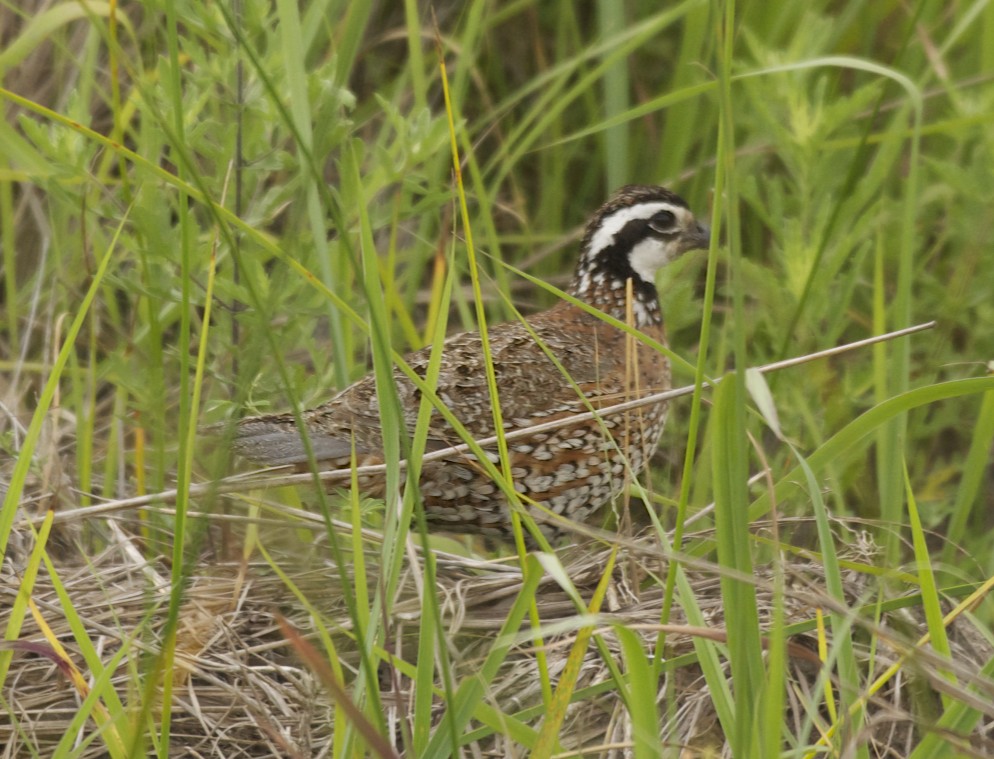
All my whining aside, picking up a lifer Northern Bobwhite compensated for the other shortcomings.  


Alas, we were not position in a nifty bird blind by a watering hole, so there will not be finely detailed images of this intricate bird to enjoy, but rather blurry, cropped photos of a fairly secretive bird going about its business.
A couple of weeks later I was able to observe these birds vocalizing from high in coastal pine woods in Carolina, which was much cooler than one might expect on paper.


In the game-birds category, we also had some of the more conventional quarry, lots more, in fact. A rafter of 19 Wild Turkeys included about a dozen chicks, a form of turkey I had not yet experienced in life. It was purdy cute.


Fueling up in the various senses around Goose Island SP provided more gulling and harbor-birding opportunities after lackluster Aransas. Groups of Laughing Gulls are always good for a pose.


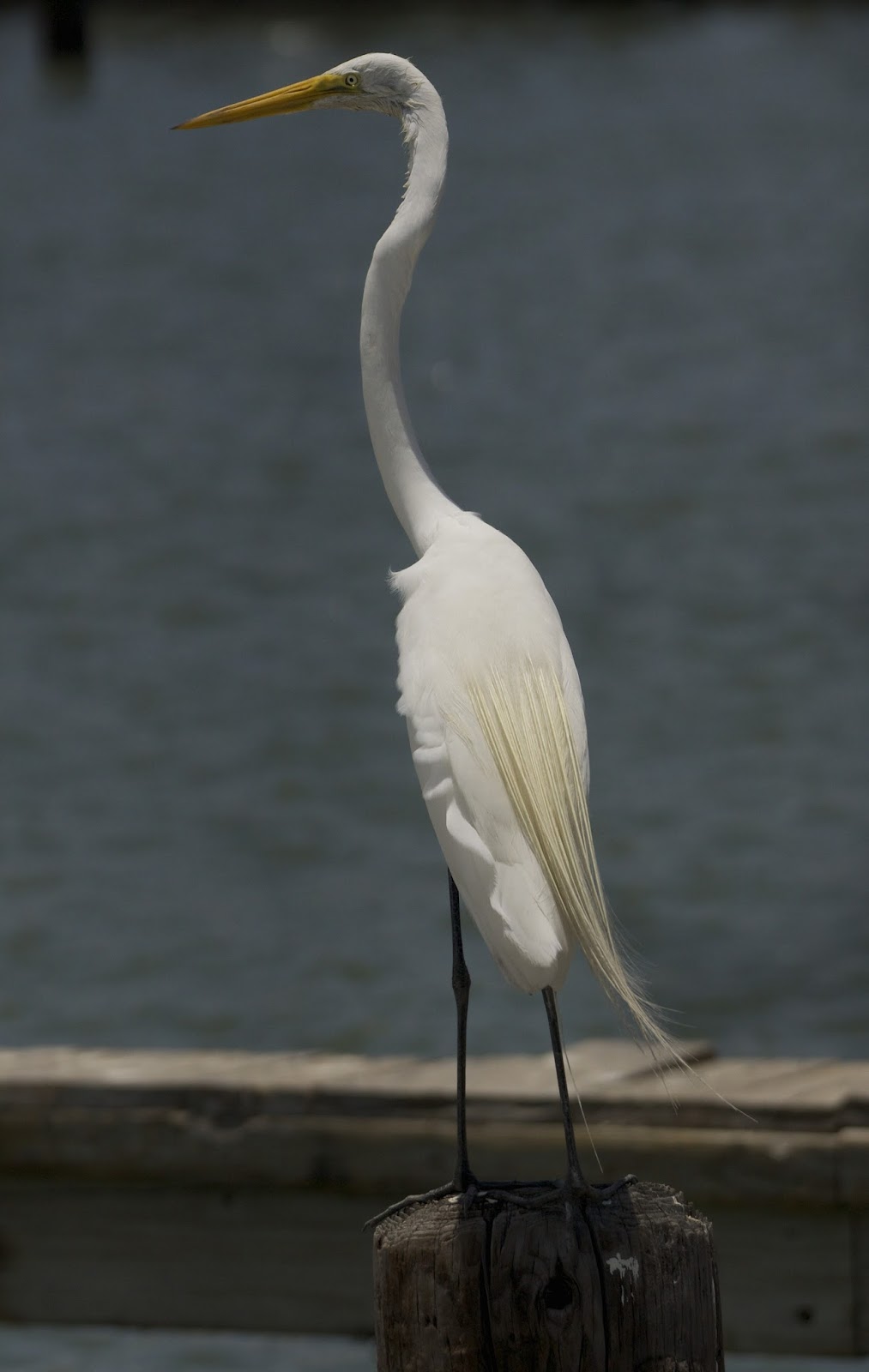
There was a fair amount of fishing boat activity around Goose Island harbor, and of course this in turn brought in all manner of birds both grungy and well-groomed. In the well-groomed department, this Great Egret, white as snow:


Less well groomed, this immature Brown Pelican, who just needed a bit more time.


The Port Aransas area also coughed up some shorebirds for the trip list, even if it didn't have quite the scenic beach landscape one might also hope to combine with maritime birding. The general abundance of scraps in that setting also brought in other carnivores and scavengers. For once I was able to check out a Caracara while not driving 80 miles and hour (or even 60mph).


We headed south in the afternoon for Harlingen, and decided to stop back in Corpus Christi, on the way down the coast, at Mustang Island SP. The beach was carpeted with soft seaweed of some kind, more of which was continually brought ashore by the heavy-laden tide. These kelpy masses were teeming with minnows and other edibles, which in turn attracted the attention of those bold enough to plunge-dive or dip precisely at water level, a la Sandwich Terns.


We were surprised to see many dozens of Black Terns in area, having thought they were mostly migratory in the area and would have moved on (maybe they move much later than I was thinking). These birds are seldom seen in breeding plumage in Arizona, and it was very pleasing to see them fulfilling their bold namesake.


Some of the mid-molt birds hung out with Sanderlings, apparently self-consciousnbess of their disappointing plumage. Royal, Elegant, Bridled...Terns are a pretty aristocratic group of birds and they seldom tolerate ugliness, but Sanderlings won't judge.


The kelp piles attracted several different species (Sandwich and Forster's below), and just above the main breakers,hundreds of Terns joined together, fighting to stay stationary above the break point, where their prey would become exposed.


Some of the more diminutive Terns, like this here Least fellow, were pretty impervious to people, while others like the occasional Gull-billed always kept a distance. 


Some Terns were way too busy being demonically possessed to have much concern one way or another. This bird later went and projectile-vomited to its young.


Sometime at the beach was perfect for clearing heads and finding footing. The next day in Harlingen saw one of the most satisfying thus far, and is coming up later this week. 

Monday, December 31, 2012

More Birding from the Car(acara)

After spending the first hour or so cruising around the farm roads and chasing Larks, I eventually made my way to Baumgartner Road and the adjacent fields.  This is one of the most reliable areas to see winter-time Caracaras in Arizona, and is also a good spot for combine harrower harvesters, for you tractor watchers out there, and there are also plenty of pecan trees for you nuts. 


 The Caracaras combine forces with the Common Ravens and follow after the combine harvesters, pillaging any disturbed ground for the bugs and rodents as they scatter for safety. It's ruthlessly efficient hunting, everything you'd expect and hope for in a cool predator like the Caracara (yes, Ravens are cool too, but we've known that ever since Oden and Edgar Allen Poe popularized them in 2,000 b.c.)


Despite getting some glimpses of the Caracaras, I could not get close enough for satisfying photos. By this desire, I was forced to chase after the tractors too, looking for the birds that were chasing them, and they chased after the un-harvested crops. I'm sure someone or something was chasing me too, just to keep the chain going. That seems to be the way the universe works. 
Though still distant, one of the Caracaras did perch and pose for a pretty picture with part of Picacho Peak in the background.


While chasing around after the Caracaras and trying to respect the private property/no-trepsassing/we-will-shoot-you-on-sight signs, an old friend caught my eye. The consistently jaw-dropping Vermillion Flycatcher is certainly one of the birds that got me hooked on birding. Now that I was all grown up and chasing after Caracaras and Mountain Plovers, the Vermillion stopped by to remind me of my roots, to remember the classics.


It certainly was a time for some naval-gazing...


He stretched; I stretched; it was good to see this iconic flycatcher again. They're not uncommon in the bottom half of Arizona, but you never know when one will turn up again. He reminded me not to take em' for granted.


After spending some time with the Vermillion, I finally swung around the Baumgartner farms, on the east side of the cattle coral, and got some closer shots of the Crested Caracara. This is a bird that shows it's still possible to be a vulture and be beautiful, and not just beautiful in that wish-washy 'it's-what's-inside-that-counts sorts way, but in the much more important superficial first-impression sense.