Showing posts with label Cactus Wren. Show all posts

Saturday, January 14, 2017

Aim Small, Miss Small

Recent goal-oriented birding in Carolina involved working long or hard hours to log relatively usual birds. Recent birding in Arizona involved distant duck sighting in dim lighting. Both of these provided their own satisfactions, but not without a bit of strain all the same. Some people like to say they have to take a vacation from their vacation, and to these people I say, "You are weak vacationers. Weakness disgusts me...but not in a way that weakens me." But on the other, more relatable hand, birding benefits from its changes of pace as well. Sometimes it's nice to watch and photograph the birdies without concern of lists or chasing, the lazier, more passive approach in local circles.
Of course, this should only be done on workdays when there's a spare hour or two in the evening. Doing this on weekends (soft birding around town) is disgusting weakness, to reiterate.

Papago Park and the Desert Botanical Gardens, frequently mentioned on this site in times long past when I was very new to the Phoenix birding scene, are still some of the best places to crush common waterfowl, Sonoran species, and other just-a-bit-better-than-generic-park birds. (Most generic Arizona parks do not have cool Warblers like out east).

This GHOW is often in the cottonwood corner at the DBG. Some day it will poop on me, but this day was not that day.

So mild-mannered are these areas that even the timid Common Gallinule (red-shielded, obvi) will swim out into the open ocean without a life vest. Fun fact: The Common Gallinule actually used to be called the Common Morehen, because their entreating calls reminded one of a rakish greedy Oliver Twist impression.


Verdins are industrious nest-builders (not pictured). They build expansive breeding nests and more conservative roosting nests throughout the year--up to a dozen--because otherwise they would be idle, and idle feet are the Verdin Devil's playthings.


The DBG pulls in a vagrant rarity from time to time, but is mostly known for its close-up opportunities with desert flora and fauna. Even so, some unusual behaviors may still be observed. What flock of birds is feeding on buds in this mesquite?


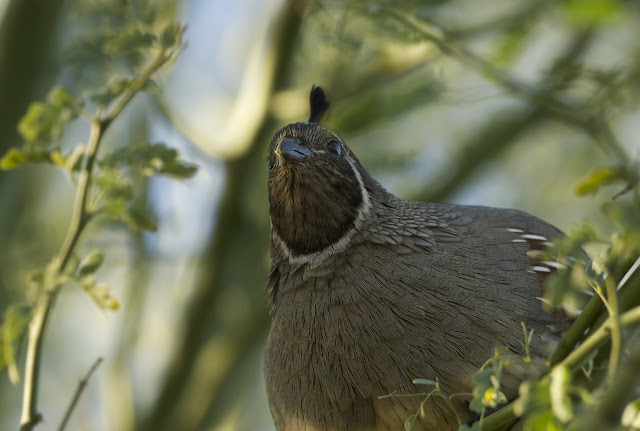
Yes the answer is Quail, Gambel's Quail. Timid like most Quail species, GAQUs also become very tame and confident in the right setting, probably also like most Quail species.

Curve-billed Thrashers also take to the trees in groups, gregarious behavior untypical of the family. Although that may just be circumstantial because these Thrashers were obviously a family, with the two younger birds following the presumed parent around incessantly. The mature adult had a shorter, stubbier bill than many CUBUs I've seen. I have no idea if this is entirely random or may be a way to sex the birds, like with Curlew and Dowitchers? 


Cactus Wrens are notoriously hardy birds. They may not be as tough as Gray Jays, per se, but are nonetheless able to withstand living in areas entirely without free-standing water and can also withstand living in the middle of Phoenix suburbia--provided the landscaping suits. They are also highly territorial during nesting season and will chase reptiles and mammals either away or into cholla cactus snares near their nesting sites, like clever and less passive clown fish. They also destroy other bird nests and bust eggs. What a jerk. Pretty great state bird eh?


Sunday, November 2, 2014

What the Arboretum's Harborin'

There are many consequences--most of them social or financial--that come with the birding pastime. There are also some benefits, one of which is that one can often combine birding with other activities. As I've been oft-whining the last few weeks, now isn't the best time to be birding, in my opinion, around central Arizona. With the low promise of plentiful birds, and the promise that many of the birds one does find being in drab plumage, there isn't a lot of impetus to get up before sunrise, especially if a drive is involved. But this weekend I needed to do some scouting for a possible class field trip at the Boyce Thompson Arboretum in Superior, AZ. 
It's a neat place with lots of trees; I needed to determine if it'd be a viable site for 90 students to spend some time reinforcing natural history/science concepts. And hey, where there are trees and water, there tend to be birdies too. So Butler's Birds decided to kill two birds with one stone this weekend (sometimes the needs of the many outweigh the needs of the few). 


The Boyce Thompson Arboretum hosts several different biomes, some of which are artificial transplants with botany from Australia or Africa, and some of which are continuations of the surrounding Sonoran Desert. The more intriguing, and also more difficult birding is near the exotic trees, where some good rarities have been found over the years. Someone reported some out-of-season birds such as Tyrranulet and Bell's Vireo in the area, but apart from Kinglets and White-crowned Sparrows I only turned up Northern Flickers, LOTS of Northern Flickers. They all stayed up high with their foraging, but I was not above (and, in fact, was below) peeking up at their spotted undergarments. #voyeuristbirding


The site would lend itself pretty nicely to a field trip, but truth be told I did not find a lot else of interest with the birds. Verdins were being weird and building nests, which they seem to do compulsively all year long, sometimes building multiple nest balls in the same tree. 


Phainopeplas perched in the desert ironwood. If Spiderman were a Cardinal these guys would be Venom, but with a prettier call note.


This ever-sharp and loud Cactus Wren also seemed to be gathering nesting stuffs, or else he thought this was a stick bug. Like Verdins, they build multiple nests to act both as decoys and also proof of their industriousness to prospective mates. Perhaps they get an early start on all that construction as well.


I haven't been crushing many birds lately, so allow me to indulge here with a closer crop. It's the state bird after all, and worth a second glance (though maybe not a third). Even though it's not the best state bird, maybe not even in the top ten, it's still way better than the large majority of other state birds.


When things started to heat up at BTA--which still happens, even in November--I drove into the old western town of Superior for some lunch breakfast. I do love me some cheap diner steak and eggs, served forth by a lady named Holly or Charmin who calls me darlin'. It was to be the Buckboard City Cafe, "Home of the World's Smallest Museum." The museum consisted of various odds and ends from the 1980s transferred from someone's attic. The cafe was full of politically opinionated bikers and the service was slow. Lastly, the food was terrible. I felt like this tree a couple of hours later. Nuff' said.


Next weekend I'll be heading south to the Huachucas with a birder friend from Indiana, if all goes as planned, and hopefully there'll be some diversity on this blog again. Here's to November!

Monday, September 5, 2011

Cactus Wren

The Cactus Wren is the largest wren in North America, and is also the emblematic state bird of Arizona. Although they are comfortable living near developed land, they are also very capable desert specialists, and the Cornell Lab of Ornithology mentions that they can survive without freestanding water.

The Cactus Wrens do very well in Arizona, and are especially noticeable at the wildlife preserves around the valley. They are very comfortable with people and semi-manufactured environments, so it's nice to get pictures of them in a more natural and aesthetically pleasing habitat.
 These purple flowers made for a pretty great setting with the evening light. 

 I like here how the cactus works to supply a textured green background, quite nice with the cactus wren...


This busy bird was adding to her nest in a yucca plant. It was already looking pretty large and lopsided, but wrens do like to keep busy.


Here, the iconic wren of Arizona greets the morning sun, while another bears the evidence of a cactus-fruit breakfast.
A little bit of bed-head


This specimen's darker brown back and head have not filled in yet, which makes me think it's a first year.