Showing posts with label Desert Botanical Garden Birding. Show all posts

Saturday, January 14, 2017

Aim Small, Miss Small

Recent goal-oriented birding in Carolina involved working long or hard hours to log relatively usual birds. Recent birding in Arizona involved distant duck sighting in dim lighting. Both of these provided their own satisfactions, but not without a bit of strain all the same. Some people like to say they have to take a vacation from their vacation, and to these people I say, "You are weak vacationers. Weakness disgusts me...but not in a way that weakens me." But on the other, more relatable hand, birding benefits from its changes of pace as well. Sometimes it's nice to watch and photograph the birdies without concern of lists or chasing, the lazier, more passive approach in local circles.
Of course, this should only be done on workdays when there's a spare hour or two in the evening. Doing this on weekends (soft birding around town) is disgusting weakness, to reiterate.

Papago Park and the Desert Botanical Gardens, frequently mentioned on this site in times long past when I was very new to the Phoenix birding scene, are still some of the best places to crush common waterfowl, Sonoran species, and other just-a-bit-better-than-generic-park birds. (Most generic Arizona parks do not have cool Warblers like out east).

This GHOW is often in the cottonwood corner at the DBG. Some day it will poop on me, but this day was not that day.

So mild-mannered are these areas that even the timid Common Gallinule (red-shielded, obvi) will swim out into the open ocean without a life vest. Fun fact: The Common Gallinule actually used to be called the Common Morehen, because their entreating calls reminded one of a rakish greedy Oliver Twist impression.


Verdins are industrious nest-builders (not pictured). They build expansive breeding nests and more conservative roosting nests throughout the year--up to a dozen--because otherwise they would be idle, and idle feet are the Verdin Devil's playthings.


The DBG pulls in a vagrant rarity from time to time, but is mostly known for its close-up opportunities with desert flora and fauna. Even so, some unusual behaviors may still be observed. What flock of birds is feeding on buds in this mesquite?


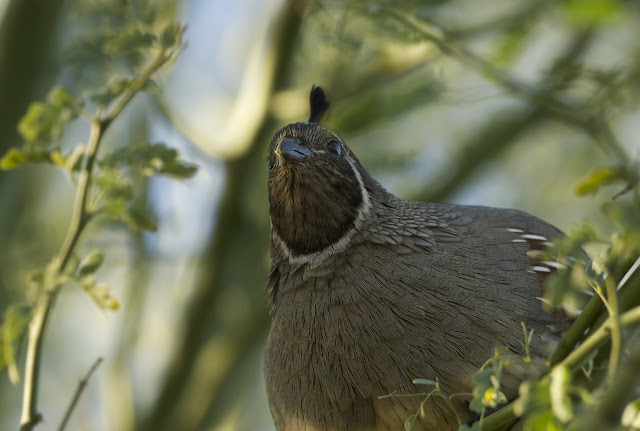
Yes the answer is Quail, Gambel's Quail. Timid like most Quail species, GAQUs also become very tame and confident in the right setting, probably also like most Quail species.

Curve-billed Thrashers also take to the trees in groups, gregarious behavior untypical of the family. Although that may just be circumstantial because these Thrashers were obviously a family, with the two younger birds following the presumed parent around incessantly. The mature adult had a shorter, stubbier bill than many CUBUs I've seen. I have no idea if this is entirely random or may be a way to sex the birds, like with Curlew and Dowitchers? 


Cactus Wrens are notoriously hardy birds. They may not be as tough as Gray Jays, per se, but are nonetheless able to withstand living in areas entirely without free-standing water and can also withstand living in the middle of Phoenix suburbia--provided the landscaping suits. They are also highly territorial during nesting season and will chase reptiles and mammals either away or into cholla cactus snares near their nesting sites, like clever and less passive clown fish. They also destroy other bird nests and bust eggs. What a jerk. Pretty great state bird eh?


Tuesday, August 21, 2012

Early Nerd Gets The Bird

Birding on Sundays is a delicate business. Sunday is the day when I have to do all of the work I put off doing on Friday and Saturday. Sunday is also my Sabbath day (a good reason not to procrastinate on Friday and Saturday). The English Premier League (soccer) has started. Also Sunday is a great day to have dinner with the family. It's a busy day, so Sunday morning belongs not just to the early birds, but to the early birders. While the initial push to get out of bed at 5 am is difficult, it does have its own rewards. The sun rises much more elegantly in the morning than I do, and it's really something to see. 


Of course, it's pretty common for birders to get up at all manner of uncivilized hours so they can gear up and hit the road for maximum birding. It's just harder to do on Sundays when you know you won't have a day after when you can catch up on your sleep. Even so, I've never had a morning of birding that would've been better spent sleeping.

This Sunday I had two stops, the first at the Desert Botanical Garden for better photo opportunities and the second at the Glendale Recharge Ponds for a vagrant Roseate Spoonbill. While the opportunities to see new or unusual birds at the DBG come few and far between, it's still one of the best places in Phoenix for nature photography, combining the desert's birds and blooms in one compact little park.


And then there are those non-indigenous interlopers like the Rosy-faced Lovebirds, everyone's favorite invasive species. They were surprisingly terse on Sunday, dare I even say laconic!? Usually they're squawking up a storm, more garrulous even than a gang of grackles.


In the morning, the Lovebirds are most often found catching the early-bird special around the Sunflowers and Mesquite trees at the DBG. They are joined, and in fact greatly outnumbered, by the humblest of finches, the Lesser Gold. Try as they might, they just don't have the brilliance of their American Goldfinch cousins.


They still catch the morning light well, and are plenty charming. But the number of times I've seen one of these yellow flashes in a tree and chased after a potential migrant Warbler is, well, embarrassing.


Considering it was still 5:30am at the DBG, the award for most vivacious and acrobatic bird goes to the Verdin. I'd submit they also deserve the overall prize for "Best in the Garden." This fella was demonstrating his Least Bittern impression. He's got the ability, but I don't know if he's got the look.


It was surprising to see young Curve-billed Thrashers, yellow gapes and all, still foraging under the large sumac trees (well, not surprising to see them foraging, just to see them at all). It seems too late in the summer for Thrashers to look this young, but if they don't mind then I won't mind. Come to think of it, it makes me rather glad.

Saturday, April 21, 2012

Picking a Spot and Getting the Shot

I fit a pleasant hour of birding in at the DBG after work on Wednesday. The wildflower garden there is bursting with color, and as such is one of the few places where there is still substantial bird activity, even when it's 94 degrees outside.

Overbearing sunlight and a bit of laziness compelled me to just pick a spot and plop down for my time at the DBG. It worked out pretty well though. The birds soon felt comfortable and were pretty close. There was a lot of stuff in the way, but I had obscured views of Green-Tailed Towhees, Gilded Flickers, and a lovely MacGillivray's Warbler. I also had some nice, clear views of many birds, and the added bonus of pleasing scener made it a very nice session of photography.

This Curve-Billed Thrasher was foraging underneath an ironwood tree (my beloved source of shade). The dry, yellow leaf littler all around reminds me of cornflakes...wouldn't he love to be standing on a big pile of those!

I've often thought that Cruve-Billed Thrasher beaks are superfluously insidious-looking. They're very functional, of course, and help the birds dig into top soil and pry under the leaf littler in search of food. But lots of other birds accomplish this too, and without looking so dangerous. I bet the Thrashers are hiding something, like they are, in fact, raptors in disguise.


The Gardens are still buzzing (quite literally) with Hummingbird activity. There are Anna's Hummingbirds at all different stages of molt and maturity, constantly bickering and chasing each other away from the flowers, never having enough time to actually enjoy the prize themselves.


This young male was a bit more subdued. He had a nice shady perch and was content to let the other hummers fight to the death, perhaps planning to claim the whole Gardens as his domain once the competition had eliminated itself. Whatever his plan, part of it seemed to entail sitting right next to me. I actually had to zoom out to fit him in the frame. How often does someone get to say that about a hummingbird? I would've liked a tiny bit more light, but I was still  very pleased.


The Thrasher was on the ground, and the Anna's sat near the top of the shrubs. This female Phainopepla seemed to like life right in the middle. She was often obscured from view, and didn't seem to be too comfortable squirming in between the brush. I suspect she had a nest nearby, but I could not find it.


She lowered her crest and she is about to take flight--always good to maximize aerodynamics.


I returned to the same spot in the Gardens on Friday evening, this time with family, as we all set out to enjoy the blooming gardens in the cooler evening temperatures. We toured the whole facility, and also made a specific stop in the same place, and again I was rewarded with some nice photographic settings. The sun was on the wrong-side of this House Finch, but his red body surrounded by yellow palo verde blooms still made for a nice composition:


He made it look pretty good. I wish I could eat flowers.


This grumpy Curve-Billed thrasher was one of the few birds tolerating the direct sunlight. He seemed to be guarding this net-covered yucca plant, and was determined that it remain concealed until its grand unveiling, whenever that may be.


But even the most stalwart sentries still need to blink, and this Thrasher was no exception. In this photo, the nictitating membrane is still visible, as only half of the eye is fully exposed.


It's nice to just sit and bird in one spot. I'm often too impatient and end up roving all over a site. I know I probably see less birds that way, and definitely get less photos, but it has the psychological bonus of making me feel like I'm doing something, like the number of birds I may see is actively within my control, even if that's not the case. Nonetheless, every time I just pick a place and wait, it's just as rewarding.

Friday, April 6, 2012

He Who Wears The Crown

White-Crowned Sparrows are mighty handsome birds. They suffer a bit from over-exposure here during the winter months as they descend on the Valley of the Sun in massive flocks. Even so, I really appreciate that they're a species consistently brave enough to stand their ground when the cameras come out. I had a great time photographing some foraging White-Crowns at the DBG a few evenings ago. Watching birds feed...does it make you pine for the good ol' hunter-gatherer days?


With the DBG in full bloom, it was a colorful all-you-can-eat-buffet, and the White-Crowns were loving every minute of it. I'm not sure they always knew what exactly they were eating, but hey, when you look this good, you don't need to know anything.


For some reason, I'd never taken a picture of the back of a White-Crowns head. Usually a bird's backside is a throw-away shot. But whenever I see the back of the White-Crown's cap I'm always reminded how cool it is. I hope my hair goes white in such a pattern.


The sulking juvenile still seemed a bit reticent to join in the feast, as if his parents were embarrassing him or he just thought the whole thing was, like, totally lame. He perched on the rusty garden fence and sullenly observed the dine-n-dash. Eventually he joined in too, as the juveniles always do.


Pretty birds. I'll miss them when they're gone.

Thursday, April 5, 2012

The Whole Bloomin' Garden!

The Desert Botanical Gardens have long been a birding staple of Butlers Birds and Things. It's nearby, has a good variety of species, and brings the birds in close. But into the winter months, they often prune heavily and remove lots of the flowering vegetation. As such, the number of species and sightings drops off dramatically and birders are forced to look elsewhere. Well, the spring planting is now well established, the Gardens are in full bloom, and the birds are coming back. It was a great pleasure to return to these familiar grounds and have another great birding experience, as I had so often last year.

Not all of the winter birds have left yet, and the first to greet me was this confident White-Crowned Sparrow--a bird with a kingly bravery to match its kingly name.


And of course, there were Verdins. There are always Verdins, lots and lots of Verdins. I've never not seen a Verdin at the DBG. I've never gotten tired of seeing Verdins at the DBG : )


The Verdins and White-Crowned Sparrows had no problem being out in the open, nor did the multitude of Anna's and Broad-Tailed Hummingbirds that have descended on the flowering Gardens en masse. There were also some skulkers, some shy birds keeping to the shadows hoping the spastic camera man would pass them by. Wishful thinking birdies!

This Orange-Crowned Warbler was one such wallflower, the first of many I will see this spring.


This male Gambel's Quail was also being a bit mopey. Maybe he was just feeling a little bit trapped. Oh sigh, Mr. Quail, the grass is always greener on the other side...


Speaking of green, this frog was in a very bullish mood, and he filled the small swampy circle at the DBG with his boisterous boasting. This would be all well and good if I were not trying to 'pish' a Common Yellowthroat out of the reeds. Alas, the bullfrog won that singing contest.


This young male Anna's Hummingbird made for some particularly fun observations. He did not seem to like feeding while in flight, and would instead try to perch near or on his desired flower. When he found a nice perch on a fairy duster plant, he blended in very nicely.


When he turned his head and revealed his developing gorget, it was very complementary, his green back and spot of red fitting the color palette perfectly. Soon he'll have his full, manly gorget, and he'll terrorize the flower gardens and try to chase all the other birds away. Of course, this will attract all the more attention from us birders.