Showing posts with label Black-Headed Grosbeak. Show all posts

Wednesday, May 28, 2014

Shadow of the Mountains: Get High on Birds in the Lowlands

Offering fantastic birds and cooler temperatures, the canyons and montane trails of southeastern Arizona are rightly lauded as the premier birding destination in the spring and summer months. This is well and good, but the surrounding lowlands should get their shake too, at least if one is looking for the complete birding experience and is an equitable shaker. Patagonia State Park and the Patagonia Rest stop are very well known for their seasonally attractive Kingbirds, but that's just the beginning. 
In fact, instead of showing a predictable Thick-billed Kingbird from that area, I'll show a singing Lucy's Warbler, because Butler's Birds is anything but conventional. 


The Proctor Road grasslands, down mountain from Madera Canyon, are some of the best. This time of year they host vocal Botteri's Sparrow, Beardless Tyrranulets, and Montezuma Quail. Where the mesquite thickets fill in and where there's a bit of water they also attract Flycatchers (Brown-crested in this case) and Yellow-rumped Shy-faced Tanagers.


Yellow-breasted Chats skulk around in the riparian oasis off the Proctor Road trail, along with several Towhee species. The best way to get crushing photos of a Yellow-breasted Chat, of course, is to find a dead one. He's skulking up in heaven now...


The Forest Roads leading up to Florida Canyon are also excellent. One junction is a pretty decent spot for Black-capped Gnatcatcher, and they're also very good for Rufous-winged Sparrow, another localized bird that is, perhaps, underrated because it has a pretty ubiquitous sparrow name. Botteri's and Baird's Sparrows sound like they're uncommon because those names--Botteri and Baird--don't come up much in the bird world, but Rufous-winged can be a tough find and should not be ignored by anyone visiting the area, especially when they're belting out defiance to the gods.
Nate over at This Machine Watches Birds got a nice recording, as he also did of the Buff-collared Nightjar we had off the afore-mentioned Proctor Road.


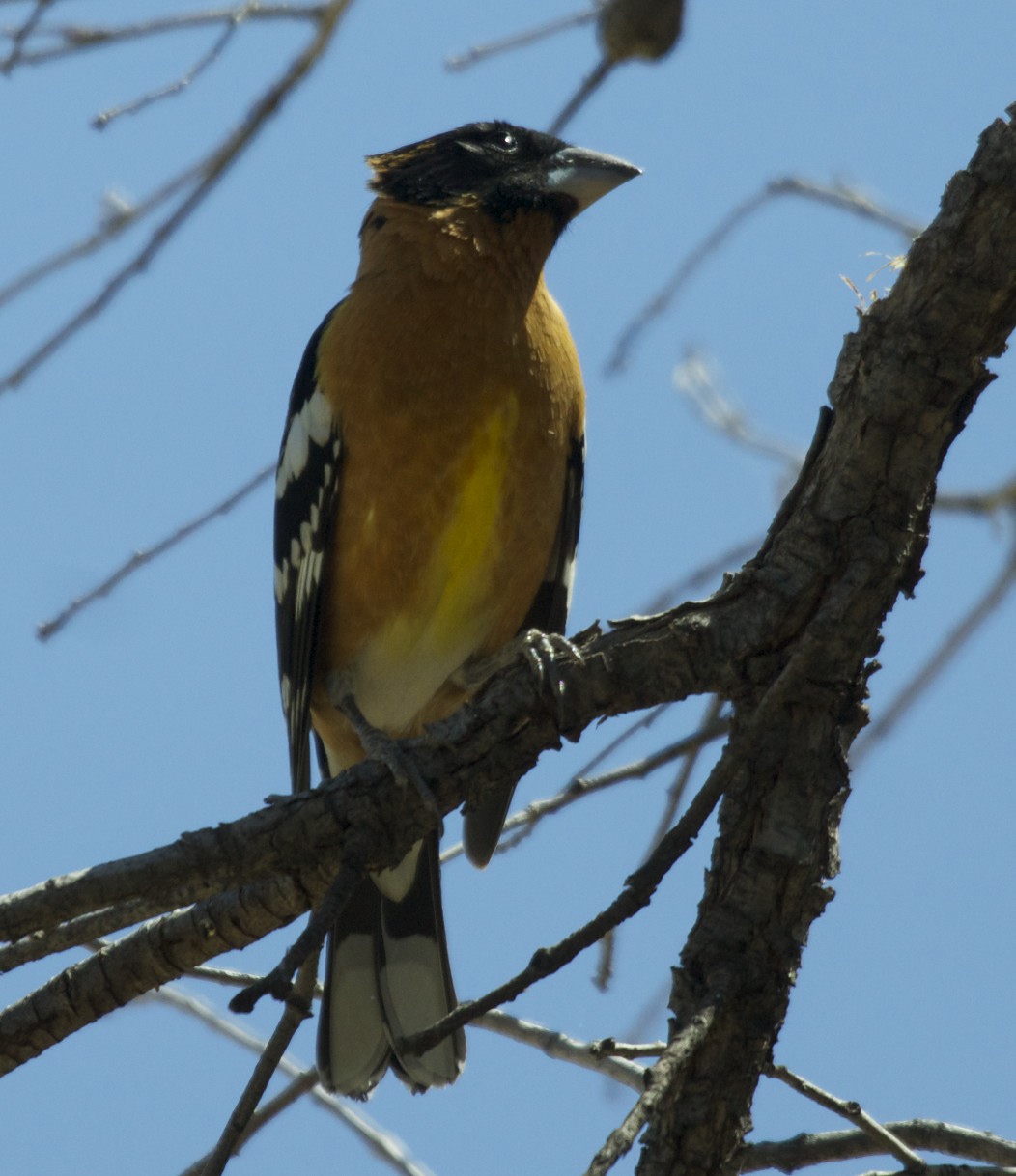
Of course, by 10am or so the lowlands are pretty scorching and bereft of shade, so sensible birds and birders both head up into the canyons. The liminal space here, were rocky grasslands meet hillsides of scrub oak, brings in the Wrens, Woodpeckers, and plenty of other cool stuff, like crushable Black-headed Grosbeaks, perhaps North America's "Most likely to be seen not in mature plumage bird." 


Butler's Birds will be relocating to Texas for the first couple weeks of June for some advanced birding. Hopefully there'll be another Arizona outing before then. Certainly the bounty of May has filled the reserves and the coffers and whatever else needs filling from one's home state for a fine send-off.

Friday, May 10, 2013

Fiery Birds in Ash Canyon

There are several famous sit-n'-spots in southeastern Arizona, where generous landowners and B&B managers maintain numerous feeders and lovely properties to keep the beautiful birds of southeastern Arizona concentrated in certain areas. Of course, this also attracts birders. Many of these sites--Paton House, Batiste B&B, Beatty Guest Ranch--have also established themselves as very reliable places to see some of the southeastern rarities. The Beatty place hosts Spotted Owls in Miller Canyon while the Paton House is visited by a Violet-crowned Hummingbird every day. If a birder is hoping to see these species, there are few places better.

Mary Jo's Ash Canyon B&B is another such establishment. Maintained by the very knowledgable and charitable Mary Jo Ballator, it hosts a Lucifer Hummingbird, along with many other pretty plumaged patrons, through the spring and summer. After our thorough birding in Miller Canyon early in the morning and afternoon two weeks ago, we spent some time at Mary Jo's in the hope that a Lucifer's Hummingbird would show itself. It's always easy to spend some time at these sit-n-spots, because there's a guarantee of plentiful, close-up views of many great birds, even if one misses the actual target (which we did. If you're hoping for Lucifer's photos, turn back now).


Lazuli Buntings occur in riparian areas in Maricopa County later in the spring, in conservative numbers and with a certain amount of trepidation. At Mary Jo's, one can sit only a few feet away as they forage, by the dozens, among her hedges and seed-scattered log piles.
Of course, there's a certain dissatisfaction in photographing of cool birds standing on feeders and artificial bird attractions, but the enterprising birder can find sites around the property where, even though though the birds are still sort of baited, they're not directly partaking in the unnatural attractions.


The roving Lazuli Buntings were joined by chipping and Lark Sparrows, along with the occasional, more uncommon Indigo Bunting. Seeing either one of these species is a great treat in Phoenix. Just a few hours down south they actively mingle and feed together in droves.


Many of the male Lazuli Buntings were not in their full plumage yet, and it was charming to see their patches of brown clinging to their caps like velvet on a young deer's antlers.


With the Lucifer Hummingbird proving to be a no-show, the main attraction around the Ash Canyon B&B property, for me, were the black, orange and white birds. This nifty color combination, in addition to describing Halloween, reaches across a few families of birds and, nicely enough, they're all stunningly beautiful.
Bullock's Orioles have made a big power play in recent years and are now, by far, the most common Oriole I see in Maricopa County. There were several of them in Ash Canyon, and even though they were outsized by some of the other O/B/W birds, they stood up for themselves well, and ultimately carved out a parcel of tree to be Bullock's boulevard.


Black-headed Grosbeaks were by far the most numerous of the O/B/W category. At one point, Mary Jo's seed trays had no less than eleven birds, many immature, clambering for a spot and a mouthful of crunchies. They have this massive beak after all. I believe they have an instinctive feeling of insecurity if they're not constantly crushing nuts. Watch out...


The plumage variations on Grosbeaks is quite amazing. Sure, it doesn't compare to Wood Warblers or waterfowl, but it's cool how there's Blue and Yellow Grosbeak, the ravishing Crimson-collared Grosbeak, and then this guy, who could easily fit in with a flock of Orioles if he just traded in the beak.


They're not particularly uncommon in the spring and summer months, nor particularly shy, but it's always exciting to see that bulky mass of orange, black, and white barreling through the air, or for that matter, perched in a mesquite.


The most resplendent of the O/B/W birds down south isn't actually orange at all, but a very striking combination of yellow, orange, and white (*editor's note: I'm purposefully neglecting Flame-colored Tanager from this mix, since it is not a mainstay).
Scott's Orioles used to be a regular occurrence in central Arizona, but I have not seen one in central Phoenix for some years now, and one of the few cosistent places to find them in Maricopa County is on the slopes of Mt. Ord. They were much more plentiful down south, not only at Mary Jo's but also in Miller Canyon and other areas around Ash Canyon. This unsatisfactory young bird was the first one which I got a good visual for the day, but there was better to come.


Especially in the desert, lots of birds adopt the 'economy of style' for their wardrobe, and make the most of various browns, grays, olive, and buffy hues to both look handsome and also blend into their arid environment. The whole Oriole group, much like the Tanagers and Grosbeaks, totally torpedos that idea. They're loud to hear and to observe; loud, but certainly not unpleasant.


Their scarcity in central Maricopa made the Scott's Orioles one of the trip highlights for me, though they were not a lifer, year bird, county bird, or even a month bird. We never get tired of looking at beautiful things or listening to beautiful music either right? I can see why Scott wanted to claim this bird to be his, this bird, and no other.

Wednesday, May 23, 2012

A Wash Before Lunch

This past Saturday my family and I decided to do some morning birding and a picnic lunch at Mesquite Wash, a great little birding spot just northeast of Phoenix. The Mesquite Wash is fed by Sycamore Creek, and while there wasn't a lot of water, there was enough to keep things green and cool.

Mesquite Wash is accessible between miles 207 and 208 off the AZ-87 (beeline) highway. There is a parking area to the west of the AZ-87, which didn't give me a great first impression. There was lots of dust and litter, but even as we pulled in we could hear birds singing from the nearby trees, and we caught glimpses of Western Tanagers and Yellow Warblers while still getting stuff out of the car!


From the parking lot, we made the short walk down towards the creek. Along the way we had good looks at some of the desert chaparral birds, including Black-Throated Sparrows, Lucy's Warblers, and Cardinals (which can also be found everywhere else).


Although it was a short walk to the stream, it was also pretty hot, and the discomfort was exacerbated by dust-stirring motorbikes passing nearby. The sound of trickling water was very welcome, and the sight of running water was a little piece of heaven.

The water at Mesquite Wash sustains the cottonwood and willow trees, which reflected their green off its glassy surface and shaded the bathing Lesser Goldfinches.


The birding was good and the environment was very enjoyable--everything was going according to plan. The big surprise came when we spotted this fatty Gila Monster slinking its way up from the water, trying to make a daring 0.024 mph escape back into the bordering grass.


This is the first Gila Monster I've seen in the wild. I must admit, the lizard's comical proportions and plodding pace largely offset its infamous reputation (it is one of only two venomous lizard species). It was very tempting to try and pet his bumpy hide, but getting bitten would've ruined our outing...prudence can be such a difficult thing.


After about half a mile the wash starts to narrow, and the desert canyons become more prominent. This provided a welcome diversity in habitat and birds. We were able to alternate between viewing Yellow Warblers, Warbling Vireos, Wilson's Warblers in the canopies and the Phainopeplas and Lucy's Warblers in the chaparral.

I will not apologize for this photo because it's my first and only Lucy's picture.


I will not apologize for this picture because Phainopeplas are awesome and should be viewed in any way, in any quality, as often as possible.


We also spent some time checking out this flycatcher. Unfortunately, I couldn't get very close for a better photo, and the bird stayed stubbornly still. It did have a notched tail (so no Western Kingbird, it was also too small and slender) but not enough yellow on the breast to be a Tropical Kingbird. My vote is Dusky-Capped Flycatcher, but I am very open to suggestions.


After checking out the desert scene, we stopped to observe a little holding pond. The stagnant water here was very popular with Red-Winged Blackbirds and lots of insects, including this nifty dragonfly which I will not attempt to identify.


We continued down the wash, knowing that soon it would be time to turn back for lunch, but also wanting to explore the liminal space where the water thinned out and the tall trees transitioned into tall grass. The last few trees played host to some Bronzed Cowbirds, one of the cooler kinds of Cowbirds and a species I do not see very often.


The tall grasses below the trees formed a charming little prairie, and it was there that we found the birding highlights of the day. You need a big beak and a big head to eat these mighty grains. This was Grosbeak territory. This male Blue Grosbeak was a lifer for me, one that I have been hoping to see for a long time.


It was only while reviewing photos later on that I discovered he had a female friend, whom you can see in the background. Birds feeding in tall grass make for great binocular looks but less than great pictures. I cared not a lick; the Blue Grosbeak is "epic," to use the buzzword of these last few years.


This azure all-star ascended to the treetops for a brief surveillance before departing. My jaw hurt from hanging open for so long. While crawling along the wash, trying to keep low and small, I had collected quite a few scrapes and scratches, as well as a lovely collection of gravel and pebbles in my pants.  Birding can be dirty, dusty, even painful business. I often feel like those stingy scrapes and after effects make a first-time sighting all the better. Getting a good look at the bird and having a bit of lingering pain...it's like a good stiff drink right afterwards (obviously, having a few scrapes and a stiff drink right after is best). It makes me feel like I've earned it. Anyone agree? 


The Blue Grosbeak was probably the most beautiful bird in the grass, but coming close is second was the male Black-Headed Grosbeak. He too was enjoying the unlimited buffet, and it was at this point that our grumbling stomachs and satisfactory sightings prompted a return to the cars.


On the way back we found lots and lots of tiny frogs in the wash gravel. They were not there when we first proceeded, so we developed the theory that some of the dirt bikes that had earlier gone roaring through had upturned the gravel and disturbed these tiny amphibians. I must admit, I was pretty irked at the dirt bikers for interrupting the serenity of the Mesquite Wash setting, especially because there was plenty of space for them to ride around that was within their limits. That being said, these frogs were pretty cute, and I'm glad I got to see them. This guy was maybe the size of a dime.


We decided to take out picnic lunch to the nearby Saguaro Lake, where we could eat on ridiculously undersized picnic tables (for me anyway) and enjoy some shade that wasn't in the water. In addition to providing a comfortable setting that went very well with our avocado, turkey, and munster cheese sandwiches (score!), Saguaro Lake had a few cool birds too, including a late Yellow-Rumped Warbler, Wilson's Warblers, and Vermillion Flycatchers:


This teasing jelly-belly wouldn't give me a look at his front, but seeing a Vermillion is undoubtedly a great way to end a birding trip, even if it's playing hard-to-get. I'm planning a return to Mesquite Wash later this summer. It was a great birding site by all accounts, and is supposed to be a good location to find Yellow-Billed Cuckoos, another one of my 2012 target birds. The summer is just starting to heat up!