Showing posts with label Glendale Recharge Ponds. Show all posts

Monday, April 28, 2014

We Shall Flight Them on the Beaches!

So there aren't really beaches in Phoenix and it's not too much of a fight, except to get photos at the Glendale Recharge Ponds, but at any rate there's some decent migration type stuff happening around the sewage basins these days, plenty of year birds and sexy breeding plumage birds and some awkward in-between birds. Since Sunday afternoon was still holding the blessed effects of a rainy Saturday (I barely got sweaty!) it was the perfect time to see who was passing through and what all was going on where my waste, and others', ended up.


This Western Sandpiper above is in-between boring and sexy pluamge. Not terrible, but not as good looking as some of the other Westerns around, like Flashdance Western Sandpiper below. 


Most of the Long-billed Dowitchers are well into their breeding plumage. They would be better appreciated for their intricate, subtle good looks if they weren't common and always occurring in groups of 6 or more. The LBDO is not an ambitious bird. It keeps its nose to the grindstone.


Of course, the Killdeer population has once again doubled in size, and now there are these disgusting adolescents running around only 2/3 the size of an adult Killdeer and half as vividly colored, so from a distance they give the excitement of something bigger than a Least or Western Sandpiper that's not a Killdeer or Dowitcher...but actually is. Little turds.


The center of the basins are still holding enough water to retain some of the Phoenix winterfowl. All three species of Teal were still present, as well as some Wigeons, and they were joined by two transient Franklin's Gulls, a gorgeous gull that I still always wish was something else.


Both species of Yellowlegs were present in small numbers, as well as a solitary Solitary Sandpiper. Some were feeding actively, while others stood to watch the sun set.


Perhaps the most exemplary displays of breeding plumage are exhibited by the numerous American Avocets right now. Not only are they big and conspicuous with their rusty heads, but they lumber awkwardly through the air squeaking and squawking with left over pent up sexual frustration. Nice.


Avocets look pretty out of their element in flight, at least most of the time. They're pretty specifically adapted for a life of picking through mud and reed flats, but every once in a while they turn on the dazzle and simply walk through the air like the secret badasses they really are.


Many of the birds still have some ripening to do, but that hasn't stopped a lot of them from going at it already, or at least just practicing their balance.


The main draw at the Glendale Basins, at least for this trip, was not the Avocets or other common migrants, but a pair of Dunlin that had been over-wintering. I had forgotten that these birds were around, or rather had assumed they moved on at some point. A recent listserv post mentioned they were still at the ponds, which meant that by now they'd be well into their breeding molt.


Such is the paucity of shore birding in Phoenix that I've never actually seen Dunlin in breeding plumage, only as larger droopy-nose Western Sandpipers in late autumn, so there was some special intrigue and excitement here. Of course, the Glendale Basins didn't really afford great photo opportunities, but I could appreciate the colors through a scope, and the continual strafing runs of Killdeer with my ears.


Alright well they're not the the most color birds, even in breeding plumage, plus they're the most common shorebird in North America (even over Least Sandpiper?) and they're named after the color gray (Dun), but all in all I appreciated this new look: Magnum.


The Glendale listserv posts mentioned Forster's Terns and a Least. In addition to these sleek sternidae, there were Caspian Terns circling and eventually plunge-diving in the deepest (southeast) basin.


It's funny how the landscape changes food-chain dynamics. In the absence of Osprey, the Caspian Terns were the largest, meanest, most intimidating birds around the ponds, but near the coasts, where they'd more be in their element, they would be very mediocre. That being the case, I don't blame them for coming inland and strutting their stuff to the shock and awe of Phoenix's awedience.

Sunday, November 3, 2013

Ponds, Rivers, and Big ol' Puddles of Sh*t

Yes, yes, those water features provide some of the most variable and high quality birding in any state, even in states like Arizona that do not feature much water in the first place. I was originally planning on hitting up the Hassayampa Preserve today after hearing about Tommy D's great finds and seeing his great photos, but I got a later start in the morning and didn't have time for the drive. As such, it was back to the west side staples with trips to the Glendale Recharge Ponds and Tres Rios promising some reliable species and maybe a migrant or two.  


I ran into Muriel Neddermeyer on the east side of the ponds, and we decided to join forces for the morning. Suffice it to say, the west Phoenix birding world shook mightily at the news of this alliance, even if some nearby foragers didn't take much heed.


The southeastern basins had good water levels, a bit too deep for some waders but deep enough to hold the daily increasing waterfowl. We had all three species of Teal, Wigeons, and a few Pintails, in addition to hundreds of Black-necked Stilts, Dowitchers, Leasts, Coots, and some Avocets.


Since the water was too deep for most of the smaller shorebird migrants and I'd already picked up my Short-billed Dowitcher for the year, I wasn't overly scrupulous nor scope-u-lous in scanning the mixed flocks (this laziness is not something to publicly admit if one wants to improve on the GBRS, but some of us birders are not so ambitious, and prefer to keep our heads down). 


In the migrant department we did pick up a non-breeding Dunlin, which isn't the most excitingly colored bird to find but it's an uncommon one, one that makes the casual Phoenix (non-shore)birder scratch his or her head for a moment and think back to those pages in Sibley. Unfortunately the handsomer and rarer Black-bellied Plover was no longer present.


Raptor activity around the ponds was very solid, with Red-tailed Hawks, Peregrine Falcons, Kestrels, and Merlins all making an appearance. A Loggerhead Shrike on the way out rounded out the carnivorous category well, though few of these rapacious raptors stayed put for pictures. 


Of course, in a large drainage basin full of sunfish and carp, the Ospreys do quite well for themselves too, and we had several of these kleeping piscivores flying loops throughout the morning. 


That was it for the ponds, so next Muriel and I decided to try some west-side rivers. The Tres Rios concatenation can be dizzying to bird, with so much space and so many species all sounding off and darting around at once. That amounts to good birding though, and it's a guaranteed 50+ species spot, if you give it a good hour or two. With those sorts of numbers the statistical odds of getting some up close and personal sightings are ever in one's favor. 


There were White Pelicans flying overhead, which never cease to amaze me with their giant-ness, and Brown Pelicans floating down below. The Brown Pelicans are a much more recent, though now reliable, addition to the Tres Rios family. To my knowledge, this is the only site in Maricopa County, and perhaps any part of Arizona away from Lake Havasu or Yuma, where one can expect to see both North American pelicaniformes.


It is not the only place in Arizona to see Belted Kingfishers, nor is it even one of the better spots, but they are another staple of the site.


Muriel and I spent a fair portion of our Tres Rios time distracted by the brazen antics of this Rock n' Roll Wren. I was very glad to see this bird on a prominent boulder spillway dam, because this long wall of loose rocks has cried out for a Rock Wren inhabitant for so long and for so long had been lacking. 


Even among the relatively drably colored Wren family, Rock Wrens are still pretty bland, but they're also very hospitable, accommodating birds. I find them and Canyon Wrens to be, by far, the most delightful Wren species. They don't have the colors, but they do have the personality of a peacock.


They also really love rocks...a lot.


After some time at the Tres Rios rivers I was compelled to head back into Phoenix for a Sunday Thai buffet, but I still didn't feel quite satisfied with the day's sightings. As anyone who's driven south down 91st avenue can attest, there is a miasmic odor that permeates the air around the Broadway/91st avenue intersection. A series of cattle feed lots to the east are responsible, and I like to drive by some of the corrals from time to time in search of Yellow-headed Blackbirds or anything else that'll perch up on the rails for a photo. Adjacent to the feed lots is a large, throbbing, beating, growing pit full of raw sewage. Two drainage pipes maintain a continual flow from the cow pens into the pit, and this rank, festering stew holds a certain attraction for the birds, and thus birders as well.

Where do Black-bellied Whistling Ducks take their chicks for a Sunday funday? To the poo pool of course! C'mon kids, hop on in! The water is...fine.


This is the satisfied look of a fulfilled parent who knows it's been a job well done.


There were several dozen Black-necked Stilts around the the sewage ponds and three species of Blackbird too (Wallace Stevens would have been happy). Just look at that Stilt, daintily posed on its little floating island of excrement above the bubbly, frothy goodness that is the domain of Whistling Ducks.


I definitely kept the windows down for the whole ride back into town, but left the west side birding sites, as always, feeling satisfied with enough birding to make it to next weekend.

Sunday, April 21, 2013

Love and Heartbreak in Glendale

I have a terrific love/hate relationship with the Glendale Recharge Ponds. They bring in more waterfowl and shorebirds than just about any other site in Maricopa County, including rarities and vagrants, but are forever frustrating photographically, due to the distances and adverse lighting that is often involved. 


About thirty minutes away from the apartment, it's a doable stop after work, and one that has produced many FOY birds in the last several weeks. It has been during these weekday explorations, however, that I discovered my camera lens is malfunctioning. With no autofocus, it has made many aspects of photography difficult, difficult and very frustrating.


Stationary shorebirds aren't too problematic, but my weekend trips elsewhere have been hurting, particularly in trying to photograph the smaller, quicker birds. I sent the lens into Sony for repairs--hopefully it will get back by Friday of this week--so here are a few of the ol' 55mm photos from this past week. To offset the tragedy of the lens, here are some risque, PG-13 photos of beautiful birds making more beautiful birds.


Avocet Amore

Sunday, August 19, 2012

Spooning at the Glendale Recharge Ponds

Just another day at the Everglades, or one of Florida's many phenomenal wetland preserves? Florida is bout the only state where the goofy and awesome Roseate Spoonbill doesn't look out of place. However, as you may have suspected, this distant and dismal shot was not taken in Florida, but at the smelly, hot, and ridiculously birdy Glendale Recharge Ponds in west Phoenix, which makes it more palatable eh?


Spoonbills are already crazy-looking birds, but this bird must actually be crazy. It's now been camping out in Basin 2 of the Recharge Ponds for two days, a good two thousand miles out of its usual North American range. First called in on Saturday by Melanie Herring (thanks Melanie!) this is the second Spoonbill to turn up in Glendale in the last four years.


It's a pretty nice lifer for me, one I was definitely not expecting to pick up in Phoenix, and one which I still need to see properly--in its normal habitat and up close--in Florida. But until then, I certainly appreciate this pretty pink fella coming by to spoon in Phoenix.

Tuesday, May 1, 2012

New: The iBis 2.0 and Philandering Phalaropes

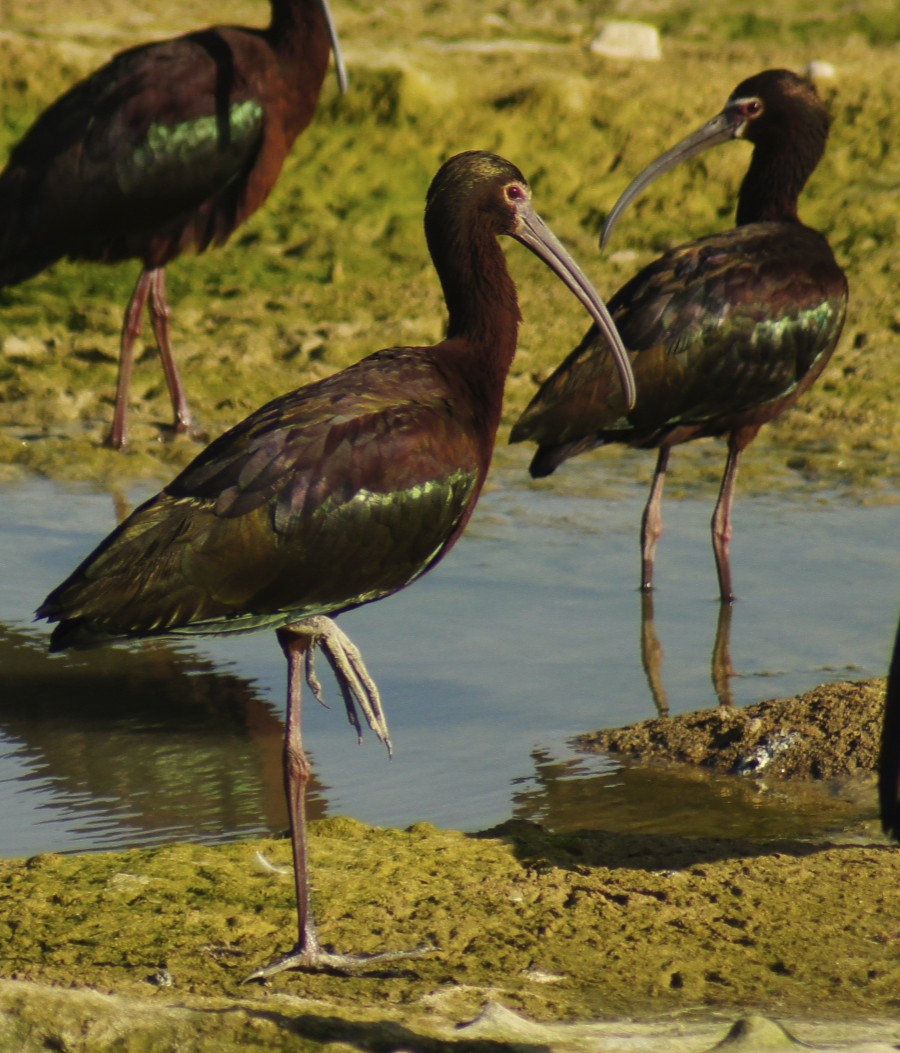
Until last week, the White-Faced Ibis were still shy, irregular birds in the Phoenix-area marshes. They stayed far away, were skittish, and their batteries ran out way too quickly, much like other Apple products.

Here's the older model: an amazing thing in itself, but not the finished product, not the final form.


With spring now getting off its fanny, Apple has introduced a new model. The iBis 2.0 seems to have replaced those timid, duller colored birds all around Phoenix now. Where there might have been two or three scrawny birds standing in the murk there are now dozens and dozens, with many more still flying overhead. They're shinier, they're hip, they combine the color and iridescence of songbirds with the ungainly and endearing frame of a wader. In short, these new iBis 2.0s are much more user friendly, and they've been great fun to observe.


It helps that there's been an algae bloom in lots of the recharge ponds around Phoenix too. These oft-desolate basins are now packed with color, even if it is an unearthly shade of green. Stare at this snapshot for too long and one might even feel like one's left earth altogether. If you do float off, not to worry, like other great Apple products, the iBis 2.0 has a nifty GPS.


The iBis are not the only birds sporting a new look and attitude. I was very lucky to see a Red-Necked Phalarope at the Glendale Recharge Ponds a few weeks ago, and now the same ponds are serving as a rendezvous point for little groups of Wilson's Phalarope.

Here's a pair of males enjoying some quality guy time as they chat about mustaches, engines, stock portfolios, etc.


Phalaropes are an interesting family of birds. They've taken the Sadie Hawkins Dance and turned it into a lifestyle with their typical gender roles reversed. The female Phalaropes are larger and more aggressive than the males. They also have much bolder plumage during the breeding season:


Just like at a Sadie Hawkins dance, the lady Phalaropes pursue and try to entice the males with their whimsical wicked wiles. Once they lay their clutch of eggs, the females depart and leave the males to incubate the eggs.

There were about two dozen Phalaropes at the Recharge Ponds on Sunday evening. This male arrived a little late to the mixer, perhaps due to his extensive application of rouge, but he soon integrated himself into the party.


It looked like they were having a charming little gala, but even Phalarope parties can get crashed, and in this case the crashers were some precocious Mallard chicks. It was kinda funny that the Mallard chicks were almost as big as the adult, breeding-plumage Phalaropes.