Showing posts with label Tres Rios Birding. Show all posts

Sunday, January 18, 2015

Duck! It's a New Year of Birding

Oh, hello there dear readers, critics, and lost orphans of the internet. It has been too long. I could list some excuses here, including blogger deleting some photos and a post at one point as well as the increasing pleasure I have been taking from birding exclusively with binoculars, the west Phoenix Fulvous Whistler continuing to elude me (and everyone else) over the past few weeks, and rainy weekends. Instead of elaborating and whining on those things though we'll try to get back on track here with BB's first post of 2015.

However, we're starting with a Song Sparrow that many would recognize as not being the "sandstone" subspecies of Song Sparrow we have in Arizona, but the buffier east-coast variety. This bird was one of several other county birds I picked up in Wayne, NC, at the end of December, 2014. I fell (6) short of claiming the All-Time eBird #1 spot in Wayne County before heading back to Phoenix (although being the only person to submit a list there in 2015, I'm sitting pretty right now), and am currently riding in 2nd with 90. Someday...  


In contrast, this weekend I made it back to west Phoenix to resume searching for the lifer Fulvous Whistling-Duck that disappeared from the radar a couple of weeks back. It may well be gone now, but searching around the Tres Rios riparian and agricultural areas where it was last seen was also a great way to kickstart the 2015 birding year, and I put up 95 species in about 4 and 1/2 hours. The diversity is pretty impressive, even if some birds prefer their solitude. It ain't easy being great.

"I am a rock. I am a island" --Paul 'Egret' Simon

The Tres Rios area mixes riparian with desert habitat beautifully, but a fair portion of the complex is permanently fenced off-limits. While leaning against the Bird-lin Wall at different points searching out the Fulvous Duck, I recorded such solid-for-Maricopa-birds as Wood Duck, Hooded Merganser, Brown Pelican and Storm Wigeon. A Western Screech Owl calling from within the pre-dawn hours rubbed salt in the wound. This is all to say, I really wish they'd open up that prime real estate. It's a friggin' treasure trove, and I bet if they let people in for a fee, they'd come out well ahead vs. the liability. Work what you got Maricopa Gov.!


Massive flocks of Ibis and Blackbirds also made the morning hours pretty eventful while scanning the small retaining ponds for Fulvous-type birds. It is a veritable Eden there, where lions lay down with lambs, eagles nest with pigeons, and Pelicans swim peacefully with Wigeon as Carp swim below and gobble up everybody's shit.


Even such blissful scenes as this were not without orneriness. Some White Pelicans were partaking in a game of "Wigeon-Dwarfing," wherein they'd swim up behind AMWIs and make them look very, very small. I have also seen Canada Geese participating in this sort of bullying throughout Phoenix golf courses. The natural world is a cruel mistress indeed.


But she's seductive though ain't she? Don't take my perverted word for it, ogle this Cinnamon Teal for a little while and then go apologize to your significant other.


Some birds are poorly named, and some birds are poorly colored. This is not one of those birds.


Party Don't Stop Jen has been doing some beastly good owling up in the Northwest of late. I can't hang with it, not even close, but this weekend did bring the small consolation of turning up another Burrowing Owl haunt. I don't mean to brag (actually I do a bit), but I've got quite the portfolio of very crushable BUOW spots in West Phoenix so...all you millionaire owl enthusiasts out there who are also lazy...hit me up. 


It's been over a month now, and I'm daring to admit that this Fulvous Whistling-Duck might well be gone. What is one to do when one has been stood up repeatedly by a rare duck? Psht, score another one on the rebound of course, one that's sexy and easy. 
Cue the a Eurasian Wigeon drake that's been at the Dos Lagos park in Phoenix for a couple of weeks now--wintering here--and like most ducks hanging out at small urban parks, this fellow is tame. He has learned well from his AMWI accomplices how to eat the fresh winter-lawn tips, and just as eagerly approach pedestrians in case they have hand-outs. 


Of course, this sort of plebeian behavior denotes that the EUWI has sold out a little bit. I know, and when left to his own recognizances he clearly feels a little bit guilty about it too.


One or two EUWIs seem to turn up in Maricopa every winter, but this one has by far been the most accommodating of the birds I've seen. Also of interest on this little pond was a lone Muscovy Duck, rocking 'the ugly' loud and proud. Now, I know what everyone is thinking, "THAT'S A DOMESTIC!!! THAT'S NOT COUNTABLE YOU GIANT BAKED PIE OF IGNORAMUS!!!"
Well, I cannot refute your accusation, but all I'm saying is this: as far as domestic Muscovy Ducks go, this fellow looks pretty good. The facial growths I've seen on pictures of wild birds show predominantly blackish, so obviously that's a giveaway here, but the otherwise dark body and iridescent wings are much cleaner than on other specimens I've seen.


It even had the white localized to its wing patches. So, don't worry, I'm not ticking it, but drop this duck off somewhere in the Rio Grande Valley or south Florida, and I bet it would be spurring a much larger discussion, and a few more people might be won over eh?


Anyhow, back to what we know. American Wigeon drakes fulfill a look that many 1970s shag carpets sought, but of which they often fell far short. I know AMWIs are a golf course duck, which puts them just about on the bottom of the pile in the winterfowl hierarchy, above only domestics, Mallards, and Coots, but they reproduce fructuously for a reason y'all.


Seagull Steve recently got very crushy with the EUWIs in California, and so once again aspects of this post seem mere after-shocks of the various quakes that left the bird blogosphere rocking, but why not indulge some more? Why not have seconds of that 3-layer carrot cake?


Aww yisss...flash that speculum baby.


I left the Wigeons all strutting their stuff, but the waterfowling was not to end. In fact, there was some fowl play going on right next to my car. Two Mallard drakes were fighting for the affection of a hen standing off to the side, apparently used to if not bemused, by this sort of occurrence. Notice how the drake on the right is more handsome than patch-eye on the left. Furthermore, he is much more photogenic; it's like the fight doesn't bother him at all and he wants to maintain eye contact with the camera--pretty studly. Naturally, we're all rooting for him.


The manky, domestic drake tore at his chest but the handsome drake simply flexed the ol' pectorals and advanced, without seeming to break much of a sweat.


With some conservative positioning, the handsome drake gained the better position and basically subdued the other drake without using much more than his chest. Name one other action hero character who's won duels in such a way. He squished the other male and then walked away with his lady, while I went to get lunch.
*It is also possible the handsome drake didn't want to fight at all, but was making advances on the the other male of a different sort.


The waterfowl are great right now, but it is also that dreaded time of year when I go in search of a Sprague's Pipit. If you don't hear from me in a while again, it's because I've thrown any and all gear into a ditch somewhere in frustration. 

Monday, December 29, 2014

Empty-Handed Chasing and Swarms of Things

Over the past couple weeks I have been very bad about posting, but this is not because I fear you or hate you, dear reader. Rather, it is because I had nothing much to post. Being unable to make longer trips throughout the AZ, and not desiring to seek out non-lifer scope-view Scoters at Lake Pleasant, my birding options and motivations took a hit this December. More recently, there has been a Fulvous Whistling-Duck reported in west Phoenix, first in the Arlington area and then around the Tres Rios Wetlands. Many people have chased after this wandering bird, among the many miles of agricultural fields, canals, and run off ponds. A few have been lucky enough to find it; while I am resolved to continue after the new year, I have not been one of them. On the up side, chasing after this phantom duck has at least given Butler's Birds some post-able material, so we're back in business!

Nothing announces a return to better days like a Kestrel on a telephone pole huh? This could be classified as a "vintage" or "classic" shot. It could also be classified as "crappy" and "mediocre."


Birding the agricultural fields is always fun. You can stay in the car for the most part, and the bird views are largely unobstructed. Of course, when the birds keep low to the ground, it presents its own problems. Bald Eagles still stick out like dislocated ogre thumbs. What is that duck nearby you ask? Is that a Fulvous??? No it is not. That would have been sweet.


Winter time and smelly farm country are a winning combination for non-Oriole Icterid watching in Maricopa County. Some people spend their entire careers and lives watching Icterids but not Orioles. True enough, not all Icterids are made equal. Look at the regal pose of this Yellow-headed Blackbird, compared to the sniveling, pusillanimous Cowbird nearby. But that would go for Orioles too right?


Well, when I ask non-Oriole Icteriders why they do what they do, the response is usually, "Up yours, kid." In their defense, Orioles don't congregate like this. 


...Or this


...Or this


Everybody likes swarms of things, except perhaps for ancient Egyptians (I don't mean swarms of Ancient Egyptians, although that does sound like bad news too) and people with a fear of bees. For those fearful of you out there, here's a nice, solitary and quiet Wilson's Snipe, one of the non-swarmiest birds there is. Theirs is an anxious existence, but damn they have nice mantles.


The trouble with the Fulvous Duck is that in its foraging it moves around a lot, and it has a lot of options. I went out to Arlington where it was first seen, thinking all the while that if I were that duck I'd head east towards Tres Rios, where there are larger, protected wetlands. Sure enough, I dipped on the duck and it turned up near Tres Rios. Since then it's been seen at different watering holes. Knowing the regular spots were being monitored without success, I decided to check a few from days of yore. This was also a mistake, because most of those retention ponds, where I birded a few years ago, now look like this. This is not very good Fulvous Whistling-Duck habitat.


Another upside to patrolling canals and retention ponds along agr. fields, of course, is the Burrowing Owls. I understand that Burrowing Owls are one of the only reasons people stop by Butler's Birds, and like any grimy politician, I give the people what they want. Different Owls, different times of day, same pose and cuteness factors.


The rarity chase has thus far been unsuccessful, but some neat stuff has turned up. Check out this dark morph raptor; Red-tail would be the first bet but the eyes and beak also are reminiscent of Ferruginous to me, and dark morph Ferruginous is pretty rare (10% of population, I have read). If this bird would have flown, that would've clinched it one way or another, but of course this is the one raptor that stayed still (and Buteo Regalis should be so brave...)


Butler's Birds has migrated over to North Carolina for its annual, weekly winter sojourn, so the Fulvous Duck must wait a little while (and maybe for a TX return, alas), but in the mean time we're going for the all time Wayne County, NC eBirding record. It's 97 species before Jan. 1st or bust, 21 to go!

Sunday, November 3, 2013

Ponds, Rivers, and Big ol' Puddles of Sh*t

Yes, yes, those water features provide some of the most variable and high quality birding in any state, even in states like Arizona that do not feature much water in the first place. I was originally planning on hitting up the Hassayampa Preserve today after hearing about Tommy D's great finds and seeing his great photos, but I got a later start in the morning and didn't have time for the drive. As such, it was back to the west side staples with trips to the Glendale Recharge Ponds and Tres Rios promising some reliable species and maybe a migrant or two.  


I ran into Muriel Neddermeyer on the east side of the ponds, and we decided to join forces for the morning. Suffice it to say, the west Phoenix birding world shook mightily at the news of this alliance, even if some nearby foragers didn't take much heed.


The southeastern basins had good water levels, a bit too deep for some waders but deep enough to hold the daily increasing waterfowl. We had all three species of Teal, Wigeons, and a few Pintails, in addition to hundreds of Black-necked Stilts, Dowitchers, Leasts, Coots, and some Avocets.


Since the water was too deep for most of the smaller shorebird migrants and I'd already picked up my Short-billed Dowitcher for the year, I wasn't overly scrupulous nor scope-u-lous in scanning the mixed flocks (this laziness is not something to publicly admit if one wants to improve on the GBRS, but some of us birders are not so ambitious, and prefer to keep our heads down). 


In the migrant department we did pick up a non-breeding Dunlin, which isn't the most excitingly colored bird to find but it's an uncommon one, one that makes the casual Phoenix (non-shore)birder scratch his or her head for a moment and think back to those pages in Sibley. Unfortunately the handsomer and rarer Black-bellied Plover was no longer present.


Raptor activity around the ponds was very solid, with Red-tailed Hawks, Peregrine Falcons, Kestrels, and Merlins all making an appearance. A Loggerhead Shrike on the way out rounded out the carnivorous category well, though few of these rapacious raptors stayed put for pictures. 


Of course, in a large drainage basin full of sunfish and carp, the Ospreys do quite well for themselves too, and we had several of these kleeping piscivores flying loops throughout the morning. 


That was it for the ponds, so next Muriel and I decided to try some west-side rivers. The Tres Rios concatenation can be dizzying to bird, with so much space and so many species all sounding off and darting around at once. That amounts to good birding though, and it's a guaranteed 50+ species spot, if you give it a good hour or two. With those sorts of numbers the statistical odds of getting some up close and personal sightings are ever in one's favor. 


There were White Pelicans flying overhead, which never cease to amaze me with their giant-ness, and Brown Pelicans floating down below. The Brown Pelicans are a much more recent, though now reliable, addition to the Tres Rios family. To my knowledge, this is the only site in Maricopa County, and perhaps any part of Arizona away from Lake Havasu or Yuma, where one can expect to see both North American pelicaniformes.


It is not the only place in Arizona to see Belted Kingfishers, nor is it even one of the better spots, but they are another staple of the site.


Muriel and I spent a fair portion of our Tres Rios time distracted by the brazen antics of this Rock n' Roll Wren. I was very glad to see this bird on a prominent boulder spillway dam, because this long wall of loose rocks has cried out for a Rock Wren inhabitant for so long and for so long had been lacking. 


Even among the relatively drably colored Wren family, Rock Wrens are still pretty bland, but they're also very hospitable, accommodating birds. I find them and Canyon Wrens to be, by far, the most delightful Wren species. They don't have the colors, but they do have the personality of a peacock.


They also really love rocks...a lot.


After some time at the Tres Rios rivers I was compelled to head back into Phoenix for a Sunday Thai buffet, but I still didn't feel quite satisfied with the day's sightings. As anyone who's driven south down 91st avenue can attest, there is a miasmic odor that permeates the air around the Broadway/91st avenue intersection. A series of cattle feed lots to the east are responsible, and I like to drive by some of the corrals from time to time in search of Yellow-headed Blackbirds or anything else that'll perch up on the rails for a photo. Adjacent to the feed lots is a large, throbbing, beating, growing pit full of raw sewage. Two drainage pipes maintain a continual flow from the cow pens into the pit, and this rank, festering stew holds a certain attraction for the birds, and thus birders as well.
Where do Black-bellied Whistling Ducks take their chicks for a Sunday funday? To the poo pool of course! C'mon kids, hop on in! The water is...fine.


This is the satisfied look of a fulfilled parent who knows it's been a job well done.


There were several dozen Black-necked Stilts around the the sewage ponds and three species of Blackbird too (Wallace Stevens would have been happy). Just look at that Stilt, daintily posed on its little floating island of excrement above the bubbly, frothy goodness that is the domain of Whistling Ducks.


I definitely kept the windows down for the whole ride back into town, but left the west side birding sites, as always, feeling satisfied with enough birding to make it to next weekend.

Sunday, October 13, 2013

A Tour of the Divers, Diners, and Drive-by Dwellers at Tres Rios

This Saturday was a busy one at Tres Rios, both with birds and with their birders. I arrived around 6:45am and was already late to the party, as nearly a dozen cars were already parked at this normally quite but increasingly appreciated spot. Excitement over the recently photographed Tres Rios Red-shouldered Hawk(s) drew a few birders that were otherwise new to the site, and I also ran into local birders and photographers Gordon Karre and Pam Barnhart, who were showing around some other members of the Arizona Southwest Birding group. The Tres Rios site features plenty of tall cottonwoods and desert scrub for raptors and Sonoran dweller alike, and it also hosts an impressive water feature with some of the fastest growing cattails ever. They're not even in the Guinness World Record Book, because every time it updates their record growth rate, it's already out of date.


It was an exceedingly comfortable 49°F when I started down the trail. I missed the pre-dawn Ibis flocks,  but there were still hundreds of Yellow-headed Blackbirds flitting along the spillway. Osprey were one of the most dominant birds of the day, something I did not anticipate initially but perhaps should have, with this sentinel being one of the first stationary birds I saw.  


An Osprey, or even several, is not an unexpected sight atop the Tres Rios treeline. Red-tails, Cooper's, Bald Eagles, and even the occasional Red-shouldered Hawk also dot the canopies, but perhaps the most common and conspicuous of these large perchers is the Great Blue Heron, a distant relative of the Great White Blue Shark. Great Blue Herons are finicky, insecure birds, despite their stature, and in an attempt to maintain their individuality, these three birds agreed to perch in separate trees. But clearly, given their identical elevations, they only have so much of a capacity for differentiating themselves. It's ok though. Coyotes, Eagles, and birders don't pick favorites either; we love them equally.


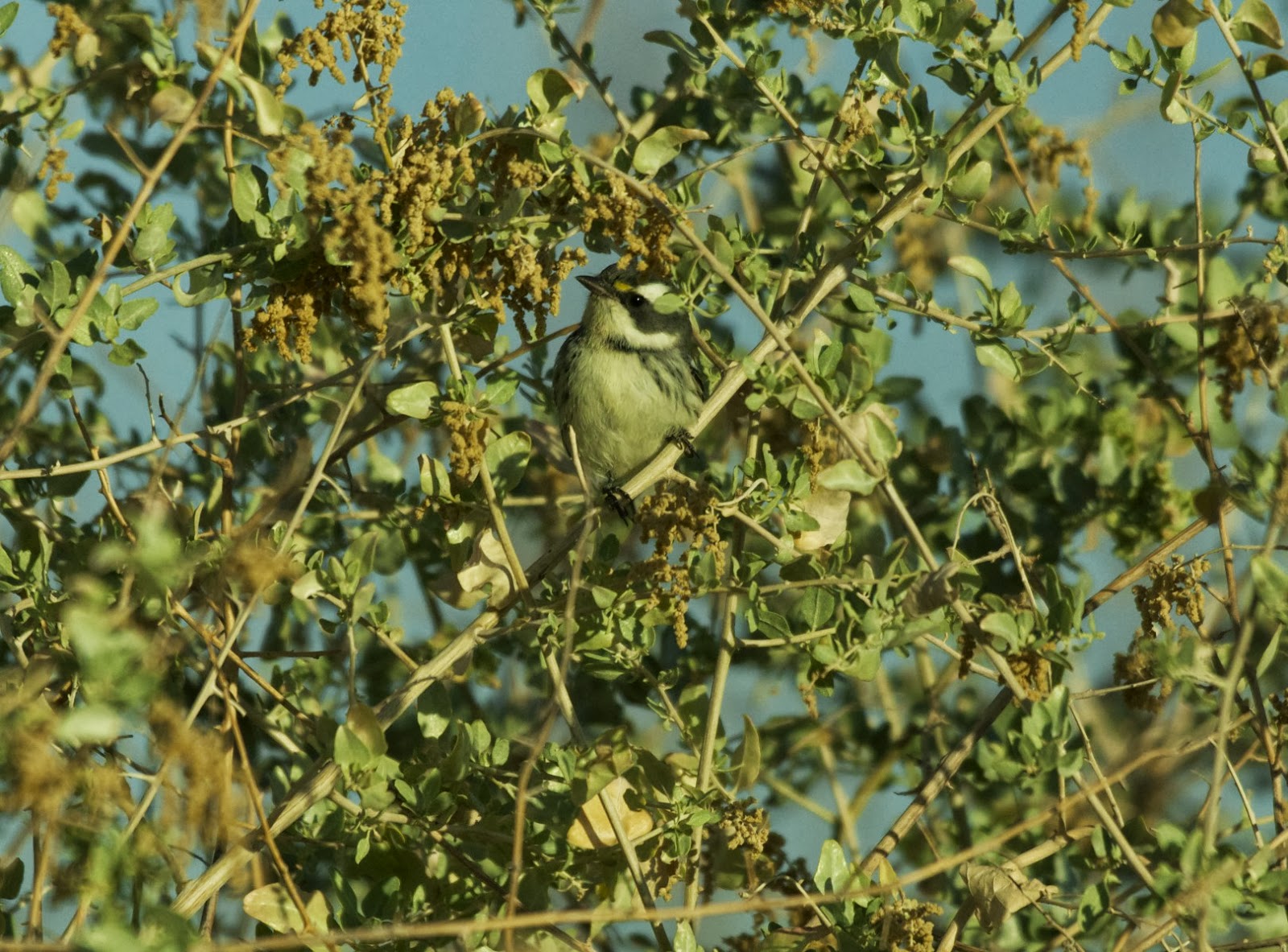
Quite opposite the Great Blue Heron is almost every way, this little Black-throated Gray Warbler was a delightful, up close sighting near the south-bound spillway. The BTGWs aren't uncommon birds during migration, but I see them far less often than Orange-crowned, Wilson's, or even Townsend's Warblers. Something about their very professional whites and grays, accentuated with just a dash of yellow on the lores, makes this a very appealing bird, even if it registers rather drably on the Warbler spectrum.


Of course, being Warblers, they're very fidgety and compulsive birds, but the Black-throated Grays, much like Orange-crowned Warblers, are more prone to foraging in scrub bushes and lower levels the canopies. This allows for better photo ops than many of their peers, even though the problem of interfering twigs is ever-present.


Now I'm not saying it's any Yellow-throated Warbler, but that beak would give em' a run for their money huh? Well done BTGW.


Most birds possess the power of flight. Black-throated Grays also possess the power of simple levitation, which is an even higher form of aeronautics.


Just about about every annual species of heron/egret/ibis is represented at Tres Rios, and the Black-crowned Night Herons can always be found in the larger tamarisk clumps near the south bound spillway, about 3/4 of a mile west of the parking lot. 


Why take nice, crisp focussed shots of these secretive birds, when their name and behavior begs them to be shown in grainy, film noir, Area 51 style photos?


A stinky pond, a mud hill, and dried sticks...the perfect perch for a southwestern sp. Song Sparrow.


Tres Rios is a prized site not only for its gluttony of birds, but also for its evolutionary biology case studies. See here what was almost a great moment in evolution. We do what we can; we feel driven by something deeper inside ourselves than we'll ever really uncover. Sometimes it drives us to glory. It can also drive us to our destruction. It's also possible this guy was just picked up by a Heron or something.


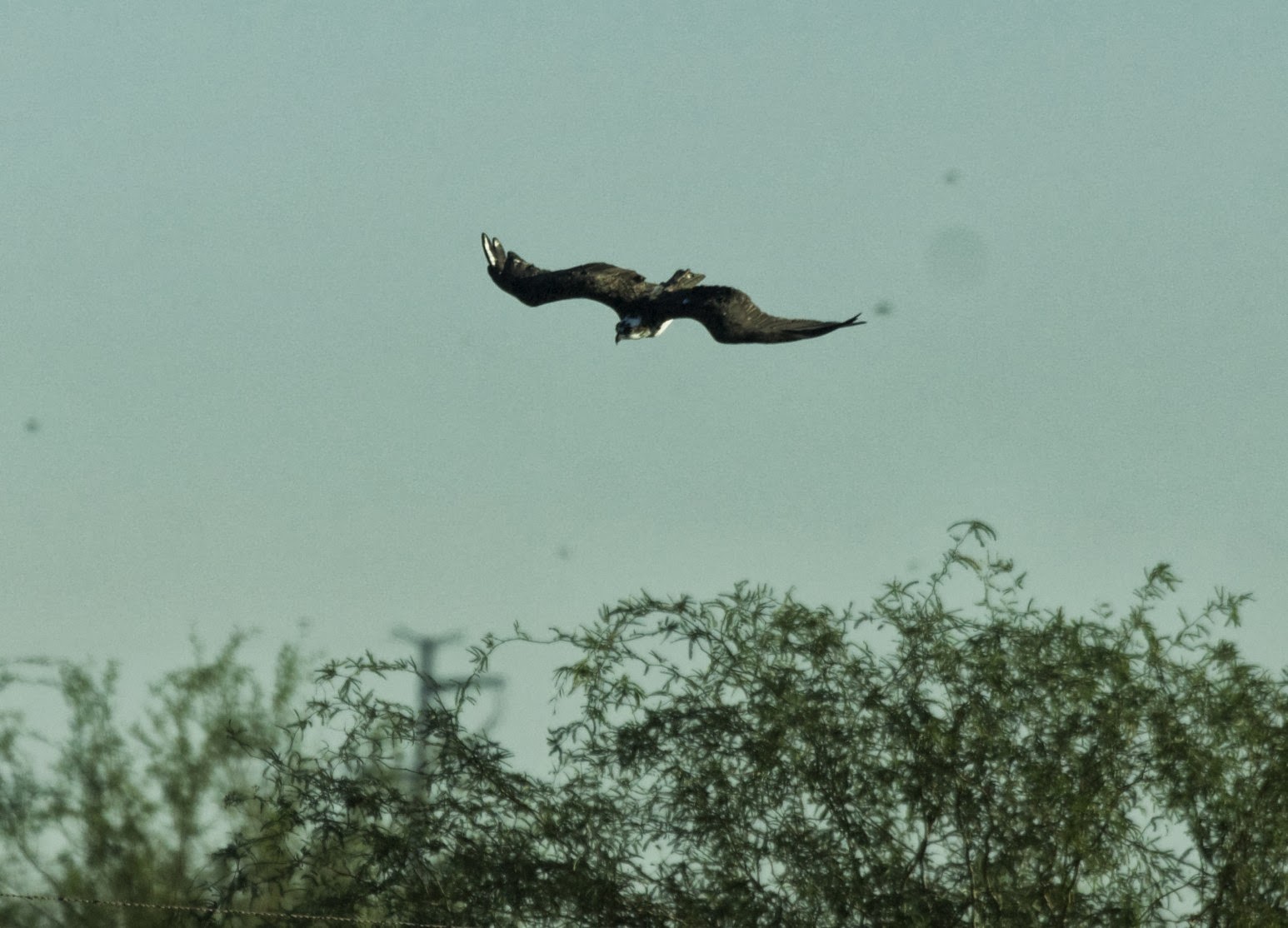
Osprey are a common sight in Arizona around any substantial or well-stocked water feature. These daring, diving piscivores are absurdly good at what they do, with a catch rate nearing 85% and a cool racing stripe on their face. It can be very difficult to capture the dive on camera, but watching the spectacle is all too easy.


Because of their excellent combination of coolness and commonality, Osprey seem to be a hook bird for lots of people, one of the first birds that really got them interested in bird watching. Osprey are one of the most conspicuous raptors, are easy to identify, and are also seen hunting/doing awesome stuff more often and consistently than just about any other raptor, or even any predatory animal in general.


The Osprey were the most dominant of the bigger birds, but in sheer mass, noise, and visual appeal, the Yellow-headed Blackbirds stole the show. They were constantly alighting, gliding, fighting, and squawking amidst the substantial cattaisl that line the Tres Rios spillway. In addition to the striking yellow head, they show Phainopepla-esque white patches in flight, though anticipating their erratic and quick flight routes, and then photographing them, is a pursuit in which I have had no success. They're fairly shy at Tres Rios, but every once in a while the reeds part just right and allow for some peeking.


Before heading back into Phoenix, it's always a good idea to do a quick drive by of the agricultural fields just north of the Tres Rios site. There's good sparrowing to be done in the scrub piles along the drive, and various avian predators, both raptors above and Roadrunners below, stalk the flat landscape.


But the most important reason of all is that no trip to Tres Rios is complete without a quick visit to Burrower's Row and its perennially grumpy, cute inhabitants.


Even in the ebb between migration times, Tres Rios still provides some of the best birding in central Arizona. Use care in visiting it though, for now that the weather is also nice, it can be difficult to find a reason to leave. The listless, binocular-holding zombie of many a once-eager birder now wanders the Tres Rios trails. You may end up joining them, but it's worth the risk.