Showing posts with label west phoenix birding. Show all posts

Monday, April 6, 2015

Crappy Birding is Good Birding

Dumps and landfills, reclamation sites and sewage ponds, treatment facilities and New Jersey...yes indeed putrescence and productivity seem to go hand-in-hand when it comes to birding. While some of my fondest birding memories come from the beautiful mountains in Arizona and Carolina, or from the Rio Grande Valley of Texas and the coasts, I have picked up just as many lifers and birds-of-interest around otherwise unsavory sludge basins, and it's safe to say that many other birders have too. 

The latest such expedition was for an immature American Golden-Plover discovered in west Phoenix--very near the Tres Rios hotspot--in a run-off basin for a nearby cattle farm. It didn't exactly smell like coffee in the morning (although there were trace elements...) but it was equally enlivening, a much more multi-sensory experience! After scouting along the pond for a few minutes I quickly picked out the plump Plover with a few vociferous Stilts.
The AGPL was somewhat wary and flew farther down the slough, which left me taking nearby inventory before continuing the pursuit.


Burrowing Owls, much wiser and unimpressed by all that, looked on with typical blasé dispositions. Some birds are tough to see but really attractive, and others are easy to see but unattractive. BUOWs are easy to see and super attractive, and we should thank them for this.


I don't know how they compare to all other Owls, but BUOWs seem to be very fecund. Everyone has seen those adorable images of 3-10 BUOW chicks all gregarious and bug-eyed around their burrow. How many other birds are there that lay (much less hatch and raise) that many eggs in a clutch? Outside of waterfowl, I struggle to think of any.


The AGPL has been around for a few days now and given pretty clear, accessible looks to most everyone who has chased it, though the bird seems to disappear later in the day. This immature bird was more brown overall than BBPL, with a longer primary extension and browner cap contrasting with the broad white supercilium.


Another telltale identification sign, which you may have noticed from the photos, is that American Golden-Plovers always face to their left. ALWAYS. If you see a similar plover that is facing to its right, it's either an immature Black-bellied or an adult European Golden (in which case, congratulations).


The marshy theme continued at the nearby B & M WMA, where I was hoping to hear Ridgeway's Rails (to no avail). Vocalizing Sora are always a treat, though they continued to deny me that perfect bird blogger moment when they step totally into the open and in good light. 


Likewise Common Yellowthroats continue to be a species I have not properly crushed, which is additionally embarrassing considering their numerical presence.  When I get the camera on these birds I just...lose...focus. They've been singing on territory for a couple weeks now.  


So the chasing was productive, not to mention easy, and the rest of the birding was nicely complementary. Saturday night I returned to the Salt River mesquite bosques in search of a Western Screech Owl photo, since I had failed there where everyone else succeeded earlier in the week, and brought some reinforcements, plus a tripod and junk.  

Saturday, September 27, 2014

Spurred On in a Slow Day's Birding

There has been a lot of talk in the news about California's on going drought and water-related problems. Perhaps surprisingly, we're having the opposite experience in Arizona, where this summer's monsoons have brought record rainfall to the valley (including the most in a single day and also overall). There have been flooding problems in many of the lower areas around town and even on the interstate. There was a heavy microburst Friday night and another this evening on Saturday. Even though the timing for birds (late September) isn't great, and Pops and I tried for some west Phoenix birding just in case something of particular interest had been grounded during the storms. 
Water levels were predictably high in all but Basin 1 at the Glendale Recharge Ponds, and we did not have any surprising Peeps or Gulls/Terns except for the lone, immature, and annual Short-billed Dowitcher (It seems we get one at this location every year in almost identical circumstances). 

The best birding highlight of the day was a single Greater White-fronted Goose in Basin 6 and some distant but nonchalant Rails.


In addition to the Goose, all three Teal species were represented as well as Shovelers, which seems pretty early for all involved. The anticipated waders were in good numbers as well. Somewhere in this picture is an American Avocet, adopted and raised by the Stilts with their milk and culture, truly believing it is a BNST. Can you spot it?


Even though Stilts can be kind of a gossipy, snooty bunch, the Avocet would insist it is one of them. It's a touching thing in this cruel cruel world, but biology can only be denied so much, and Avocets can't bank as well as Stilts...revealed!


Oddly enough, the day's highlight came away from the water, in one of the run-off canals that was littered with masses of vegetation and silt from recent flooding.


The tortoise was making a break away for the shaded, muddy mouth of the wash, moving with incredible speed and a battle-hardened determination that comes with carrying one's own house on one's back everywhere (Snails know what I'm talking about). He was mobile-homing like a beast; we caught up to him in about 10 seconds.


Pretty impressive forearms. This tortoise was a large tortoise, probably close to 40 pounds and bristling with spurs. He had a bit of camouflage on his face, though it did not leave much to the imagination.


Obviously, one doesn't get the opportunity to consort with such ancient and slowly-metabolizing creatures every day, and I had many pressing questions, the foremost being, of course, what to do to stop The Nothing from destroying everything. As one might expect, I was sneezed on several times. What I did not expect was how super creepy tortoises look when they blink.


Pops brought some fruit down from the car to see if we could entice the ol' terrapin. It responded immediately, as if it had interactions with people before...

This is not a species of Arizona Desert Tortoise, but I believe an African Spurred Tortoise. This species grows to be the third largest tortoise in the world and the largest that is not island-bound. African Spurred Tortoise, and you have guessed, are not native to North America. I didn't know the species until doing some research at home later, but this animal's ready response to our offerings already had us believing it to be a release or escapee.


We were musing as to how this fellow could have survived the heavy flooding that the area experienced, an indeed its possible he was only recently abandoned. I'm tempted to swing by again tomorrow, both to quickly scan the basins and reclaim Brandon Marla, as I now name it, for a rescue shelter. 
It's introduced, and while I have no doubt it could find subsistence and is probably too big to worry about predation, flood waters are something it might be unprepared to deal with. On the other hand, post-monsoon and early spring are the only two times in the year when tortoises are active, apart from that they mostly hang out in semi-subterranean haunts.
About an hour after first finding Brandon Marla, we followed its tracks just for funsies and found it had moved all of 10 feet, some prospects for relocating are good, will update.

Saturday, July 26, 2014

Take it to the Barnyard

This summer's great birding adventures have drawn to a close and work--preparing for the next school year with a panoply of meetings and seminars and meminars and seemittings--is now underway. Of course, the next thing one has to do when the great birding trips are over is start planning new ones, but even that cannot fully dull the pain of late summer birding doldrums in central Arizona. So at a time like this, when there's not a great opportunity for even in-state birding, it back to the birding chores, tying up loose ends closer to home.

One such loose end was the Barn Owl out at Base Meridian WMA. Just west of the superlatively birdy Tres Rios Wetlands, B&M WMA is a pretty reliable spot for Barn Owls each year, in fact that's how I've ticked my BAOW year bird for the last 3 years or so. In fact, this is the only place I'm actually, clearly seen living Barn Owls (I have a knack for finding dead ones). In fact, this bird has always been kind of a pain because I've never gotten photos. In fact, even if they were crappy, that eluding needed to end.
So this late July birding chore was to finally photograph the skittish Barn Owl at B&M WMA. I'll be straight up though, I got there later in the morning, around 10am. The birds were no longer roosting, and the photos are very poor. This is entirely for posterity.


Although I only had one bird, a pair of BAOWs successfully raised at least one chick here this year, and others have had great looks at these reclusive birds. I didn't get great looks; I got blurry flying-away shots, but it had to be done.


B&M is also a great spot for Clapper Rail (a very tough bird in central AZ), Least Bittern, and Yellow-billed Cuckoo. I arrived too late in the day to have much of a shot at the skulking riparian birds, but a couple of Cuckoos were still braving the heat. Well, not exactly braving it.


Not that I can blame them. It was around 110°F and I could feel my overly Irish mantel burning even through my shirt, so I didn't stay out very long either. The birds were more active near the B&M run off, where the scant remains/returning run-off of the Salt River are finally allowed to flow al naturale.


Some of Arizona's best birders and bird bloggers are rocking it up in the White Mountains right now, notching sweet state birds like Pine Grosbeak, American Dipper, and Gray Jay. Alas that I could not join, but in my limited time available here there's perhaps one trip left in the tank, one trip to the southeastern corner of the state, one trip to find some Mexican Chiquitas and a blunted Hawk. Hopefully the Chiricahuas produce, more on that soon.

Wednesday, March 12, 2014

Twilight Gatherings in the face of Desolation

The sun-scorched earth...nothing can grow, nothing can live...much less survive. The stoic Ibis stretches from one forsaken spot to another, the only shade being provided by rocks even more lifeless than the desiccated soil itself. Truly, this may be the spitting image of the last bit of life on earth, when that day comes...until that fragile little flame dies out amidst the all encompassing black of the universe.


Or it's just suggestive cropping in a particularly poor-looking area. On the other side of this little dirt road there was much more going on, and there always is, if one swings by in the last hour of daylight. These photos were all taken around the Broadway dairy farms, which are, quite in contrast to atmosphere of the beginning photo, teeming with activity.


Cattle Egrets have the namesake and reputation for bovine association, but out in west Phoenix where Cattle Egrets are few and far between anyway, the Yellow-headed Blackbird is, by far, the species seen most closely socializing and living with the cows.


They roost in the thousands at the protected Tres Rios wetlands just a mile south, and spend their days and evenings chittering, chattering, and making bizarre metallic sounds with their cow buddies.
It's a rip-snorting good time. Everyone gets plenty to eat, has plenty of gossip, and wallows in their own feces. When everyone's a party pooper, the party don't stop!


The Yellow-heads aren't the only birds to come out in large numbers in the evening light. Bulkier, quieter Eurasian Collared-Doves, the awkward wallflower or any semi-urban get-together, line the corrals. They know they're a good looking dove, but also that no one really likes them very much or wants them to be there.


Adjacent to the masses of unscrupulous farmyard birds, Burrowing Owls also become readily conspicuous as the evening wears on. They must remain diligent in looking out for Red-tails and Cooper's Hawks, but that won't stop them from imitating those wire-perching birds either.


Two look-outs are better than one; these fellows had the panorama covered well. They didn't mind my presence either, perhaps thinking that the large gangly creature would further deter any raptors from swooping in and ruining their evening porch time.


I'm hoping to try for a Maricopa rarity Harris's Sparrow this weekend and get some good photo ops at the Oak Flats campground in Superior, AZ. It's nice to have some direction and plans going into the weekend. It's also very nice to have some reliable spots, like those shown here, where fun and fine-looking birds can always be found. They sometimes have a gruff (or in the case of yellow-heads, cacophonous) demeanor, but they don't mind visitors in the evening, just don't stay too late. 

Tuesday, January 14, 2014

Returning to the "Field"

2013 snuck away quietly into that goodnight, and for the first week of 2014 I was similarly unable to do much birding. Now, two weeks into the new year, I am still not satisfied with my time out in the field, but life is busy and it tends to sweep one along in its current unless you grab onto something and buy yourself some time. This past weekend I was finally able to get back out after the birdies, accompanied by a British birdingpal named Christopher, who was in town for a conference on Renewable Phosphorous, but really just for the Sonoran specialties.


Our first stop, a long-time favorite of mine, was the thrasher spot out in west Phoenix. Our time there was not overly productive though we did hit some targets. For the first hour or two after sunrise there was a lot of vain searching, and semi-vain listening. Wafting out among the creosote bushes and sage, the stuttering song of a Le Conte's Thrasher called to us. 


Say's Phoebes, Sage Sparrows, White-crowns, Verdins and Gnatcatchers all went about their daily business, but the birding was pretty slow at the Thrasher Spot. Admittedly and expectedly, I'm also terribly out of practice by now. The birds could tell too that I hadn't been putting in the requisite hours. They fled in disgust, even those that usually sit still.


Eventually we got a bead on a singing Le Conte's Thrasher and enjoyed some really nice scope views, courtesy of Christopher. The Thrasher seemed to be singing out its territorial claims, and no others dared sing a response, but an Anna's Hummingbird got involved at one point to insist on its own suzerainty.
As my British associate pointed out, it was one of very few birds in Arizona to actually boast a pretty, involved song, even if they're not exactly eye candy. Thrasher have many appeals for me, and their vocalizations certainly are a strong one.


Although Le Conte's is a rarer/more specialized/generally more desired bird, the best sighting at the Thrasher Spot was a Great Horned Owl conspicuously perched in a mesquite tree. I've never seen these large predators out here before, figuring they fancied higher concentrations of larger trees, the large population of meek cottontails not withstanding.


From the Thrasher spot we drove west through Arlington, picking up Ferrugionuous and Red-tailed Hawks, a dozen Kestrels, Meadowlarks, and other expected species of the agricultural land.


A quick stop at Tres Rios, cut short by my obligations elsewhere, helped bolster our species list for the day, adding many riparian and aquatic birds to our raptor and desert-heavy list of species.


It was a little weird to see this bird in January, but not because of its species. Any guesses?


The cattle pens a mile northeast of Tres Rios were also a nice attraction. It's such a large, expensive operation to feed so many birds...and the cows occasionally get food too.


Next weekend I hope to hit up the Seven Springs recreation area and Rackensack Creek for Fox Sparrows, Waxwings, and Solitaires. It's time to get this birding year back on track!

Monday, December 16, 2013

Smartbush Sparrows and Rusty Hawks in West Maricopa.

For whom did the Bell's toll? Not too long ago, it tolled for the Sage Sparrow. That once noble and singular species was callously and scientifically split into two equally noble species with slight differentiation and range overlaps. Such splits are usually welcomed by birders, as it means another potential tick for the ol' Life List, and maybe even a 'buy one, get one free' if both species were seen before being divided. Arizonans came off particularly well with the split too, because both species can be found co-habitating in the central area of the state (and elsewhere), though it takes some serious scrutiny to tell them apart.  


The Thrasher spot in Buckeye, some thirty miles west of Phoenix, is already a famous and well-visited site. It's perhaps the best site in Arizona to turn up Le Conte's Thrashers, and often provides Crissal as well as Bendire's and Sage in the right months. Since it also plays host to both species of the former conglomerate Sage Sparrow, it's equity has only increased with recent appraisals. Never mind that it's next to a nuclear plant!!!


Last week I undertook a mission to find and photograph both of the new species, plus anything else that was up and about in the cold scrub. I succeeded in half of the endeavor--finding both species--but failed in photographing the Bell's Sparrow, which is also the less common of the two in central AZ. With this spot already being so high on many birdingpal's lists, I'm sure I'll get another chance.


The Sagebrush Sparrow tends to have a more distinctly gray head and heavier streaking on the back and mantle. The particular specimen shown both above and below had darker streaking, though it stopped a little shorter than expected, but the gray of the head shown pretty distinctly against the browner back, and as such I'll call this a Sagebrush.


The malar stripe is one of the better distinguishing features. Sagebrush Sparrows feature a malar stripe that is the same color as (thus, not in contrast with) the head and it tends to be of a thinner width. Honestly, this particular specimen troubled me a bit because the malar strip seemed thicker than I expected, having looked and many pictures of Sagebrush vs. Bell's comparisons on the interwebs. The lack of contrast still points to Sagebrush for me. That being said, it's maybe a tiny bit darker, and could this even be a younger, less apparent bird??? I dunno, I hate this hobby...


Before heading out west I met up with New Mexico birdingpal Mark, who was in town for several days and wanted to have some photo opportunities with the Arizona annuals. After we scoured the scrub for a bit, also getting quick looks and Bendire's and Crissal Thrasher, we took the scenic drive down Salome Hwy to Arlington, stopping for many the raptor along the way, including a handsome Ferruginous Hawk named Rusty Venture.


In the (sadly) few photo-ops I've had with this species, both of mature adults and immature birds (which can be told apart by their juvenile sense of humor and pimply faces), I have noticed a consistent, serial-killer stare when in direct eye-contact. Look at that gleam...he's got murder on the mind.


The Thrasher Spot and Arlington drive offers some great looks at some particular, esoteric species, but doesn't offer a surfeit of species overall. Thus, any trip to the west side of Maricopa is best capped off with an hour at Tres Rios to bump the day list into the seventy or eighty species tally where it belongs. I don't exactly hang my head in shame when I say this is perhaps the best photo of a Belted Kingfisher that I've managed--they're a skittish bird--but I kinda do.


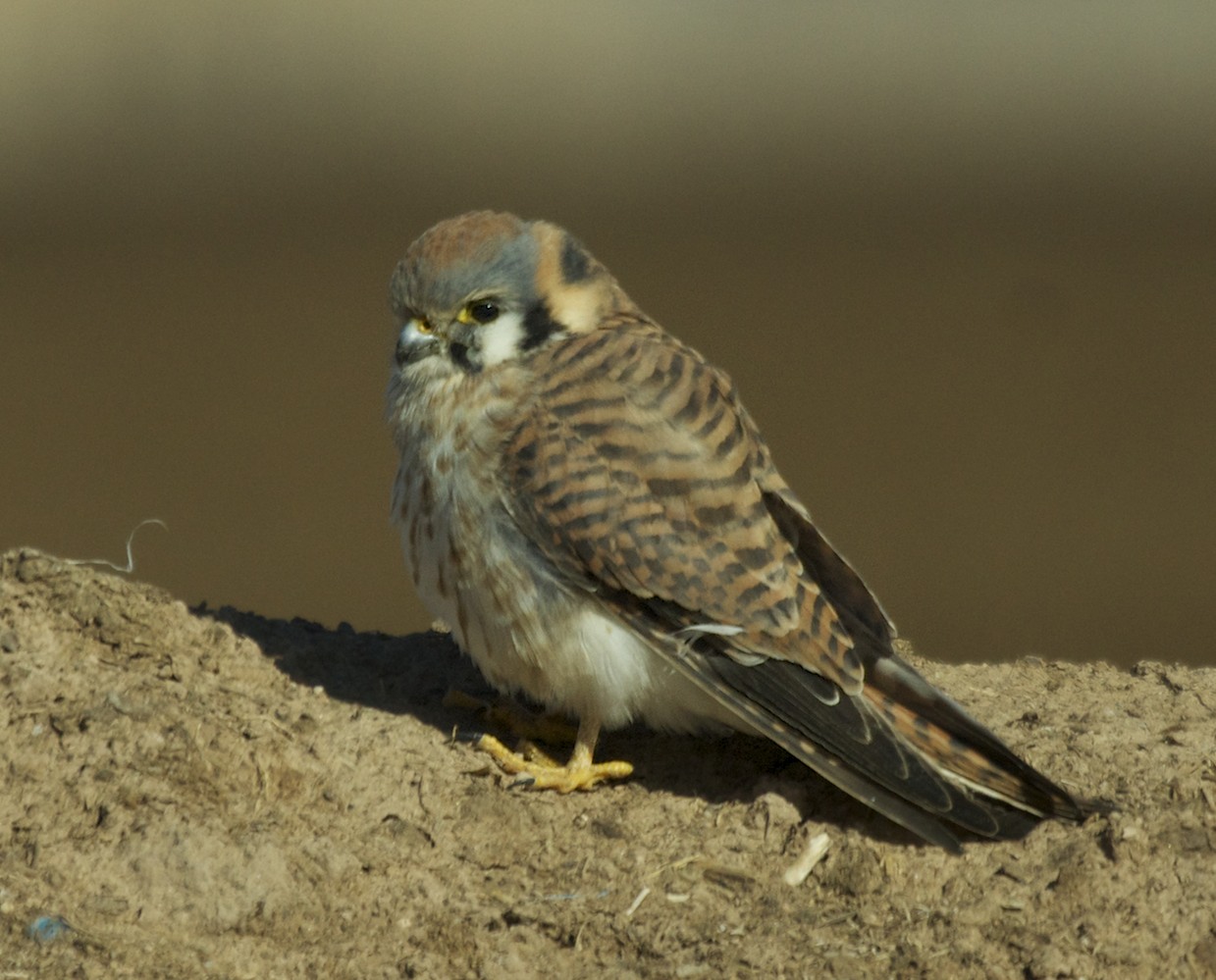
For the first time ever, Burrower's Row just north of Tres Rios was deserted. We did drive by a fellow who was rather brazenly discharging his shotgun at blackbirds on the telephone wires nearby, so this was perhaps keeping the wise Owls underground. The detour wasn't entirely for naught though, as this American Kestrel stayed perched alongside the road long enough for some nice shots. Apart from Red-tailed Hawks, this is the most common raptor in Arizona, but it's pretty rare for me to see them at eye level--a nicer sighting, in fact, than the Burrowing Owls on which I am already spoiled.


An American Pipit was also pipiting along the berm. They're kinda dull birds but they make me happy.


The cattle farm on Broadway was not quite as productive as on my last visit, when I delightedly watched a family of Black-bellied Whistling Ducks frolic in the bovine excrement ponds, but any beer enthusiast appreciates this blackbird.


And Yellow-headed Blackbirds are just objectively pretty no matter what sort of enthusiast you are.


I'll try again for the Bell's Sparrow in a few weeks. On a related note...if you have any thoughts on the above Sparrow contrary to it being Sagebrush, let me know. Hope to see y'all in the field some time.