Showing posts with label Desert Birds. Show all posts

Tuesday, April 30, 2013

Sonoran Saints Preserve Us!

One of Phoenix's main attractions, in addition to the excellent dining scene and cheap, plentiful alcohol, is that there are mountains right in the middle of the city. Sandwiched in between the SR 51 highway and Tatum Boulevard, the Phoenix Mountain Preserve showcases the marvelous combination of urban life and nature-scapes that Phoenix brings together so well. Just a few miles to the east, Camelback Mountain just east is one of the most hiked peaks in America. True enough, it's harder to enjoy these scenes when it's 104 °F in late April (come on!), but when I swung by the Phoenix Mountain Preserve in early April, it was an all round' gorgeous scene. 


This is a nice place for hiking and mountain biking, but it's not normally on my rotation of local birding hotspots. It features great scenery and good birding, but an average day at Papago or the Desert Botanical Gardens will yield more species of the same genre. 
However, in late March and early April, just for a few weeks, the washes in the Phoenix mountains provide temporary housing for migrating Long-eared Owls, a coveted bird anywhere in the U.S., and all the more so in the Sonoran desert. With these Owls in mind, I made several trips into the Preserve, one with fellow birders Tommy D. (who had more success than I) and Dominic Sherony, and another with  a great birder, naturalist, and field guide author Duncan Butchart, from South Africa. 

As far as the secretive Long-eared Owls go, below is my only sighting and only shot of the beasts. Yes, it's the dark, hazy shape in the lower center of the photo, ruining an otherwise lovely shot of some mesquite trees. If you came here for sweet Owl shots, you're in the wrong neighborhood!


The visuals I had on the Owl were better than the photo, enough to ID the bird by its size and flight, but it wasn't the most satisfying of sightings. The treks through the Phoenix Mountain Preserve, on the other hand, were absolutely beautiful, both for the birds and the general desert wildlife.
The Long-eared Owls prefer the dense mesquite and palo verde trees in the many jutting washes of the Phoenix Mountains, and so into these shady, rattlesnake-infested gullies the daring birder must go. The explorer must have a nerve, and socks, of steel, for the cactus spines and dry grass prickers, along with non-stop flash mob rattlesnake attacks, can leave one worse for the wear.

Luckily there are enough feathery gems, like this shady Anna's Hummingbird, to make the misses very, very palatable. I bet if I'd gone searching deliberately for Anna's, I would've found Owls instead.


In between the sandy, brushy declivities preferred by the Owls, flat expanses of scrub grass, cholla cactus, and creosote span all through the mountain range. These desert-specialist plants serve as nifty perches for late migrant Sage Thrashers, as well as Black-throated Sparrows just starting to settle in.


The very thick tangles of brush form impenetrable webs of stickers and misery for any creature that comes to close. Any creature, that is, that's not tiny. Roving clans of Brewer's Sparrows find these bristling brush piles to be irresistible, and in fact they even seem to inspire song.


In the dull color vs. great vocalization ratio, Brewer's Sparrows are tops. Their lengthy song, a combination of chips, whistles, and buzzing vibratos is both recognizable and delightful, even if their preferred habitat must be enjoyed from a distance. 


Ash-throated Flycatchers don't care for the prickly stuff so much, and they, like the numerous Say's Phoebes in the area, will take a clear perch atop a mesquite any day. This, below, may have been the exact view first enjoyed by the ornithologist who named the bird.


With their prickly perches, the Brewer's Sparrows bring some sting to the Sonoran birding flavor. Ash-throated Flycatchers, needless to say, bring some smoke, and the Say's Phoebe's, with their beautiful cinnamon wash and acrobatic, unabashed fly-catching, bring some spicy flavor. Like a nice pork chili verde, these desert birds, seen in their respective microhabitats, produce a dish that's not particularly rare or difficult, but one that is nonetheless a salivating feast, especially when one is starved of Owls!


Speaking of feasts, the Phoenix Mountain Washes did produce some interesting signs of Long-eared interest.  This Western Fence Lizard (correct me if I'm wrong) would make a nice little snack in the twilight hour, and for the main course...


How about a nice, plump ground squirrel? This was left in the middle of one of the washes, no doubt as an intentional warning, from the Owls, against any paparazzi intruders.


Though they tended to dominate the Sonoran soundtrack, the Brewer's Sparrows didn't have a total lockdown on the little brown bird symphony. Rock Wrens and Curve-billed Thrashers chimed their pretty notes too, sometimes even from the same rocky perches, though in this case the Trasher was busy with nesting material. Two's company, but I made it three and that's a crowd.


The birds will always be of primary interest, but there are many other aspects of the Mountain Preserve to enjoy. Especially with the evening lighting, the blooming cactus are absolutely stunning. After more than twenty years of desert romping and roaming, I can (un)safely say that I've been pricked by every possible Arizona cactus in every possible place. Despite them making many tracts of landscape somewhat hostile, and making some yards totally inhospitable to soccer balls for unlucky boys, I wouldn't trade them for the world. 


They can grow for months without water and even, apparently, grow out of solid rocks walls (or out of the tiny dirt margins in between the rocks. Like a fine zinfandel or malbec, the hardship that these plants endure does nothing to vitiate their color (or flavor), and actually seems to maximize their aesthetic.


The cactus also provide homes to legions of desert fauna, and not just the Brewer's Sparrows. Curve-billed Thrashers and Cactus Wrens make their massive, messy nests in the bosom of cholla bunches, while the massive Saguaro cacti house Gila Woodpeckers and Western Screech Owls in their cavities. The hinges of saguaro arms provide solid domestic foundations as well, not only for Mourning Doves but also, as I discovered, for Roadrunners, keeping the young safe and high off the ground, until they are grown and ready to terrorize everything that's smaller than they are. 


As April has worn on, the sun set of my Long-eared Owl opportunities. They will be back again, and so will I. It is comforting that, while it will dry out and brown in the next several months, the rugged beauty of the Phoenix Mountain Preserve will stay a constant. 
 

P.S. I was exaggerating about the rattlesnakes, but look out for nocturnal Sonoran Ground Snakes, which may in fact be the most poisonous animal known to science. They're too polite to ever bite anybody, so that's not the worry. It's their biting sarcasm that hurts the most.

Monday, August 27, 2012

Mon-late Monsoons

We've had some fun weather these past couple of weeks in Phoenix, with the August heat punctuated by intermittent monsoon aftershocks. It's like living in Dallas again-- 100°F at 7 am and then thunderclouds by noon. Silly troposphere just can't make up it's mind. Funky weather makes for funky birding as the daylight alternates by the hour and throws off feeding times.

Whatever mayhem the funky weathers visits on the birds is magnified for reptiles like this Twin-spotted Spiny Lizard, perhaps the only critters in Phoenix this time of year who really appreciate full sunlight.


The European Starlings at the DBG like to tune their voices in the overcast evening light. Their beautiful plumage almost makes up for everything that these birds have going against their popularity. Without any larger context, this bird is an emerald and ebony gem. The luster starts to fade when one considers how common they are, that they're introduced, and that they displace other species. Oddly enough, European Starling populations are actually decreasing in Europe--isn't that a weird thought.


The funky weather really got to this Inca Dove. It just kinda froze in the middle of a gravel path and stood perfectly still, perhaps waiting for the sun to reemerge. From its gaunt physique, I'd say this is likely a first year bird, and one who does not yet have the necessary life experience to know what to do when the sun is gone by 4pm.


Other birds at the DBG have problem adjusting at all. This Great Horned Owl was plunked on up in a mesquite tree. From his concealed position, he kept tabs on all the little bunnies hopping around below him and contemplated violent things.


Just to make sure this was, in fact, a Great Horned Owl, and not some other bird in disguise, I checked off some tell-tale characteristics.

Large Eyes and ability to turn head 180°-- check 


Large, intimidating, zygodactyl talons -- check


Gruff personality and sense that this awkward biped is an affront to an owl's regal existence? -- check


While the tiger owl waited up high, this debonair Cactus Wren, strutted around down low. The largest and loudest of the North American Wrens, these towering troglodytes act like they own the place. Seeing as they are the state bird, they may have a case. I like the pose here, and feel like this Wren should have a flag waving behind him in the background.


I'm sure that by the time this post is up, the clouds will be gone. As we're still in monsoon season, they'll probably be back this evening. Here's hoping.

Sunday, February 26, 2012

Borrow Your Burrow?

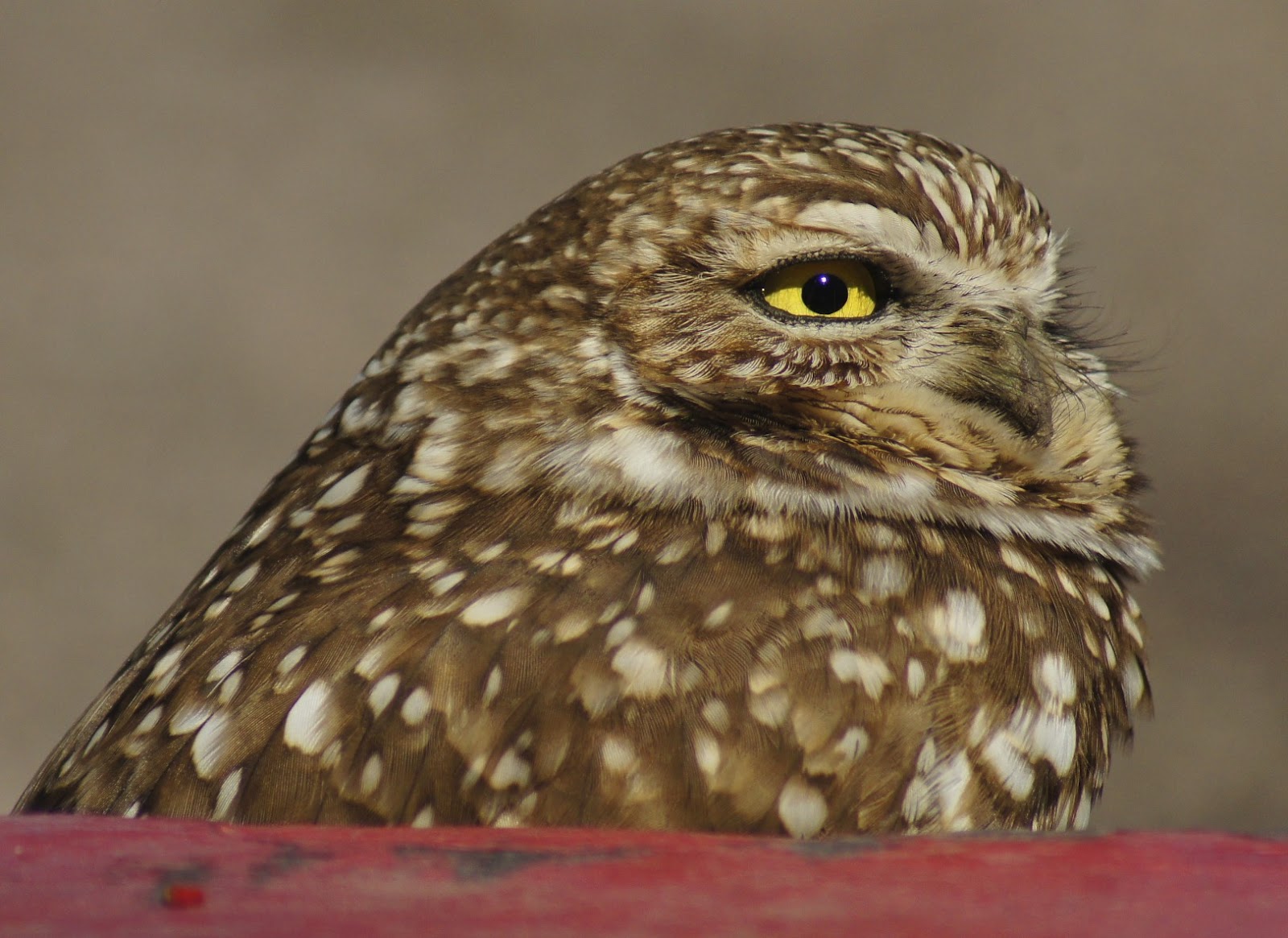
Burrowing Owls are probably one the top five cutest birds of all time. They're small, they live in prairie dogs burrows (and other excavations), they've got owl proportions, and they've got attitude. Somehow I managed to live in Arizona for 18 years without seeing them in the wild, though to be fair I've only been seriously birding for the last couple. I finally got proactive and went out to the Rio Salado preserve in south central Phoenix. There were reported owl sites near an old gravel pit, and the rumors did not disappoint.


A couple of these bold sentinels stood guard above their burrows and watched the setting sun. There is a railed walkway that guides the spectator parallel with the dirt ridge where the owls make their homes, keeping about thirty feet distance between the owl ridge and any onlookers. It was too bad that the evening sun was somewhat behind the birds. But on the other hand, I like this negative lighting. Maybe this is stretching it a bit to say, but there seems to be something very western about that bright setting sun and the silhouettes its leaves, and there's something western about the Burrowing Owls. After all, the sun sets in the west...


There are also communities of Burrowing Owls around the Scottsdale Community College, so I went there in the hopes of getting some closer, albeit less scenic shots. Driving around the campus, I wasn't exactly sure where the owls were supposed to be, but then I had to slam on the breaks! There, standing next to a little drainage hole in the curb of the parking lot sidewalk, was Mr. Owl.


Well, you can't always pick your spot. I was thrilled to see the bird so close, but his position and the lighting did necessitate that I get on the school-side of the parking lot, which meant that the owl's lower half was mostly hidden from the camera. 


As you can see from the red stripe, this Burrowing Owl had made his home, quite illegally, in a No Parking Zone! He seemed quite unconcerned, and spent most of his time looking skywards, though I did not see any hawks or other birds myself.


Here's a quick look at the nictitating membrane, as well as his blurry nostrils.


I really couldn't figure out what he was staring out. Now I think maybe he was just prognosticating, you know, looking into the future? Given this expression, he must have seen something quite shocking. I like how the pupil in the left eye is smaller than the right. Behold, the symbol of WISDOM!


I had a blast with the Burrowing Owls this week. They're beautiful in their whites and browns, and they will give you more expressions in fifteen seconds than any other bird, and probably more than most people.

What're you lookin' at, punk!?


I discovered a family of 4 Burrowing Owls near some farmland just north of the Tres Rios site in west Phoenix on 05/17/2012. The first Owl I spotted was actually perched atop telephone wire (the highest I've ever seen a Burrowing Owl perch). The next three were all sitting atop little marker posts on the edge of the field, watching the sun go down to bring up the night. 

Wednesday, February 8, 2012

The 2011 Butler Bird of the Year

Well it took about a month and a half to decide, but the jury has finally reached a verdict on the best Butler Bird of the Year (also know as the B-BOY award, only slightly less famous than the Oscars). With close competition from Phainopeplas, a Townsends Warbler, and an inner city Lewis's Woodpecker, the award goes to...the Elf Owl!


This was certainly the most surprising sighting of the year, both because of the relatively uncommon and inconspicuous nature of the bird. I'm never really expecting to see Owls, which maybe explains why this and the Great Horned are the only two I've ever seen in the wild.


These tiny birds were hanging out at the Desert Botanical Gardens in September, and provided one of the best all-round birding experiences of my 2011 birding year. I'm definitely hoping to get some more owls this year, but I don't know if any of them will match this super fun sighting. Here's hoping!

See the full Elf Owl adventure recorded here

Friday, February 3, 2012

Some Power Birding

I snuck in a quick bit of birding this evening after work. I have been trying to relocate a Common Yellowthroat I saw a while back (a current photographic nemesis) at the Tres Rios preserve in south-central Phoenix. While I was again unsuccessful in that regard, it was a nice walk around with plenty of other fun and common birds.

This Great Blue Heron was hanging out on the water's edge in those nasty red vine things. I don't know what they are, and I'm sure they're a biologically impressive species, but they remind me of the vein-like things that the aliens use to digest the earth in War of the Worlds. The Heron was cool though; he didn't seem to mind. By the way, should we call a female Great Blue a Heroine?


I've been trying to improve my in-flight photography (when the bird is in flight, not myself). Slowly but surely I'm learning things about better settings and when/how to anticipate take-offs. It's a good challenge, and the big lumbering herons make pretty easy subjects for beginners such as myself.


I still haven't glimpsed that ruby crown, but otherwise the Kinglets have been great this year. They're hanging out around Phoenix in large numbers and with very little shyness. Now, taking their picture without obstructing twigs is another matter entirely.


The Verdin is one of the signature species of the arid southwest. Like the Kinglets, they're pretty personable and pretty good-looking. I'm been having warbler envy this winter, but the Kinglets and Verdins and Yellow-Rumps are doing their industrious best to keep me satisfied. Thanks guys.  

Saturday, September 10, 2011

More Fun at the Gardens

I'm now a card-carrying member of the Desert Botanical Gardens in Phoenix. Between the Gardens, Encanto Park, and the Gilbert Water Ranch, I think I've found a good local triumvirate of birding spots to sustain me through the year. I had a great time at the Gardens on Labor Day, and while I did not get a lot of good photographs this time around, I did see a MacGillivray's Warbler, a Black-Throated Gray Warbler, and a Black-Tailed Gnatcatcher, which were all news ones for the List.
   I did get some more decent shots of Verdins, Cactus Wrens, Cordilleran Flycatchers, and Lovebirds, but Warbler Photography is still a skill I have yet to even approach. It's always nice to be birding though, and Larry Butler 
Senior, Birder in Chief, came out this weekend as well. Company is always great, company with a commanding knowledge of Warblers is even better, and company with one's pops is greater still.
There was also a Great Horned Owl in the Cottonwood Grove, although he was not in the mood for pictures, and the Lesser Goldfinches, Roadrunners, Doves, Hummingbirds, Thrashers, and Quail were again well-represented. As it cools off in Phoenix, I'm hoping for more diversity and photography at both the Gardens and the Gilbert Water Ranch. These adventures always seem to have their one big opportunity too. Last week it was the Greater Roadrunner with a lizard. This week was the Black-Throated Gray Warbler, but I just couldn't focus in time...
And there was also this guy.