Out east of Phoenix there are several fantastic birding sites along the Salt River. The most well-known, and perhaps the all-round birdiest site, is Granite Reef, which is also the farthest west and provides a trail to the Granite Reef dam, where one can see concentrations of waterfowl a-plenty. But farther east are other attractions which, though comparatively lacking in their waterfowl, have really neat mesquite bosque and chaparral habitats that are absolutely teeming with birds during the right time of year. I swung by Blue Point earlier this winter for a fabulous Red-breasted Sapsucker, and weekend before last I hit up Coon Bluff after stopping by Red Mountain Park for some singing Bendire's Thrashers (see earlier post).

The Coon Bluff site is stunning, especially as the wild grass shoots up and the scraggily trees bud out after a recent February downpour. That being said, I was a bit unlucky with my timing. When I arrived at the parking area ($6 Tonto National Forest permit required) I discovered the Phoenix metropolitan area boy scouts had planned a full scale, D-Day invasion of the place. I don't mean to sound grumpy, and in fact I was glad to see many people out enjoying the fabulous weather and scenery, I just had to move my birding site farther east than I would've preferred. Ultimately it worked out fine.
I've been on a bit of a Flycatcher binge lately, and with a particular desire to find and photograph Gray Flycatchers I set out into the mesquite bosque looking for little dull empids. Inevitably, my attention was drawn to the larger, louder, more conspicuous and totally suave Phainopeplas.

The mesquite trees host hemi-parasitic mistletoe which provide sustenance and lodging for the Phainopeplas. Find some ripe patches of mistletoe, and the treetops will be littered with these cool birds. There were acres of scrub where it seemed like every single tree had its own resident, chatty set of birds. Don't let their red eyes and silky aesthetic fool you. These birds are shameless gossips, as bad as Wrens or elderly neighborhood sodalities.

The bird sightings tended to come in waves, with mixed flocks moving through and giving one a couple of minutes to try and pick out all the species before they'd inexorably and without apparent coordination, simultaneously move on in a random direction. As one would expect, there were plenty of White-crowned Sparrows and Yellow-rumped Warblers. Lark, Brewer's, and Vesper Sparrows also made it into the mix, while Say's Phoebes and Vermillion Flycatchers impressed with their overhead acrobatics. In the first few hours I picked out three or four Gray Flycatchers but was unable to get satisfactory photos of them. Normally this would be more vexing, but I was content in the knowledge that soon I'd be driving down south to greater concentrations, to strike into the very heart of the Gray Flycatcher nation in Patagonia.

While out romping around and whooping it up, I also bumped into four British ladies (I didn't literally bump into them; that would've been awkward) who were exploring the bosque with lots of camera equipment and were in search of wild horses. I hadn't given the distant horse noises much thought until then, for when I heard the neighing and whinnying I assumed it was trail-riders and didn't think there was such a thing as wild horses in this area. I kept my personal misgivings private and directed them towards the noises and fresh droppings I noticed earlier that day. And yes, noticing droppings did make me feel like a real live naturalist. I didn't see the ladies again but hopefully they had some luck. I found three different groups of horses during the outing, none of which seemed particularly wild, other than that they were in a non-fenced area. One way or another, here's a cool attraction at Coon Bluff.

Eventually I progressed to the Salt River itself, which being rather thin and shallow at this point, did not host much in way of birds. A few pairs of Common Mergansers were squabbling farther west, and a lonely Great Blue Heron stood vigil at the banks. It's always kinda funny to find the water/riparian habitat to be less birdy than the surrounding desert, but that's the nature of how vegetation grows there.

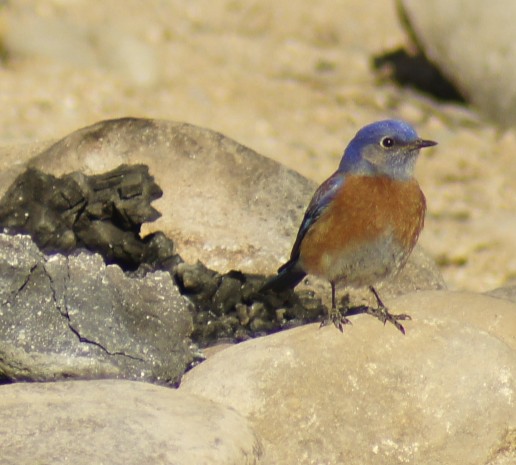
I did have my FOY (first of year) Western Bluebirds at Coon Bluff, and some of the cottonwoods along the river did allow for better photo opportunities than I'd managed earlier in the day. They may be less iconic than the Eastern Bluebirds, but I gotta argue that the Westerns are prettier. In the right light (not pictured), their colors are positively electric.

The birding diversity at Coon Bluff isn't as high as at Granite Reef, but the openness of the site is very appealing, and since the two are only few miles apart, stopping at both is the best way to go!