There are several famous sit-n'-spots in southeastern Arizona, where generous landowners and B&B managers maintain numerous feeders and lovely properties to keep the beautiful birds of southeastern Arizona concentrated in certain areas. Of course, this also attracts birders. Many of these sites--Paton House, Batiste B&B, Beatty Guest Ranch--have also established themselves as very reliable places to see some of the southeastern rarities. The Beatty place hosts Spotted Owls in Miller Canyon while the Paton House is visited by a Violet-crowned Hummingbird every day. If a birder is hoping to see these species, there are few places better.
Mary Jo's Ash Canyon B&B is another such establishment. Maintained by the very knowledgable and charitable Mary Jo Ballator, it hosts a Lucifer Hummingbird, along with many other pretty plumaged patrons, through the spring and summer. After our thorough birding in Miller Canyon early in the morning and afternoon two weeks ago, we spent some time at Mary Jo's in the hope that a Lucifer's Hummingbird would show itself. It's always easy to spend some time at these sit-n-spots, because there's a guarantee of plentiful, close-up views of many great birds, even if one misses the actual target (which we did. If you're hoping for Lucifer's photos, turn back now).

Lazuli Buntings occur in riparian areas in Maricopa County later in the spring, in conservative numbers and with a certain amount of trepidation. At Mary Jo's, one can sit only a few feet away as they forage, by the dozens, among her hedges and seed-scattered log piles.
Of course, there's a certain dissatisfaction in photographing of cool birds standing on feeders and artificial bird attractions, but the enterprising birder can find sites around the property where, even though though the birds are still sort of baited, they're not directly partaking in the unnatural attractions.

The roving Lazuli Buntings were joined by chipping and Lark Sparrows, along with the occasional, more uncommon Indigo Bunting. Seeing either one of these species is a great treat in Phoenix. Just a few hours down south they actively mingle and feed together in droves.

Many of the male Lazuli Buntings were not in their full plumage yet, and it was charming to see their patches of brown clinging to their caps like velvet on a young deer's antlers.

With the Lucifer Hummingbird proving to be a no-show, the main attraction around the Ash Canyon B&B property, for me, were the black, orange and white birds. This nifty color combination, in addition to describing Halloween, reaches across a few families of birds and, nicely enough, they're all stunningly beautiful.
Bullock's Orioles have made a big power play in recent years and are now, by far, the most common Oriole I see in Maricopa County. There were several of them in Ash Canyon, and even though they were outsized by some of the other O/B/W birds, they stood up for themselves well, and ultimately carved out a parcel of tree to be Bullock's boulevard.

Black-headed Grosbeaks were by far the most numerous of the O/B/W category. At one point, Mary Jo's seed trays had no less than eleven birds, many immature, clambering for a spot and a mouthful of crunchies. They have this massive beak after all. I believe they have an instinctive feeling of insecurity if they're not constantly crushing nuts. Watch out...

The plumage variations on Grosbeaks is quite amazing. Sure, it doesn't compare to Wood Warblers or waterfowl, but it's cool how there's Blue and Yellow Grosbeak, the ravishing Crimson-collared Grosbeak, and then this guy, who could easily fit in with a flock of Orioles if he just traded in the beak.
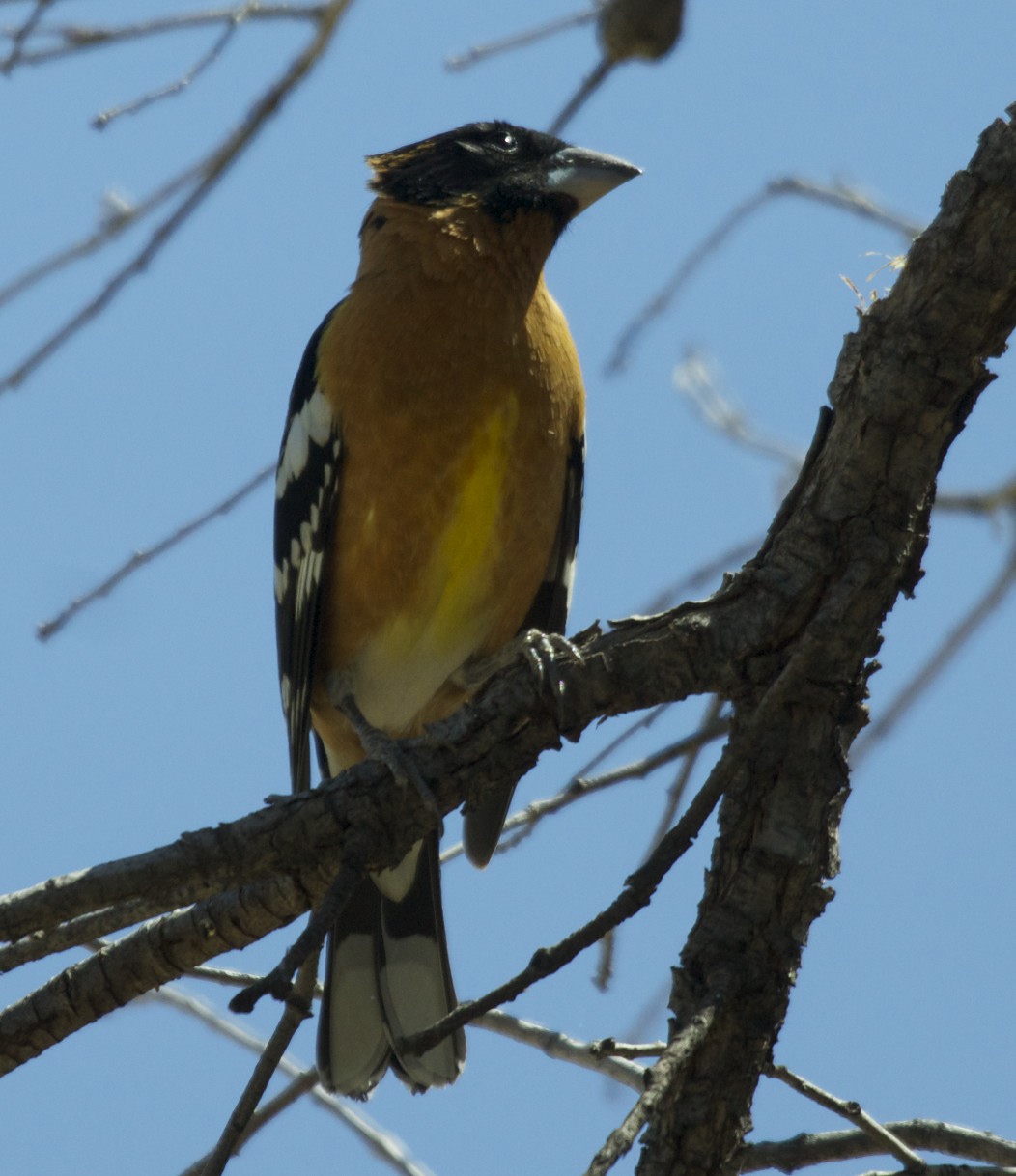
They're not particularly uncommon in the spring and summer months, nor particularly shy, but it's always exciting to see that bulky mass of orange, black, and white barreling through the air, or for that matter, perched in a mesquite.

The most resplendent of the O/B/W birds down south isn't actually orange at all, but a very striking combination of yellow, orange, and white (*editor's note: I'm purposefully neglecting Flame-colored Tanager from this mix, since it is not a mainstay).
Scott's Orioles used to be a regular occurrence in central Arizona, but I have not seen one in central Phoenix for some years now, and one of the few cosistent places to find them in Maricopa County is on the slopes of Mt. Ord. They were much more plentiful down south, not only at Mary Jo's but also in Miller Canyon and other areas around Ash Canyon. This unsatisfactory young bird was the first one which I got a good visual for the day, but there was better to come.

Especially in the desert, lots of birds adopt the 'economy of style' for their wardrobe, and make the most of various browns, grays, olive, and buffy hues to both look handsome and also blend into their arid environment. The whole Oriole group, much like the Tanagers and Grosbeaks, totally torpedos that idea. They're loud to hear and to observe; loud, but certainly not unpleasant.

Their scarcity in central Maricopa made the Scott's Orioles one of the trip highlights for me, though they were not a lifer, year bird, county bird, or even a month bird. We never get tired of looking at beautiful things or listening to beautiful music either right? I can see why Scott wanted to claim this bird to be his, this bird, and no other.


