Wednesday, November 12, 2014

Work Patch Birding: Day 139

Birder's Log: The quest to add waterfowl species and Belted Kingfisher failed today. There was no sign of such birds, not even a freaking manky Mallard. Grackles and Starling in abundance mocked me, as did the pigeons. Passerines and Piccaniformes were also lacking, with only a single Verdin and no woodpeckers recorded. Has God abandoned me to this place? Has my country? Why am I here? Would anyone really care if I was just swallowed up, without ever hitting 30 species for this dinky little patch? Got to hold it together. I hear the fluttering of the wings of the angel of death about my ears. This may also explain the absence of other birds in the pines.  


Birder's Log: Turns out the angle of death was a Great Horned Owl, which may explain the absence of other birds. New species recorded for the SRP AZ Falls site. This brings my list of species seen while wearing a tie up to 33, which is now well ahead of my number of species seen while micturating, though that second list has some better birds on it.

Sunday, November 9, 2014

Bosque Birds and Caring-Caras

This Sunday was a slow day's birding, but hey it's Sunday, whadda ya expect? I was joined by Indiana birder and friend Alex Capaldi for some target birding in the pleasant weather, as we strove best we could to ignore the impending duties of Monday's work. Given the day and date, most of our targets for the day were long-shots, but we came away with a few solid sightings and a feeling of success, even if the photos say otherwise. 
November is a time to appreciate the residents again. The winterfowl have not all arrived nor are in their dapper suits, so it's back to the bosque birds and their never-ending quest to embody all the manifestations of brownish gray.  


Those birds that are even thornier than their perches do not have to be quite so camouflaged, more's the pleasure for the rest of us. As always, I scoped around to try and find this Shrike's larder, which should be well-stocked considering winter's approach. It was well hidden, or else this bird has a Plan B (like just treating Arizona winter as it would any other season).


Townsend's Warblers and a late Blue Grosbeak made for some of the prettier sightings. One of our target areas was the Santa Cruz flats, a great wintering ground for raptors and Mountain Plover. Despite scanning all of the sod fields we couldn't turn up the MOPLs, though Pipits and Horned Larks kept us company, along with a surprisingly small and quiet number of Killdeer, one of the birds with the most disproportionate prettiness vs. disliked-by-birders ratios (very pretty, very disliked).


The MOPLs are a fickle bunch, on top of being well-camouflagged on their barren terrain. The Caracaras in the area are more reliable, as well as conspicuous. We counted six of these Falco-Vultures in total, though most were far away behind the Baumgartner corral, protected by a very aggressive, grumpy defender of private dirt lots (whom I did not provoke this time). We did find a star-crossed pair in the fallow grasses, being all brooding and lovely.


This last photo encapsulates the feeling of many the Sunday evening for me.
This week should provide some time for patch-birding; it's time to record some ducks and get that list up to 40 species, fingers and feathers crossed! Merry birding to all, and to all...merry birding.

Sunday, November 2, 2014

What the Arboretum's Harborin'

There are many consequences--most of them social or financial--that come with the birding pastime. There are also some benefits, one of which is that one can often combine birding with other activities. As I've been oft-whining the last few weeks, now isn't the best time to be birding, in my opinion, around central Arizona. With the low promise of plentiful birds, and the promise that many of the birds one does find being in drab plumage, there isn't a lot of impetus to get up before sunrise, especially if a drive is involved. But this weekend I needed to do some scouting for a possible class field trip at the Boyce Thompson Arboretum in Superior, AZ. 
It's a neat place with lots of trees; I needed to determine if it'd be a viable site for 90 students to spend some time reinforcing natural history/science concepts. And hey, where there are trees and water, there tend to be birdies too. So Butler's Birds decided to kill two birds with one stone this weekend (sometimes the needs of the many outweigh the needs of the few). 


The Boyce Thompson Arboretum hosts several different biomes, some of which are artificial transplants with botany from Australia or Africa, and some of which are continuations of the surrounding Sonoran Desert. The more intriguing, and also more difficult birding is near the exotic trees, where some good rarities have been found over the years. Someone reported some out-of-season birds such as Tyrranulet and Bell's Vireo in the area, but apart from Kinglets and White-crowned Sparrows I only turned up Northern Flickers, LOTS of Northern Flickers. They all stayed up high with their foraging, but I was not above (and, in fact, was below) peeking up at their spotted undergarments. #voyeuristbirding


The site would lend itself pretty nicely to a field trip, but truth be told I did not find a lot else of interest with the birds. Verdins were being weird and building nests, which they seem to do compulsively all year long, sometimes building multiple nest balls in the same tree. 


Phainopeplas perched in the desert ironwood. If Spiderman were a Cardinal these guys would be Venom, but with a prettier call note.


This ever-sharp and loud Cactus Wren also seemed to be gathering nesting stuffs, or else he thought this was a stick bug. Like Verdins, they build multiple nests to act both as decoys and also proof of their industriousness to prospective mates. Perhaps they get an early start on all that construction as well.


I haven't been crushing many birds lately, so allow me to indulge here with a closer crop. It's the state bird after all, and worth a second glance (though maybe not a third). Even though it's not the best state bird, maybe not even in the top ten, it's still way better than the large majority of other state birds.


When things started to heat up at BTA--which still happens, even in November--I drove into the old western town of Superior for some lunch breakfast. I do love me some cheap diner steak and eggs, served forth by a lady named Holly or Charmin who calls me darlin'. It was to be the Buckboard City Cafe, "Home of the World's Smallest Museum." The museum consisted of various odds and ends from the 1980s transferred from someone's attic. The cafe was full of politically opinionated bikers and the service was slow. Lastly, the food was terrible. I felt like this tree a couple of hours later. Nuff' said.


Next weekend I'll be heading south to the Huachucas with a birder friend from Indiana, if all goes as planned, and hopefully there'll be some diversity on this blog again. Here's to November!

Sunday, October 26, 2014

Mountain Birds and a Conspiracy of Crow-like Woodpeckers

Late October is a tricky treaty sort of time. There is so much pumpkin flavoring floating around, creeping its way into beers and confections, into ciders and even lotion. Feet become dry and cracked. Small disguised strangers come to one's home and demand sugary benefactions without providing any compensatory services. Plus it's starting to get cold, as the gaping chasm of winter, with it's icy teeth and abysmally dark, frozen gullet, begins to close its jaws. 
Yet there is opportunity here as well. Some pumpkin stuff isn't disgusting. Pumpkin lotion and dry feet can compliment each other nicely. Kids in costumes can be cute. Best of all, one can start to get cold-weather winter bird species without having to fully endure the winter itself. Of course, the hardcore tundra dwellers will not be in Arizona for another few weeks, but some of those other frost-biters have now arrived in the state, or if they are resident, are now more visible. Butler's Birds teamed with Tommy DeBardeleben, Gordon Karre, and Mark Ochs this weekend for some preemptive birding around the Flagstaff area, home of a college, good birding, and a terrific red ale (Lumberyard).

Our first stop was the Rio de Flag nature walk behind the Northern Arizona Museum. Although the walk itself is pretty small and borders a suburban neighborhood, the birding here was very productive. We had Cassin's Finches, Merlin, Bluebirds, Siskins, and all the expected AZ conifer-lovers for that area, as well as our target bird, Evening Grosbeak. Alas, the Grosbeaks and Cassin's Finches stayed pretty high, but winter's chill will force then lower in a few months and perhaps I shall return for better crushing then, if not camera frying bigger bird fish.


The finches and nuthatches were loving them some ponderosa pines, while the equally numerous American Crows were loving them some warmth-accumulating asphalt shingles--to each their own.


The next stop, south of Flagstaff along lovely Lake Mary Road, was at Ashurst Lake to scan for waterfowl. There were some prescribed burns and a lot of smoke in the area, but by time we reached the water it was not a deterrent. The waterfowl numbers were high and diversified, though lacking rarities, but it was scope-views only so I did not bother with waterfowl photography.
Instead, here is a Mountain Bluebird trying to blend into its surroundings. Not bad blending eh?


The MOBL is a mucho gorgeouso bird. Unfortunately they are mostly cowards unless you find them actively feeding or, even better, drinking/bathing, so they often require heavy cropping.


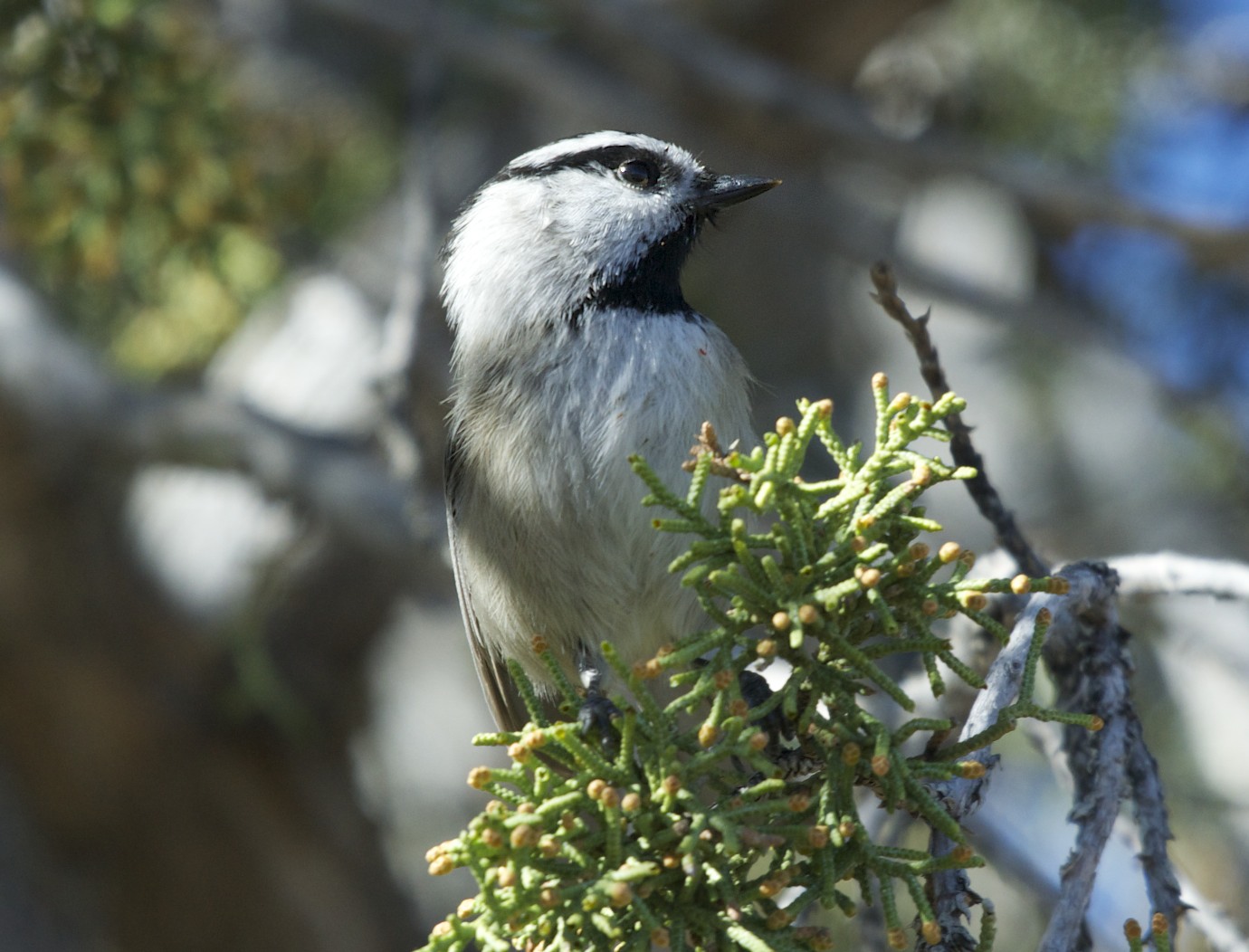
While my better trained and better disciplined birder accomplices were scanning the lake, I continued to explore the surrounding juniper scrub. Kinglets, Nuthatches, and a few Titmice abounded, but the dominant species was the Mountain Chickadee. By Chickadee standards these birds are pretty good-looking and creative with their plumage. By regular standards they're pleasant and professional. This bird is sporting just a hint of yellow on the end of the bill. It is possible this is just lighting. It could also be Sandwich Tern hybridization. More research is required.


Like other species of Chickadee and many other smaller, fluffy birds, the MOCHs are considered by many birders to be 'cute'. 'Energetic', 'sweet', and 'darling' are also used to describe them. This is well and good; often these adjectives apply quite nicely.


But get too near their space, their juniper heart tree, and there will be blood, blood and bellowing.


Better known for bellowing and blood-letting, a few Bald Eagles also terrorized the lakes, seeming to delight greatly in trying to kill their American Coot prey via cardiac arrest instead of direct assault. They would ride the strong winds right over the water, dipping every once in a while to cause the Coots much consternation and belabored flushing (y'all know how Coots struggle to take off). Big, strong, mean, often getting involved with other groups of birds when it needn't, and sporting too much jewelry...a fitting national symbol??


My final stop for the day was Mormon Lake. We first swung by the elevated lookout area just in case any Unshaven-legged Hawks or, much rarer, Northern Shrikes, had arrived early (they hadn't). The Mormon Lake basin was empty, and likely will remain so until the early spring run off, but the many different grasses, shrubs, molds, and shadows of the valley made for an impressive sight nonetheless.
#iwanttoshootladnscapeslikejensanford


The lodge area and campgrounds around Mormon Lake are one of my favorite northern Arizona birding spots. It was here two years ago that I had a very good day--teenagers might even say epic--in picking up lifer EVGRs and RECRs, even getting some decent photos.
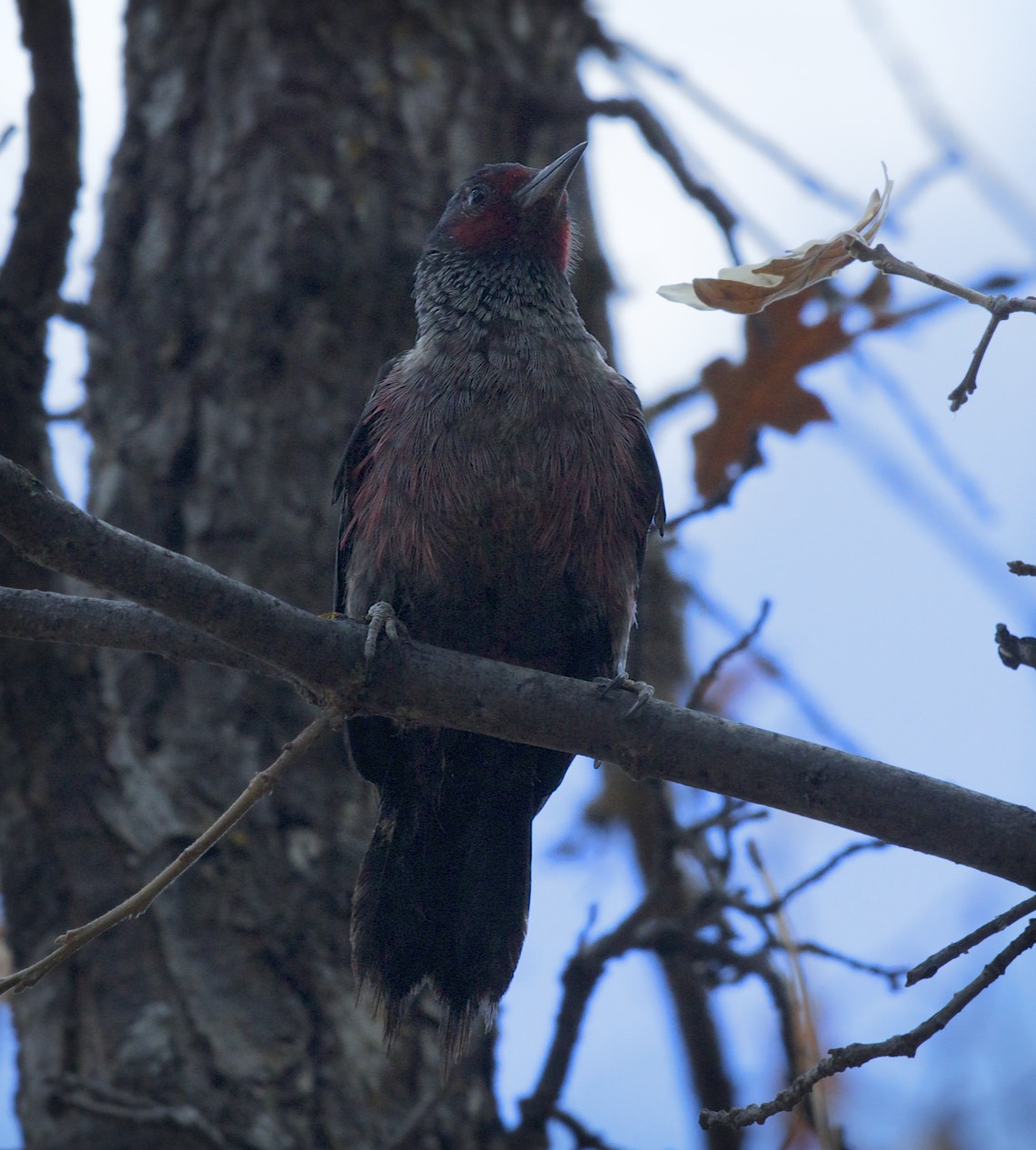
The high elevation pine and oak forests around Mormon Lake and Flagstaff, in general, are great habitat for Lewis's Woodpecker. We had seen two birds prior to our arrival at this final site, and pulled to the side of a dirt access road to excitedly observe three or four more as we approached. We were amazed to see so many birds so close to each other, plus this bird is just crazy, like almost tropical in its plumage. Little did we know the Mormon Lake area was, in fact, infested with Lewis's Woodpeckers.

They were distracting. They made it hard to find any other birds. My conservative estimation is that we had over three dozen individuals in the handful of acres we covered.
Something was going one, some great conspiracy of these Crow-ish Woodpeckers. It was like a movie where a character suddenly realizes he is under surveillance and people are watching him from all the corners, all the shadows, all the nut-stashing spots in the woods. There were clandestine LEWPs on the ponderosas.


They were hiding along oaken limbs, relaying information back to base.


They were perched with the sun behind them, backlit and blending into the dark tree trunks...plotting.


They perched and starring sunward, surveying their domain and contemplating conquest while pretending not to be following us through the woods, waiting for use to stray too far from the cabin sites and any other witnesses.


There was constant activity as they flew across the trails, sometimes right over us, sometimes just beyond focus in the lower shadows of trees. The woods echoed with their raucous calls, and even the Stellar's Jays trembled before them.

(trembling)
If Butler's Birds does indeed return for better finch photos in a couple of months, I fully expect to find the Mormon Lake lodge area abandoned, with the porous ruins of acorn-stuffed buildings badly shading the corpses of so many flanel-clad humans, sprinkled with a thousand tiny holes.
Meriwether Lewis himself went mad and committed suicide not long after discovering this bird.
Beware. They are out there. They are coming. The Others

Tuesday, October 21, 2014

Creepy Crawlies and Plain Posers

Things are, as one might expect, still slow in central Arizona right now. Making birds the focal point with precious weekend time can lead to disappointment, unless one is willing to do some heavy driving. But how about incorporating a bit of birding into a pleasant day of hiking and fishing around Wood's Canyon Lake as sweet violas play gently and magically in the background while butterflies land on your various appendages? Some of those things are good ideas, and even possible. 
At 7,000 feet and near a reservoir, Wood's Canyon Lake is normally birdy, though I have yet to turn up rarities there. Even so, the avian populations this time around were low. Bluebirds, Chickadees, Nuthatches, and some Woodpeckers--the annual residents--were the only feathers of which to speak. Nevertheless, there are creatures in the woods that will give one that tingly feeling, especially if they're crawling on one's face. This Desert Tarantula was strutting his stuff after the most recent rain. 


I was hoping for some later migrants or maybe an owl but was disappointed in these aspirations. Despite the promising habitat I've never had an owl species at WCL. I've always wanted to help establish this place as a good birding site since it has nostalgic value (old family camping spot, etc.), but part of the problem is I seldom go there explicitly for birding, or at least for lengthy, belaboredly-plumb-the-depths-of-the-woods-and-turn-something-good-up birding.
Sometimes life just gives you female Western Bluebirds, dull female Western Bluebirds.
By the way they make a terrible lemonade.


I don't find Bluebirds to be an oft-crushable species though, so this opportunity was welcome. The crushes come so few and far between these days. In most things, it's usually winter that is the time of scarcity, but birding around central AZ one kinda wishes it would hurry up and get here...bring some Evening Grosbeaks while it's at it.
What's that they say, "The worst part is the calm before the battle...and then the battle's not so bad." Yeah, pretty sure that's what they say.

Friday, October 17, 2014

A Re-Salute to Sparrows (Or, Salute to Sparrows Installment II)

Butler's Birds went to some fantastic places this past summer, birding all along the Rio Grande Valley, in the Piedmont and tidewater coast of North Carolina as well as the Great Smoky Mountains. Of course, Arizona factored in too, with the Santa Rita foothills giving up some choice offerings in August. The main reason for doing this, of course, was to further the Butler's Birds goal of finding, photographing, and cruelly judging all North American Sparrow species as if they were merely intricately patterned, audibly diverse chattel, or even worse still, Miss American contestants. 

Harris's Sparrow IQ = Miss Texas IQ, despite what the sparrow says. But which sounds better?

I know I know, "That's mean!" Well, Butler's Birds didn't set out this summer to make friends. Seeing in the field and representing on the webpage are two very different things, as any bird blogger will tell you. Naturally I saw more Sparrows this summer than I photographed well, and saw more than I photographed at all. Alas, Bachmann's and Seaside Sparrow eluded the lens and judgment for a little longer, but their time shall come. (Bachmann's Sparrow, particularly, is fearing that final reckoning).   

Without further adieu, here are a few more installments of the Butler's Birds Salute to Sparrows. This information has also been recorded on the main thread, which will always be updated with new additions. 

Botteri's Sparrow: Also famously known as the "dumpy plain boring flat-headed little shit sparrow" in Arizona, the Botteri's is the Bachmann's Sparrow of Southeast AZ and Texas. Little sprinkles of rufous here and there are insufficient to spicing on this dull-flavored bird. There is something to be said for a handsome platinum beak, but that's not too special for a sparrow. 
Vocalization: More creative that one might expect, with almost vireo-esque single notes preceding a crescendo trill that is clearly an homage to Black-chinned. 7/10
Appearance: Unimpressive, plain, and what is the deal with that crew cut? 5/10
Overall: 6/10


Field Sparrow: Named for the renowned plumber Gerald P. Field, the Field Sparrow is the bread and butter sparrow for much of the midwest and eastern United States. As the name coincidentally indicates, it favors grasslands and agricultural areas, especially near woods. It looks, acts, and sounds like we expect an American sparrow should. Although this Sparrow has lost much of its relevance and esteem in current discussions and appreciations of Sparrows, the FISP had a heavy hand in establishing the stereotypes of Sparrows that we birder enjoy today.
Vocalization: Bold and recognizable, as if all the roadside fields and grasslands in the east and midwest were filled with tinkling bouncing balls (as if).  7/10
Appearance: Warm toned but dull overall, reminiscent in some ways of a female House Sparrow. The pinkish-orange beak is a nice touch, but lipstick alone won't win pageants. 5/10
Overall: 6/10


Golden-crowned Sparrow: A large and hardy sparrow, not as well distributed as its better known White-crowned and White-throated cousins, the Golden-crowned is nonetheless a fine specimen. The individual shown below is a vagrant that visit Sun City on northern Phoenix every year for the last three winters at least. Can he even be called a vagrant anymore?
Vocalization: A pleasant, mournful song (overly) short, sweet, and to the point. 7/10
Appearance: Very typical for zonotrichia Sparrows. Of course the black and golden crown is distinct but a fancy hat it not always enough. 7/10
Overall: 7/10


Olive Sparrow: Often found in Texas next to strip malls next to Red Lobster and Baby Kays, the Oliver Garden Sparrow is a fun and fancy take on the traditional sparrow archetype--much like Oliver Garden is a fun and fancy...well, never mind. It is the only Sparrow in North America, maybe even the world, with an olive (yellow/green) back, which also continued onto the tail. It has a brown cap hemisected with white, a faint brown eye-line, and is non-migratory--gotta admire the commitment.
Vocalization: A series of full-bodied notes of similar pitch, never reaching the crescendo of other Sparrows. 6/10
Appearance: Inventive and colorful yet still reserved enough to show a Sparrow's good sense and economy of style. 8/10
Overall: 8/10

Sunday, October 12, 2014

Pesky Sparrows and Cold Blooded Lovin'

Fall migration is stil underway in our hearts and minds, but in terms of producing some rare birds in the Phoenix area, it came and went without much adieu (it usually does). But we're well into October now which means waterfowl numbers are starting to swell and, even better, winter sparrows are returning. It has been a long time, too long of a time, since I've properly crushed some good birds. One could go to a park and crush Green Herons or Ducks easily enough, but Butler's Birds decided to do it the harder way and met up with Gordon Karre, Caleb Strand, and Tommy DeBardeleben for some sparrowing. 
Tommy had recently scouted a great location for the recently split Bell's Sparrow and came away with some great photos of this tricky-ID bird. Both Bell's and Sagebrush Sparrows are possible at the well-known Thrasher Spot in Buckeye, AZ, but the Bell's are much rarer there, preferring the thicker saltbrush habitat around Robbin's Butte where they invert the population disparity and finally outnumber the Sagebrush. 
And so, like the super studly guys were are, we set out into the saltbrush in the early morning to track down some of these early arrival, early departure sparrows. 

We had some great, diagnostic looks at a half-dozen Bell's Sparrows, one or two Sagebrush, and maybe nine or ten more that we did not see diagnostically. Alas, both of these species are very skittish on their wintering grounds and I came away with no photos whatsoever. The numbers were pretty good though and I definitely recommend Robbin's Butte for anyone chasing Bell's in central AZ.

The birding has been pretty glum lately but the herping has been excellent with our recent, heavy monsoons. This continued at Robbin's Butte, where the non-bird highlight of the day (and one of the overall highlights, for me) was a pair of Western Diamondback Rattlesnakes.


I found the couple under a tree while I was attending some nature business and they were attending the devil's business. The other snake's head is hidden in the photos, though whether from shame or circumstantial positioning is unclear. The back halves of the snakes were tightly wrapped together and moving in an undulating motion while the front halves were free to move about as they pleased. There wasn't a lot of eye contact or smooching. The whole thing was somewhat unromantic.


...or maybe not. We'll see what kind of internet traffic this post brings.


On our way back to the vehicle Caleb also found a medium sized gopher snake shading itself from sun and Red-tail Hawks. Unlike with the mating rattlesnakes, this was a hands-on opportunity. 


In the ancient greek myths, Meliampus became very wise because he helped some young snakes once and in gratitude they licked his ears so clean that he could hear/understand animals. This snake was less grateful, and we didn't even ask the rattlers, but what wisdom might the humble gopher snake be able to impart? Living life horizontally must give one all manner of different perspectives compared to us uptight uprights.


After Robbin's Butte we swung by the Arlington Widlife area, scanning for shore-bird friendly flooded fields and any migrants of interest. Again, be forewarned that I'm in a photo-slump here, but the birding at Arlington is always pretty good. The combination of tamarisk groves, cottonwoods, marsh areas, and agr. fields maintain a variety of wildlife, and our two highlights were a Lewis's Woodpecker and Common Black Hawk, both rare for this date and location.
Cassin's Kingbirds outnumbered the Westerns, and all of these guys are technically dawdling; they should've moved on a couple of weeks ago.


Birding agricultural expanses is always nice because it's predominantly done from the comfort of the car and there's a better chance of getting closer to the birds. This wasn't exactly the case on Saturday, but we did have some of the typical roadside highlights to round out a day with near 50 species.


Winter birding will bring its own intrigues, and I'm already looking forward to chilly trips into the San Rafael grasslands for Baird's Sparrow and Short-eared Owl, or up to Mormon Lake for Grosbills and Grosbeaks. In the mean time, it's a matter of damage control, birding when and where one can make the most of this interim. And in that mean time, watch your step!