Thursday, April 17, 2014

A Rookie Mistake: Dial Plan B (For Birding)

Last weekend it was all planned out...kind sorta somewhat perhaps. It wasn't going to be a full-on epic bird day, but it was supposed to be pretty good. I was going to scour the Sierra Vista hillsides, chasing down leads on Montezuma Quail, and then spend a few hours in Ramsey and Huachuca Canyon. It was going to be crisp, efficient, and potentially a 3-Quail day. But I have a serious short coming as a birder (several, I am sure). Being from Phoenix, I grew up with a nasty, nasty habit. No no it's not smoking, which is of course scientifically proven to strengthen respiration as the tar helps oxygen stick to one's lungs. No it is because in Phoenix we have about 358 days of sunshine each year, so when we're making weekend plans, weekday plans...any kind of plans, there's never need to check the weather. 
Of course with birding, weather is key, and I totally dropped the ball on checking the Sierra Vista weather before heading out from under Phoenix's clear skies at 3:30am. 
It was heavily overcast, rainy in some places, and exceedingly windy. The first couple of hours in the area were almost devoid of bird activity, except for a few sympathetic Lark Sparrows, and so I sulked (snoozed) in the car instead of seeing glorious Quail, who were all wisely keeping their heads down.


By 10am or so the weather still hadn't cleared. I spent some time in Ramsey Canyon, trying to get away from the wind, where I was very pleased to find all three species of Goldfinch in the sycamores around the AZ Folklore compound. Apart from the finches and some FOY Scott's Orioles it was pretty dead.
By 11am the sun had risen high enough that it occasionally broke through the heavy cloud cover, though the terminally heavy wind kept most of the birds down low.

Rufous-crowned Sparrows were good sports about it all, still vocalizing when they had the chance and giving some life to the Sierra Vista grasslands. I would prefer Five-striped, naturally, but to each their proper time and place.


A pair of Pyrrhuloxias in Ramsey canyon also made for a nice sighting. This is a bird I don't see or photograph nearly enough, given their relative rarity in Maricopa County, and this is especially distressing as they're way more rad than Northern Cardinals.


Although there were a few nice sightings, for all the driving and time killed it was a pretty disastrous start to the morning. I decided to head farther north back toward the Tucson area to pursue some birds where the elements were more cooperative. I learned a lesson, learned it well and good. The question was if Plan B could redeem something of my Saturday. 

The next site was Christopher Columbus Park, a pre-fabricated suburban watering hole with uncomfortably blue-colored water that, nonetheless, has highly visible Wood Ducks.
It doesn't even have great habitat for them, but whatever the reason a Wood Duck drake has been here all winter, and this was a species I had not been able to photograph up close, having formerly flushed them at Tres Rios or seen them at a distance in Prescott. It's not a rare Quail, but it's a gorgeous thing.


Wood Ducks weren't the only offerings at the park. Though not as cool as the Thick-billed Kingbirds for which I'll be traveling through Patagonia in a month, or even the taller, darker, handsomer Cassin's, I also had some really nice sightings of Western Kingbird around the park's grassland. They're common and conspicuous, and also pretty cool. But usually they're up on the telephone wires and what not, and although their bellies are a lovely yellow, it doesn't make for great repeated viewing. Seeing them at eye level was tops.


By 1pm or so, the sun was out over Tucson, which is a bit over an hour northwest of Sierra Vista, enough so that birds were taking shelter from its midday wrath. It was too late to head southeast again, where the weather was likely still inclement anyway, but the few birds at Christopher Columbus offered some great sightings as a consolation.


In addition to the earlier mentioned Wood Duck sightings/dynamics, I've also seen them, distantly in Pennsylvania, but this unwholesome pond in Tucson, by far, offered the best looks I've had in the last few years, and hey even a nifty Wood Duck vs. Mallard size comparison (the Mallard looks like a giant). 


Chasing the waterfowl at city parks almost feels like cheating. That's not to detract from the tick or the photos or any of that. In a sense, these ducks are still more wild/less baited than the feeder-fed Hummingbirds in Madera or Miller Canyon, or at the Paton House, but it just feels very removed from nature, from the proper context of when and where one should be seeing these cool species.
That being said, the when and where for Wood Ducks in Arizona isn't exactly easy access, so I can't complain. I can only berate myself, and check the weather.

Monday, April 14, 2014

Perseverance at the PM Preserve

Birders the continent over are now reaching for their 'nocs and cameras with increasing regularity and even the chummiest of city parks teem with excitement again as the spring migrations get underway. In the central part of AZ, migration isn't quite as big a deal. Spring always brings a welcome change, for sure, but in many ways the winter birding down here is preferable for total species, especially since the breeding Orioles and Buntings don't arrive until later. Compared to the scenes in the central, east, or northwestern parts of the country, the few Warblers and Flycatchers that push through are a welcome addition to the scene, but just in general the beginning of migration time doesn't have the same full spark in the Phoenix area is in much the rest of North America.  


So, apart from roaming the rocky hillsides looking for black-tailed jackrabbit, who are in turn looking for some shade in the rocky hillsides, what is a Phoenician birder to do? As always, Sparrows hold part of the answer. Those that left for winter are returning and staking out their territory, as are the residents, which makes for some excellent visual and auditory opportunities.
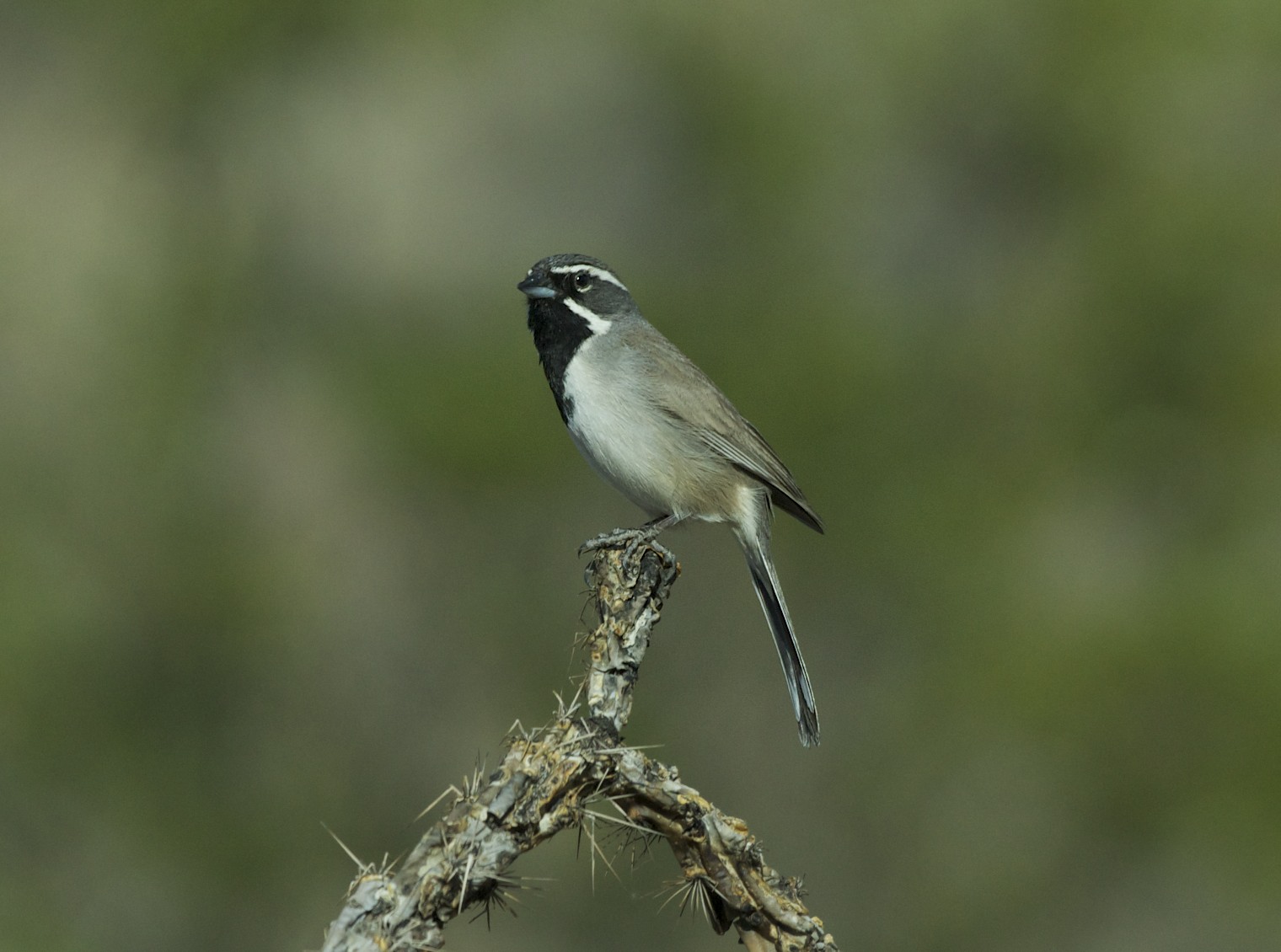
I have been able to lay many the crush on Black-throats in the last month, something that never ceases to stimulate, and even amid the infamous March doldrums these birds keep the spirit high.


Spending some time with one's state bird is also a goodly dose of birder medicine, recommended by 8 out of 10 doctors and even cautiously advocated by the FDA. If they pose nicely on a namesake perch, all the better.


But Cactus Wrens can perch and sing/grunt/gargle for a while, and for those birders with itchier feet, chasing around Black-tailed Gnatcatchers is another solid outlet. Unlike rattlesnakes and rattlesnails, they're not more afraid of you than you are of it.


All of these photos were taken during a several day trial in late March, one I've now undergone for two years in a row. Racing through Phoenix rush hour traffic, which is very reminiscent of the climactic chariot race in Ben Hur, and unloading at the Phoenix Mountain Preserve by 4pm, I've got about two and a half hours of daylight to hike out into the mountains and explore the various gulches and shady hollows where the mesquite and palo verde trees spread their bows. 
The task here is not just to see the usual desert dwellers, but to pursue one of Phoenix's better and harder-to-find migrants, a bird who's accessibility in central AZ is predominantly limited to the last week or so of March and the first week or two of April. They're shy and silent during this time of year, so obviously I'm not referencing Gambel's Quail.


No, but with great perseverance (several tries last year and several more this year), prodigious sweating, burr-laced socks, thorn-impaled shoes, quiet treading, keen eyes, a pre-St. Patrick's Day Irish dosage of luck, and maybe a few whistles to the treetop Phainopeplas, one can find a real treasure of a bird in the channels of the Phoenix Mountain Preserve. 


Last year I only had quick visuals and a blurry flight silhouette shot to show after four attempts in the treacherous but beautiful landscape. After that many busts and semi-busts, even the fantastic sights and sounds of Sonora are scant consolation.
This year it took two tries, and this year I had much improved results. Josh Wallestead, who has seen himself plenty of Owls up in Minnesota this year, joined me while in town and racking up his own nice list of Sonoran lifers. We scoured the PMP gullies for a few hours, and while heading back south towards the vehicles through one of the deeper washes we finally had our break, just after the sun crested below the hills and lent everything its hazy, yellow light.
Finally, at long last, I got to stare face-to-face with a regal Long-eared Owl. It was tops.


Of course, diminishing light and the Owl's shyness, along with my own apprehensions about approaching too close, didn't allow for the crisp crushes this finely plumaged raptor deserves, but the sighting alone was enough to fully validate a March otherwise largely devoid of awesome sauce migrants in Phoenix. Really, I depreciate Phoenix birding too much. It doesn't get much better than Long-eared Owl. 

Friday, April 11, 2014

Records Fall: Work Patch Birding

It's breaking past the 90s in early/mid April, so that's gross, but I've passed another milestone (figuratively speaking)...30 species for my near-work patch, oh yeah! 
See, I'm trying to sound all ironically jazzed by over-celebrating a minuscule accomplishment, but the truth of the matter is that I do actually fell pretty pleased with that. It's not like jumping up and down because of a lifer Rustic Bunting pleased, but like, "yeah, I'll stop for a celebratory beer on the way home" kinda pleased. 
Like this mid-launch jailbird Black Phoebe, I have broken free of the shackles that held my patch list to less than 30 species. 


Having only 50 minutes or so after work, it was a productive bit of birding this past Tuesday that resulted in several new species for the little site. Northern Rough-winged Swallow (expected), Black-chinned Hummingbird (expected) and White-winged Dove (expectedly early) combined with a single Cassin's Vireo in the few ornamental pines (unexpected) for a tidy little haul, like the tidy little haul of gnats this Black Phoebe routinely snatches up from its various perches.


I'm still waiting and hoping for Kingbirds and Lesser Nighthawks along the canal portion of the patch. Usually I don't stay late enough for there to be much nighthawk activity, but in a few weeks they'll be so active along the canal during twilight that I'm hoping to find some perched/roosting birds in the daylight. Then I can see and enjoy them in greater detail, detail like that which shows up in this Black Phoebe's feathers when it finally turns towards the light. 

Sunday, April 6, 2014

Chirps and Trills and Mountain Top Thrills

The early spring Gray Vireo photo hunt goes on, and may at this point just be postponed for a couple of weeks. But in contrast to this apparently defeatist admission, this weekend saw some fantastic birding with plenty of migrants and early-arriving spring/summer breeders moving through Mt. Ord. 
This is no ordinary site, after all, being the highest point in Maricopa County. The mid-level scrub and chaparral hosts plenty of Sparrows and what not, (and will soon host the GRVI in numbers even I can find), while the higher pines and oak entertain plenty of warblers, thrushes, and woodpeckers, lending a fantastic splash of color after a somewhat dreary March. 
I set out to Ord this weekend with Pops, planning on a quick look for any GRVIs and then a more thorough exploration of Forest Road 1688 and the summit. Of course, there were no GRVIs on the corral trail halfway up the mountain, but the Black-chinned Sparrows were singing in force.


We took the corral trail laterally along the mountain for about a mile, waiting both with dim hope for a Vireo call and also for the morning overcast to burn off. Chipping, White-crowned, Black-throated, Black-Chinned, Brewers, Rufous-crowned and Vesper Sparrows all made appearances or vocalizations at different points on this hike, and of course this sum total of emberizids was outnumbered by the all-conquering Spotted Towhees. The oddest sighting at this stage, though not exactly the most exciting, was a young Mockingbird that Pops picked out from its little perch just on the ridge. I'm not sure of the elevation here, maybe 3,000 feet or a bit under. At any rate, this is the highest point at which I've seen a Mockingbird. I don't know if that makes me weird or the bird weird. It certainly looked out of place, but then again I probably did too.


With the sun was still taking its sweet time to clear the Mazatzal ridge, we parked near the FR 1688 trail and were immediately greeted by the calls of Black-throated Gray Warblers as they staked out territory. Some of them were very determined, even menacing, with their sentry-duty.


The lower oaks were also inhabited by Kinglets and Scrub Jays, and of course Towhees, but the BTGRs were the most vocal bird as we started the gradual climb up FR 1688.


After a quarter mile or so and the first bout of ponderosa pine, FR 1688 opens up to a view of the west valley and also a steep slope covered in desert holly, scrub oak, and all kinds of other un-cuddly plants. Although we could still heard the BTGRs calling behind us, the dominant noise and motions now came from Blue-gray Gnatcatchers.


These birds were absurdly loud and active on the open, sunny stretches of FR 1688, and we actually continued to see them throughout the rest of the hike, even as we gained another 1,000 feet. No exaggeration, we even had them in the ponderosa occasionally, nearer the false peak where FR 1688 terminates. Gnatcatchers in pines...that's only supposed to happen in Florida. Even the boisterous Scrub Jays seemed taken aback by the Gnatcatcher industriousness.


Our forest road meander turned up Hairy Woodpeckers and Hutton's Vireos, along with a couple fly-by Rufous Hummingbirds and a plethora of Bewick's Wrens. We had no luck in the long-shot Pygmy Owls, but as we neared the end of the FR, where the trail terminated into stickery thorny things and a slope up to more oaks and a few mulberry-type trees we picked up renewed activity.
Fly-over Zone-tailed Hawk and Golden Eagle always give one a little rush, and the adrenaline continued as we picked up our first Redstart of the day, a preposterously good-looking bird. After continuing to scan through the mixed flocks and canopy movement--which turned up handsome Mountain Chickadees and Bridled Titmice--we saw something even more exciting.


What's more exciting than a Painted Redstart? Well, an FOY little gray bird with a yellow butt. We heard a Virginia's Warbler call once and had to do quite a bit of chasing and triangulating amid the steep terrain, loose rocks, and abrasive, shin-slashing vegetation, but finally we were able to pin this pesky little bird down, a photo-first for myself and a lifer for Pops.
Got the call, got the sighting, got the shot. Who needs eastern wood warblers (me actually, please)?


About half-way up the FR 1688 trail there's a turn off into the ponderosa, marked by a semi-permanent campfire circle. There's a game trail here that runs more or less parallel to the forest road but takes the birder through thicker pines and better birding, if one has already maxed out on the mountain side scrub-dwellers, which we had, or wants to escape the chronic, debilitating chattering of Bewick's Wrens, which we did. There were no Hermit Warblers but Hermit Thrushes and Western Bluebirds, along with Red and White-breasted Nuthatches continued the list-pumping.


After 400 yards or so the game trail dumps out around some water basins and an old cattle fence, and here a couple of sycamores, oaks, and other greenery provide exceptionally drawing habitat for the mountain birdies. We had two or three more Redstarts that were happily vocalizing when not busy naval-gazing...


...and an equally vocal Grace's Warbler, which we first picked out by its song and then picked out from its ponderous perch. This was another target warbler for our trek and a solid lifer for Pops. The Grace's is basically a slightly less cool Yellow-throated Warbler, but it's birds like these that will keep us Maricopians from unhealthily envying our eastern birder counterparts too much in the next couple of months.


This Grace's contributed to the overall Call of the Wild and its timing was impeccable, coincidental, or maybe even causal. Many people keep a list of bird's they've seen exercising their excretory systems. I keep the inverse, and if I may list boast for a moment I've got Vermilion Flycatcher, Gray Hawk, Elegant Trogon, Northern-beardless Tyrannulet, and now Grace's Warbler on mine (and in case your wondering, wetting one's pants at the sight of an awesome bird does not count, that'd be too easy!).
After attending our own respective calls, Pops and I made our way back to the car and finished the increasingly bumpy, treacherous drive to the summit of the Mt. Ord. 

The accessible road terminates maybe 3/4 of a mile from the ranger station and radio towers at the top, but while the gated road prevents vehicular progress, birders can happily progress continue along the road and without fear of hairpin traffic. Mt. Ord's summit provides lodging to hundreds of Violet-green Swallows, which are both beautiful and unusually prone to landing/perching as far as Swallows go. Later in the year this area is also fantastic for Hepatic and Western Tanager, and also for getting mutations from being too close to illegally high radio wave emissions.


Props to the Violet-green Swallow for being the only Swallow, other than Purple Martin, named for its physical characteristics and not where it typically lives (how would we like it if we were all named Home Body or Suburb So-and-So?).


While I was messing around with the Swallows and Dark-eyed Juncos along the road, Pops called out my favorite sighting of the day. Grayish body with some dull yellow on the wings, olivey-orange head...I think...I think...oh yeah!


Olive Warbler!!! This is just a fantastic bird, and one that we Arizonans must cherish. East of the Mississippi right now, there are probably dozens of face-melted birders recording 30+ warbler days, but none of them can also lay claim to this beauty. Alright so maybe I'm over-playing it and this bird isn't even in full plumage yet, plus it was shaded, but I still was pretty stoked. It had been far too long since laying eyes on this Peucedramid.

We were also treated to better looks at Grace's Warbler along the service road, which provides somewhat eye-level views of the ponderosa canopies growing adjacently downhill. The Amazing Grace's was joined by plenty for Black-throated Grays and some Bushtits.


As we beheld distant Roosevelt Lake from our 7,000 foot pedestal, we felt the warm fuzzy feeling that can only be kindled with a fantastic morning's birding. Such a glowing sense of accomplishment and success can only be improved upon with cold beer. And it was.

Thursday, April 3, 2014

Birds and Blooms and Birds on Blooms

Even though we had no winter this year (temps in the 80s through February), it's clearly spring time. This is not something I can tell from the position of the sun in the sky nor exclusively from the fact that now driving to work is no longer done in the dark, with with the sun directly in my eyes (not sure which is better). Everything is starting to bloom now, and even in a place not necessarily known for its colorful fauna, that indicator holds true in Phoenix just as well as anywhere else. The mesquites and palo verde are bursting with their dainty yellow flowers, while all the century plant and aloe groups are shooting up stalks (those that flower annually) with a quaint resemblance to tiny bananas. 


The cactus are all getting their bloom on as well, much to the delight of everything that eats them.


The ground has finally thawed enough that rodents are exiting their winter hibernation and shedding their thick winter coats, changing from their white robes into more appropriate desert brown.


Another strong indicator is that all the Phoenix residents are nesting. Hummingbirds are courting, Mourning Doves, Curve-billed Thrashers, and Cactus Wrens all have raucous chicks in their prickly fortresses, and Abert's Towhee juveniles are already bumbling around, bad at everything.
Despite all that change and twitterpation, some species re carrying on much the same as they always have. Verdin are constantly foraging and building nests, which they seems to do through winter, spring, summer, and sometimes fall just to be sure. There is no big they won't chase and no position too awkward for them to hold in their pursuit.


While the eastern half of the nation mobilizes with its 'nocs and Bengay for some outrageous Warbler migrations, Phoenicians will have to content themselves with Verdin antics and the occasional Townsend's or Hermit interloper. Yeah there are Orange-crowns too but who cares, and has anyone ever actually seen a MacGillivray's?


Anyway, it's a good time to be in the valley, even if we're relatively less spoiled for the birdies right now. Besides, I'm still on Gray Vireo detail this weekend. Warblers can wait.

P.S. Check, out how many bugs are on this plant. In addition to the Verdin's overflowing maw, there are ants and gnats all over the upper stems. Tis' bountiful.

Wednesday, April 2, 2014

Looking for Cliffs under the AZ Falls

It had been a few weeks since visiting my cozy little work patch, so this past week I returned with a specific goal in mind. Having scoped out most of the likely species for this little site, last time here I made specific and successful efforts for Red-naped Sapsucker. This time around I was pursuing a more mobile quarry. I had a single Cliff Swallow back in February, flying around where the canal falls drop down several dozen feet to continue on their westward course. This was a very early sighting for Swallows, and I didn't see that bird upon further visits but it keyed me in to the possibility that in a month or two, they might take up nesting under the Arizona Falls Bridge. Cliff Swallows nest colonially under bridges near water, and are in that sense predictable to find. However, these elevated colonies and the subsequent shade that comes with them means that photographing these birds satisfactorily is a challenge.
Best of all, trying to find the Cliff Swallows at AZ Falls would let me revisit my favorite sign/water fountain placement situation maybe ever.


All of the winterfowl, even the Ring-necked Ducks, in this strip of water are gone, but Cormorant numbers were up. They're mostly Neotropics, but Rhinoceros Cormorant (front) and Headless Cormorant (back) also turn up this time of year. 


The main advantage vis-a-vis Swallowing is that the AZ Falls has a walkway and adjacent slope right next to the elevated plane at which the Swallows are building their muddy manors. This means that without rope ladders or cherry-picker trucks, eye-level viewing is somewhat possible.


With a small amount of trepidation and a certain amount of balance and control, positioning oneself on the dirt and cement slope seen on the left of the picture above allows for fantastic, eye-level views of the busy birds, even if the problem of photographing in the shade can't entirely be avoided.


And as for the Swallows themselves...they couldn't care less. Joggers and cyclists are often passing by on the walkway above their nesting site, and my increased attention did not deter them in any way. Clinging to vertical walls and building a house entirely out of mud and spit requires plenty of concentration, and worrying about the clearly out-of-its-element biped nearby is not high on their priority list.


It was a real treat to watch them working up close. One Swallow would often stay in the nest, molding  the inside no doubt and handling the decoration.  It would then emerge, apparently, to give direction to its partner, who would make the frequent trips down to collect more mud. Have we not all experienced this dynamic, in some sense or another, on a moving day?


And as a further point of relating and sympathizing, Swallows seem to lose patience too during these onerous exercises. Or maybe Cliffs just have a grumpier disposition than cavity-nesting Violet Greens, who find most of their domestic organizing done for them.  


It is interesting also to observe these groups of swallows and compare them to other colony birds. European Starling flocks and Blackbirds fly together and seem similarly sociable, but with the impressive Starling flocks, a sort of a common collective mind seems to pervade the group's movements (even though this likely isn't the case, they just operate, necessarily, under stricter rules that come with being in a larger group). With the gregarious Cliff Swallows, the community is central to everything the birds do--there are seldom any outliers or loners, any separate nests or pariahs. These Swallows are even known to move their eggs from one nest to another if a clutch fails or its own nest is deemed inadequate. 


Swallow crushing is not the easiest of pursuits, but if you can't bring Mohammed to the mountain...then find a way to get up the side of the mountain, lean over some railing, get a bit dusty, and take a few pictures. Everybody's happy.