In the mean time and for no particular reason (the best kind of reason), this send off post is going to be all about American Sparrows. Loved by many, hated by a few, and feared by some, these plainly-colored, intricate birds hold something for everyone: challenging but not-impossible IDs, frequent vocalizations (thanks for nothing, empids), pulchritudinous patterns, and no predilections for the tops of canopies. Their main drawback lies in the general blandness/straightforwardness of their names. There are plenty of gorgeous and better-named eastern Sparrows I have not yet seen, and even a couple of western, but here for thought and criticism is an alphabetical rundown and rating of a bevy of emberizids that can be found in Arizona throughout the year.
**Disclaimer: All ratings and opinions are extensively researched, empirical, and objective. Measurements are done on the Audubon/Petersen Sparrow Scale.
Botteri's Sparrow: Also famously known as the "dumpy plain boring flat-headed little shit sparrow" in Arizona, the Botteri's is the Bachmann's Sparrow of Southeast AZ and Texas. Little sprinkles of rufous here and there are insufficient spicing on this dull-flavored bird. There is something to be said for a handsome platinum beak, but that's not too special for a sparrow.
Vocalization: More creative that one might expect, with almost vireo-esque single notes preceding a crescendo trill that is clearly an homage to Black-chinned. 7/10Appearance: Unimpressive, plain, and what is the deal with that awful crew cut? 4/10
Overall: 5/10

Black-chinned Sparrow: The Black-chinned Sparrow, named for its black eyes. There are few land-birds more in love with soft gray than this mid-elevation fellow. They're one of the less intricately patterned sparrows, but they're also some of the first to start singing that bouncy-ball trill in spring and once they start they do not often stop.
Vocalization: Pleasant and recognizable. 8/10
Appearance: Simple and straightforward but well-composed. 7.5/10
Overall: 8/10

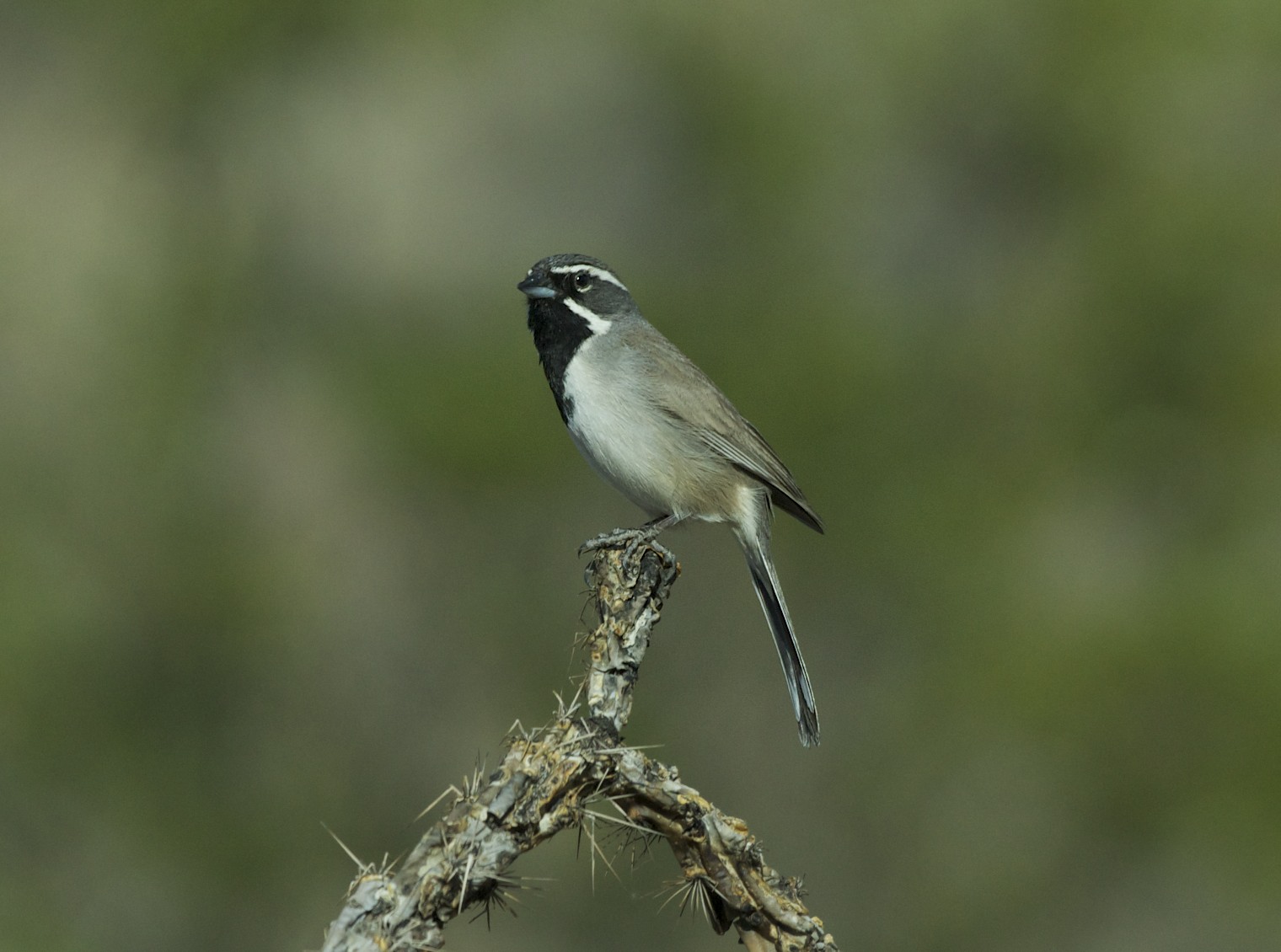
Black-throated Sparrow: What a show-stopper. Although not done in intricate patterns, brown, gray, white and black rarely look this good on a bird, even down its legs. They also are very vocal, sociable, and conspicuous--as one would expect of such a handsome bird. As Nicholas Martens over at Hipster Birders recently said, it's a bird you want to sit down and drink some whiskey with.
Vocalization: Pleasant but plain. 7/10
Appearance: Strikingly sharp and well-defined. 9/10
Overall: 9/10

Brewer's Sparrow: This bird is about as drab as they come. Even the finest specimens would probably lose out to a female House Sparrow in a beauty contest. That being said, they're arid scrub specialists in the winter, and they take full points for use of desert fauna in their lifestyles in Arizona before heading farther north and comfortably breeding in a totally different habitat. They also boast an incredible, involved, and lengthy vocalization.
Vocalization: Long, strong, and variable, among the best to be found in any emberizid. 9/10
Appearance: Pretty drab tan and brown, and it's deliberate. 5/10
Overall: 7/10

Cassin's Sparrow: A pretty crappy-looking bird with a nice flight display and solid song, the Cassin's is a localized bird in Arizona, found in the summer months in arid grasslands in the southern half of the state. Really snooty birders overlook regular Cassin's Sparrows, unless they're displaying, in favor of the much rarer rufous-morph, pictured below (which still is a crappy-looking bird).
Vocalization: Not Brewer's quality but delicate, intricate, and amusing. 8/10
Appearance: Pretty plain all around, and yeah that's appropriate for grassland species, but there are plenty of eastern grassy Sparrows that are way better looking. 5/10
Overall: 6/10

Chipping Sparrow: Common and chipper (pun half-intended), these gregarious sparrows form some of the more lackluster gangs in the bird world. They've got numbers and they've got some style, but their gangs are more interested in hanging out in little trees near grasslands--it would be like a gang in The Warriors that paid regular fare to ride the Tram and deferred on their seating to old ladies.
Vocalization: Simple but somewhat uniquely liquid for sparrow song in its vibratto. 7.5/10
Appearance: Straight-forward and standard up to the head, but the eye striping and cap is as bold as Mint Chocolate Chip...though not similar in flavor. 7/10
Overall: 7/10

Clay-colored Sparrow: This is a hard bird to turn up in most parts of Arizona, and the very specimen pictured below was both a lifer and also one of the first rare finds to which this greenhorn birder can lay claim. They're not greatly different in appearance from Brewer's Sparrows, except better buffiness all around, a nice wide malar stripe, and of course, the party-in-the-back gray nape give it an edge. It also benefits from the rareness factor.
Vocalization: Infrequent in Arizona and also pretty annoying, sounds like an irritated bug. 5/10
Appearance: Relatively simple, even bland, but buffy is a pleasant thing to behold. 7/10
Overall: 6/10, *Rate at 7.5/10 if in Arizona

Field Sparrow: Named for the renowned plumber Gerald P. Field, the Field Sparrow is the bread and butter sparrow for much of the midwest and eastern United States. As the name coincidentally indicates, it favors grasslands and agricultural areas, especially near woods. It looks, acts, and sounds like we expect an American sparrow should. Although this Sparrow has lost much of its relevance and esteem in current discussions and appreciation of Sparrows, the FISP had a heavy hand in establishing the stereotypes of Sparrows that we birders enjoy today.
Vocalization: Bold and recognizable, as if all the roadside fields and grasslands in the east and midwest were filled with tinkling bouncing balls (as if). 7/10
Appearance: Warm-toned but dull overall, reminiscent in some ways of a female House Sparrow. The pinkish-orange beak is a nice touch, but lipstick alone won't win pageants. 6/10
Overall: 7/10

Golden-crowned Sparrow: A large and hardy sparrow, not as well distributed as its better known White-crowned and White-throated cousins, the Golden-crowned is nonetheless a fine specimen. The individual shown below is a vagrant that visits Sun City on northern Phoenix every year for the last three winters at least. Can he even be called a vagrant anymore?
Vocalization: A pleasant, mournful song (overly) short, sweet, and to the point. 7/10
Appearance: Very typical for zonotrichia Sparrows. Of course the black and golden crown is distinct but a fancy hat it not always enough. 7/10
Overall: 7/10

Grasshopper Sparrow: Though year-round residents in southeastern Arizona, they're much more numerous, vocal, and better-looking in the eastern half of the country in the summer. Their insect-like call may be useful for a namesake, but this judge finds it to be a bit of a gimmick, a cheap crowd pleaser. Still, it is impressive to see how many bugs these birds will try to cram into their mouths, and their tendency to perch above the grass-line is much-appreciated.
Vocalization: : ::yawn:: : another sharp, high-frequency trill. 6/10
Appearance: More intricately patterned than many western grass sparrows, and with a bit of yellow on the eyes and, with some birds, the epaulets aid the aesthetic. 7/10
Overall: 7/10

Lark Sparrow: This bird is an absurdly good-looking bird. They're also very successful and prone to flocking, which maybe detracts from how good-looking the Lark Sparrow really is. The face is the big money-maker, and with good reason.
Vocalization: pretty involved, as is the courtship display a la Cassin's. In fact, it's one of science's greater mysteries how female Cassin's Sparrows have not all been inadvertently wooed by Lark Sparrows. The LASPs probably just know better. 8/10
Appearance: This bird has, like, double orbital rings, black leading into brown on the lateral crown stripes, a broad median crown stripe, two-toned supercilium, two-toned auriculars, bold malars, and even some eye black. There's even a little breast spot, not an homage to so much as insult to injury of the Sagebrush and Song Sparrows sporting similar chest ink.White flashes on the tail when in-flight are also distinctive. The only downside is that this bird doesn't have much going on anywhere else, and its one of the larger sparrows. 9/10
Overall: 9/10

Lincoln's Sparrow: Ah, the 16th Sparrow of the United States. If you like spotting, streaking, and maybe even pointilism, plus emancipation, then this is the sparrow for you. There's a fair bit of color and pattern happening on the face, but the back, breast, and flank streaking on this bird, set against the buffy tones, are probably the biggest attraction and one of its prominent identification marks.
Vocalization: Though they're not as loquacious as their namesake, these Sparrows still have a pretty song of above-average length. 7/10
Appearance: Strikingly involved streaking and spotting that expands over 87% of the body. 8.5/10
Overall: 8.5/10

Olive Sparrow: Often found in Texas next to strip-malls adjacent to Red Lobster and Baby Kays, the Oliver Garden Sparrow is a fun and fancy take on the traditional sparrow archetype--much like Olive Garden is a fun and fancy...well, never mind. It is the only Sparrow in North America, maybe even the world, with an olive (yellow/green) back, which also continues onto the tail. It has a brown cap hemisected with white, a faint brown eye-line, and is non-migratory--gotta admire the commitment.
Vocalization: A series of full-bodied notes of similar pitch, never reaching the crescendo of other Sparrows. 6/10
Appearance: Inventive and colorful yet still reserved enough to show a Sparrow's good sense and economy of style. 8/10
Overall: 8/10

Rufous-crowned Sparrow: A versatile mid-elevation Sparrow, they exude moderation in every department. Their plumage, voice, mannerisms, frequency/visibility, and flavor are all well, normal. The colors they involved, the length and intricacy of their song, etc. are all somewhere in the middle of the Sparrow spectrum.
Rufous-crowned Sparrow: A versatile mid-elevation Sparrow, they exude moderation in every department. Their plumage, voice, mannerisms, frequency/visibility, and flavor are all well, normal. The colors they involved, the length and intricacy of their song, etc. are all somewhere in the middle of the Sparrow spectrum.
Vocalization: A quaint, recognizable tune that they sing with respectable gusto. It's no Brewer's composition, but it's better than a Clay-colored! 7/10
Appearance: Pretty plain body with mild patterns on the mantle and just a bit going on with the face. They're more interesting than Brewer's and Clay-colored, but can't hold a candle to the eye-candy sparrows, and not just because they don't have hands. 7/10
Overall: 7/10

Rufous-winged Sparrow: Take a Rufous-crowned, add one extra, skinny little malar stripe, up the gray, and throw your concoction into some sparse mesquite interspersed with arid grass, and you've got a Rufous-winged Sparrow. This species' more specific range and slightly darker hue makes it a little more desirable than Rufous-crowned, but most of the critique for the aforementioned species carries over, though their vocalizations are still very different.
Vocalization: A quaint, recognizable tune that they sing with respectable gusto. It's no Brewer's composition, but it's better than a Clay-colored! 7/10
Appearance: Pretty plain body with mild patterns on the mantle and just a bit going on with the face. They're more interesting than Brewer's and Clay-colored, but can't hold a candle to the eye-candy sparrows, and not just because they don't have hands. 7.5/10
Overall: 7.5/10

Sagebrush Sparrow: Fresh out of its recent divorce with Bell's Sparrow, the Sagebrush is another habitat specialist that does well to distinguish itself from so many of the ubiquitous grassland birds. They don't spend much time in Arizona, but the platinum, quicksilver element they add to the desert sage for those few chilly months is most welcome.
Vocalization: Since they only winter in Arizona, this is not heard often. It is a pretty simple, short blurble that doesn't really score extra points. 7/10
Appearance: This is a sharp looking Sparrow. The platinum helmet inlaid with white eyebrows, submoustachial stripe, and orbital ring make this one of the better looking western sparrows from the neck up, but unfortunately the interest pretty much ends there. 8/10
Overall: 8/10
Overall: 8/10

Savannah Sparrow: This may be the most numerous Sparrow in North America but no one is quite sure. All researchers/observers have gotten too tired of looking at them and either gone mad, which renders their data quite unusable, or have resigned the task. This is really saying something, because Savannah's are a handsome Sparrow. The main frustration comes with the fact that they are pretty variable in their plumage and when people are looking for rarer Sparrows, say Baird's or Henslow's, they are often thrown off by the multitude of Savannah's. Just look at the summer range of this bird some time, from parts of Arizona all the way up to the Arctic Sea.
Vocalization: Pleasant, high-pitch notes, but pretty short. This Sparrow could write a one-hit wonder, but not produce a concept album. 7/10
Appearance: Very nice streaking, complicated facial patterns, and a nice touch of yellow on the lores--this is a handsome bird, even if it is too common. 8/10
Overall: 7/10

Song Sparrow: Somehow, even after the Sage Sparrow got the chop, it's still just one species. The lighter, rustier southwest subspecies is pictured first, followed by the much darker pacific coast version (which is not expected in Arizona). This is probably the most common and oft-seen and heard sparrow in the United States, after House Sparrow. We probably don't appreciate them very much, but would miss them terribly if ever they left.
Vocalization: It's what they're known for, and even if it's pretty simple, it's got some length to it and it's sung unabashedly. 8/10
Appearance: Song Sparrows are also hurt by their over-saturated demographic. They're a pretty good looking Sparrow, really, with the breast spot and flank streaking. The other problem is that, in addition to being too easy to see, it's mostly the same color, and as such is not very provocative. It's sort of like Northern Renaissance portraits, skillfully done but too dark. Why is the Sistine Chapel so famous? Because Michelangelo made that ceiling taste the rainbow long after it was full. 7/10
Overall: 7/10


Vesper Sparrow: The boring Sparrow with the cool-sounding name. Credit to them for having the boldness to do most of their singing in the evening, but the remarkability pretty much ends there. Their larger size, pale complexion, and white primaries on the tail help identify the bird, but who gets overly excited about identifying Vesper Sparrows?
Vocalization: Their vocalization is pretty nice. It has a respectable length and undulating pitch to it. It's not as compensatory as the Brewer's song, but solid enough, one of the better Sparrow songs. 8/10
Appearance: It's like a Savannah Sparrow that's been through the wash too many times, or just once but accidentally with some residue bleach left over from the preceding white load. Anyway, 6/10
Overall: 6/10

White-crowned Sparrow: We both fear and anticipate their coming every year. Big, well-marked, and about as easy to identify as it gets, this species' annual winter invasion guarantees that any area with a bit of cover and seeding plants will have tons of activity, and this bird is by no means hard on the eyes. However, they also become onerous when one is searching for some other ground-dwelling bird, as their continual peripheral movements are constantly distracting.
Vocalization: It's nothing special, and they chitter more than most sparrows while feeding. Luckily this helps identify and dismiss their little feeding bands quickly if one is looking for that vagrant Harris's Sparrow in the mix. 6/10
Appearance: The plain gray breast is, well, plain, but it's all about the hat, and the gray breast helps push attention up toward that crown. The mantle has some delicious white and chestnut alternations too but, again, it's all about the crown, and that crown really is something. It's not nothing either. In the great Sparrow Wars of the mid-1700s, a White-crowned scalp would fetch double the money. 8/10
Overall: 7/10

White-throated Sparrow: A rare but annual (and increasing) winter visitor to Arizona, here is another exceedingly good-looking sparrow whose reputation may well suffer from its own fecund success. The throat and yellow lores/eyebrows form a face upon a face, and the rest of the head isn't too shabby either.
Vocalization: A very pretty, undulating crescendo staccato cleft of musical jargon, especially when ringing out through a heavy mist atop a mountain in New Hampshire. Unfortunately, this seldom happens in Arizona. 8/10
Appearance: These birds aren't just nifty for facial anatomy practice; they're straight up suave. Luckily in Arizona we're far from getting so many that the effect is not lost. 9/10
Overall: 8/10

This list is exhausting but by now means exhaustive, and it does not touch on the eastern Sparrows much. If you have more analysis to contribute and/or excoriation of this post, or anything else, please comment below.