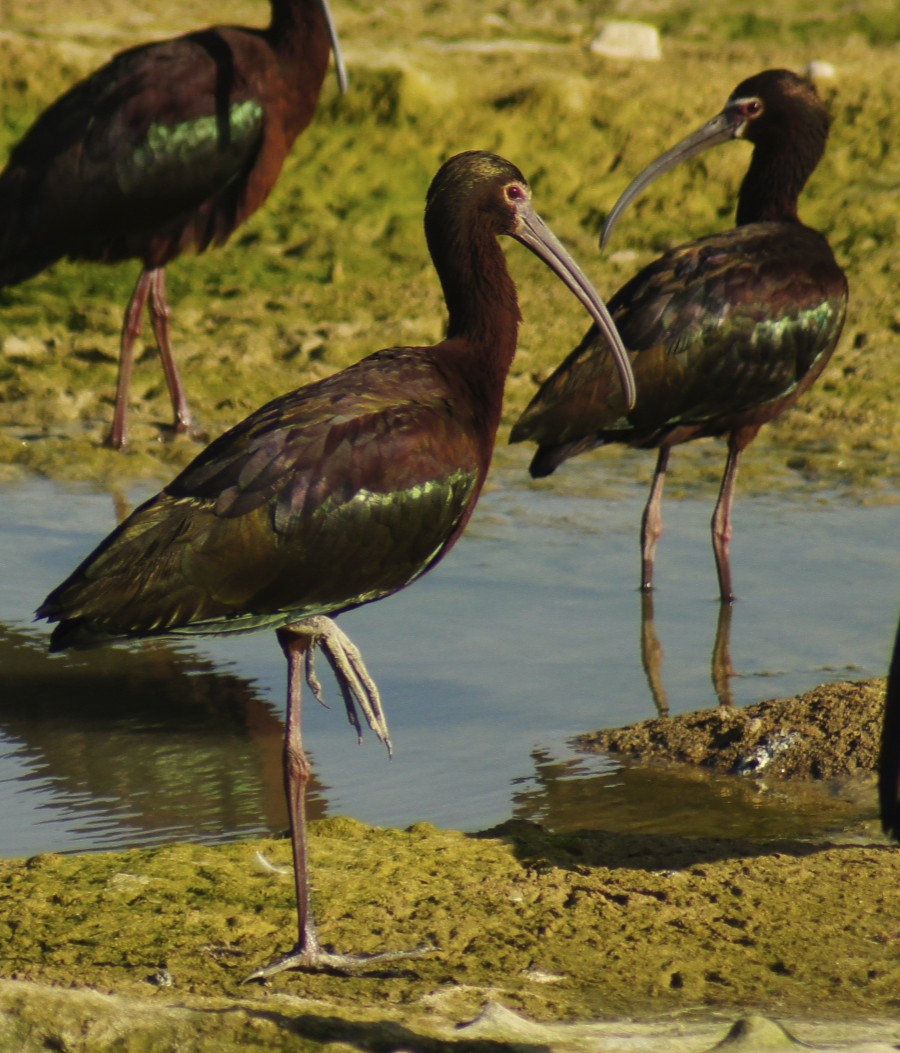
Monday, May 14, 2012

Birding the Arizona Beach

It seems like spring only lasted for a couple weeks, and now we're already into summer. Perhaps that explains the recent beach posts on lots of birding websites. As the sun climbs higher and stays longer in the sky, we start to pine for the breezy shores and salty air. Chris Rohrer over at Las Aventuras, Gordon Karre over at Birding Adventures, and Seagull Steve at BB&B have all had some excellent recent posts revolving around beach birding, and they've got me yearning for the shore. Alas, central Phoenix is a far cry from the Pacific Ocean, but to try and keep myself sane these last few weeks, I shall endeavor to deceive!

These accounts and photos are from the Glendale Recharge Ponds, a bleak, ugly place in northwest Phoenix that offers surprisingly good birding around the holding lakes. This is my place for shoreline birding. So take a whiff of saltwater, hold some seashells to your ears, close your eyes, and pretend you're now at the beach (don't really close your eyes; then you wouldn't be able to read the post).....


So, here we are at the beach. It must be low tide, for there are no waves and the water is rather shallow. Thinking little of the low water level in the ocean or the faint smell of distant sewage, we unfold our rickety beach chairs, stick an umbrella in the ground, and soak in the scenery.


Upon closer inspection, we see that the shoreline is dotted with Semi-palmated Plovers, an uncommon bird in Arizona but a predictable sighting for us here on the Pacific coast...


While the Plovers scurry around the tide pools, we notice some shadows from above. Looking up, we see some Cliff Swallows catching bugs with exceeding delight.


They dip and turn and bank with impressive agility. Clearly, this a bird designed to fly and fly, to spend its life in the sky.


A larger, lumpier shadow moves across the beach. Again looking up, we see an American Avocet coming in to land. Beautiful and graceful though these birds are, they do not look so comfortable in the air. The upturned beak makes perfect sense for skimming through the shallow mud and muck, but now makes the Avocet look like it crashed into a window.


There's a lot of traffic in the sky today. Several Caspian Terns fly overhead, reveling in the knowledge that they're one of the largest and sleekest aviators in these skies.
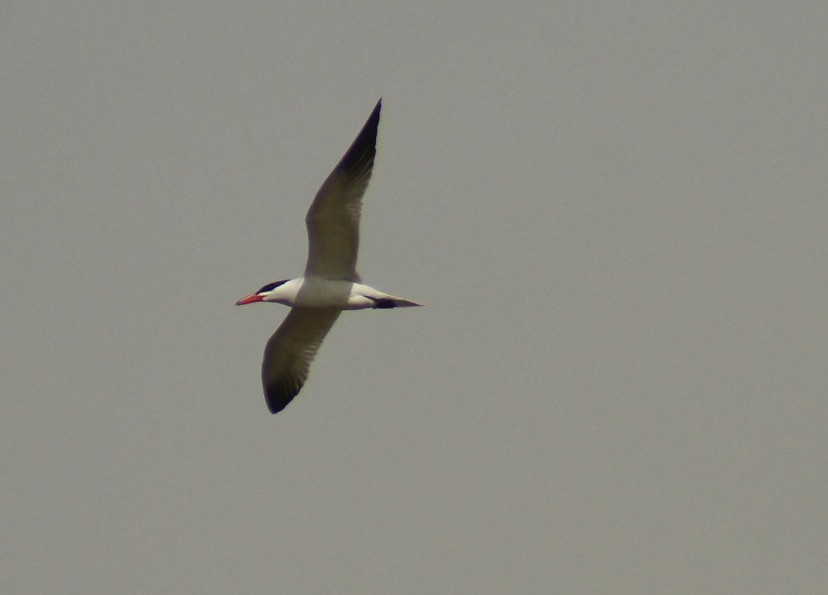

This too, would be an unusual and exciting sighting in Arizona, but since we're on the Pacific Coast we won't get too energized...


We've been studying the sky for a while now and our necks begin to hurt. After reaching for a cool beverage and leaning back in our creaky chairs, we again scan the shoreline for adventurous peeps, such as this Spotted Sandpiper popping in and out along the rocky wharf.


The Spotted Sandpiper seems determined to keep its feet dry, but eventually the allure of tasty treasures draws him into the water. Come to think of it, that sounds pretty good!


As we make the short walk down the beach, a startling cry echos from the right. Of course! It is a Killdeer, the common and noisy Plover near and dear to our hearts. He's standing along a rocky outcropping, blending in very nicely. Since this is the Pacific beach and not an Arizona sewage pond, we marvel at this unusual and refreshing sighting!
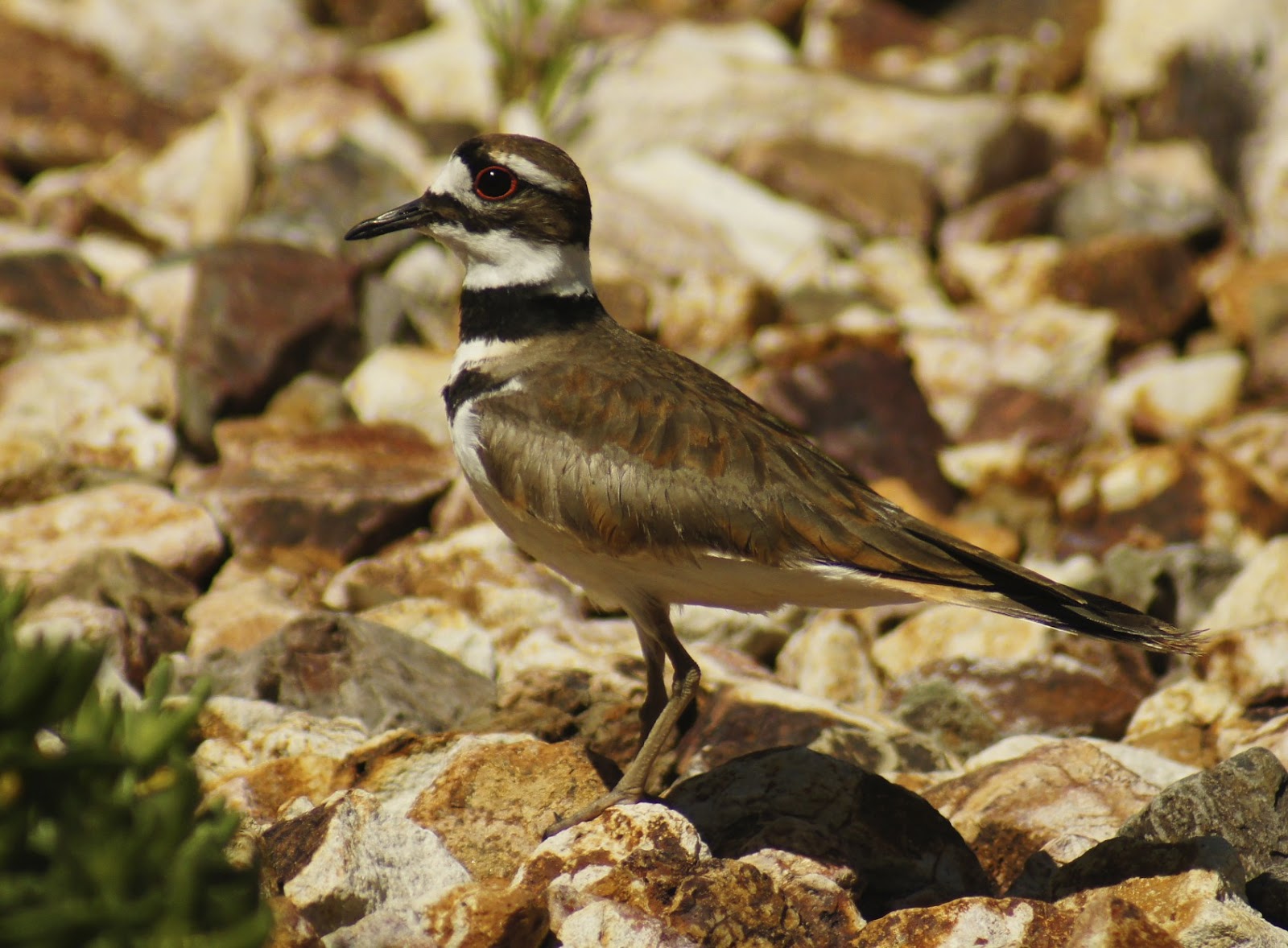

Ahh...a quick dip, some picnic lunching, some more cold beverages and it's time to pass out. What a lovely trip to the beach this was!

Friday, May 11, 2012

Land o' Larks

Lark Bunting, Lark Sparrow, Meadowlark...it seems like the name 'Lark' is often put with birds that aren't even in the family, strictly speaking. The Horned Lark is a true lark--a ground-dwelling bird with long hind-claws and a preference for singing while in flight. They're also really cool looking birds, ones I see fairly often at the Glendale Recharge Ponds in Phoenix but seldom approach.

Even from afar, their distinct plumage and hoppity hop hopping around makes them easily recognizable. I made it a goal last week to get some better pictures of these unique North American Larks, and this required that I venture out into the dry basins they call home.


In my personal experiences, Horned Larks do not tolerate a close proximity to people. But I've also heard of people driving by them on the side of the road, particularly in the midwest, where they'll be feeding in a very casual fashion.

At any rate, my objective was going to require some crawling, slithering (which I don't do very well), scooting and slinking. With this spongy red weed covering lots of the drying mud, it was a neat experience, as if I was exploring an alien planet. The male Lark shown above was always heading away from me, but his female companion decided she liked her spot, and let me get pretty close.


Alas, she lacks the manly mustache of the male Horned Lark, but is still a very pretty bird. She seemed to be feeding on the shoots of grass that managed to poke their way up though the dry soil. She'd bend them down with her Lark feet and then nibble away.


It was really nice to get in close and get some better photos of these cool and delicate birds. It was also really nice to slither away without disturbing them too much. Why is it that people are always disturbed when I slither away from them? I'm just trying to be considerate...
Here's a male I saw while driving around the Santa Cruz Flats in December.


Wednesday, May 9, 2012

The Least Bittern

These Bitterns have it rough. They're one of the smallest birds in the Heron/Egret/Bittern group. Their larger cousin, the American Bittern, is renowned for its patriotism, even though it too, like the Least Bittern, prefers to hide or flee instead of fight. Perhaps the Least Bittern's trouble is that they are too good at hiding. They're small, quiet, and very well-camouflaged for their reedy habitat.


Usually I see Least Bitterns as they're flying away from me or retreating into the cattails. This past weekend I was fortunate to see four Least Bittern at Tres Rios. Alas, I saw all of them in the usual startle-and-fly method, which always makes me feel like a clumsy unobservant oaf. But as it wasn't yet too hot and I was really hoping for some pictures, I decided to maintain a stake out for one of the birds that flew across the river, but did not disappear entirely.


I could follow the bird through the reeds by observing the swerving plants, and after five or six minutes it emerged at the edge of the cattail hedge to reassess its surroundings.

I totally dig the pin-stripe pattern on the neck. These birds aren't especially uncommon, but their secretive nature and neat coloration ensures that they're always a pleasure to see, and never a sight to take for granted.


Monday, May 7, 2012

Mondays: Morose and Morbid

As we get closer and closer to summer, it seems harder and harder to make it through each week. Somehow, it seems like time slows down, and yet we still don't have enough time to get everything done. Instead of being chipper and trying to lift spirits, here is a presentation of some blackbirds I've seen lately, come to commiserate with us minions of Monday.

I don't see them too often, so it's refreshing when there's a Brown-Headed Cowbird out in the woods. But this bird is brown, black, and doesn't have the same iridescence or colorful eyes as other blackbirds or cowbirds. He's got the Mondays every day of the year.


The Black-Tailed Gnatcatcher isn't so dark a bird. He tries to put on a bold face, tries to bounce around with great energy and cheerfulness, much like we do with our Monday morning coffee. Do not be fooled by his optimistic showing. Deep in those eyes you can see the remorse of a bird that knows full well he can never escape his dark shadow...


Even among Hummingbirds, there are the comparably muted species. This Black-Chinned Hummingbird is still handsome, but is perhaps the least colorful of the family. He knows it too...


It's a treat to see the little ring of purple, but can only be done as the bird's face disappears in darkness. Such a sad trade-off.


If there's one bird that really makes black look good, it's probably the male Phainopepla. This bird weathers Mondays better than most of us, perhaps because he has awesome hair.


But as you can see, this bird is always seeing red, and at times he will lash out--usually against small bugs and such.


Even the handsome Phainopepla can sometimes be overwhelmed. When he realizes that it's only Monday, he is known to let out a shout of dismay, much like the rest of us. Unlike the rest of us, this shout has the added bonus of attracting females.


The Redwing Blackbird is a resilient bird. He knows that Mondays are hard, but he has a nice lunch break to anticipate. Here, he's chowing down on cattails. You can see how the stalk is nibbled away like an ear of corn right up to the bird's right foot.


All lunch breaks come to an end. As he realizes his happy eating time is over and he must get back to the grindstone, the Red-Winged Blackbird feels the same dismay as the Phainopepla, the same dismay that can be found, from time to time, inside us all.


Eh, maybe I'm exaggerating. Monday's aren't too bad. I guess the worst part is just that they mean I won't be able to go birding again for a while.

Happy Monday. Have a good week y'all!

Saturday, May 5, 2012

The Little Things In Life

It seems like all around the country, autumn went ahead and skipped winter, moving right into spring by the end of February. Though it's early, there are now young birds all around the Phoenix birding spots, and it's totally delightful. Of course, just because some birds have already brooded doesn't mean they're all at the same stage. This pair of Sparrows were behind the times, but better late than never!


It's great to have the spring migrations coinciding with breeding/fledging season. I was lucky to see an entire Bullock's Oriole family in the same tree--ma, pa, and 2 kiddos--a great treat and one which embodies the young and colorful feeling of this season so well.

From his colorful perch, the pater familias oversaw his brood work out the kinks in their foraging techniques. Unlike many of the other desert birds, Orioles, are pretty and proud creatures who refuse to perch on ugly things.


While pops stood proud and tall, junior skulked in the shady branches. He peered nervously around while eating, as if he was worried someone might be watching...


The Orioles like to stay higher in the trees, and this makes the color composition more interesting, if more challenging to photograph. Of course, I'd probably be grumbling if it was a new bird that I wanted to see up close--fickle as a finch am I.


Look at all these yummy flowers; this Oriole has it made! Though this bright bird's cup did overfloweth with nectar, that didn't stop him from being a real whiner. He squawked and screeched as if he thought the whole world was lucky just to hear his cracking voice. These Orioles are beautiful, but I must admit I find their sound to be bullocks.


While the Orioles are starting to fill in the tree canopies, the Gambel's Quail are pairing off down on the ground. They're much more common than the Orioles, and it's a daily occurrence to see them on their evening dates all over Phoenix. This Thursday I saw my first Quail chick of the season. The little rascal (alfalfa, I think, given its hair style) seemed to be an only child--rather odd. He'll be the oldest kid in his grade and he'll be spoiled rotten...lucky duck (Quail).


While this camouflaged couple picked through the desert detritus, Mr. Quail looked on from his elevated and verdant dinner chair. Soon his vigilance gave way to the tempting bean stalks hanging in front of him, and he started pecking away.


Foraging Quail are a common sight. This is the first time I've been able to witness the precise destructive power of the full-grown Quail beak. See the little snippets, the little bite marks taken out of the bean stalk? It is a widely believed fact that Quail bite down with an astounding 33,469,000 psi--about the same compressive force as a black hole, or Thor's vice-grips. The beans never stood a chance.


At first this stately cock kept his reserve and nibbled with the proper dignity, the dignity befitting his renaissance headgear. Eventually he lost patience and severed the stalk, rending it asunder in a way that would shock even the most iron-stomached vegetarians into carnivores.


Of all the young birds out and about these days, by far the most adorable has been this puffy, fluffy, stumpy and lumpy Curve-Billed Thrasher. I like Thrashers a lot, but I wouldn't say they're especially beautiful or aesthetically pleasing birds (except the Brown Thrasher). I wouldn't have expected them to make such cute babies. It's like the 'Ugly Duckling' story except backwards (and, I guess, we already know what species this bird will turn out to be). Most adorable chick ever? Perhaps.


There's been so much great birding these last couple weeks. It's amazing to think that things are just now heating up; there is a whole summer of birding festivals and migrants yet to come.

Friday, May 4, 2012

Roadkill Over at Birding is Fun

Hello Readers,

Today is the 4th, which means my monthly post is up over at BirdingIsFun. Between you and me, this is one of my favorites. Check it out!

Tuesday, May 1, 2012

New: The iBis 2.0 and Philandering Phalaropes

Until last week, the White-Faced Ibis were still shy, irregular birds in the Phoenix-area marshes. They stayed far away, were skittish, and their batteries ran out way too quickly, much like other Apple products.

Here's the older model: an amazing thing in itself, but not the finished product, not the final form.


With spring now getting off its fanny, Apple has introduced a new model. The iBis 2.0 seems to have replaced those timid, duller colored birds all around Phoenix now. Where there might have been two or three scrawny birds standing in the murk there are now dozens and dozens, with many more still flying overhead. They're shinier, they're hip, they combine the color and iridescence of songbirds with the ungainly and endearing frame of a wader. In short, these new iBis 2.0s are much more user friendly, and they've been great fun to observe.


It helps that there's been an algae bloom in lots of the recharge ponds around Phoenix too. These oft-desolate basins are now packed with color, even if it is an unearthly shade of green. Stare at this snapshot for too long and one might even feel like one's left earth altogether. If you do float off, not to worry, like other great Apple products, the iBis 2.0 has a nifty GPS.


The iBis are not the only birds sporting a new look and attitude. I was very lucky to see a Red-Necked Phalarope at the Glendale Recharge Ponds a few weeks ago, and now the same ponds are serving as a rendezvous point for little groups of Wilson's Phalarope.

Here's a pair of males enjoying some quality guy time as they chat about mustaches, engines, stock portfolios, etc.


Phalaropes are an interesting family of birds. They've taken the Sadie Hawkins Dance and turned it into a lifestyle with their typical gender roles reversed. The female Phalaropes are larger and more aggressive than the males. They also have much bolder plumage during the breeding season:


Just like at a Sadie Hawkins dance, the lady Phalaropes pursue and try to entice the males with their whimsical wicked wiles. Once they lay their clutch of eggs, the females depart and leave the males to incubate the eggs.

There were about two dozen Phalaropes at the Recharge Ponds on Sunday evening. This male arrived a little late to the mixer, perhaps due to his extensive application of rouge, but he soon integrated himself into the party.


It looked like they were having a charming little gala, but even Phalarope parties can get crashed, and in this case the crashers were some precocious Mallard chicks. It was kinda funny that the Mallard chicks were almost as big as the adult, breeding-plumage Phalaropes.

Monday, April 30, 2012

Short-Billed or just Short-Changed?

I recently photographed a small group of feeding Dowitcher. As always, I was on the look-out for a Short-Billed, having never conclusively found one before. One of the birds stood out from the pack this time. It seemed lighter and smaller than the other Dowitchers. Of course, none of those things in themselves prove it's a Short-Billed, but if anyone can venture a guess from these grainy photos I'd appreciate it.


I'm not getting my hopes up, but you never know...

Sunday, April 29, 2012

Thrushed with Orioles and Orioled with Thrushes


While out birding at the Botanical Gardens on Friday I had the pleasure of adding some new birds to my Garden list. Chief among them was a group of four Hermit Warblers foraging underneath a very large mesquite tree. 


Hermit is a good name for this skulking Thrush. Hermit Thrushes have a very pleasant, somewhat melancholy song and prefer to feed in the leaf litter underneath thick shady trees. They're soft, spotted, and polite, yet also fairly inquisitive within their small domains. I don't see them that often in Arizona, and their preference for shade can make them tricky to photograph. 
This first shot summarizes the bird well, at least in my experiences--close to the light but never fully illuminated. 


Like finches and sparrows, Thrushes have something very appealing in their simple yet unique and intricate plumage.


Here is the diagnostic rufus tail, the surest way to tell the Hermit Thrush apart from other, similar looking Thrushes.


They're compact and have good posture. They inhabit a small niche, but it's always a pleasure to enter into their world.


The Botanical Gardens were very crowded on Saturday, and it was hard to find any corner of the site with a little bit of quite and privacy. For the first hour or two I saw little of note. I was convinced there was someplace within the grounds where the birds might have retreated, some place where they were concentrated while trying to avoid all of the traffic. I don't know if there was anything to that theory, but I found a path of mesquite and palo verde trees near the herb garden tucked away from most of the other visitors, and sure enough there I found some new birds for my Garden list.

It was a near-overload of yellow and orange as a pair of Bullock's Orioles gleaned the palo verde blooms. It's safe to say that all Orioles are mouth-watering birds, and the Bullock's is a pretty classy specimen.


I've only had a few opportunities to photograph Orioles, and this was the first successful attempt, since this Oriole was thoughtful enough to do some quick preening out in the light. He gave me a great look at his diagnostic white wing pattern.


Not wanting me to have too much of a good thing, he quickly departed. Beautiful bird.


There were some small birds doing small bird stuff in a nearby mesquite tree. Upon closer inspection, most of them turned out to be Gnatcatchers and Brewer's Sparrows. My old photographic nemesis, the Wilson's Warbler, also made a quick appearance. This was my first time seeing one at the DBG, and I came very close to finally defeating this ornery yellow bird.


I even got most of the bird in focus, but of course OF COURSE there's a nice patch of shade obscuring the face. Ah well. Summer is just beginning and we'll meet again...mwuahahahaha.