Saturday, April 6, 2013

One and Only Patagonia

The Spotted Owls at Miller Canyon were a miss yet again, but like any good birders, we had a contingency plan in Patagonia. Sure, there are some other famous Patagonias in the world, but nine out of ten birders agree that Arizona's is the best. By heading southwest and then looping back up towards the Santa Ritas, we'd be able to spend several hours in this veritable birding mecca of southern Arizona, and that's really saying something for the area. We hoped to find a lifer Black-capped Gnatcatcher at Patagonia State Park, as well as the wintering Trogon that has been returning to parts of the Sonoita Creek off and on since the late 1990s. But before any of that we had to stop by and pay our respects to the Paton House, one of Arizona's birding landmarks. 


For the last half-century this property has been maintained with its many feeders and bird attractions, providing some excellent, at-ease birding for those staying in town or just passing through. The current caretaker, Larry Morgan, is also a very knowledgable, experienced birder and is often flush with up-to-date information on recent sightings in the area.


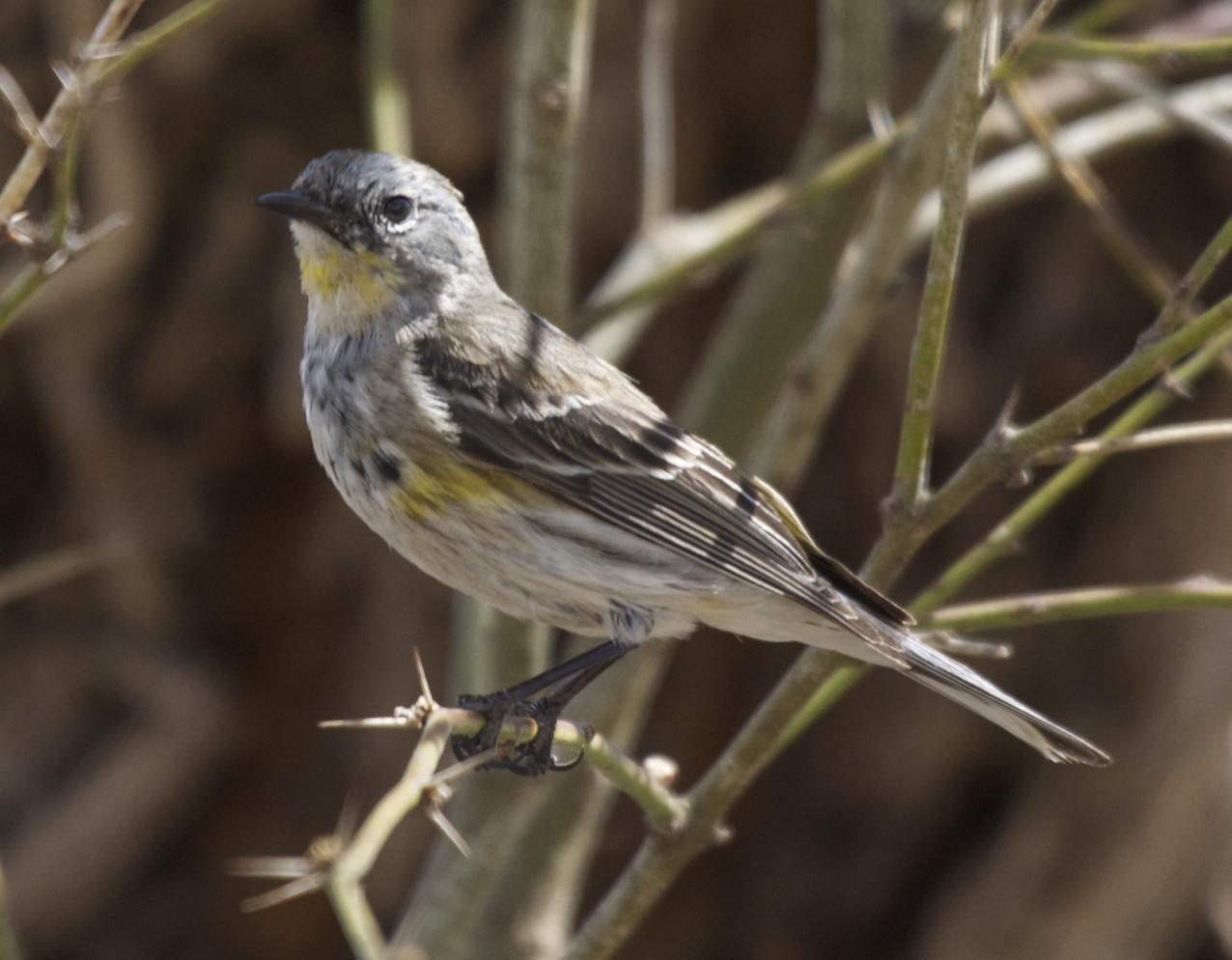
It was about midday when we arrived--hardly ideal timing--but we nonetheless had some very nice sightings, including first-of-the-year Lazuli Buntings, along with Pyrrhuloxia, White-winged Dove, and a million billion Broad-billed Hummingbirds. Naturally, the only bird I photographed was a ragged Yellow-rumped Warbler that wasn't even in its nice breeding plumage. Just gotta be different...

We missed the Scott's Orioles by only a couple of minutes, but had some brief, satisfying views of the Paton House speciality Violet-crowned Hummingbird, which has been reliably found here for the past several years. These white-fronted Hummers turn up elsewhere down south, but nowhere is so reliable for them as the Paton place.
Missing the Scott's Orioles still puts me in the peculiar position of having only seen Orchard Oriole in Arizona for the 2013 year. That is rather backwards and shall have to be remedied directly.


After a thirty-minute stake-out at Paton's, we proceeded towards Patagonia State Park, keeping all of our various sensors peeled--eyes, ears, noses, radar, potatoes, etc--and it paid off when we had a promising silhouette fly over the car and a nearby butte off the Highway 82. In hopes that the raptor would circle around, we pulled over to the side of the road, parking on the wrong side with doors hanging open and all concern for safety hanging with them.


Not only did our raptor swing around for another pass, but it was joined by a buddy, and I was treated to the best looks and photos of Grey Hawks I've yet managed. Abiding traffic laws is for chumps (**I'm a chump 99.5% of the time).


Getting to see these unique raptors was a real treat. They're basically hawks in evening suits, and they ooze more class than a Princeton course on viniculture attended entirely by Spanish aristocrats wearing french cologne and smoking Arturo Fuente cigars.


We got pinged by the somewhat steep entry fee for Patagonia, but as soon as we parked near the Sonoita Creek trailhead, east of the visitor center, we had more promising sightings.
By soaring high in the cloudy skies and keeping the sunlight on his back, a Common Blackhawk did its very best to disguise itself as an ubiquitous Turkey Vulture. Silly Common Blackhawk...your wings are too fat, and your tail band is showing!


The first portion of the Sonoita Creek winds through some mesquite bosque, which was particularly pleasant habitat with the recent rain softening and greening things up. In these low, scraggily trees lurked a potential lifer in the annual but ambiguous Black-capped Gnatcatcher. A male Black-capped Gnatcatcher can be told apart from the similar looking and sounding Blue-grays, but that would be just too easy.
After checking out some Gray Flycatchers and other mesquite lovers, we heard a Gnatcatchery veeer, reminiscent but different from that of the Blue-gray. When we finally got some brief sightings of the bird, naturally it was backlit and clouded over, but I think we got enough to make the ID. Both female and male Black-capped Gnatcatchers have a proportionally longer beak and more graduated primaries on the tail, with a touch more black as well. It's hard to pick these plumage subtleties out in the field; luckily we got a few photos to examine in the dark room afterwards.


The Sonoita Creek trail and mesquite bosque open up to cottonwood riparian habitat as you head east of the lake, and here we had some more great birds such as Lucy's and Yellow Warbler,  as well as Cassin's and Bell's Vireo. This certainly was not my nor Tommy's first time down the trail, and there were a half-dozen other birders in the area as well. However, the most veteran explorer of Sonoita Creek was actually our other target for the site. 
While most Elegant Trogons wait until later Spring and summer to really press north into Arizona, a single male Trogon was been wintering along Sonoita Creek since, allegedly, the late 1990s. In a sense he's sort of the Pater Familias of all the other Arizona Trogons that have followed in his footsteps, exploring further north into the Santa Rita Mountains and elsewhere. The documentation of this individual bird is as extensive as it is impressive, and despite seeing Trogons elsewhere and visiting Patagonia many times, I'd never seen this particular bird.
About a half-mile from the lake, down the Sonoita Creek Trail and hanging out in the mid-level scrub...that all changed.


The brilliance of the male Elegant Trogon really can't be overstated. It is one of the most colorful, bodacious, and grandiose birds that occurs in North America. That doesn't make them easy to find either. Especially in the winter/early spring months, when these birds are silent, it comes down to luck and persistence. Scanning scrubby tree after scrubby for that green and red...eventually we spied this fellow sitting perfectly still and perfectly comfortable. It was silent; it was stunning; it was surreal.  


Of course, we were only two of hundreds, even thousands of birders who have ogled this Trogon in the last dozen or more years, but that did nothing to dim the magnificence of the sighting, especially because in the silent wood, we were only twenty feet away from the bird, and we had it to ourselves.


Unsurprisingly, this old fella was used to people. He patiently indulged us as we filled our memory cards with face melting images. He showed all his sides, including the resplendent, shimmering back, and even took a break to catch and eat a caterpillar during the shoot--the action of which I unfortunately missed, but here you can see a bit hanging out of his beak.


It worked out splendidly well. We couldn't have asked for better looks of the bird, and we were close enough that the cloudy weather didn't corrupt the sharpness in the photos. It was just another day in the life for Mr. Trogon, but I daresay we were positively glowing. 


After getting our private session with the HIs Elegance, we then had the pleasure of being able to share the bird with some other birders passing through. 


There was an older couple who began recounting when they saw this very same (presumably) bird ten years before, a group of four younger birders (it feels weird saying that...) who started geeking out about it hard, and some folks visiting from Colorado who were not expecting such a sighting and were overjoyed. To be fair, we were expecting the sighting, and were also pretty ecstatic. Here's Tommy, with the Trogon in the background. The bird stayed so still, we could've taken family portraits with it.


It was only early March, but bird sighting/experience of the 2013 year? Very probably.


Still buzzed from the Trogon, we stumbled around Patagonia for another hour like drunken sailors aboard a drunken ship in an ocean of beer. The Sonoita Creek trail yielded a few more cool birds, and we scanned the mesquite for further sightings of Black-capped Gnatcatcher, since we did not feel satisfied with our earlier sighting at the time. Eventually we decided to swing by the Patagonia visitor's center and then head north to the Santa Ritas. 
Much to my relief, the visitor center was open and had bathrooms. More pertinent to a bird blog, it also had Broad-billed Hummingbirds, along with a few White-throated Sparrows.


Even around 2pm, it seemed like the birds were out and everyone was having a great day. But while the people and critters of Patagonia all enjoyed the cool weather and were generally congenial, one sour bird sat and moped, perhaps contemplating some past insult or plotting a revenge.  


Blarg! This was, without a doubt the grumpiest Green-tailed Towhee I have ever seen. Usually they're such chipper little birds, colorful on the outside and the inside. Not so with this misanthrope; he looked like that surly Internet Cat's best buddy, if crotchety animals can have best buddies.


Before you ask, yes this bird haunted my dreams for weeks afterwards. It was too grumpy to even bother flying away. I was all smiles and taking photos, and it just kept staring and staring, letting the shame and loathing set in until I hung my head and backed away...backed away...backed away.


The Green-tailed Towhee was a buzz-kill (not really), but once again Patagonia delivered with some the best birding I've yet experienced in 2013, and that was my feeling even before examining the Gnatcatcher photo too, so the life bird was just a bonus. I got to visit my best buddy the Trogon again, and see some other magnificent birds along the way. 

It was almost a lethal overdose of birding. Luckily this all occurred during my spring break week, and I didn't have to work again for several days. Upon returning to Phoenix I had severe withdrawal symptoms and was incapacitated for some time. Visit Patagonia but be careful. It will ruin you.   

Wednesday, April 3, 2013

Miller Time: The Not So High Life...

Last year when I visited Miller Canyon in the Huachuca Mountains, it was an all-round fabulous trip. Alas, I dipped on the famous Spotted Owl, but came away with several new, closely photographed Hummingbird species, along with lots of the other southeastern AZ species.
A few weeks ago I swung by again, this time with more support both for the drive down and for some hard core birding throughout the day. My friend Tommy had tried for the Miller Canyon Owls before and dipped before too, in fact several times, but on this trip we were both feeling good about our prospects. Things started off well too, when he had some direct information from Tom Beatty Sr. of the Beatty Guest Ranch in Miller Canyon, on where the Spotted Owl had most recently been seen. After only ten minutes in the canyon, we even had a glimpse of an awe-inspiring Northern Goshawk making its way up the canyon--talk about a good omen!

Well, it actually was a bad omen. Maybe the Goshawk had the Owls keeping a low profile (good call there, Owls), but at any rate after several hours of frustrated searching, inclined hiking, and in my case one lovely half-turn spin pirouette backwards dive/fall into a ditch, we could produce no Owls, even amidst the sounds and sightings of many other great birds, including some firsts for the year like this Painted Redstart.


We heard the Goshawk calling off and on, though it too stayed elusive for the rest of our time, and had to contend ourselves with picking out Arizona Woodpeckers and House Wrens from the scrub oak and occasional pine. With many birds singing and less frequently seen, it was great exercise in audio birding, but otherwise there wasn't too much to show for our Miller Time, especially as the Goshawk was seen before there was any light for photography. I shall have to return once more.


While we were in the area, we briefly swung by Mary Jo Ballator's Ash Canyon B&B, just a few miles up the road from Miller Canyon. Her plentiful feeders often host a Lucifer hummingbird--one I still need for the ol' Life list--and are often a good spot to get local news on sightings and general bird goings on. We only tarried for a little while, and did not have the Lucifer's either, but did see some Coue's White-tailed Deer along the road.


Mexican Jays, one of the loudest and most abundant residents of the southeastern sky islands, were also predictably visible. While always fun to see, they were scant consolation.


We left the Huachucas and headed to Patagonia, where he had several hours of fantastic birding, too fantastic for me to mention here and still maintain the lugubrious nature of this post, so that all will be posted separately and later!
We ended the day in the lower reaches of Madera Canyon, first stopping by the Proctor Road turn off to look and listen for Northern Beardless-tyrannulet. We did succeed in the hearing portion, but failed in the seeing. We did see some other nice birds, including some handsome Black-throated Sparrows. We also heard what sounded like a cow giving birth to a small moon, but turned out to be merely a cow just sort of belching (no photos, out of respect).


Farther up Madera Canyon we spent the twilight hour by the Madera Kubo, adding Hepatic Tanager, Rufous-crowned Sparrow, and Yellow-eyed Junco to our list for the day. We also had some nice visuals and mediocre photos of Magnificent Hummingbirds, which we had seen and heard earlier in the Huachucas as well.


The Santa Rita mountains are fabulous birding and a visit there is never time poorly spent. Even our semi-bust of a trip to the Huachucas still had its highlights, and Patagonia gave us plenty as well. With the bookends to this recent trip down south now established, I can follow up with the substantial middle chunk of the day soon. Stay tuned!

Sunday, March 31, 2013

The expanded guide to solving all empid enigmas (not really, no no no no no) is up now over at Birding Is Fun.

Check it out, for your sake and the sake of your children!


Saturday, March 30, 2013

Bull's Eye at Buckeye

During my spring break week I was able to visit some phenomenal and far away birding sites, with Patagonia and Madera Canyon down south and Mormon Lake up North being some of the highlight trips. During the subsequent week of work, I was of course still on a high from a week of near-nonstop birding, and given the great anticipation for a continuation of great birding, I had to plan that precious, upcoming Saturday carefully. With it being a holiday weekend and having some other responsibilities to attend, I decided to keep it fairly local and head out west to the Buckeye agricultural areas, with a stop at the Base Meridian Wildlife Refuge along the way.

The Base Meridian Refuge is essentially a little preserve where the Tres Rios water reclamation site ends and the Gila river continues to flow. It's one of the better places to try for Clapper Rail in central Arizona, and while my chances were still slim, that was the plan. Heavy overcast (for the third weekend in a row!) nixed the photography from the start, and in general the area wasn't very birdy. Some surprises came in the form of a Cattle Egret mixing it up with a few Snowies and a Barn Owl that flushed from under the northern end of the Avondale Bridge. Apart from these year birds there wasn't much to report, and I quickly moved farther west. It's the end of March and that means the birds they are a changin.' Well, some of them at least. 


Along Palo Verde and other north/south roads in Buckeye, it's now prime time to go trolling for Swainson's Hawks, the Hawk that wants to be a Falcon. These pointy-winged, long-tailed Hawks can currently be found perched on the ground in fallow fields and low farmlands as they refuel and rest up in their continued journey north. It's still on the early side of migration, so their numbers will continue to grow and a few weeks from now there will be real spectacles, with some fields hosting dozens and dozens, if not hundreds, of these grounded raptors. They come in a dark, light, or intermediate color morph, all of which were on display today but not all of which were photogenic. 


There were thirteen Swainson's Hawks in a field of Lower River Road and Palo Verde, and a bit farther south was another conspicuous raptor perched in an old cottonwood tree. When first approaching the bird I was thinking the white indicated a light-morph Swainson's, but when I had a full frontal view the predominant white and the feathered legs ID'd this bird as a juvenile Ferruginous Hawk. I hadn't taken any presentable photos of Ferruginous Hawk this winter so I was glad to have an opportunity, even if the hazy overcast made things less than ideal.
This young bird hasn't yet developed the rusty flanks of the adult Hawk, and still has the yellow gape of immaturity on its beak.  Even so, there's a burgeoning ruthlessness in those eyes...

"When I grow up, I'm going to be a mammal mass murderer..."

It's also that time of year when a new, but familiar silhouette again adorns the agrarian utility lines. The Western Kingbirds are prominent perchers and a common sight, but keep an eye out for Cassin's, and maybe even a Tropical, trying to disguise itself with these similar yellow-bellied tyrants.


When I first arrived at the Base Meridian site in the very early morning, I witnessed several hundred Ibis leaving the Tres Rios site in different flocks. They were all heading out west to graze in the Buckeye and Arlington fields. and I came across a group of sixty or so birds foraging near Palo Verde, not much farther north than where it terminates. Seldom do I get close to these birds at Tres Rios, so it was nice to run into a group out where the terrain isn't as limiting.


After finishing the raptor scanning, I headed farther west to the Arlington Wildlife Area off of Arlington School Road. This series of ponds and marshes borders some very lush farmland and is also a good spot for Rails, as well as the other expected waders and riparian birds.


Unsurprisingly for this time of year and this time of day (10am), I heard no clacking Clapper Rails. Instead, Yellow-headed Blackbirds filled the air with their tormented, metallic call as they sought to establish territory and prove their manliness.


There wasn't too much happening at the Wildlife Area, but the adjacent farmlands were very popular. A few dozen Great Egrets and Yellowlegs loped through the tall grass. The most exciting find there, even though it was not a new bird for the year, was a flock of forty-nine Long-billed Curlew. I had seen a couple of Curlew in this area before but they were distant and flying away from me--not a very satisfying way to see North America's superlative sandpiper.


This time they were contentedly grazing and gossiping in the tall grass, grass that would've frustrated and thwarted birds with lesser beaks, so I was able to spend a goodly while observing and photographing this incredibly cool species.


I took Arlington School Road back east, stopping along the way to gawk at a massive kettle of birds along one of the canal roads. When I reported thirty Black Vultures the eBird automated check was a bit incredulous, but hey there ain't no arguing with this, and if anything I under-counted.


Not that Black Vultures prefer to argue either. They'll just wait til' you're dead, and then have the last word. The cloudy weather was a bummer for photography, but I was able to have lots of close-up views to compensate for the poorer image quality. It was a super Saturday of birding, full of year birds and satisfactory sightings that made the wait for the weekend well worth the anticipation.


I'll follow up with more photos and specifics on each location and the sightings throughout this week, and hopefully that enduring focus will get me through to the next weekend!

Tuesday, March 26, 2013

Rough Around the Edges: Mormon Lake Grasslands

Last weekend saw my final days of March Madness, my spring break week in which I was able to do lots and lots of birding, to see what the world would be like fifty years down the road (I already have the disposition of a seventy-something year-old too) when I can go out birding everyday. I had excellent birding adventures around Phoenix, and a truly marvelous day down in the southeast corner of the state (more to come on that later), so for my spring break's birding swan song I headed up north to Mormon Lake and Flagstaff. Spring, even uber spring, is happening down in the Phoenix valley, where we've already had record high temperatures in the 90s. That wasn't so much the case up north, where windy, 20-degree conditions greeted me outside of the car. Luckily I wore pants, but why bother seeking out wintery conditions in March? For this:


Yes, the largest natural lake in Arizona, Mormon Lake and its surrounding grasslands were hosting some serious BOIs (birds of interest). A listserv report from several days before listed Eurasian Wigeon and Rough-legged Hawk both being in the area. With limited time and scoping abilities, I didn't try very hard, nor find, the Eurasian Wigeon, but the Rough-legged Hawks were on the most-wanted list. Staring hundreds of yards down into the grassy, dryer parts of the lake bed, I could see some butiful buteo silhouettes.


Killer looks huh!? Even at significant distance, the Unshaven-legged Hawk seemed apparent for its different dimensions and gait. The Common Ravens didn't care if they were Roughies or Red-tails, and they quickly drove this bird away from its fence post. On closer inspection though, this bird had far too much white on its breast and belly. Despite it almost being a rarer sighting for the time and place, some of birding gurus pointed out that this is likely a juvenile Ferruginous Hawk, something that wasn't really on my radar (another newbie mistake, ugh!).


At the time I was assuming Rough-legged, since I had seen some kiting when I was first approaching by car. The distant sightings were not very soul-satisfying, and as it later turns out this wasn't even the right bird. There were other stops to make on the opposite side of the lake though, and with the morning growing older I decided to move on and then check again on the way back to the interstate. While continuing to drive south down Lake Mary Rd, which runs parallel to the eastern shore of the lake and amid the bordering grasslands, I was treated to the sights and sounds of signing Meadowlarks.


It was cold. There were snow banks in places along the road and a formidable breeze, but none of these   factors proved prohibitive to the loquacious Meadowlarks. Both Eastern and Western varieties can turn up in this area. Listen to the song and decide which species is singing here. 


Near the southwest corner of Mormon Lake, the Mormon Lodge and adjacent campsite provided some fantastic birding. It was great to get back into some high altitude pines--a habitat I haven't visited since last summer--and see the cool birds up there. There's something about high-altitude birding...everything just feels more rustic, more wild, more genuine and impressive when you see it. That material will be in another post. 
On the drive back up from Mormon Lodge, I kept my speed low and my eyes peeled for any Rough-Legs that may have perched nearer the road. Perhaps it read my mind, or I read its. Anyway, sure enough one of the Roughies was perched prominently on a fencepost maybe twenty yards from the roadside.  Of course, it chose the east side and was thus pretty back-lit, but I won't complain. 


I took a few snaps of this regal raptor, a sense of great wonder and satisfaction warming me up as I gawked at this stunning bird. Alas, I wasn't the only one who's attention was caught by the Hawk. Another fellow in a truck pulled over and parked just behind me. He must've been in a chatty mood, for he immediately openned his door and walked over to my car (which I was using as a blind of sorts). 

"Hey friend, watcha looking at over there, the Hawk? Oh yeah, I drive up and down this road all the time and I see lots a' hawks and birds along.....(he kept talking about stuff and things)."

"Well mister," I thought, "To answer your question, I am looking at nothing now. Nothing." 
The Hawk flushed when he got out of his truck. I probably wouldn't have gotten better shots anyway, but it was still a bit vexing. At any rate, as the bird retreated I got to see that white and brown tail too--another diagnostic sign--and overall felt much better about my sighting. If I had only the early morning opportunities, it would have been a long, bleak ride home.


This coming weekend it will be time to find some Swainson's!

Monday, March 25, 2013

Run out of Town on a Rail

Last week I fulfilled a long-time goal. No no, I didn't swim the English Channel in one breath or slam-dunk a basketball with ma' feet--those are still on the list. I had been wanting to bike along the Tres Rios spillway for a while, both for the general experience and to measure how long it takes to get from the 91st avenue entrance to the approximately 121st avenue termination. The best birding at Tres Rios is, in my experiences, in the first mile or so and then at the end, which leaves 2 or 3 miles in between to cover that's not very birdy and, in the hotter months, is a serious deterrent to seeing what's at the end.  Since there's no driving on the site, biking is the quick alternative, and in truth it only took maybe fifteen minutes to go the distance. 
The downside is that bicycle birding is not great birding. It's difficult to hear vocalizations, and while you can still pick up waterfowl and raptors, you tend to miss the smaller birds. Maybe it's just as well, because little buggers like this Wilson's Warbler always pose with a branch in their face anyway.


It's a really pleasant ride though, and I am glad to have scoped out the schematics for future expeditions when I need to go down the and back the site, and want to do it quickly. The real triumph of the day though was not just the minor feat of biking, but a nifty bird sighting. Very often at Tres Rios I hear Virginia Rails, but seldom see them. Whizzing by on a bicycle only exacerbates this problem, which means it just must've been a lucky day. Near where I stopped with my dad and younger brother to examine a chunk of dry-ice someone ditched out in the middle of the trail (Was it from a cooler or something? I don't know, it was odd.), I just happened to be standing in the right spot to see one of these common but elusive swamp chickens tip-toe out of the reeds.


With my frame largely concealed by the tulles, the Rail comfortably foraged around, sometimes in the sun and sometimes in the shade. Of course, it was often obscured from view too, but every few minutes it would stray into visible areas.


Ah yes, it might be impolite to stare at the bird's derrière, but there is much to appreciate in it's lateral shape--perfect for slinking through tall reeds with minimal disturbance. Thin as a rail...it's an appropriate expression.


It was most satisfying to finally see one of these birds out in the open. Eventually it spied me and bolted back to the reeds. That part of the experience was a little bit heart-breaking; here I was thinking we had been bonding and becoming good bro pals. Wild animals will always be wild, and they will always hurt you, eventually.

Sunday, March 24, 2013

Hustlin' Hassayampa

An hour northwest of Phoenix but still within Maricopa County is a totally sweet birding spot. The Hassayampa River Preserve is a beautiful and well-known riparian area fed by underground springs that make up the Hassayampa corridor. It's a fabulous birding site, far more fabulous than my subsequent photos will demonstrate, as migrating Black Hawks, nesting Gray Hawks, and tons of passerines turning up there every spring. Recently there have been impressive sightings of Williamsons's Sapsucker, Downy Woodpecker, Winter Wren, and in the past few years it has also hosted cool vagrants like Dickcissel and Green Kingfisher.

Here is the view from Lyke's Lookout, a tidy little hill west of the visitor center. This big strand of green is visible flying into Arizona from California and is one of the most extensive and densely foliated riparian channels in the state.


Unfortunately, I have only birded hew a few times. One big reason for my negligence is that the hour of driving must take place on Grand Avenue, a perverted freeway still possessing numerous traffic lights and speeding cameras, along with lots of aloof drivers. Grand Avenue is literally my least favorite place to drive in Arizona. It also has an entry fee ($5 isn't too steep though) and is closed on Mondays and Tuesdays. At any rate, my recent trip there was a reminder of how truly special this site is, and I promise to be more dutiful to it in the future.

At about 6:30am I met up with Tommy DeBardeleben, also known as the Mayor of Maricopa for his exploits in Maricopa County birding and blogging. If you've ever google-searched a birding site in central Arizona and been to this website, Tommy is to thank, and if you haven't, well, then you really should visit it. Anyway, he had clued me into a report of Williamson's Sapsucker at the preserve, a bird I was planning to chase at Boyce Thompson Arboretum but which had not been relocated there for a couple of days. We started our morning of birding at the Hassyampa rest stop, which is about two miles southeast of the actual preserve and is one of the best places to see concentrated Vermilion Flycatchers doing their thing.


Their thing is basically limited to perching and being gorgeous, devouring flies, and chasing each other around while trying to also perform flight displays. It was funny to watch all of these birds, because the males would perform their twittering fluttering flight displays for the ladies, and then also chase them away if they got too close to the favored perches. Life is full of angst for these birds. Can't have it both ways...

The Hassayampa Preserve opens at 8am, and for the next three hours or so we scanned cottonwoods, chased after shadows, and saw a lot of cool birds on the way to never actually finding the Sapsucker. Flocks of Lawrence's Goldfinches, calling Gray Hawks, and one flushed Black Hawk made for an excellent morning, even with our target bird a no-show. We did get some nice looks and vocalizations from an over-wintering Scarlet Tanager too, and I am ashamed to admit that this is the best photo I've managed of this canopy-craving species. Blotchy and pale...this bird is a mockery of the true Tanager form, but maybe he'll turn up again when he's more sexy.


In the vein of getting poor photos that are still better than anything else I'd managed, we also relocated a  tiny Winter Wren that Tommy had discovered at Hassayampa a while back. Yup, this grainy, twig-heavy shot is another personal best. Winter Wren played right into our hands...


By 11am, we were starting to feel that the Sapsucker would be a no-show, and the rest of the day's testimonials proved that this ultimately was the case. During this period we had also developed an unhealthy annoyance, even anger, against the numerous, distracting, false-hope-giving Ladder-backed Woodpeckers frequenting the same haunt as the Sapsucker. So that we could still take something great from the afternoon and not swear a vendetta against Ladder-backs, we swung by the private residence of another birder friend who has hosted a wintering Orchard Oriole for the last several years. Nothing about this occurrence and this sighting wasn't weird, but nothing about it wasn't awesome either.


Rather unbelievably, my first and only Oriole of 2013 is an Orchard, seen in central Arizona. For the next few months the birding will only get better and better at Hassayampa, and I intend to return soon. There's always great scenery and seemingly some rarity to chase too, even if you have to drive down (not so) Grand Avenue to get there (*note: there are alternative routes).

Friday, March 22, 2013

A Bit of Brit

Recently I listed myself as a birding reference though the Birdingpals site for people visiting the Phoenix area. This nifty network allows out-of-state or out-of-country enthusiasts to get in touch with locals and meet up for some birding or at least get some information about their locale. It's an opportunity to share some of the Phoenix area birding delights and meet some interesting folks, folks one might not otherwise meet out and about at the Maricopa County birding sites. I know what you're thinking and yes, it is indeed irresponsible for someone who makes as many clumsy ID mistakes and typos as I do to take people out and about the treacherous Sonoran Desert in pursuit of birds. We all know the risks... 

Last weekend I met up with Peter, a peripatetic peregrinating birder and aviation enthusiast from Lancashire, Britain. While he was in Phoenix for a couple of days we were able to visit several different sites, racking up lots of lifers, getting some great sightings, and also sampling cuisine better than the usual fast food to which one is often restricted when visiting a foreign place and staying in a hotel by the airport. 


After work on Friday I picked up Peter (with my car) and we headed over to the Desert Botanical Gardens. These beautiful gardens showcase a wide range of desert fauna, but post a staggering $18 admission fee if you are not a member. As one would expect, excellent desert habitats host excellent desert birds, and even some birds that aren't exclusively desert, but do just fine there anyway. Embarrassingly enough, this is the first time I had a visual on a Western Screech Owl, a bird I often hear and am taunted by at night. This fellow was in a north-facing cavity on a saguaro about 100 yards south of the wildflower loop trail. 


There are always Curve-billed Thrashers, Doves, and Quail around the DBG, along with Northern Cardinals and Ruby-crowned Kinglets is great numbers during certain times of year.


After doing a loop through the DBG, further picking up Gila Woodpecker, Red-shafted Flicker, Lesser Goldfinch, Black-chinned Hummingbird, and Blue-gray Gnatcatcher, we headed to the neighboring Papago Ponds, which are great spots for waterfowl.
Last week was absurdly warm, hitting the lower 90s on several occasions, and it proved too much for many of the ducks. The Pintails and Canvasbacks were all gone; only a few Wigeon and Gadwall remained to keep the Ring-necked Ducks company. There was an interesting domestic duck on the shoreline, which caught my attention because it did not have a Mallard beak (usually there's Mallard-type beaks on all the domestic ducks). The dark brown head and bit of white at the base of the mandible, like the beak, almost indicate that some Scaup is involved, but I will postulate no further.


The next day we headed out west, first stopping at the Thrasher Spot in Buckeye and then moving east to Tres Rios, the Glendale Recharge Ponds, and Encanto Park. It was heavily overcast in the morning, much too dark for photos, but we succeeded in finding all four Thrashers at the spot, with the trickiest and last Thrasher being a very handsome Crissal that Peter picked out of a tree top while we were exploring the north side of the road. The pair of Le Conte's were again reliably seen on the narrow wash just north of its intersection with the old fencepost line.

Tres Rios is one of the birdiest spots in Maricopa, and in just a couple hours there we logged another sixty or so species, only birding the first mile of the site. Of course, the only raptor that was photographable had to blink and ruin the picture.


There were plenty of Yellow-headed Blackbirds, as well as all three Teal species sighted in the first marshy stretch. We also saw at least one Mexican Mallard, told by the darker body and clean, bright yellow beak. This was a first for the site for me, and as far as I am aware is an infrequent occurrence much north of Tucson.


Someone must have told this Snowy Egret a great joke just before we saw him. He was really yucking it up, and was indeed too preoccupied to even bother flying away as we walked along the Tres Rios flow channel. Alas, this was the only snow we had in Phoenix this winter (not the only Snowy).


One of our best stretches of birding was along the south-side riparian corridor, starting adjacent to the big clump of eucalyptus trees. We had Orange-crowned and Wilson's Warblers, along with Ash-throated Flycatchers (one of my favorite birds) and this grumpy-looking, backlit Great Horned Owl.


It was a great weekend for Owls, with the Western Screech the day before and the Burrowing Owls found along the nearby agricultural fields making it a three-owl weekend. 


We picked up Black-necked Stilts, Yellowlegs, Kingfisher, and American Avocets at the Glendale Recharge Ponds, and then found the resident Harris' Hawks at Encanto Park. Peter ended up with some seventy or more lifers for the trip, and with another stop in Pennsylvania he may well end his vacation with over one hundred new birds to add to his life list. Pretty stellar!
We finished off the afternoon with Thai food, chilled pears and India Pale Ales. It was a great weekend of birding and I am looking forward to further experiences with the Birdingpals network.