Tuesday, September 13, 2011

A Brief Hiatus

Hello Friends,

I won't be able to do much birding this week due to an increasingly busy schedule. However, I hope to make an excursion (or even 2!) this weekend, and will hopefully have some new and fun material to post. I think the weather may be temperate enough to venture an excursion at the Gilbert Water Ranch, and perhaps another visit to the DBG is in order. There is also a nearby, developing Audubon Center in Central Phoenix I'll have to check out one of these days. I have been learning/reading more and more about photography in this off-time, and am eagerly awaiting to return to the field. I must say though, ignorance can sometimes be bliss. Now that I know more, I don't feel satisfied with nearly any of my pictures. The decent ones aren't great, the bad ones are inexcusable, and the great ones could've been better.

See ya this weekend!
-Laurence
                            

Saturday, September 10, 2011

More Fun at the Gardens

I'm now a card-carrying member of the Desert Botanical Gardens in Phoenix. Between the Gardens, Encanto Park, and the Gilbert Water Ranch, I think I've found a good local triumvirate of birding spots to sustain me through the year. I had a great time at the Gardens on Labor Day, and while I did not get a lot of good photographs this time around, I did see a MacGillivray's Warbler, a Black-Throated Gray Warbler, and a Black-Tailed Gnatcatcher, which were all news ones for the List.
   I did get some more decent shots of VerdinsCactus WrensCordilleran Flycatchers, and Lovebirds, but Warbler Photography is still a skill I have yet to even approach. It's always nice to be birding though, and Larry Butler 
Senior, Birder in Chief, came out this weekend as well. Company is always great, company with a commanding knowledge of Warblers is even better, and company with one's pops is greater still.
There was also a Great Horned Owl in the Cottonwood Grove, although he was not in the mood for pictures, and the Lesser Goldfinches, Roadrunners, Doves, Hummingbirds, Thrashers, and Quail were again well-represented. As it cools off in Phoenix, I'm hoping for more diversity and photography at both the Gardens and the Gilbert Water Ranch. These adventures always seem to have their one big opportunity too. Last week it was the Greater Roadrunner with a lizard. This week was the Black-Throated Gray Warbler, but I just couldn't focus in time...
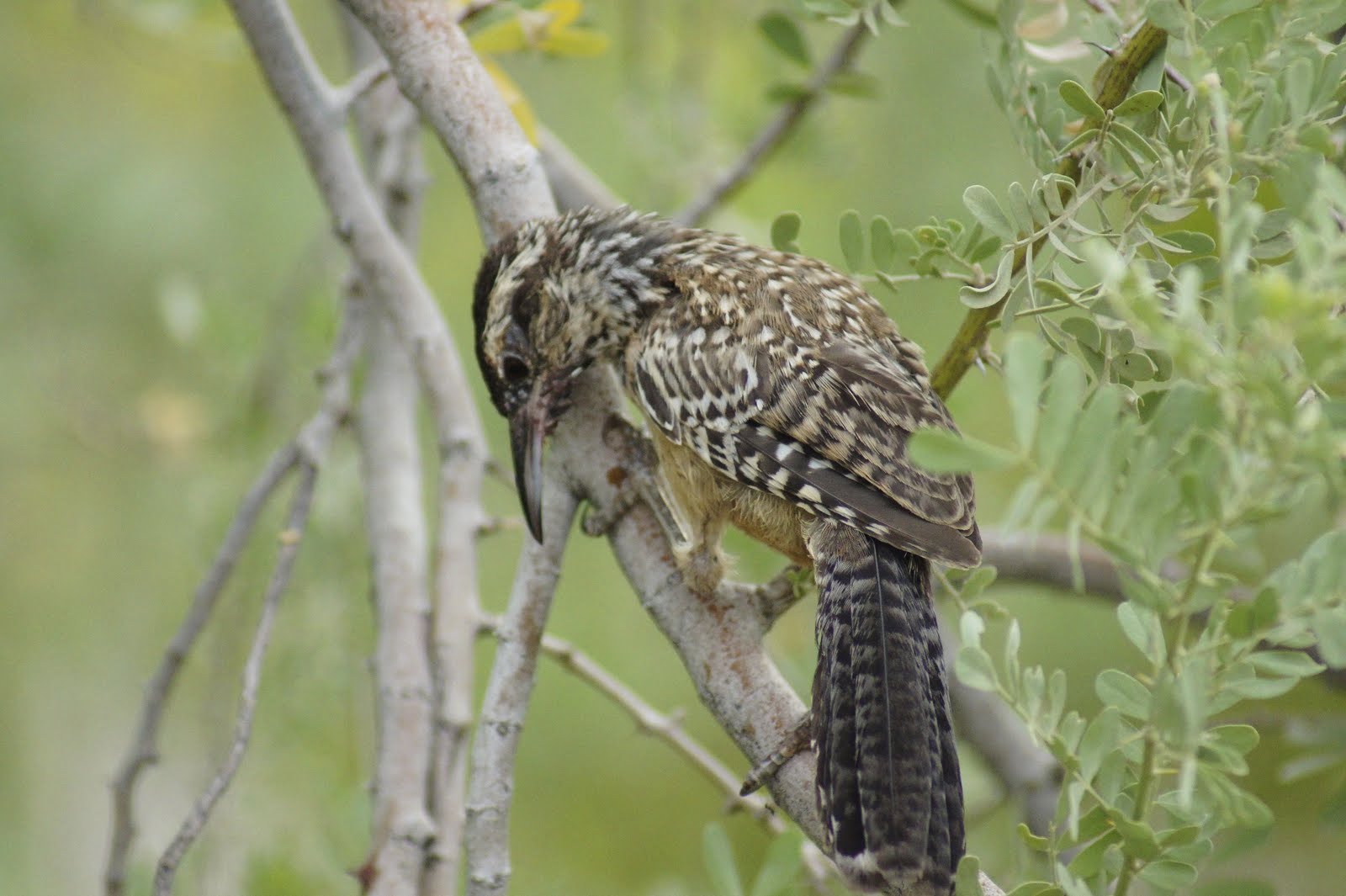
And there was also this guy. 

Monday, September 5, 2011

The Desert for Dessert


I treated myself this Labor Day with a trip to the Desert Botanical Gardens in southeast Phoenix, and it was a most satisfying trip to conclude a busy couple weeks of work and birding. Although I did not get to add a lot of new species to my list, I managed to get a lot of photography practice and add to existing blog entries with much better pictures. Be sure to see the full updates for Roadrunners, Lesser Goldfinches, Curve-Billed Thrashers, Verdins and Cactus Wrens (click on pictures for larger images).


The Gardens host a weekly bird walk on Monday morning at 7 a.m., and since I won't be having many free Mondays for a while, I really wanted to make the most of this adventure. Things started off promisingly, as I spotted Cactus Wrens, Gambel's Quail, Curve-Billed Thrashers, and the normal medley of doves before even entering the actual Gardens. However, I was getting pretty frustrated by 7:30 or so, at which point I had not seen anything that wasn't visible on the other side of the gate and that didn't require a $10 admission fee. It was a fleeting fickleness though, and once I found the right spots in the maze of prickly botany, the more exciting birds began to appear.


Steve and Gina (let me know if I misremembered your names!), 
two migrants who flew in from Chicago. Nice folks.


The photography started in earnest with the Cactus Wrens and Verdins, who were not at all shy about showing their capable maneuvering through mesquite tangles. There is a very small riparian area wherein I saw a few frogs, turtles, and two Green Herons (not photographed this time) before pursuing a Curve-Billed Thrasher into the undergrowth on the other side of the path. I was rewarded with some decent shots of him thrashing, and I also interrupted the breakfast of a rather chubby ground squirrel, but I was soon distracted by the yellow flash in a nearby palo verde tree. Of course, it had to be my great nemesis, the Wilson's Warbler.                                                                             
While I fruitlessly circled round the tree trunk trying to gain favorable lighting and visibility over my quarry, I also saw a Western Tanager land in the canopy. He too, proved to be too obscured for a decent picture (yes, even I have standards), but it was at this time that I turned to see a magnificent Greater Roadrunner casually sauntering by, only to emerge minutes later with a tasty lizard clasped firmly in his beak. I then spent a good period of time trying to capture the motion of a Gila Woodpecker as it busied itself with carpentry, but with poor lighting and somewhat hidden subject, I met with little success. Spirits still very high, I abandoned the warbler and explored the wildflower garden, and found a healthy population of Lesser Goldfinches, Cactus Wrens, Black-Throated Sparrows, Aberts Towhees, and even a juvenile Yellow  Warbler. I also joined with a couple who flew  down from Chicago (we're talking people  now) and we explored the garden together, enjoying the goldfinch antics and the shade as  the sun rose higher in the sky. The Rosy Faced Lovebirds were also well-represented, and before I turned in for lunch I had a decent glimpse of a Ladder-Backed Woodpecker and even a Cordilleran Flycatcher, which added a new bird to my list with the last photo of the day.


Ladder-Backed Woodpecker

The Ladder-Backed Woodpecker is one of those unfortunate birds that must work very hard to distinguish himself from other similar or more recognizable members of his family (Picidae). He has a black-and-white zebra back like the sapsuckers, Gila Woodpecker, Red-Bellied woodpecker, the Red-Cockaded, and the Nuttall's Woodpecker. However, he is a couple inches smaller than the Sapsuckers and Gila, while the Red-Cockaded Woodpecker, in addition to being very rare, does not move West of Texas. Thus the Ladder-Backed Woodpecker's real competition is the Nuttall's, but their facial masks are distinguishable, with the Nuttall's preferring a bit more black, and the Ladder-Backed is the only one of the two to be found east of the Sierra Nevada Mountains.
I really like the texture and hue this cottonwood adds to the setting.

Black-Throated Sparrow

When in their full-plumage, these are very fine looking birds that wear their otherwise dull colors of brown, gray, black, and white very well. The Black-Throated Sparrows inhabit the arid deserts of the Western United States and Mexico, and tend to maintain their appearance even in harsh circumstances, which can't can't be said for other desert-dwelling birds. They're exceptionally handsome, and make it very hard ti pick a favorite emberizid.


This series is of a juvenile, who had not yet developed the black bib and sharply defined brown on his head and back, but such intermediate birds are common this time of year as their adult plumage begins to fill in.


Pacific-slope Flycatcher

This and the Cordilleran were once considered the same species and identified only as the Western Flycatcher, but the Cordilleran has a different vocalization and its range does not extend into much California, whereas the Pacific-Slope Flycatcher, which is otherwise identical, won't be found east of the Sierra Nevadas outside of migration. Unfortunately, neither bird is keen to vocalize in my experiences

This species is common at the DBG Sept.--Oct and Mar--Apr.. Because the Cordillerans typically stay in the higher altitudes, the general opinion is that the Flycatchers at the DBG must be Pacific-Slope. However, it's pretty far inland for Pacific Slopes, so it still doesn't seem necessarily more likely to me that it's one or the other based on those two pieces of evidence. The Sibley's field guide doesn't show either coming into the Phoenix area much, but the Cordilleran's summer range, though normally at high altitude, is nearby, whereas Sibley only shows the Pacific-slopes as coming through in migration. Given the options, it seems to me that the likely species is the one that actually lives in the state of Arizona. That being said, it's possible some Pacific-slope Flycatchers are just residing for the summer, or at least for two months of it.


Who am I to argue. Here, I guess, is the Pacific-slope Flycatcher.

Orange-Crowned Warbler

I've seen these little yellow warblers all around the Phoenix area now. For a while, I was misidentifying them as juvenile or female Yellow and Wilson's warblers, because they just always seemed too generally yellow to be the Orange-Crowned in field guide pictures. However, I recently got some great feedback from the Arizona field ornithologist group, confirming that these are all, in fact, Orange-Crowned Warblers.
The broken eye-ring and faint, black eye stripe seem to be key identification marks.


Here are a couple more Orange-Crowns I saw at the DBG. 

Female Hummingbirds

Without a male around, it can be difficult to tell the species of a female hummingbird. Their green backs and grayish bellies/chin are pretty generic, but they're still pretty and photogenic birds in their own right, so here is post dedicated to the anonymous lady hummingbirds, the single chicks who have not yet settled on a flamboyant beaux. At the Desert Botanical Garden, it was a lady's morning out.


Cactus Wren

The Cactus Wren is the largest wren in North America, and is also the emblematic state bird of Arizona. Although they are comfortable living near developed land, they are also very capable desert specialists, and the Cornell Lab of Ornithology mentions that they can survive without freestanding water.

The Cactus Wrens do very well in Arizona, and are especially noticeable at the wildlife preserves around the valley. They are very comfortable with people and semi-manufactured environments, so it's nice to get pictures of them in a more natural and aesthetically pleasing habitat.
 These purple flowers made for a pretty great setting with the evening light. 

 I like here how the cactus works to supply a textured green background, quite nice with the cactus wren...


This busy bird was adding to her nest in a yucca plant. It was already looking pretty large and lopsided, but wrens do like to keep busy.


Here, the iconic wren of Arizona greets the morning sun, while another bears the evidence of a cactus-fruit breakfast.
A little bit of bed-head


This specimen's darker brown back and head have not filled in yet, which makes me think it's a first year.

Sunday, September 4, 2011

Cockatiel

Also known as a Quarion or a Weiro, this is the smallest of the Australian cockatoos, but is the second most popular avian household pet behind the Budgerigar. As such, they have a large domestic presence in America, and while the populations of escaped Cockatiels have not found the level of success seen in local Lovebird populations, they're nonetheless an increasingly common sight around parks and ponds in the city.
This particular Cockatiel seemed to be imitating the Gila Woodpeckers common around Encanto Park, but he didn't do a very good job. I observed him then take to the ground by a group of mallards, only to discover he could not swim. It is likely he'll soon amalgamate with the local Lovebird population in the area as I have seen other escaped parrots and Budgerigars do, and they'll add a little color to the urban birding scene.
A poor substitute for a woodpecker

I like their heavy-set beaks. With their crags and density, they look as if they're made out of stone.