Sunday, September 4, 2011

Cockatiel

Also known as a Quarion or a Weiro, this is the smallest of the Australian cockatoos, but is the second most popular avian household pet behind the Budgerigar. As such, they have a large domestic presence in America, and while the populations of escaped Cockatiels have not found the level of success seen in local Lovebird populations, they're nonetheless an increasingly common sight around parks and ponds in the city.
This particular Cockatiel seemed to be imitating the Gila Woodpeckers common around Encanto Park, but he didn't do a very good job. I observed him then take to the ground by a group of mallards, only to discover he could not swim. It is likely he'll soon amalgamate with the local Lovebird population in the area as I have seen other escaped parrots and Budgerigars do, and they'll add a little color to the urban birding scene.
A poor substitute for a woodpecker

I like their heavy-set beaks. With their crags and density, they look as if they're made out of stone.


Saturday, September 3, 2011

Curve-Billed Thrasher

Thrashers get their name from the jerky, side-to-side head movement with which they turn over loose top soil and dig for seeds, bugs, etc. when feeding. The Curve-Billed is the most common, and most generic Thrasher. While its modestly curved bill and mottled breast don't easily differentiate it from other Thrashers, its noticeably orange eyes are unique among the Thrasher family. 


This messy bird was sitting atop a covered yucca plant, looking rather grumpy. The blurry eye here is actually the result of catching the bird mid-blink (totally by chance).


Here the nictitating membrane is half-way over the eye.


Despite their tough, mean-lookign exterior, Thrasher also produce some ridiculously cute and cuddly chicks.


This Thrasher was intent with his burrowing. I'm not sure what he was pursuing, but he made quick work of the topsoil.


This Thrasher has clearly been helping himself to some prickly pear fruit, or else it just mauled another bird.

Gila Woodpecker

The Gila Woodpeckers barely make their way into New Mexico and California, so in a sense it's actually more unique to Arizona than the Cactus Wren (state bird) which ranges even into Texas and Colorado. The Arizona/Strickland's Woodpecker is only found in Arizona, but it's too uncommon to be the state bird. The Gila Woodpecker is a zebra-backed picidae like the Golden-Fronted and Red-Bellied, but the Gila's only cranial feature is a small, rounded red cap. These photos also allowed me to observe the zebra-striping on the inside of the tail, which I'd never been able to see before since they usually perch parallel on a tree with their back to you.
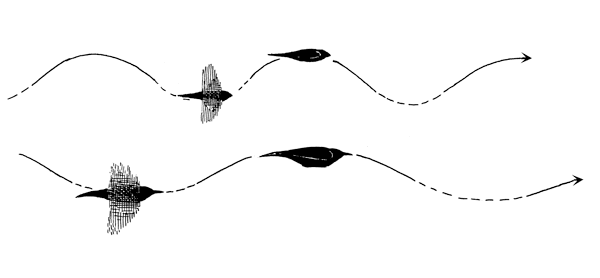
They're fairly common around Phoenix, though still hard enough to get a picture of since they continually circle around their trees and are pretty shy to begin with. I was lucky to get a few in-flight shots though. Like other woodpeckers, the Gila flies with several quick wing beats before allowing itself to glide and loose a bit of altitude.
With all the sightings, I was a bit peeved I had not pulled off any good shots of a Gila Pecker, but then this fine fellow had his picture taken 09/24/2011 at the Desert Botanical Garden. Click on the images for a larger viewing.


Courtesy of Cornell Lab of Ornithology


Northern Mockingbird

The common mimid of North America, the Mockingbird has a wide geographical range only exceeded by its vocal range. A healthy Mocker is a fine looking bird, with their well-defined grays, blacks, and white making them look very business/professional, even though their behavior is anything but. In addition to their audibility, these birds will fearlessly chase cats, hawks, dogs, and whatever else comes too near their nests or territory. 


Great-Tailed Grackle

The Great-Tailed Grackle lacks the blue and green sheen of his Common and Boat-Tailed cousins found farther East, but he can boast of being the longest Grackle, reaching lengths of 18 inches. Like other Grackles, a good specimen will still have nice iridescent purples and black that can catch the light well and accent their yellow eye.


The female has much more brown, and must be one of the more generic looking birds in the avian kingdom.


This guy has a bit of a cross-bill going on, which likely mean he hasn't been eating what he's supposed to be eating.

Embden Goose

The Embden is a breed of Domestic Goose thought to have originated in Holland or Germany, though other theories abound that it is in fact the product of English and German White Goose interbreeding. dating back to the 13th century.
They're nice, sturdy-looking geese with pure white feathers, light orange beaks, and blue eyes that resemble those of a human. They have a curious glide through the water in that they let their legs drag idly behind them when they can. I don't know if other geese indulge in such laziness, but it does add to the overall calmer demeanor of these pretty birds.


European Starling

Like the Eurasian Sparrow, and the Rock Pigeon, the European Starling is a well established introduced species whose range spans over the entire U.S. Although the Starling can be a very pretty bird when it dons its iridescent mating plumage, they nonetheless have a negative impact on other cavity-nesting birds as their aggressiveness and large numbers tend to monopolize nesting places from more fragile species such as the Purple Martin.


Watching massive flocks of Starlings move above city-scapes in the evening, apparently with some sort of common consciousness (no not really) is a truly incredible sight. 

Sunday, August 28, 2011

A Surprising Bit of Birding at Grenada Park

When I went to Grenada Park this week, which is by all accounts a pretty non-descript, unremarkable piece of land, I was not expecting much in way of birding. I should have remembered our experience on Camelback Mountain, but at least this time around I had the camera handy. Grenada Park has two small ponds, so I was expecting the usual suspects of geese and mallards. I was quickly surprised to see a Lesser Scaup (*misidentified at the time) among the crowd (well before the Fall) as well as a handsome Double-Crested Cormorant and a stately Coot.
I then heard the familiar screeching of the Rosy-Faced Lovebirds, who seemed as surprised to see me as I was to see them. The fun continued as I proceeded towards the uphill pond, and passed a lone Killdeer sentry at a safe distance along the way.
An odd bulk in an otherwise ordinary
conifer tree caught my attention, and further examination revealed a finely decorated Green Heron failing in his camouflage, but also not seeming to mind the attention too much. I served as this Heron's paparazzi for a while, and even managed to get a couple good in-flight photos, as well as some interesting close-ups of his funny heron feet, which I had never been able or bothered to observe before. I don't know that Grenada Park will hold much more until the weather relaxes a bit, but it provided yet another nice birding jaunt that far exceeded expectations.

Green Heron

I had a great bit of luck photographing this little heron in Arizona, and in August no less! I first noticed him perched rather curiously in a pine tree, but when he decided I was not threatening he soon returned to the water's edge, which provided me with much better lighting for some detail photography. In addition to the welcome shots of his lovely green and brown iridescence, I was very surprised to see how offset the Heron's rear toe was relative to the rest of his foot and to his leg.
Even though I couldn't get him to extend his neck or raise his crest, I consider this and the Red-Tailed Hawk some of the best photographical moments I've yet had, and am glad to be able to find such cooperative waders in the middle of the Summer.