Thursday, April 24, 2014

Donny, You're Out of Your Element! The Yellowlegs is not the Issue Here!

Lately it seems like there's been some good gossip and bust-ups of the listservs and other birding-related media (you Texbirds people need to stop hogging all that ornery goodness too yourselves). For those of us that frequent the different email or facebook-based birding forums, of course there's a certain cringe, but also guilty pleasure in seeing things blow up. birders are generally mild-mannered people, but the anonymity and distance of internet correspondence allows for some unfettered tirades and arguments to metastasize with great effect.
Our AZ listserv is pretty quiet in this regard, at least lately. Most of the contributors are well-established, have their own surveillance areas, and tend to keep whatever grumbles they may have off-list, except for some added grumpiness on April Fool's Day. This is all to say I feel like I'm being deprived of an essential aspect of my 21st century birding experience: no big bust-ups.

Sometimes there can be really perplexing stuff on the bird forums too, perplexing because a species or specimen is hard to identify. Other times the perplexity can come from a person's penchant for misidentification and their resistance to correction, especially in the case of urban-dwelling Goshawks in Tucson.
I bring this to attention knowing fully well that I'm no ace of ID, that I've been stubbornly on the losing end of many the ID argument, and know first hand that a little self-deprication and humility, even in the face of embarrassing mistakes, is a must for progressing beginners like myself. Without much further adieu then, and without intentional meanness or derision, but merely general amusement, here's a fun little exchange from last week. Most of the people here are being good sports amid a perplexing case:


 CR

{Here's a photo of a} Rail:
Like · 

Sunday, April 20, 2014

Gray Day Heyday

For the second weekend in a row we had lousy weather around Phoenix, though lousy only in how it related to birding. Under any other circumstances I'd welcome the heavy clouds and cool ocean breeze, but Saturday needed to be the day of Vireo hunting, the day I turned previously fleeting sightings of the infamous Gray Vireo into well-documented put-to-bed peace-of-mind no-doubt-about-it tucked-in-with-a-warm-glass-of-milk-(gross) sightings. Despite the weather gods' caprice I headed out to Bushnell Tanks on the Hwy 87 for another date with destiny, another chance to get lucky. This time destiny was going to pay, and to hell with "complimentary" valet parking!


With the cool temperatures and saturated colors the Bushnell site was absolutely gorgeous. It offers some fine riparian habitat, replete with porous old sycamores and cottonwillows. On either side, the rocky hills of the lower Mazatzal Mountains ambled off into the horizon. The juniper scrub dotting their granitic flanks, just now starting to fruit, is perfect for Gray Vireos, and offers fine birding in general.


While walking through the riparian area and heading for the juniper trails, I recorded FOY Hooded Oriole, Olive-sided Flycatcher, Lazuli Bunting, Summer Tanager, and several species of Warbler, as well as Ash-throated Flycatchers and Black-throated Sparrows in the liminal chaparral. Bell's Vireos, as expected, were totally out of control while still being predominantly invisible. A large flock of Lark Sparrows, containing around 30 birds altogether, was an awesome sight as well.


Since the clouds diminished the sun's effects (apart from its propensity to quickly burn my pasty Irish skin), the morning chorus and activity seemed to last much longer than usual. Birds were vocalizing from every bush and canopy, lizards were scuttling around doing lizard things, and bees were going face-deep into the blooming thistle. 'Twas a great morning to be out in the nature.


After enjoying some Cardinals and a Black-headed Grosbeak in the riparian wash, I finally made the commitment to the higher juniper slopes. As expected, the bird sights and sounds diminished. Blue-gray and Black-tailed Gnatcatchers added some beeps, whirrs, and whistles every once and again. Turkey Vultures soaring overhead required constant scanning to pick out the Zone-tailed Hawks I'd heard screeching earlier in the sycamores. At last, I heard the few call notes I'd been waiting for and filled the great soul-sucking void in my life.


I gained some elevation until coming to a stretch of trail, about 1/3 mile up from the divergent riparian wash, which featured several large fruiting junipers and plenty of intermittent scrub in between. First I had one, and then another Gray Vireo singing out its territory from atop their redolent perches.


"Heeey you got me!"
This photo gives a good idea of the Bushnell Tanks habitat. The riparian isn't as extensive as that on the other side of the highway at Sunflower, where the Black Hawks nest, but Bushnell mingles the riparian with the desert scrub stuff nicely, and between those two habitats there are quite a few birds to see.


I continued to follow the Gray Vireo calls on the southeast side of the Bushnell trail for a little while, getting solid looks and great audio of the birds, if not really satisfying photographs. High up on the hills, Black-chinned and Rufous-crowned Sparrows added their voices to the choir, and a low-flying Zone-tailed Hawk put a face to the raucous calling I had heard from the sycamores below.


With a bit of pishing I turned up a third bird, one I new to be separate because the other two were bickering in the same juniper nearby. At long last I had put this semi-nemesis, a seminem, to rest.


Gray Vireo was a bird I neglected for far too long, given that I lived in Phoenix. I only recorded it on my life list last year, noting the call and a quick, flushed glimpse of a bird spending the winter on telegraph trail on South Mountain. The sighting was in no way satisfactory but I had a very tight schedule to keep that day. It continued to bug me. I figured I'd see more around Mt. Ord, and then even went to some juniper scrub sites, such as Oak Flats, where I knew they would be, always coming away with great sightings but now Gray sightings. Now that I wanted this scrub-dweller specifically, I turned up everything else instead, for many weeks in a row.
Finally their increasing sprin-timg numbers pushed the odds enough in my greenhorn favor and I managed to chase this bugger down, getting the soul-satisfying views, some decent shots, and making peace with round-beaked little dope.

Thursday, April 17, 2014

A Rookie Mistake: Dial Plan B (For Birding)

Last weekend it was all planned out...kind sorta somewhat perhaps. It wasn't going to be a full-on epic bird day, but it was supposed to be pretty good. I was going to scour the Sierra Vista hillsides, chasing down leads on Montezuma Quail, and then spend a few hours in Ramsey and Huachuca Canyon. It was going to be crisp, efficient, and potentially a 3-Quail day. But I have a serious short coming as a birder (several, I am sure). Being from Phoenix, I grew up with a nasty, nasty habit. No no it's not smoking, which is of course scientifically proven to strengthen respiration as the tar helps oxygen stick to one's lungs. No it is because in Phoenix we have about 358 days of sunshine each year, so when we're making weekend plans, weekday plans...any kind of plans, there's never need to check the weather. 
Of course with birding, weather is key, and I totally dropped the ball on checking the Sierra Vista weather before heading out from under Phoenix's clear skies at 3:30am. 
It was heavily overcast, rainy in some places, and exceedingly windy. The first couple of hours in the area were almost devoid of bird activity, except for a few sympathetic Lark Sparrows, and so I sulked (snoozed) in the car instead of seeing glorious Quail, who were all wisely keeping their heads down.


By 10am or so the weather still hadn't cleared. I spent some time in Ramsey Canyon, trying to get away from the wind, where I was very pleased to find all three species of Goldfinch in the sycamores around the AZ Folklore compound. Apart from the finches and some FOY Scott's Orioles it was pretty dead.
By 11am the sun had risen high enough that it occasionally broke through the heavy cloud cover, though the terminally heavy wind kept most of the birds down low.

Rufous-crowned Sparrows were good sports about it all, still vocalizing when they had the chance and giving some life to the Sierra Vista grasslands. I would prefer Five-striped, naturally, but to each their proper time and place.


A pair of Pyrrhuloxias in Ramsey canyon also made for a nice sighting. This is a bird I don't see or photograph nearly enough, given their relative rarity in Maricopa County, and this is especially distressing as they're way more rad than Northern Cardinals.


Although there were a few nice sightings, for all the driving and time killed it was a pretty disastrous start to the morning. I decided to head farther north back toward the Tucson area to pursue some birds where the elements were more cooperative. I learned a lesson, learned it well and good. The question was if Plan B could redeem something of my Saturday. 

The next site was Christopher Columbus Park, a pre-fabricated suburban watering hole with uncomfortably blue-colored water that, nonetheless, has highly visible Wood Ducks.
It doesn't even have great habitat for them, but whatever the reason a Wood Duck drake has been here all winter, and this was a species I had not been able to photograph up close, having formerly flushed them at Tres Rios or seen them at a distance in Prescott. It's not a rare Quail, but it's a gorgeous thing.


Wood Ducks weren't the only offerings at the park. Though not as cool as the Thick-billed Kingbirds for which I'll be traveling through Patagonia in a month, or even the taller, darker, handsomer Cassin's, I also had some really nice sightings of Western Kingbird around the park's grassland. They're common and conspicuous, and also pretty cool. But usually they're up on the telephone wires and what not, and although their bellies are a lovely yellow, it doesn't make for great repeated viewing. Seeing them at eye level was tops.


By 1pm or so, the sun was out over Tucson, which is a bit over an hour northwest of Sierra Vista, enough so that birds were taking shelter from its midday wrath. It was too late to head southeast again, where the weather was likely still inclement anyway, but the few birds at Christopher Columbus offered some great sightings as a consolation.


In addition to the earlier mentioned Wood Duck sightings/dynamics, I've also seen them, distantly in Pennsylvania, but this unwholesome pond in Tucson, by far, offered the best looks I've had in the last few years, and hey even a nifty Wood Duck vs. Mallard size comparison (the Mallard looks like a giant). 


Chasing the waterfowl at city parks almost feels like cheating. That's not to detract from the tick or the photos or any of that. In a sense, these ducks are still more wild/less baited than the feeder-fed Hummingbirds in Madera or Miller Canyon, or at the Paton House, but it just feels very removed from nature, from the proper context of when and where one should be seeing these cool species.
That being said, the when and where for Wood Ducks in Arizona isn't exactly easy access, so I can't complain. I can only berate myself, and check the weather.

Monday, April 14, 2014

Perseverance at the PM Preserve

Birders the continent over are now reaching for their 'nocs and cameras with increasing regularity and even the chummiest of city parks teem with excitement again as the spring migrations get underway. In the central part of AZ, migration isn't quite as big a deal. Spring always brings a welcome change, for sure, but in many ways the winter birding down here is preferable for total species, especially since the breeding Orioles and Buntings don't arrive until later. Compared to the scenes in the central, east, or northwestern parts of the country, the few Warblers and Flycatchers that push through are a welcome addition to the scene, but just in general the beginning of migration time doesn't have the same full spark in the Phoenix area is in much the rest of North America.  


So, apart from roaming the rocky hillsides looking for black-tailed jackrabbit, who are in turn looking for some shade in the rocky hillsides, what is a Phoenician birder to do? As always, Sparrows hold part of the answer. Those that left for winter are returning and staking out their territory, as are the residents, which makes for some excellent visual and auditory opportunities.
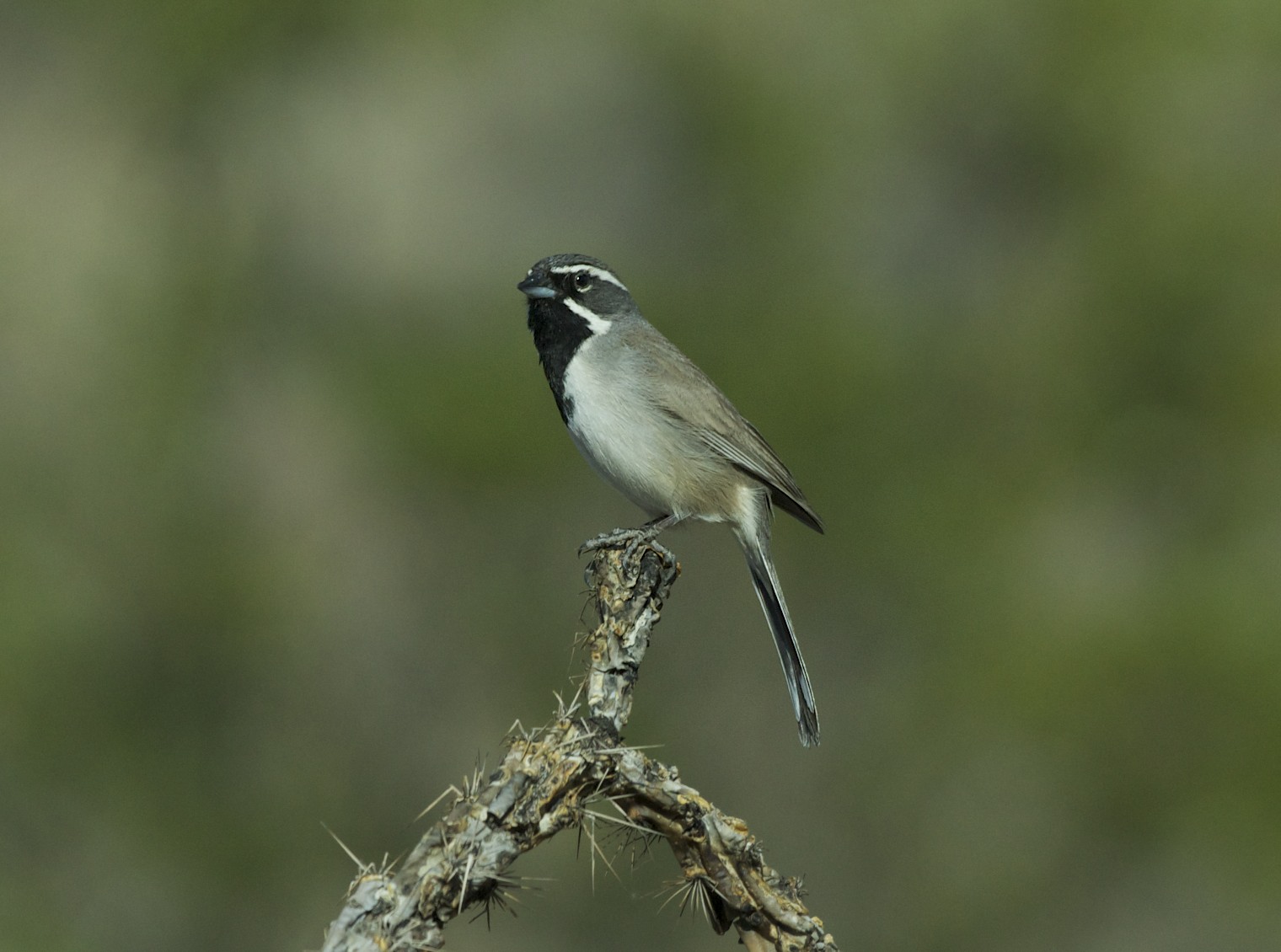
I have been able to lay many the crush on Black-throats in the last month, something that never ceases to stimulate, and even amid the infamous March doldrums these birds keep the spirit high.


Spending some time with one's state bird is also a goodly dose of birder medicine, recommended by 8 out of 10 doctors and even cautiously advocated by the FDA. If they pose nicely on a namesake perch, all the better.


But Cactus Wrens can perch and sing/grunt/gargle for a while, and for those birders with itchier feet, chasing around Black-tailed Gnatcatchers is another solid outlet. Unlike rattlesnakes and rattlesnails, they're not more afraid of you than you are of it.


All of these photos were taken during a several day trial in late March, one I've now undergone for two years in a row. Racing through Phoenix rush hour traffic, which is very reminiscent of the climactic chariot race in Ben Hur, and unloading at the Phoenix Mountain Preserve by 4pm, I've got about two and a half hours of daylight to hike out into the mountains and explore the various gulches and shady hollows where the mesquite and palo verde trees spread their bows. 
The task here is not just to see the usual desert dwellers, but to pursue one of Phoenix's better and harder-to-find migrants, a bird who's accessibility in central AZ is predominantly limited to the last week or so of March and the first week or two of April. They're shy and silent during this time of year, so obviously I'm not referencing Gambel's Quail.


No, but with great perseverance (several tries last year and several more this year), prodigious sweating, burr-laced socks, thorn-impaled shoes, quiet treading, keen eyes, a pre-St. Patrick's Day Irish dosage of luck, and maybe a few whistles to the treetop Phainopeplas, one can find a real treasure of a bird in the channels of the Phoenix Mountain Preserve. 


Last year I only had quick visuals and a blurry flight silhouette shot to show after four attempts in the treacherous but beautiful landscape. After that many busts and semi-busts, even the fantastic sights and sounds of Sonora are scant consolation.
This year it took two tries, and this year I had much improved results. Josh Wallestead, who has seen himself plenty of Owls up in Minnesota this year, joined me while in town and racking up his own nice list of Sonoran lifers. We scoured the PMP gullies for a few hours, and while heading back south towards the vehicles through one of the deeper washes we finally had our break, just after the sun crested below the hills and lent everything its hazy, yellow light.
Finally, at long last, I got to stare face-to-face with a regal Long-eared Owl. It was tops.


Of course, diminishing light and the Owl's shyness, along with my own apprehensions about approaching too close, didn't allow for the crisp crushes this finely plumaged raptor deserves, but the sighting alone was enough to fully validate a March otherwise largely devoid of awesome sauce migrants in Phoenix. Really, I depreciate Phoenix birding too much. It doesn't get much better than Long-eared Owl.