Arizona is know, justly, for its desert landscapes. It has a lot of them, they are interesting, and they are relatively unique in North America. Arizona also has mountains. It has a lot of mountains, 210 ranges in fact, and some of the prettiest, tallest, and most ecologically inviting are the White Mountains in Apache County of northeastern Arizona. The fittingly titled Mt. Baldy is the tallest peak/mountain in the range, and it hosts a wilderness loop trail that ranges between 14 and 20 miles--depending on one's route--that cuts through several different biomes and offers plenty by way of scenery and wildlife. I had hiked and birded portions of this area in years previous, but on this holiday weekend crammed down our throats by fat-cat union gangsters (Labor Day) I endeavored to walk the whole loop (success!) and crush some birds in the process (semi-success).

The Mt. Baldy west fork/east fork trails take one through healthy and not-so-healthy spruce, fir, and pine forests, as well as alpine meadow that hosts truly tremendous numbers of elk feeding before dawn. The landscape is also dotted with small lakes and reservoirs, most of which are fed by snowmelt and the Little Colorado River. As such, Ospreys do very well here.

Animals that live in these high and harsh temperate zones must be very tough and adaptive to survive. It is a fascinating place. It is a hard place. It is an odd place. It is a place where tiny populations of Spotted Sandpipers and Magnificent Hummingbirds come to breed, both above 9,000 feet. It is a place where one sees...off-kilter things...but things not best left unseen:

It is also a place where one sees many good things, like American Three-toed Woodpeckers exfoliating conifers with their slash-and-burn-style 'flaking' technique. Just look at the reddish, exposed portion of these trees vs. the grayer, older, weathered bark. This may be America's most industrial Woodpecker.


What is the evolutionary advantage of having three toes you ask? There is no definitive answer yet. Some say it allows better leverage for their style of feeding, at the expense of climbing speed. Some say the style of feeding came because of the lack of toe. In order to find out the advantage or disadvantage, we'll just have to ask them after the apocalypse.

The West Fork trail is longer than the East Fork portion of the loop, but of the two was the site of more recent Dusky Grouse sightings and thus my trailhead. With this now being the 5th time I've unsuccessfully sought the bird in proper habitat in AZ, it's becoming a bit of a nemesis. It feels more of a nemesis because DUGR is also one of those secretive, sparse species that's also seen easily by people who aren't even trying.
Every time I've hiked in the White Mountains area I'll run into a non-birder, usually a plump lady with a purple sweater and a small white dog, excitedly sharing how she had "3 funny little turkey chicken birds with yellow eye feathers run up to me from the woods!" So that is frustrating, but there's plenty else to distract the mind on a Grouse-less hike, questions that are probably very answerable and yet, to my uninformed mind, provocative.
Why are there so many various and cool types of fungi? What are their competitive advantages? Why does that one look likes pecans? Why does that one look like Dip-n-Dots? It is the fungi of the future?


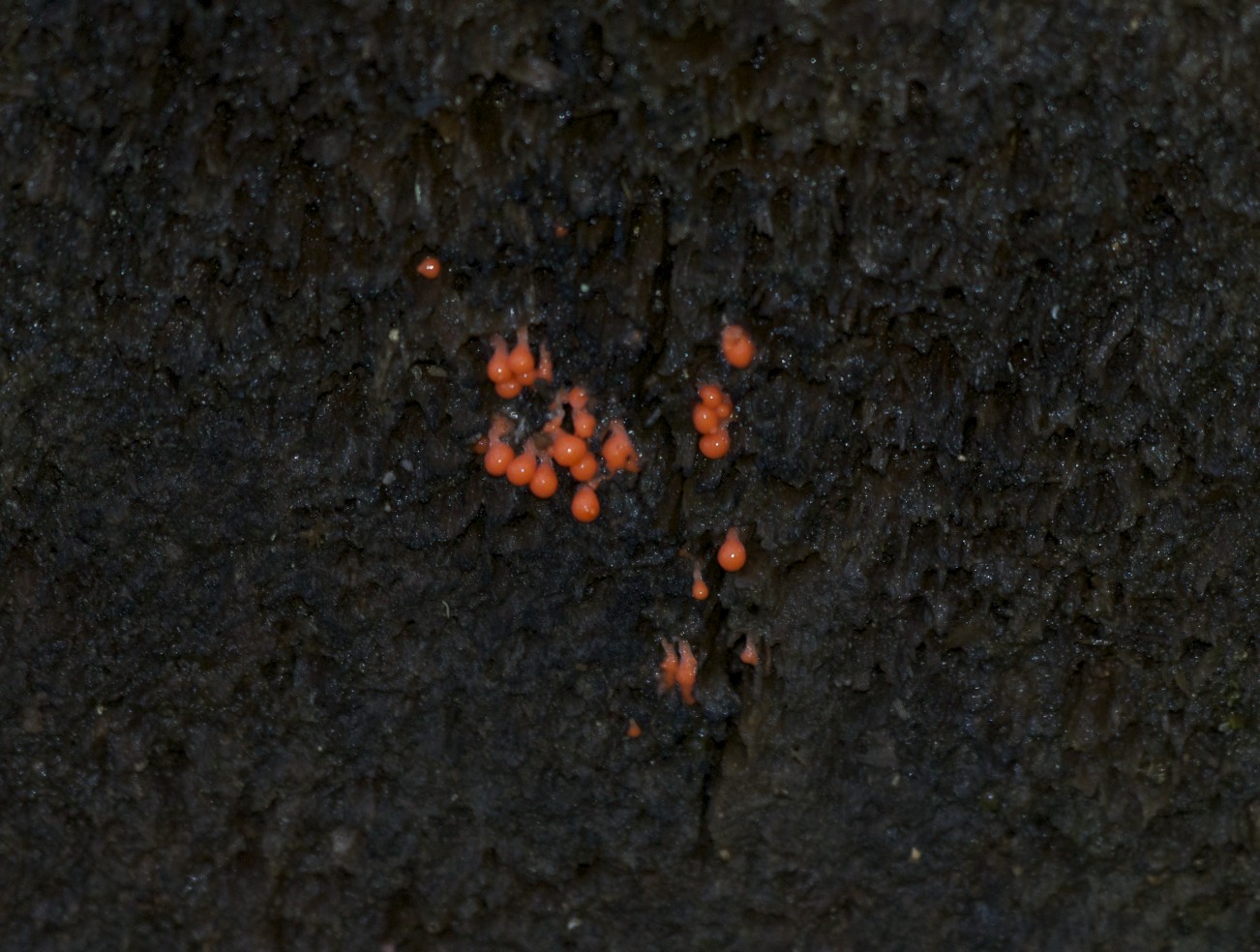

Why do trees grow so particularly in some places, seeming to form a huge, cascading flow of conifers and aspens and then--STOP--no more trees. Or there will be meadow and then a few trees just giving a big rude middle timber to the rule-following masses pressed up against the invisible boundary. It must be a cultural thing.

And in other areas the woods are severely skeletal, and not apparently from fire. This is below the timberline, where young fir trees are sprouting but all the spruce seem to be dying either from bark beetles or maybe even just a natural progression of their life cycles, being similarly aged.


The West Fork trail passes through all these habitats but, apart from the constant chatter of Mountain Chickadees and Golden-crowned Kinglets joined occasionally by other expected mix-flock members of their ilk, the trail-birding is pretty bland. As mentioned previously, the Grouse failed to materialize again and I was neither lucky nor skilled enough to find more breeding records of Pine Grosbeak. Since I was hiking with others and on a timeframe I was reticent to go much off trail or explore detour patches. Everything comes with a cost in this world it seems, though also plenty of reward.

After 8 miles of West Baldy we reached the gentile's false peak. The actual Baldy summit is off-limits to non-tribal members without permits. The East Baldy trail is actually a bit shorter and proved to have more interesting rock formations, as well as better birding on the day--so I'd recommend it the more highly of the two, although doing a loop hike whenever possible is man's God-given exhortation.


There are three birds in the photo below, which composed 3/5 of two different family groups near the top of the West Fork Trail. I mention these uninteresting numbers only to point out that Townsend's Solitaire's are not nearly as solitary as their namesake might suggest, although I have experienced this to be the case, predominantly, with Solitary Sandpipers (none of which were seen atop Mt. Baldy).

Immature Townsend's Solitaire's one members of a very small group of birds that might actually look better, or at least more interesting, than their mature/adult counterparts. 8 out of 10 Solitaire's I saw were of the young scaly variety, which is probably expected in early September. TOSOs learned long ago that being too solitary is a bad strategy for passing on the genome.


The East Baldy trail was also the site of a well-executed ambuscade. With hope of extra-cool birds beginning to fade, I was very pleased to see the shining white cap of a Gray Jay later in the afternoon, another species only found in AZ in these mountains and that seemed to materialize out of the encroaching gray mass of clouds and thunder.

While distracted by this distant bird the attack came not from the front, but from the sides. The other Jays I didn't even know were there. They flew in and landed with total silence on owl-quiet wingbeats and without any vocalizations, something very unusual considering the day's lengthy exposure to antithetically behaving Stellar's Jays. Clever Girls...


Since the Grouse and Grosbeaks felt like long-shots in September anyway and were also no-shows, the target Gray Jays had a redemptive quality to them. While "redemptive" may not be a quality often associated with Jays of any kind, it is not the only quality that GRJAs boast. They reside year-round in coniferous forests near the timberline, storing caches of food only where it is cold enough and the trees are scaly enough to harbor such stockpiles. They also utilize cooperative breeding, and have very good manners for being in the corvidae family.

The greatest lesson learned from the long day's excursion? Little mountain towns that claim to have "The World's Best Thai Food" are dirty rotten liars.


