Sorry to disappoint you, but Butler's Birds is NOT dead and buried. Buried maybe, under piles of work and the charred hopes and dreams of a full summer vacation that just could never be...but not dead. It has been far too long since last I launched my own tawdry offerings into the blogosphere. Fortunately this summer has not been totally bereft of birding, nor was my time in Carolina the last means of a salvo. Without much further adieu, we blast off and up to 12,000 feet, to Loveland Pass, CO, where breathing comes hard and the trees do not go.

I had been yearning for some high alpine hiking during most of June and July. I was not able to take the full week off to camp in the White Mountains of AZ, so a weekend scurry to Denver and back was instead on the cards. From Phoenix to Loveland pass is an 11,000 foot elevation change. Considering I had been up late tossing back margaritas, plus, you know, Denver, I did not arrive in the best state (of being).
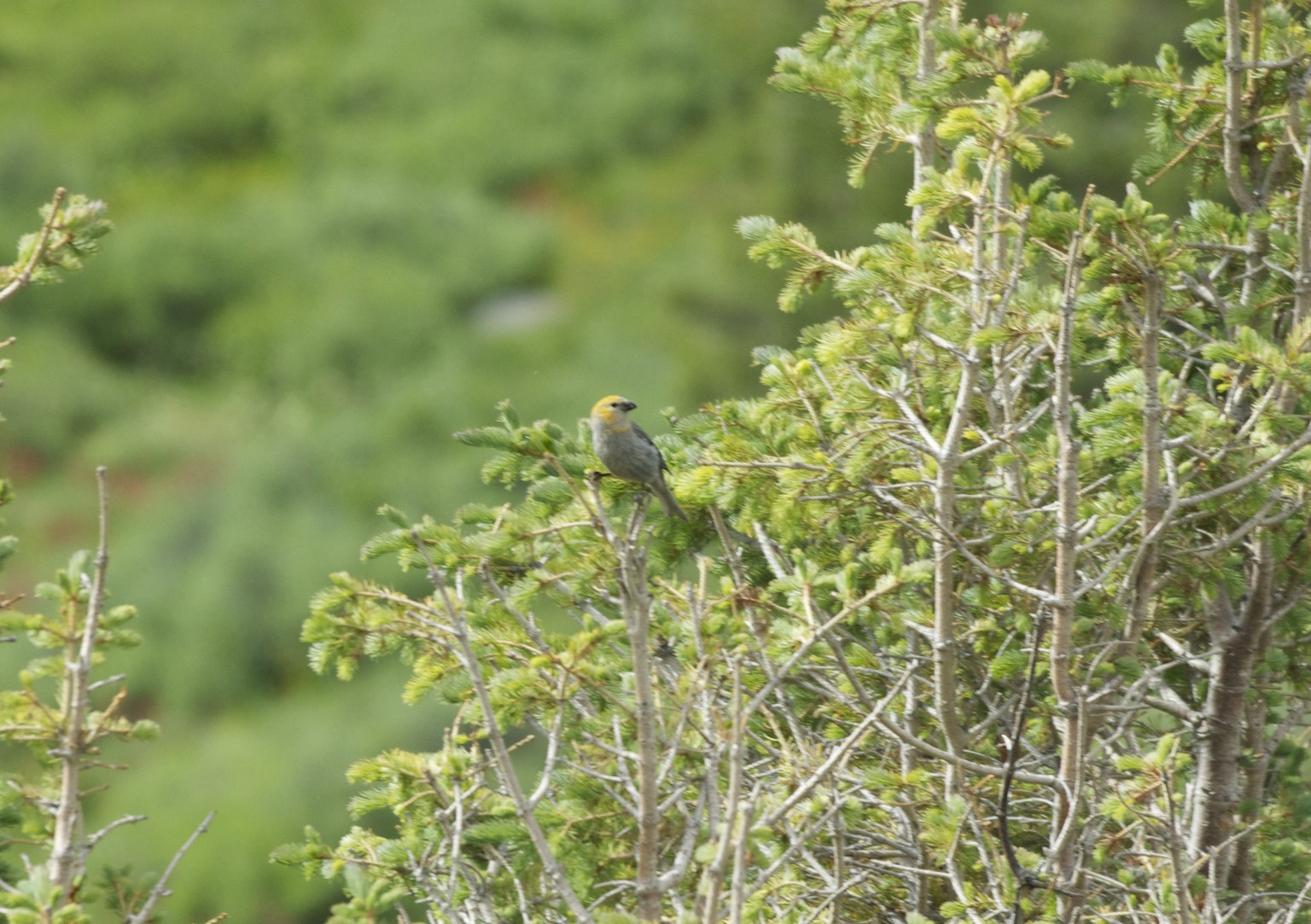
And yet, for whatever reason, the birding gods were pleased with me. Maybe it was karma for holding down the fort and plugging away at an otherwise empty school office all summer. Most likely it was a just a bit of luck. As soon as I looked down the slopes, to one of the little islands of spruce scrub still growing above the predominant tree line, there sat a Pine Grosbeak.
YEEAAHH. The whole point of this hike was to get up above the tree line, a height to which I had never been before in the Rockies, and literally the first bird was a lifer--a really good lifer--with a tree in its name.
The Grosbeak took off and flew too far to be chased. In fact, simply climbing back up the hill afterwards took some doing. Exploring the little patch that it vacated, I found several other species of birds all crammed into the tiny spruce tenement. Wilson's Warbler, Rufous Hummingbird, Robin, White-crowned and Lincoln's sparrow were all chattering and positioning in the half-dead little trees. It was very interesting to see that many birds crammed into such a small space--like maybe 20 cubic feet. Looking at the surrounding landscape it made sense. The slopes leading up to the Continental Divide were barren except for very low-growing weeds and wildflowers, and in many areas snow patches still clung to the mountainsides.

And yet even where the green became sparse, at the dying edges of the mountain where erosion was master, animal life thrived. Of course, in areas with no tree cover and bitter cold in the winter, most animals have to be supremely and specifically adapted to survive. The grumpy rock sitting on top of the other mild-mannered rocks is a Yellow-Bellied Marmot. Males of this fat uber ground squirrel species spend like 3/4 of the year hibernating and the rest being serviced by a harem of females. Occasionally they have to post as sentries near their burrows and bark at intruders, or at least look surly.
Apparently there's a lot of variation in this species, because there is only one marmot species in the Rockies and this means these ruddy buggers below are the same as the heather-looking fellow above. At that elevation and in that environment, Marmots are probably the largest and heaviest critters around. P.S. Yes I did say the appropriate Big Lebowski line every time I looked at one.


On the other end of the size and industriousness spectrum of the rodent scale is the humble Pika. They're about the size of a plum and twice as delicious--according to local Golden Eagles. They do not hibernate like Marmots, perhaps due to a lack of relative fatness, and so instead spend all of their spring and summer time stocking up their larders with seeds and grass and what not for the coming winter. Apparently they have to accrue a mass of food reserves equivalent to an economy-sized sedan in volume. They make Marmots look like lazy sacks of sacks. As you may note, they also have an extra butt-pouch of fur, which allows them to sit comfortably in cold places.

Pika are pretty damn cute, but before you get wooed by them too much keep in mind that they habitually ruminate on their own feces two or three go-arounds...so there is that. Don't get too kissy.

Forget-me-nots are the state flower of Alaska. They are to other wildflowers what the tiny, sweet Pika are to Marmots, except without the proclivity for feces pieces. I need to start carrying around a short lens.
Another aspect of this summertime trip to the Rockies was reacquainting with birds that I usually see only in fall or winter--though some Horned Larks over-summer too--and in much different habitats. HOLAs principally hang out in dry agg. fields and empty ponds basins around Maricopa. They also do not have as prominent of horns.
Sage Thrashers hang out in sage brush desert areas, in case you were wondering. I'll be honest, I was not expecting to see this bird up so high. I need to pay closer attention to range maps.
Of course, the main reason for this trek was not to reacquaint with old birds nor breathe the fresh mountain air. It was not the supreme satisfaction of standing on a peak and knowing one is literally the closest thing to the heavens as far as the eye can see (sorry other hikers who are not as tall). The main reason any unreasonable person goes to such altitudes and clambers about on the scree, getting embarrassingly out of breath in the process, is White-tailed Ptarmigan.
WTPT are perhaps the pinnacle example of seasonal camouflage in North America. They morph all white in winter, seemingly melting away into their snow banks. Then as the snow melts away so does their alabaster; they become as mottled as any of the granite stones in which they find purchase. When sitting still, they are very hard to discern. Even after they've been found...they are still really hard to discern.
Especially considering they make very little noise (compare to the totally nutso sounds of Willow Ptarmigan) and are reticent to flush, pulling these birds out of the rubble can take some doing, but it is not without sweet, sweet reward.
Once they're singled out and established, once you are locked in and have them in the ol' heat-vision goggles, they really do not care about you or what you are doing or why you are changing your pants--yet again. I gotta say, seeing these birds and spending time with them totally floored me. They were far calmer than I was.

The initial sighting was outstanding. Even more amazing was taking a step forward as the first Ptarmigan shuffled on its way and realizing I almost stepped on another. Luckily she gave me a courtesy ruffle to differentiate herself from rocks.
I wish I could say that she is bellowing here, as I would love to know what WTPT sound like, but in reality she was pecking and gargling stones--also pretty cool, and tough.
I was not sure I would see WTPT on this hike. I was not sure that if I did see them I would get particularly good looks. I had never seen
any upland game birds before, excluding Ring-necked Pheasant. So, indulge me here, because it turns out WTPT will let you get pretty crushy.
If you have not participated in a Ptarmigan photo shoot before, I highly recommend it. They don't have the braggadocio eye comb of Spruce Grouse, but even their feet still look good, good and impressive.
WTPTs are not the most diverse birds when it comes to shape. They can be oblong, and they can also be blobular. Daedalus himself would get lost trying to navigate the labyrinthine patterns of this bird's plumage. This bird's breast...it's like a thousand tiny moths or skippers all came home to roost.
It's amazing to look at a creature like this and study the vast intricacies of its appearance, how each feather seems to be both unique and uniform at the same time. Focussing on that micro level makes it all the more intriguing that they can seemingly disappear into the rocks, even as one is still looking at them. How can something be that unique and yet blend into a part of everything else?

There were also White-crowned Sparrows adorning the little spruce clumps, but who cares about that? Ptarmigans win.