Saturday, June 23, 2018

On the Move: Getting into the Good Stuff

By end of May everything was packed up, vacated, discontinued, etc. We were essentially homeless, jobless, and heading across country in our pod-topped Outback with an 11 month-old, hoping to go 6 to 7 hours a day. We puddle-hopped in 2-hour stints from McDonalds to Chik-fil-A, or anywhere else that had a "Play Place" along the I-10, I-40, or I-20.
P.S. Ball pits don't exist anymore, sad but understandable.

The light at the end of the tunnel was not our final destination, but western North Carolina and the mountains, where we rendezvoused with grandparents to recoup for a few days in Maggie Valley. The view in the evening was pretty good. The view in the morning was even better.

...if you're into the Great Smokies and what not

Like fancy hotels and aggressively advertising crappy apartments, the NC mountains offer many amenities, though the montane amenities are of a much more natural and holistic aesthetic. For the grandparents, it was all about the bucolic drives and quaint roadside stands toting knick-knacks and mountain honey. For B's Bs Jr. it was just about comfortably being outside, in general, for once. For Mrs. B's Bs and I it was all about the critters and the fungi, and of course, The Birds.

Now is the time for Wild Turkeys and chicks. 

We dallied in the Great Smokies in mid-June, and as such we had missed the larger concentrations of birds one might catch during migration (and many birds were much higher in the canopy now, if still very vocal), but we still experience an fantastic variety of fauna. The mountain ponds contained outrageous numbers of tadpoles. A couple of cool mystery newts/salamanders were basking as well.

Internet identification has been typically ineffective for these guys. I'm not sure if it's my own poor searching or if these are some intermediate stage of salamander species and I'm only seeing mature phases.

Pre-pubescent Eastern Newt and Slimy (Dusky?) Salamander made for easier IDs, and at the other size of the Great Smoky size spectrum, we had roadside looks at Elk while traveling the Blue Ridge Parkway just after sunrise. 

Such majesty...

There was also plenty of cool flora to appreciate, such as this super water-logged disintegrating vine. I had never noticed nor appreciated the structure of the vine as it came apart, revealing sheet-layers of fiber. There were also some enterprising vines that, tired of a life of parasitism and living in the hardwoods' shadows, seemed to be making a tree unto themselves.


Mrs. Butler's Birds and I recently listened to some very interesting podcasts about the subterranean communication and exchange networks between fungus and tree roots, with fungal networks exchanging minerals for sugar with tree roots, facilitating flow from tree to tree, and even seeking out organic life--little bugs and such--and ensnaring it to be processed. 
Also, emerging evidence is that some plants can sense the presence of water from vibration alone and they can learn to react or not react to certain stimuli over time. In other words, if the AI or the octopi don't come for us, the trees will finish us off. M. Night Shyamalan was right all along...but the first prophets are always stoned. It's best to play it safe.

                     
"The fields have eyes and the woods have ears" --Chaucer

Anyway, there were plenty of cool Appalachian fungus (they may be less socially evolved than more metropolitan fungus, but are much more wholesome and down-home).We have a guide book now, but have not even begun to climb the first slope of the learning curve.  I will have to work on IDs for these at a later time and provide some proxy IDs until then.

Orange-capped Bark Propper

White-scaled Trunk-stacker

Fulminating Slime-Piler

On the auditory scale, the birding was great. There were many species, including wood warbler varieties, singing on territory. However, unless one could find a ridge, road, or trail portion that elevated up to canopy level, the visual logs lagged far behind. 
Northern Parulas are always gregarious though and we did have a couple that weren't too busy to check us out in various poses.


This reminds me of a Cuckoo posture

Dark-eyed Juncos were everywhere. They were at every elevation, in every habitat, making all manner of varied calls, chips, and songs. It was kind of frustrating to be honest, but one can't help but admire their success. So here's an acknowledgement, one such individual of many hundreds. Respect, Junco. Please try to sound less like other birds. I swear they're mimids sometimes.


Keeping excursions balanced with the rest of the crew's wants & needs, we made a couple of forays on Black Balsam Mountain in pursuit of an overdue lifer, a buzzy flash of orange up high in the mixed hardwoods. The first few days were actually pretty crummy weather, overcast and windy. We dipped on the first of our three attempts at Flat Ridge Trail. We did pick up a pretty adorable consolation prize, so no complaints.


On Day 2 we hiked from the Black Balsam Campground to a little higher elevation, actually where the previous day's trail would end as well, had we time to finish. The morning 'smoke' burned off to an unusually clear day, and near the Heintooga Overlook we heard that much lusted for buzzy warble. Alas, when we looked up, there was only a Waxwing being weird.


Our quarry was high, and small, and flighty as all get out. It was also an astounding combination of bold oranges and blacks, and we chased the flashes of flame through the verdant canopies for a while in search of the SSV (soul satisfying view).


We had two males and a female near the terminus of Flat Ridge and Balsam Mtn. Nature Trail, be the Heintooga Overlook. I thrashed and crashed around like a 3-legged Elk (but even less majestic) while Mrs. Butler's Birds opted to recline and stay put. Obviously she's the one who had a male BLWA foraging like 10 feet away from her face. Good thing she had the wherewithal to snap this photo shortly before her face melted. 

                       
Insert caption to make this an REI advertisement for boots or a fleece or something: "Wherever you go, go with comfort."

Sweet, sweet lifering. It has been a while, and I have missed the feeling in all the ways and means. What a crippler. A Top 10 Best Looking North American Bird? Most probably.


Maggie Valley is about as close as you can get to the Great Smokey NP, but it's still 20-30 minutes of single-lane mountain roads to the nearest trailheads (albeit on beautiful stretches of Blue Ridge Parkway). The drives are loaded with scenic vistas, but between the early morning fog and the roadside elk, it can be a little nerve-racking as well. Having some Black-throated warblers near our lodge was thus both convenient and wonderful. The Greens stayed in the highest strata but the Blues would forage within view. I bore witness to a geometrid holocaust every afternoon while poking around the local woods. 


All different birds (presumably) with all different worms (even more presumably)

Between the steady overcast and heavy shade, conditions were never great for photos, but they were great for observations, and I saw many the cute little inch worm snatched and thrashed to pieces by the voracious and appropriately re-classified setophaga (moth eater).


I don't know what sort of moth the inchworm larva become, but this impressive specimen was hanging around the lodge the first two nights, and then hanging around dead the third day. He was almost BTBW-sized himself. 


I snuck out for a couple hours on the day of our departure, planning to bird a little lower in less specialized but more birdy habitat. Butler's Birds UNLEASHED coming up next time (although it got cut short because the kid woke up early, we had to hit to road, etc...so re-leashed pretty quickly).

Monday, June 4, 2018

Bum Birding...

...it could be defined a number of ways. It could be birding that is done with such dedication and reckless abandon--especially at expense of one's personal hygiene and presentability--that one comes to resemble a bum, a ragamuffin, a bird-obsessed junkie willing to do dubious things for a quick hit of White-tailed Ptarmigan. It could also be birding as a mooch, bumming rides, bumming cigarettes, bumming gear, bumming IDs and even lifers. It could also just be birding while homeless. In my case, bum birding is birding from the bum, from the seat of the pants, from the decumbent derrière. Technically right now I am also homeless, so there's that too.

Condo repairs & painting, packing and shipping, child-rearing...these are the enemies of good birding. While Team B's Bs eventual route east will take us through some potential birding spots (hello Appalachia!) the AZ birding seems to be going quietly into that goodnight. Reenter bum birding, also known as "geriatric birding" or "Geri birding" in the more scientific circles. I would gladly (well maybe not gladly) trade this bum birding for any of the aforementioned varieties, but until such times as better opportunity presents itself, I must settle to whispering softly with Lovebirds and cooing with Doves.


Many Rosy-faced fledglings are now well into adolescence, fully formed powerful flyers and screechers, if still more peach-faced than rosy-faced. This one has also lost the black band the young birds usually are sporting on the base of their bills, but it's 'rose-face' is still more 'rosacea-faced'.


White-winged Doves have been pouring into the valley since March, and at this point their numbers are truly staggering, as are their droppings. Now begins the heated WWDO breeding scene, as Phoenix neighborhoods become debauched spectacles of tail-lifting doves spreading degeneracy (and more WWDOs) all about them.


Just think, most Americans do not get to pick up Inca Doves when they are doing any kind of bum birding, or birding in general. I shall be among this number soon. Here's one for you and me, most Americans:


Bum birding of this sort is pretty low stakes: low risk and low reward. But all is fair in love and war, so always watch your back, or have someone watch it for you. Or, actually, have someone scratch your back, or even your bum; that's really the bum birding ticket!

Sunday, May 27, 2018

Tubac Succor: Birding Alive and Well

Southeast Arizona is regarded as one of North America's premier birding hotspots. This is known. The Catalina, Santa Rita, Huachuca, and Chiricahua ranges, as well as other "Sky Islands" offer continuous habitat for many tropical species that otherwise would not stray into the ABA area. But this year the lowlands and riparian corridors in SE AZ have been holding their own as well, turning up some nice vagrants with migration and also holding down some fantastic, long-staying ABA codes, the kind that people on Big Years spend outlandish money to go see. 

Sinaloa Wren (1+ individual) and Rose-throated Becard (1-2 pairs) are both established as nesting along the Santa Cruz river in Tubac this spring. Rufous-backed Robins have also been over-wintering (over-springing?) and are still being seen off and on in the area. Throw in breeding Gray Hawks, Kingbirds, and the possibility of an errant Green Kingfisher and one could forget all about Madera Canyon.

In these tangles...legends are made.

Also as a bonus, you can be on the ground birding in Tubac within 2 hours of leaving Phoenix, not bad by birding-commute standards. B's Bs Sr. and I headed down to try for the Becards and whatever else came with time permitting. Even the parking area off of Bridge Road was absurdly birdy. We logged between 20 and 30 species, half the day's total, in the first ten minutes while crossing the bridge. Flycatcher numbers in the early morning were especially remarkable and made it hard to keep eyes on the prize. 


Also remarkable was the tameness of the local javelina, and the size of the local bullfrogs. Neither of these things would prove to have further relevance to the day however.


This was also my first time being out and proper birding in proper habitat this spring, which meant this was a time of reacquainting with Tanagers and Chats. While I did not do much crushing on this trip (more on guide duty), it was a fillip all the same. Has anyone else noticed how good Chats are at sounding like 4 other kinds of birds? 


Thanks to some extremely detailed directions from the AZ listserv (thanks Tim Helentjaris), we located the Becard nesting spot quickly. It was a massive and messy structure, not what I was expecting at all for this type of bird (which shows what I know).


The cottonwoods in this area were among the tallest I have ever seen, and even knowing we were in the right spot, it took a long time to find anything. If I were a Becard, I would build my dream home here too...though there are a lot of peeping toms.


We finally latched on to the female, getting some pretty nice looks and structural comparisons for this tropical false flycatcher with the Brown-crested and Dusky-capped Flycatchers in the area. However, the male Becard never showed that morning. We stayed for a few hours, as did several other birders whom we ran into later in the day, and they reported that despite playing tape the female stayed silent and the male never materialized. Both birds have since been photographed so I guess we were just rusty (Ferruginous) or unlucky (Plumbeous?). To bird is to suffer, sometimes.


The female Becard was still Class-A and gave me the best looks I've yet had of this species, but we also lost a lot of time--prime time--in the waiting. When we finally capitulated and traipsed to the general area where the Sinaloa Wren and Robins had been seen, the birding activity had severely dropped inverse to the temperature, and we did not pull any more target vagrants. Thick-billed Kingbirds swopped in with consolation, however...giant, front-heavy, awesome consolation.


There was also a Swainson's Hawk doing a nice Peregrine imitation (or perhaps a Peregrine doing an even better Swainson's impression).


Damn. I really need to work on my photography--the quality has taken a nose-dive the last several posts. I am ashamed. I am not sharing this looking for platitudes, just saying that I see it to...gotta find that ol' bar and raise it up again. At least there's still one foot in the field.

Thursday, May 24, 2018

The Exotic Hotel

There are many exciting birding prospects in North Carolina, now not to far around the corner (though, alas, after migration). Some are near, many are far, and one will be as close to home as possible. In the N.C. we will have a proper yard, a yard where living creatures will want to be! NOw getting into middle age and also being a Dad, Yard Birding is the Ultimate.

Despite doing some significant landscaping here in PHX the last few months, B's Bs yard list is still hovering around 15 species, and as such I do some subsidizing for my local and organically sourced birding needs with the neighbor's plot across the street.


The irony, or course, is that the birds and their purchase there are anything but locally sourced. Date Palms and Royal Palms are probably the most common transplants around Phoenix (other than snowbirds) and while they suck up a lot of water and contribute little shade, they do serve as havens for many avian transplants. Rock Pigeons and Eurasian Starlings nest in the niches and cavities where old fronds were cut. Within the last few weeks, a Red-eyed White Dove has taken up residence as well, after a harrowing escape, release, or mutation from primordial pet shop ooze.


The Rosy-faced Lovebirds--Phoenix's favorite and best ABA-countable exotic--also love the palms for nesting, and seem to hold their own in terms of numbers and aggression against the other larger tenants.


Lovebirds are notorious for their networking ability, and apparently this extends to others in the Psittacidae family. A liberated blue Budgerigar has now also taken up residence in the date palms, making for at least 5 species of exotic/introduced birds also nesting in the introduced palms. 
Now if I could only log some House Sparrows there we'd really be in business.


It's perverse. It's corrupt. But this exotica erotica is the most exciting birding going on in the hood these days. Fortunately I did get down to Tubac for some formal birding (we wore Tuxedos), so better stuff to come.

P.S. learned that the Australian slang for a men's Speedo swimsuit is a "Budgie smuggler."

Wednesday, May 16, 2018

Here and There Birding

Sometimes you just have to eek out the birding where you can. With everything else going on this past weekend, I did not have specific birding opportunities. My eBird checklists were embarrassingly "Incidental." The 10 month-old certainly has the right sleeping habits for birding--down by 6:30pm and up at 5:30am, but his needing a first nap by 8:30, plus still being rather demanding of attention, limits how far I can take him afield. Some kids are happy for hours in the stroller or hiking pack. He is not one of them; there's too much to taste out there.

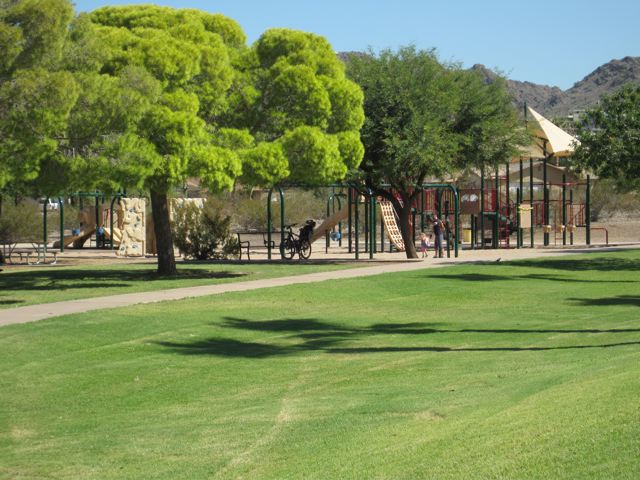
Lately I have been taking BB Jr. to Granada Park, a decent sized urban park with a couple duck ponds, some transplant pine trees, and desert scrub. It's served as a stop-off spot before for winterfowl, notably during a 5-MR challenge a couple years back. Having recently become very opinionated about small city parks, I now choose it as our family park of choice because of its comparative birding potential and water fountains that don't smell like pee.
BB Jr. likes it too but he's pretty easy to please if he can get down and move around.

  (He got un-stuck eventually)

There's an old mesquite tree near the playground/sandbox area, and last Saturday it was quite the little hot spot for migrants. The blooming mesquite attracted bees and many other insects, which in turn attracted Yellow, Black-throated Gray, Townsend's, Wilson's, and Hermit Warblers, plus the usual residents and the largest Warbling Vireo I have ever seen. Returning the next morning with my crusher, I was disappointed to observe almost no activity in the same spot--such is the caprice of migration I suppose. 

Image result for granada park playground
Photo courtesy of Playmapped.blogspot.com

However, B's Bs is made of sterner stuff and does not give in to despair, at least not for like 15 minutes or so of sustained adversity. Granada Park is also one of the best places to see Rosy-faced Lovebirds...as I have often relayed to out-of-town emailers getting in touch with amusing nervousness about when and where they'll be able to see these birds. They nest in the palms at Granada in large family groups, and they will also forage in lower bushes, sometimes even on the ground.


This was the first time I had seen them feeding in/on the fuzzy white creosote seed capsules. Tough birds eating a tough plant...there is great continuity here (though purists may point out that creosote is a hearty native and Lovebirds are a hearty invasive). Presumably the Lovebirds do the creosote a solid by way of pollination and seed distribution, and the creosote does the Lovebirds a solid by being eaten by them. This would seem a less one-sided relationship than that of gators and Egret chicks. Most of the carnage I see at Granada Park has to do with some dog-walker's poop-scooping glove malfunctioning (not pictured).


Sunday afternoon we celebrated a tri-generational Mother's Day, which was well and good, especially because perfectly cooked beef tenderloin was involved and the sides I contributed didn't suck.
Also cool was finding a Cactus Wren chick, recently out of the nest but not yet fully fledged. It was skulking and scurrying along the planters while parents supervised. They all blew a gasket when I approached the bird of course, but after I got to live out my 'bird-in-the-hand' field biologist fantasy all was quickly restored.


I will be finishing out my last week of work and its aftermath through this weekend, finishing out a 7-year tour of duty in AZ education. Although there is plenty yet to do for the move, there will be more than incidental birding in the couple weeks to follow. There must be, or I shall explode.