Thursday, July 10, 2014

Show me the Money Birds: Hugh Ramsey and Estero Llano Grande

There were great birds in San Antonio, and great birds in Laredo and Corpus Christi as well. But these places and birds were all prelude to the next few intensive days of Tex Birding. Finally, with the Rio Grande just a site and a sniff away, we were in the tropics around Harlingen and Brownsville. This was what I had been missing for years, being totally immersed in birds I couldn't see elsewhere in north America, in new habitats, and even in newish shoes (though the old birder rags stayed the same). Nothing but Valeros and Whataburgers, and birding habitat, far as the eye can see Tip of the fin LRGV birding time. BOOM!


The morning was misty and often overcast--the really annoying kind of overcast where thin clouds don't keep out the heat, but do make settings and subjects brighter and hazy to behold, forcing a constant semi-squint. 
Hugh Ramsey Park, pretty near the our hotel, was the first stop. Long-billed Thrashers and Olive Sparrows were loudly foraging in the tropical mesquite willow stuff. White-tipped Doves cooed loudly from deep in the growth. Plain Chachalacas were also boisterous members of the morning traffic.


Also known as the Mexican Turkey Chicken, the Chain Plachalaca, and the Raucous Brown Pheasant, this bird was not a lifer, but one I missed very badly from my brief time in south Texas years before. It was one with which I was determined to return possessing souvenir photographs this time around.
Since I have, to date, not seen a single species of Grouse or Ptarmigan, and thus otherwise not known the joy of having a large bird close by in a tree and easily visible, I must cherish and hold the Chachalaca close to my man-bosom. It is my Tatalaca.


"...What the hell did you just call me!?"

Hugh Ramsey Park was excellently birdy. It has plenty of little paths and differing habitats painstakingly established--or at least funded--by one Audubon group or another, and some of the shady cul-de-sacs offered fantastic views of perched Buff-bellied Hummingbirds.


Although I still seek the similar-looking an equally impressive Berylline Hummingbird, this looker was a particularly satisfying find. In typical hummingbird fashion, after about 2.17 minutes of acclimation it entirely quit caring about our presence in its territory, and would sometimes land abidingly close while circulating through its various perches. Shade and clouds made for low shutter speeds, but I shan't complain because we avoided feeder shots, the lowest form of bird photography (in which, of course, I do still operate when there is no other option). 


Chachalacas and Buff-bellies are wonderful, and also easy, non-draining birds to ID. That's less so the case when one starts examining the yellow-bellied tyrannus birds that reside in the area. For a non-Texan birder lacking Texas-sized confidence and ability, the Couch's vs. Tropical challenge is a bit daunting. As with many empids, waiting for these birds to vocalize can cost one a considerable amount of time better spent with other birds (maybe I should always try playing tape of both species eh?).
This fellow was one in a group of three birds, two of which were immature. The beak doesn't seem big enough for Tropical here, so I'll posit Couch's for it.


This next tyrannid, which was actually photographed later in the afternoon at another site, seems to have more olive-green on the breast and a larger beak in proportion to its head, though no doubt this is a much different angle and perspective than with the preceding bird. I'm still going with Tropical on this one--a bird we also get in small numbers in Arizona, and one I should study more diligently.


Ramsey Park had its select offerings and was very conveniently near our lodging. We decided to return in the evening (when the Hummingbird above was actually photographed) and move on to a larger destination, one with an absolute advantage over Ramsey in terms of its birds, one for which I had the highest hopes and expectations for the trip, one that is now, surely, one of my all time favorite birding destinations thus far visited in North America, Estero Llano Grande.

It rocked my socks off, though luckily I brought an extra pair. Before we'd even gone through the visitor's center/official entrance, we had out first and only Altamira Oriole of the trip (during what would prove to be a very low-Oriole couple of weeks overall) and a lifer Clay-colored Thrush. There were also absurdly crushable Olive Sparrows, a bird I was intently seeking as a part of the unnecessary and unsolicited Butler's Birds quest to find, photograph, and judge all North American Sparrows.


I think my understanding of the presence of the CCTR was a bit dated, as I thought this would be a rare and difficult bird to find. This individual was one of two found during the whole trip, but apparently they're more reliable, especially in shady areas near feeder stations or clearings with other easy food sources. At any rate, this was a lifer that surprised me, one of those birds I wasn't particularly expecting to see, relative to other potential lifers at Estero I was prepared, at least theoretically and with extra undies, to behold.


Not only did this normally shy skulker show well, it even vocalized a bit. This is an interesting bird, though it's tough to articulate why. It's clearly related to Robins and other Thrushes, and is a rather dull brown overall. And yet, maybe just because I'm prejudiced in knowing this bird's range and seeing it specific habitat, but there's something very obviously tropical-seeming about it.


Around the Clay-colored Thrush there were, of course, more obliging Olive Sparrows. Perhaps knowing I was a very stern judger of Sparrows (I am, The Law), they did their best to impress and importune their way towards ingratiating my Dred Judgment. I won't say it didn't work.


Eventually we did make it through the official entrance. The attendants there provided some information on the resident Common Pauraque, the main Estero attraction, that can be found and photographed very well earlier in the season at the Alligator Lake bench area. Unfortunately, they informed me that no one had found any birds for the last couple of weeks, including during the morning Audubon walks led by docents who knew all of their usual haunts. Apparently, once the birds have fledged their young (or tried), they all disperse into the thicker and inaccessible vegetation.
This news was tremendously disappointing, as COPA was one of the most anticipated birds of my trip. With heavy heart and hearty head we set out onto the Estero trails, splitting up pretty soon to see what all was still around. The ponds were devoid of smaller shorebirds, but still held the larger residents.


I spent about an hour scrupulously searching every pile of leaf litter, every bump on a branch, every shadow and every other conceivable Pauraque-type thing in the Alligator Lake area, turning up only a White-eyed Vireo for my troubles. In the mean time, Mike spent most of his time birding in the much shadier and far birdier 'tropical area' while I stubbornly languished in the nightjar-less plot.


I later rejoined Mike where we had some concentrated and excellent birding. For future reference, the 'tropical zone' at Estero, which actually lies outside the visitor center controlled area, was by far the best birding. We had the earlier Olive Sparrows and CC Thrush there, as well as Kiskadees, Green Jays, Northern Beardless Tyrannulets, Bronzed Cowbirds, and plenty of other goodies, with the pièce de résistance being a vocalizing but distant (and shaded) Tropical Parula.


But the shady joys of the 'tropical zone' were, until later in the day, quite apart from me. I was in the baking sun, without a Pauraque and really much else to show for my time and trouble. A pair of Golden-fronted Woodpeckers, both stuffed full with bugs, were a nice but insufficient consolation on the way back from Alligator Lake. It was at this point I also ran into the bird walk group completing their morning rounds. The conspicuously dressed guide rather indignantly mentioned that, of course, they hadn't seen any Pauraques this time of year and day, like maybe I was implying this was a failure on his part and embarrassing him in front of the 60 year old bird ladies he was trying to impress. 


Whatever. Failure is, in fact, an option at Butler's Birds. In fact sometimes it happens without even being chosen, obnoxiously enough. But not this time, or not so easily.
The Camino de Aves trail in the northeast portion of the park terminates at Kiskadee Lake, and I figured maybe here I'd get a shot at some tropical Kingfishers (not at all, as it turns out). Along the way the path winds through cactus and mesquite bosque on one side, and willow scrub oak type stuff on the other, with thicker cover and more leaf litter. I was still looking in the leaf litter and low branches for Pauraque bobs, but Long-billed Thashers and Common Ground Doves in the more deserty stuff kept distracting me. After one such distraction, attempting to photograph a Roadrunner--which isn't even a bird I should be spending time on in Texas--I audibly said to myself (yes, I talk to myself a lot both in general and while birding, I don't have to justify anything, leave me alone!), "Ok Self, stay focussed on the other side here or there'll be no chance at all of finding this bird. Get it together man."
Right as I made the utterance--and for once, no hyperbole is being used here--I looked back over to the thicker side of the trail and there, just beyond the liminal grass, sat the gorgeously patterned Pauraque.


It almost knocked me on my backside. In fact, only the nearby presence of cactus and a quarter century of learned experience about what cactus does helped steady the knees. After so much expectation, and with so much hope having drained away, by luck or judgment, there sat the not so Common Pauraque, and it was stunning, totally stunning.
I'll admit to a very, very slight disappointment that the heavy grass and overhanging branches prevented a full, close crush of this bird, but I got to examine it from every angle, admiring its many chevrons and herringbone patterns, its smears of buffy and peanut butter, its massive nictal bristles and eyes next to to tiny little peaked beak.


I quietly back away and found a nearby little red flag that someone was using to mark a sprinkler head or bubbler line. Now it was marking the Pauraque spot. I went back to find Mike, and after we enjoyed the afore mentioned bounty of the tropical zone, we returned to find the COPA, as expected, in its same spot but turned with and away from sun.


Estero Grande turned out to be a tremendous spot. It provided several lifers and many fantastic views of other birds, including fantastic photo ops. It must be truly incredible in May, when migrant Warblers and shorebirds are also in the park. Even though I'd have much less to gain by way of new birds upon a return, the sheer birdiness of this place is a very strong temptation to return some time in May. 

Sunday, July 6, 2014

Texas Birding: Average Aransas and Mustang Island, Wild and Free

The Texas Birding Adventure was a large endeavor, large enough to require reinforcements to split some motel costs, intimidate away highway brigands, and also enjoy the birds. Mike from The Iowa Voice postponed his date with the Supreme Court to join in the Texas birding experience for a few days. It is unhealthy, after all, for one to go too long without Scissor-tailed Flycatchers in one's life.


Our first stop was at the birdiest site in all of Texas, which puts it high in the running for birdiest spot in North America, with over 370 recorded species. It is also the famous wintering grounds for a majority of North America's Whooping Crane population. Pretty impressive credential yes? 
Well, truth be told, Aransas NWR in June is pretty disappointing, unless one is hoping to lose a pint of blood or two to mosquitos. We did still have some good bird sightings, and plenty of other nifty wildlife. Behold, a Six-lined Racerunner, with battle damage, and a fecund family of javelinas. 


Aransas is a massive space and within its birders one encounters a multitude of habits. We were mostly out of luck with timing. The grasslands, the exceedingly buggy forest, and even the shoreline portions were all pretty mellow. Migrants had moved on and residents, other than Turkey Vultures and Northern Cardinals, were few and far between. It was a bit of a let down, given the earlier success and momentum of the trip. 
Perhaps the best sighting of the day was this ridiculously tall trail sign. It had normal trail sign info on it, stuff about the grassland flora and what not, but it this information, apparently, is only intended as accessible for the very vertically gifted. 


In a similar vein of photographing tall and graceful things, the white morph Reddish Egret was also pretty inspiring, even from a distance. They are among the more spastic and entertaining feeders of the heron/egret group. Their 'shadow-wing' feeding technique (not pictured) was the inspiration for at least two different forms of Kung-Fu and probably a few more bad movies about said disciplines. 


The main disappointment at Aransas was that all of the birding trails within the deciduous growth were  absolutely swarming with mosquitos and relatively birdless. Passerines and Woodpeckers were almost none to be found, and even though migration had moved through, we expected more activity. The birding was probably best at turn offs from the auto-loop, where clearings allowed one to look and listen for birds like White-eyed Vireo in the liminal brush, and other critters in the grass.
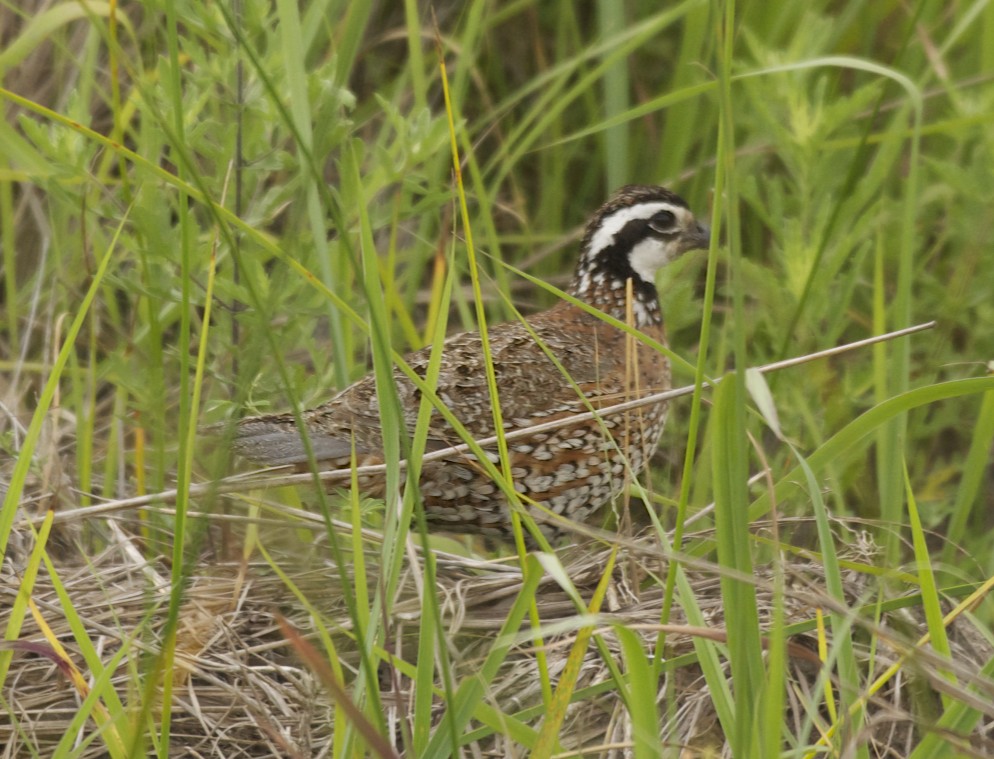
All my whining aside, picking up a lifer Northern Bobwhite compensated for the other shortcomings.  


Alas, we were not position in a nifty bird blind by a watering hole, so there will not be finely detailed images of this intricate bird to enjoy, but rather blurry, cropped photos of a fairly secretive bird going about its business.
A couple of weeks later I was able to observe these birds vocalizing from high in coastal pine woods in Carolina, which was much cooler than one might expect on paper.


In the game-birds category, we also had some of the more conventional quarry, lots more, in fact. A rafter of 19 Wild Turkeys included about a dozen chicks, a form of turkey I had not yet experienced in life. It was purdy cute.


Fueling up in the various senses around Goose Island SP provided more gulling and harbor-birding opportunities after lackluster Aransas. Groups of Laughing Gulls are always good for a pose.


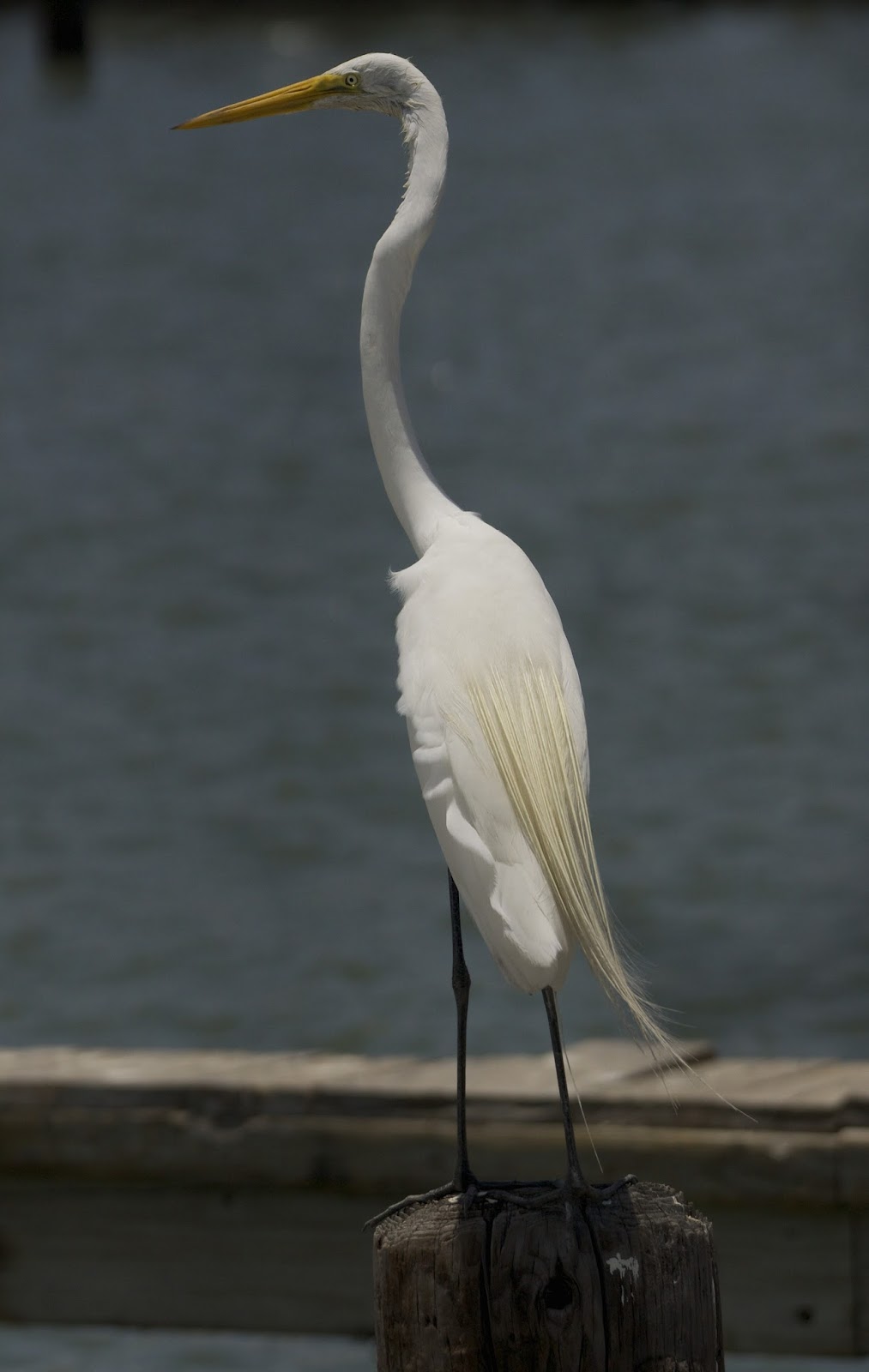
There was a fair amount of fishing boat activity around Goose Island harbor, and of course this in turn brought in all manner of birds both grungy and well-groomed. In the well-groomed department, this Great Egret, white as snow:


Less well groomed, this immature Brown Pelican, who just needed a bit more time.


The Port Aransas area also coughed up some shorebirds for the trip list, even if it didn't have quite the scenic beach landscape one might also hope to combine with maritime birding. The general abundance of scraps in that setting also brought in other carnivores and scavengers. For once I was able to check out a Caracara while not driving 80 miles and hour (or even 60mph).


We headed south in the afternoon for Harlingen, and decided to stop back in Corpus Christi, on the way down the coast, at Mustang Island SP. The beach was carpeted with soft seaweed of some kind, more of which was continually brought ashore by the heavy-laden tide. These kelpy masses were teeming with minnows and other edibles, which in turn attracted the attention of those bold enough to plunge-dive or dip precisely at water level, a la Sandwich Terns.


We were surprised to see many dozens of Black Terns in area, having thought they were mostly migratory in the area and would have moved on (maybe they move much later than I was thinking). These birds are seldom seen in breeding plumage in Arizona, and it was very pleasing to see them fulfilling their bold namesake.


Some of the mid-molt birds hung out with Sanderlings, apparently self-consciousnbess of their disappointing plumage. Royal, Elegant, Bridled...Terns are a pretty aristocratic group of birds and they seldom tolerate ugliness, but Sanderlings won't judge.


The kelp piles attracted several different species (Sandwich and Forster's below), and just above the main breakers,hundreds of Terns joined together, fighting to stay stationary above the break point, where their prey would become exposed.


Some of the more diminutive Terns, like this here Least fellow, were pretty impervious to people, while others like the occasional Gull-billed always kept a distance. 


Some Terns were way too busy being demonically possessed to have much concern one way or another. This bird later went and projectile-vomited to its young.


Sometime at the beach was perfect for clearing heads and finding footing. The next day in Harlingen saw one of the most satisfying thus far, and is coming up later this week. 

Monday, June 30, 2014

Texas Birding: Turning South and Turning Tropical

The Butler's Birds Texas Adventure started out with a delectable appetizer of Painted Buntings outside San Antonio and then continued the next morning with endangered Black-capped Vireo and Golden-cheeked Warbler. After recording a clean sweep pretty early, I headed south to what is both harshly and accurately called the a**hole of Texas: Laredo. 
Of about three sites ID'd as good for White-collared Seedeater--the main reason to go to Laredo--Zacate Creek seemed like the most contained and easy to find (anyone else get overwhelmed when you're at a massive new site with 50 trails? So much nagging and doubt...). 
The place was totally trashy, with trails in disrepair and garbage all along the river banks, which served to accentuate the miasmic air blowing through the tall cane on the banks. Plus I was accosted several times by ICE agents, one of which ruined a perfectly good Green Kingfisher stakeout that was about to pay dividends for me, and one of which involved a fellow gun-in-hand (not pointed though). But damn, the birding here was phenomenal, and I caught a break from the cloud cover in the late afternoon (coincidentally, the hottest time of day). 
White-collared Seedeater was actually the third bird I had by the Zacate River, behind MODOs and GTGRs. Hearing and seeing these tiny birds would prove to be pretty easy. Photographing them was another beast entirely, a sweaty, smelly, swampy beast.


Since the Seedeaters were a relatively easy find, I spent more time exploring the trials and other habitats around Zacate Creek. Green Jays, Golden-fronted Woodpeckers, and a couple of Green Kingfishers made for exciting year birds and solidified the tropical feel of the area. Great Kiskadees were sounding off from the trees, their boisterous betraying how shy of birds they really can be, and a couple of Olive Sparrows further boosted the day's species list.


Exploring the thicker palm groves yielded fewer birds overall, relative to the thick riverside tamarisk and cane, but this unique vegetation provided the only Audubon's Orioles of the trip. Including the birds from Kerr WMA in the morning, this added to seven lifers, probably the most I've recorded in a single day in several years. Zacate was a dank and dirty place, but it was productive.


Although it was late in the season, a lingering Black-throated Green Warbler was feeding in the mesquite canopies at the end of the trail--the first Texas bird that would flag and require an eBird justification, given its tardiness. These are, I will somewhat ashamedly and somewhat unashamedly admit, my only photos of the species to date. To all haters out there I simply say...zee zee zee zoo zee!


The Seedeaters stayed high and far throughout the afternoon, offering poor photo ops and better binocular views. As the sun started to descend the number of ICE agents in the area increased, anticipating the push of immigrants that comes every evening.
At this point in the day I was pretty tan and had left my wallet (and ID) in the locked glove compartment of my car as a precaution. Not wanting to be profiled and rounded up, I decided to call it a night, after finding some public showers, because using the Zacate River would've exacerbated things.


The next morning saw the first big busts of the trip, which luckily had nothing to do with windows, tires, or other parts of the car, nor my face. I had hit all the Laredo targets--and then some--at Zacate the first afternoon, but figured I'd try a few more sites recommended form the Texas Birding Trails website. 
It turns out that site was a bit out of date. One of the areas has since been totally leveled and turned into a gated community with no surviving wetlands (except a duck pond) and another required advanced notice and a $40 entrance fee. 
Instead of doing that...I went to the beach. 
Driving across the Texas fin from Laredo to Corpus Christi, there were several dozen Crested Caracaras adorning various pedestals. While I didn't stop to photograph them (high, telephone poles, etc.), I must say this is probably the best highway roadside bird one can ask for in the U.S. 

When one arrives on the Texas/Gulf Coast in June, one is beset by Laughing Gulls. Hundreds and Thousands of Laughing Gulls. Try to pick out the occasional late Franklins, even a Ring-billed--I did a couple of times--but you will also go mad and begin laughing manically too, just like the Gulls that have hounded and driven you to this point wherever this sand and/or garbage. 
Still, they're pretty good looking Gulls.


There was some time to kill in Corpus before picking up The Iowa Voice in the evening for several days of joint birdventuring, so I used it to scan the Corpus Christi tidal flats and pick up some more diarrhea. I didn't know it at the time, but Corpus really is a great birding area with many more sites where at I could've better spent time. Relaxing around the easy-access beaches was nice though, no doubt, and still provided some nifty birds. Willets are an uncommon but reliable find in Arizona. Of course in Texas, they're among the most common shorebird in June.


The lifering continued via some Wilson's Well-Endowed Plovers. With their slightly but noticeably longer beaks, this species will eventually drive all other similarly sized Plovers to extinction.


Daylight was fading, as was the fast-food-fueled stamina. There was still some time to explore the area, but with no particular Corpus Christi specialties on my radar cruising around a new town--which wasn't as riddled with billboards as most other Texas towns--was a nice way to see off the sun. Driving over the Oceanfront bridge from Corpus to the naval base even yielded another lifer, one I wasn't expecting or really pursuing until later on in the trip, one that, I admit with mild embarrassment, I should have picked up earlier in life. Unfortunately I had already finished my dinner sandwich before crossing this frost-capped specimen of Tern. Of course, it would have been somewhat reckless, even inconsiderate, to simply pull onto the narrow highway/bridge shoulder and photograph the bird. Of course, a lifer is a lifer, and Butler's Birds sets high standards for such affair, so I did it anyway: