Saturday, October 8, 2011

A Good Day for Pictures

I made my first evening trip to the Desert Botanical Gardens today, and I almost didn't see a single new bird! As I was leaving I did notice a Rufous-Capped sparrow, so the List still grows on.
What was really special though was the setting. The sunlight was picking up and reflecting off of the granite and sandstone hills that surround the DBG and a soft orange light filled the area. The birds were occupied in their evening foraging and were especially photogenic. Even though I did not see many new birds (and yes, I realize the day will come when I will not see any new birds at all), I did get a lot of great pictures of familiar birds, and virtually all of them provided better and updated photos for their respective entries. It was one of the best all-round photographical experiences I've had thus far.
I have not reproduced all of the photos here, but have filed them into each species' entry, which will be linked below.
All images can be enlarged by clicking on them.
 This fluffy Mourning Dove was the first to greet me at the DBG.
 An Anna's Hummingbird delicately sips her drink. It was after 5 pm after all. This is a female Anna's, courtesy of the connected eye-stripe to the forehead. I especially like all of the pollen that's stuck to her beak.
 Of all the places to find a Cactus Wren...
 This Curve-Billed Thrasher was either eating prickly pear fruits for his dinner, or is a cannibal--pretty stark contrast.
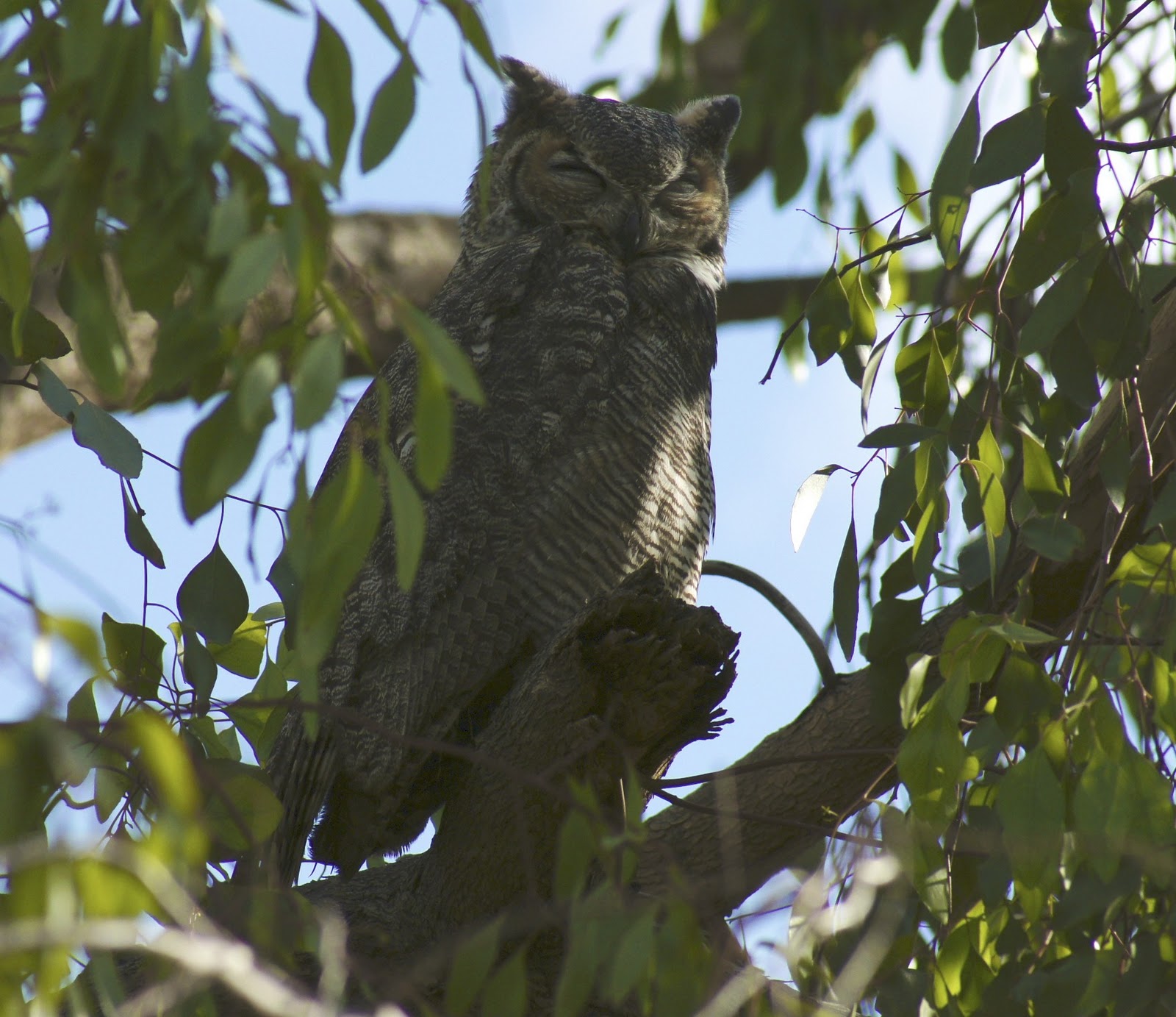
 Great Horned Owl: Lord of this Land. Mighty in Wisdom, Great in Sleepiness. 
 The House Sparrows even seemed to be especially pretty. I mean, they usually are kind of interesting because of their intricate coloring, but the right lighting and cool weather (finally!) just makes everything seem more photo-worthy. 
 I have still not been able to get the right shot of a Gambel's Quail. I don't know what it is. There are more Quail at the DBG than any other bird, but I just can't make it work.
 The debate rages on at the DBG as to whether this is the Pacific-Slope or the Cordilleran Flycather. I've thrown my lot in with the Cordillerans, but I don't know if it will ever be settled. There appears to be a stick poking into this handsome Cordilleran here. I wonder if he felt it?
 Verdins are great. They're colorful, energetic, and not overly shy, but they also don't give it all away up front. This lovely specimen was in the mood for lantana berries.

Not the most flattering angle, though I guess it was rude to watch her eat in the first place.
 Success! One of the last ripe berries.
 You know, looking at that beak and that berry, I'm not sure it'll all fit.
 This female Northern Flicker was digging for ants, which as I found out is a fairly common practice among Flickers. I guess it's easier than pecking wood. I really like her polka-dots.
 I really appreciate that this Cactus Wren posed among the purple for me. I'll vote for him to be my state bird any day!
 The Green-Tailed Towhees seem to be at the DBG in force now with Autumn setting in. 
 This Rufous-Crowned Sparrow was the sole new bird on this trip, and it figures that I couldn't get a decent picture. There's always next time Mr. Sparrow...I know where you live.
Even the Abert's Towhee, drabbest of birds, was looking good this evening. This specimen seemed to feel it as well. Standing tall and out in the open? Hardly the normal behavior for the humble Abert's.

Friday, October 7, 2011

House Sparrow

House Sparrows are everywhere all the time always forever. They live our airports, wal-marts, and apartment complexes. They're crafty, shrewd, and are probably better adapted to living on the street then amongst the trees at this point.
I hadn't bothered to photograph a House Sparrow yet, but this specimen seemed particularly clean-cut, so he was chosen among all the others to represent the vast House Sparrow empire.

Rufous-Crowned Sparrow

The Rufous-Crowned Sparrow has a darker back and darker wings than most of his cousins. They don't stray very far out of the southwest and aren't especially common, so it was nice to see one by the exit to the Desert Botanical Gardens. I didn't even have to do any work.
That being said, I didn't get great pictures either, and I'll be keeping a careful eye out for this rufous-headed rascal next time.
Apparently it's pretty rare to see them in the lower altitudes, and this was the first reported/documented sighting at the Desert Botanical Gardens, YAY.
 Here in the sunlight you can see the rufous cap, as well as the facial stripes and even the hint of a dark line running down the chin. These all help to distinguish the Rufous-Crowned Sparrow from look-alikes such as the Lark and Chipping Sparrows.
In addition to the rufous crown, you can see the peculiarly dark wings. Sparrows usually have a lot of mottling or streaking with white and lighter browns, but not this guy. The tail is similarly dark, but I cut it off in the picture...I know I know.

Great Horned Owl

The Great Horned is the third largest and most common Owl throughout North America. It seems kind of unusual for one of the larger species of birds to be the most common in the (owl) family, but then there's lots about owls that sets them apart from other birds. The "horns" are actually feathery tufts, and the owls coloration varies greatly by region.


Here are some fluffy Owlets almost ready to fledge.


The feathers underneath the beak of this second owlet make it look like the bird has a very creepy smile, as if he's contemplating all the mischief he will soon cause, or is thinking about eviscerating something with his Owl claws.

Wednesday, October 5, 2011

In a Few Day's Time...

I'll be birding again this weekend and hopefully coming away with lots of fun to share. In the mean time, the larger Ring-Necked Duck post knocked down the Brewer's Sparrow post, which is also recent and worth seeing. There are also new pictures of the American Coot, and this time they're not blurry!
See ya this weekend.

Monday, October 3, 2011

Ring-Necked Duck

This is my favorite Ring-Necked Duck, for a number of reasons. It's the first and only specimen I've seen since I got my camera, and I've been able to see this specific bird now on three separate occasions.
When I first saw this Duck, which I shall henceforth name and call Gary, he was oddly hanging out at the drainage pond at the barren Grenada Park in the middle of the summer in Phoenix. He was the only non-mallard on the pond, and I must confess I judged him to be a Lesser Scaup at the time.
Here is the picture taken in early August (All photos can be enlarged by clicking on them):
I judged Gary to be an immature Scaup because they and Ring-Necks are about the same size, have the same yellow eye, a similarly curvy bill, and the lightly-streaked gray on their flanks, as well as the dark brown breast. I was forgetting the dark on the back however, which Scaups do not have (their wings, sides, and backs are all the same sort of soft gray). Since Scaups are more common than Ring-Necks, I hedged my bet in that direction.
I appreciated Gary's bravery at the time, as I think temperatures hit 111 degrees that day and be he Scaup or Ring-Neck, he was way, way farther south than either species' normal summer range.
A week later I saw Gary again at Grenada Park. Again he was the only non-Mallard and non-Coot on the pond, and he looked much the same.
On October 2nd I returned to Grenada Park hoping to see some migratory ducks. While I was disappointed in that pursuit, I had a pleasant and surprising reunion with Gary.
It's Gary!
Here I had been thinking Gary was a Lesser Scaup, when in fact he was a mighty Ring-Necked Duck all along! He was/is still one of a kind at Grenada Park, and it was very cool to reunite with perhaps the bravest and toughest Ring-Necked Duck of them all.
Here Gary looks for deliverance from the company of these Mallards he's been forced to endure all Summer. 
Gary still doesn't have his fully mature plumage. The Ring-Necked Duck, like the Lesser Scaup, has an iridescent purple covering its head and neck, and a strong white vertical bar on the shoulder. However, the two white rings on the bill, one at the base and one before the black tip, are diagnostic. It's also interesting to note how low the tail hangs. It is horizontal with the duck's body and often rests atop the water. Many other ducks keep their tails more erect.
This is the blank, vacant stare of a duck who has had its brain scorched and friend for 3 months, in summer heat it was never meant to endure, in a pond that is maybe 50 by 100 feet, with only Mallards and a few obnoxious geese for company.
Here again, is the dark back that clearly disqualifies Gary from being a Lesser Scaup. 
As Gary recognizes me, his long lost and only true friend, he sheds a tear of joy.
His attention was quickly stolen away by a wobbly lady toting Wonder Bread, but I know Gary was glad he could show me that, while he was maybe confused about his summer migrating, his identity as a Ring-Necked Duck is firmly established.

Gary, King of Grenada Park, I shall return someday soon to see your purple crown. Hopefully you will find a queen, ring her neck with pearls, and have lots of Ring-Necked chicks.


Here are some more recent photos taken in November:


Brewer's Sparrow

At 5 inches, the Brewer's Sparrow is one of the smaller emberizids, and also one of the less colorful.
The Brewer's Sparrow has the nondescript browns and tans of of the sparrow group, but has more streaking on the head and back, as well as darker primary feathers that set it apart to the careful observer. They prefer rocky terrain, sagebrush, and desert shrubs, which is great, because not a lot of other animals do, and it's nice to still find new birds in the more dull scenery.

What they lack in visual pizazz they make up for with their song, a very complex string of oscillating high notes that is as unmistakable as it is pretty.


Saturday, October 1, 2011

Bust at Boyce Thompson Aboretum

I made the short drive outside of Phoenix to the Boyce Thompson Arboretum this Saturday. Having heard its sterling reputation for attracting all manner of avian fauna, we made the trip out in pleasant weather with the company of another acquaintance.
The scenery at the Arboretum is stunning. The jagged cliffs and peaks of the Arizona desert mixed beautifully with the palm trees, oak, and eucalyptus that abounded throughout the grounds.
Click on the images for larger viewing


We also came across some particularly impressive cacti, with this saguaro seeming to push 50 feet. I count over 14 arms as well.
I was also surprised to see a domesticated cat in the area--probably an unwelcome invader to this carefully crafted ecosystem. I liked that he had a corner of his ear missing, and took a picture. Little did I know he'd be the best subject of the day.

The hiking itself was very nice. It was most level going, with enough of a breeze and occasional shade to keep our temperatures down. A dried out river bed cut through the canyon to provide the exceptional views seen earlier, and yet amidst the grandeur we still found the small and delicate things to appreciate. This Hummingbird nest was notably unoccupied, but still pretty cute. They don't build any extra space into their domiciles.

While snooping around, I also noticed a determinedly camouflaged grasshopper. He imitated a leaf very well, but his ruby red leggings gave him away. He was lucky I was neither a bird nor John the Baptist.

By this time we had been in the park for a good 2 and a half hours, with still remarkably little seen in way of birds. Turkey Vultures, Verdins, and Hummingbirds were common enough, as were Abert's Towhees. It was a surprisingly unattended party at this fabulous garden all in all, and I only managed some far away shots of a Western Kingbird, and wouldn't ya know it he just had to perch on the telephone wire. Of all the places!

It was a pleasant afternoon, and we had some yummy Mexican food afterwards, but I think I'll be focussing more on the Desert Botanical Gardens and Gilbert Water Ranch for a while yet.

Lesser Goldfinch

The Lesser, or Western Goldfinch has two subspecies, black-backed and green-backed, which have an overlapping range in the Rocky Mountains and even into California, where they may run into the Lawrence's Goldfinch, their uncommon cousin.
These little birds always seem to be peppy. They share at the feeders, which means they're often pushed out of the way by house finches and sparrows, but their love of thistle seeds is second to none (except probably to the American Goldfinch).
They have a large population at the Desert Botanical Gardens in AZ, where their thistle diet has been effectively substituted for the wild sunflowers. They didn't seem to mind at all.


My Arizona family had never seen one at the house, despite maintaining several bird feeders year-round. Once they displayed thistle seed, they had over  a half-dozen goldfinches flitting about within 48 hours.