Thursday, August 16, 2012

The Evening Dregs

We caught some brief thunderstorms last night, but otherwise it has been silly hot this week. I spent a lot of summer doing prep work and attending seminars; now school has started. Summer break is gone, but the heat is still here. It's very nice to be back to work in a meaningful way, but it has severely cut back my time outdoors, and I can feel my birding skills already starting to rust.  

I had not paid a visit to the long-favored Tres Rios site since last May and a return at the first opportunity beckoned me, even in an enervated state and on a school night. after all, birding in the evening is very relaxing; everything is calm and getting clamer. Time and light are against you, but there's a sort of cozy quality to everything you see and hear in the evening stupor. 

Alas, when I reached the Tres Rios site, it was closed! Not just regular closed to the public, but closed to everyone. They even took the time to move large boulders in front of certain access points, and the boulders refused to acknowledge my nifty orange permit to ingress. Digging a tunnel underneath the boulders was out of the questions, and I left all of my dynamite at home. Ugh. Evening birding opportunities come few and far between now, so after shaking a fist at fate, I decided to explore the adjacent farmland and see who was left in the dregs around Tres Rios, the muddy farmland around the beautiful preserve that sinks into the landscape like the gritty gunk at the bottom of a wine bottle.

Of course, before I fully exited the Tres Rios site, I paid a quick visit to Burrower's Row and greeted its quaint residents. The soy crops and alfalfa along Burrower's Row were recently harvested and the Owl numbers seemed to be down. They were also staying much farther away from the road than normal. It was sad to see the Row in a state of relative disarray, but if the owls have lived here for more than a year then they're probably used to it. They seemed to be enjoying the sunset just fine. 

"Dude...I'm totally dilating right now!"

It was very disappointing to make the drive out to Tres Rios and find it closed, but birding in the surrounding area did allow for some safari-style (that is, in-the-car) birding, which is pretty rad when it works. From the relative shade and concealment of my vehicle, I got to steal looks at all the evening diners of Farmington Glen. Red-winged Blackbirds crouched low and munched away. With the chores of singing, mating, and rearing young seemingly past them, they were all unusually quiet.


In the back of my mind, I was secretly hoping for a gem shorebird, something rare and conspicuous like the Upland Sandpipers that turned up in southeast Arizona today. No such luck in the rare shorebird department, so it fell to the White-faced Ibis and Lesser Yellowlegs to represent, and all-in-all they did the waders proud.

These Ibis were having a little preen-n'-gossip session, no doubt making quips about who would be too fat to fly south for winter (or too not fat? I guess it's kinda the other way around with birds).


The Yellowlegs were a bit more conspicuous, or at least they tried to be. They didn't blend in very well but that was fine with me. Usually I only see Yellowlegs in Arizona around nasty sewage ponds, so it was nice to find them within a greener, healthier-looking environment.


A single Black-bellied Whistling Duck was the highlight of the evening. He flew in from the now off-limits Tres Rios preserve with his Red-winged Blackbird sidekick.


After making their grand entrance, this dapper duo paused only for a minute before they realized that Tres Rios was, in fact, a much better spot than this slough, and they soon departed. Oh, to have flown after them...


Bird activity wasn't restricted just to the semi-flooded farmland. The telephone wires and fences were covered with Eurasian Collared Doves--probably the largest concentrations I've seen in Phoenix--and they certainly were acting like they owned the place.

"The Sun is setting on the White-winged Dove empire...mwuahahaha."

Across the street a forlorn American Kestrel cast heavy glances towards some shrubs, perhaps mourning the field mouse that got away.


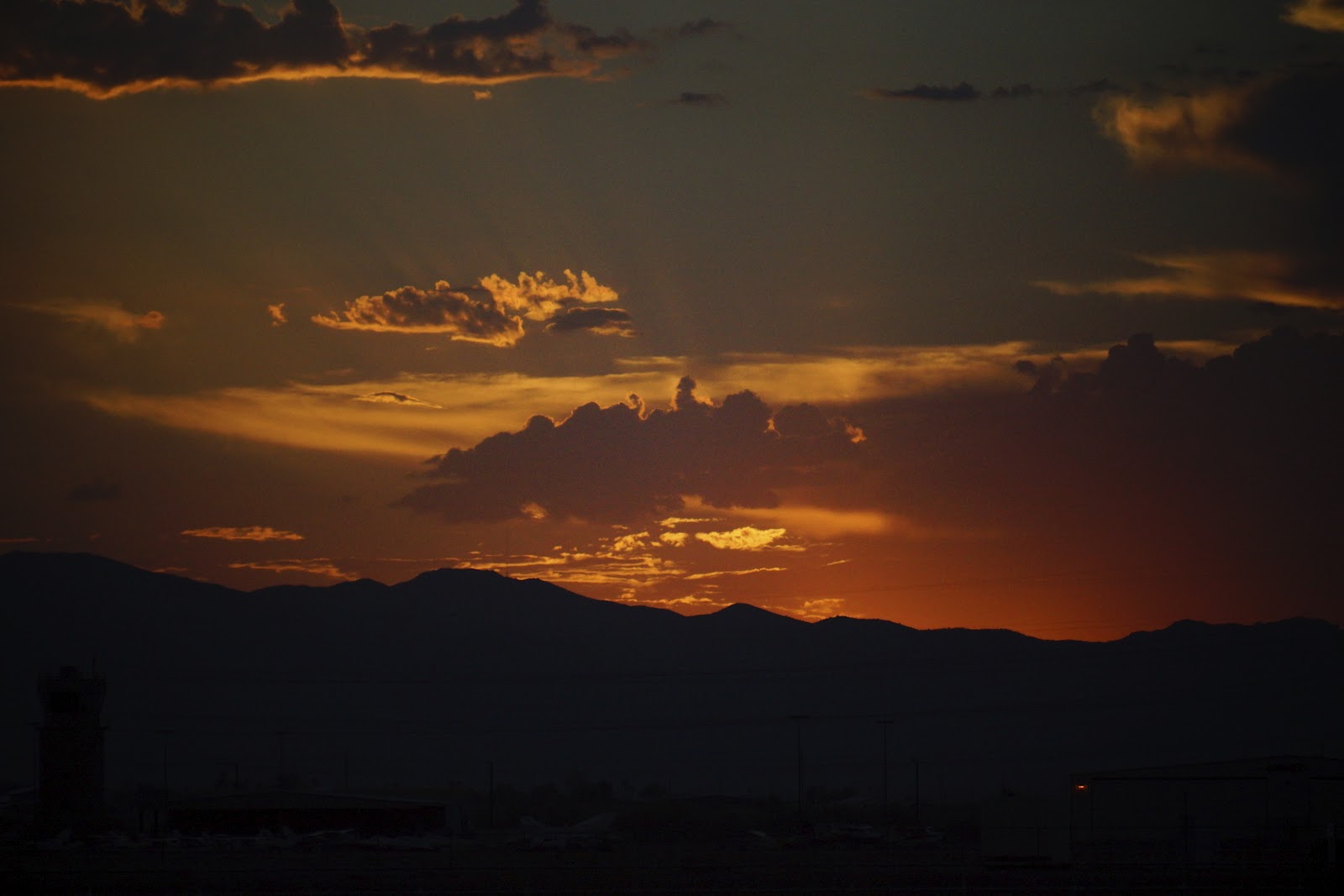
I was surprised by how quickly the sun set, but, I am proud to say, unsurprised by its beauty. It may just be empty boasting, but the Arizona sun really knows how to make an exit. A gorgeous sunset is probably the best way to deliver the news that birding time is over. 


A few more trips around the valley can hopefully tide me over to Labor Day weekend, and a trip to the Salton Sea. The sun never sets on the Birding Empire.
Friday, August 10, 2012

Going...Going...Trogon

These past few weeks have been very busy with school about to restart. With the exception of one brief, photo-less trip to Glendale to see a Tri-colored Heron (nice!), my birding has come to a standstill. This won't hold forever, but maybe until next weekend. So, just to keep something new(ish) on the site, here's a repost of my monthly entry from Birding Is Fun. Apologies to those who have read and cringed
at it already.

For years now, my Pops and I would make trips down to southeastern Arizona, always enjoying the beautiful birds and scenery, but also leaving a bit unfulfilled. We weren't always there at the right time of year, and we didn't always try really hard, but the fact remained that despite a long residence in Arizona and not-infrequent trips down south, we never saw an Elegant Trogon. At first it was a palatable failure. We weren't too serious and Trogons are not common birds. But over time, we began to sense a great emptiness in our lives, a void in our existence that could only be filled by avian elegance, and so the need to view the Trogon grew and grew.


The frustrations and failures continued over the years, with the taunting of this psychedelic bird eliciting outbreaks of psychosis every summer. The Trogon changed from just an avian jewel to a full-blown nemesis, a very stylish nemesis, which is the most dangerous nemesis of all. Instances of missing the birds in Madera Canyon or the Chiricahua Mountains by a day or even hours turned the pursuit into something more than just a leisurely birding expedition. It became an existential imperative that we see the Trogon. It became...mortal combat!!!


The intensity and passion is always palpable when birders squeeze into a small sedan and head off into the mountains, and on July 19th the little red corolla must've been glowing as the Butlers Birds Team embarked on an epic quest down to the Santa Ritas once more. As per the usual, our main goal was to see a Trogon. But this time things were different. This time the phrase, "or die trying" was thrown around a lot. This time we had all the necessary ninja gear. This time we were ready. 

We didn't get up into Madera Canyon until the afternoon, having first made some great stops at Montosa Canyon and the Kent Springs Trail for Plain-capped Starthroat, Scarlet Tanager, and Sulphur-bellied Flycatcher. Seeing these other birds was awesome, and it was all part of a perfect and ridiculously circuitous plan. By going after other specialties and rare birds first, the Trogons would not be suspicious that we were coming for them. 

Loud and flashy, the Sulphur-bellied Flycatcher is a great decoy when one is going after a nemesis.

We ran into some other birders on the Kent Springs trail who were seeking the Scarlet Tanager (a rare bird for Arizona), and they informed us that they had heard some Trogons calling on the Madera Canyon Super Trail earlier that day. We made a mental note and then continued to search out this enigmatic Tanager. We eventually located the ruby-red bird and helped our earlier helpers to some great views as well, before heading over towards the Super Trail, an appropriately hyperbolic name for a nemesis showdown. 

Heading down Kent Springs and then further up the canyon was grueling. The heat was hot, as heat is known to be, and the humidity kept things humid, as humidity is wont to do. But no amount of adverse meteorology, not even meteors, could deter our meeting with the Trogons. Even when an adorable bricolage of bubbly birds--Bushtits and Bridled Titmouse and Bell's Vireos--came bumbling through, we stopped only for a minute. House Wrens and Canyon Wrens called to us as we hiked up the Super Trail wash, "Go back! It's too dangerous!" but soon they sat quietly on the sidelines, eager to see how it all would go down. 


The Wrens were not the only bystanders; other Madera residents, like this Yarrow's Spiny-tailed Lizard, peeked up to witness the reckoning. 


After hiking maybe a half-mile up the Super Trail, we began to hear the famous croaking calls of the Elegant Trogon. In fact, it seemed like there were two birds talking to each other. We scoured the trees for their bulky, long-tailed silhouettes. Beads of sweat began to form and run for the ground while the air held still, broken only occasionally by the koa koa koa that faintly echoed around us. After an eternal-seeming fifteen minutes, the calls came discernibly closer. I turned to face Pops and just as I did, a whooosing sound shot past my head. Reacting just on instinct and training, I tucked into a somersault, rolled forward in an action-hero kinda way (not really), and drew my Sony Sharpshooter. I looked up to see Pops' gaze transfixed ahead of me. There perched our elegant nemesis, resplendent and radiating with a show-stopping beauty nearly unparalleled in North America. Rather appropriately, the light was behind him, shining down in regal fashion.


The Elegant Trogon did not stay for very long, but even this brief sighting was enough to appease the aggravation of those fruitless years. The bird was incredible in the literal sense of the word; I couldn't believe I was looking at it then and there. The Trogon didn't exactly seem to fit in that sycamore and scrub-oak canyon. It didn't seem like his natural environment. Nonetheless, every year these tropical visitors bring the hard-earned reward of jaw-dropping beauty to the southeast Arizona birders, and this year we were finally among the lucky number.  


Seeing an Elegant Trogon was top priority this summer, and it came as one of our last sightings on the last real birding adventure of the summer. By golly, these birds know showmanship! And so, a tale of nemeses and hardship ends in happiness. So far, we've all lived happily ever after.

Sunday, August 5, 2012

Havin' a Crack at Mt. Graham

A couple weeks ago I drove out to eastern Arizona for some early morning birding and some afternoon astronomy. This trip to Mt. Graham was not really a birding trip--thus the early morning stop at Willcox--but the mountain provided its own stunning scenes of natural beauty, and my hope that there would be some Yellow-eyed Juncos hanging around the picnic area near the summit was also fulfilled. 


Yellow-eyed Juncos are pretty sweet birds, and in fact have a rating of six mega-fonzies on the cool scale (that's very cool). For starters, they've managed to stay independent of the massive conglomeration of subspecies and systematics that is the Dark-eyed Junco mess. Considering how many other Juncos (Pink-sided, Slate-backed, Slate-colored, White-winged, Red-backed, Grey-headed, etc.) are still stuck in the Dark-eyed Junco morass, this is quite an accomplishment. The Yellow-eyed Juncos must've realized that the key was the eye, and by wearing colored contacts they could finally disassociate themselves from all the other other variant Dark-eyed species in the U.S. It should be noted though that there are four or five subspecies of Yellow-Eyed Junco in Mexico. Here in the U.S. they enjoy their greatest distinctions.


They're classy birds too, with the rusty backs and solemn grays giving them a very professional look, while the yellow eyes and black mask add a bit of dash and daring. They're not the only cool birds to look for in the high altitudes of Arizona, but the Crossbills and Olive Warblers are not nearly as consistent. The Yellow-Eyed Junco is a cool bird that'll always be there. You can count on them.


This fellow on the charred bit of wood is an immature Junco by the looks of his streaking and splotchy mask. He was taking advantage of the cloudy skies and cooler temperatures atop Mt. Graham (10,700 feet) to practice his jumping, an essential aspect of the Junco lifestyle.


See, they jump with their arms (wings) folded behind their backs like true gentleman and gentle ladies. You won't see any Olympic long jumpers leaping with such composure.


Near the summit of Mt. Graham are three different high-powered telescopes...each more high-powered than the next. The enclosed, barn-looking scope on the left is the Submillimeter Telescope. The weird-looking doo-dad on the right is the Large Binocular Telescope, one of the most powerful ocular tools in the world. To put it in perspective, the Hubble Telescope can give a clear image of a golf ball thirty-two  miles away. The LBT give a clear resolution image of a BB (like the thing shot out of BB guns) at the same distance. My well-worn Bushnell 10x42s fall well short of both.


The LBT isn't only used for viewing BBs and golf balls. It has also provided astronomers with some of the best photographs of planets and quasars ever seen.

This is the Vatican Advanced Technology Telescope, housed in a third observatory atop the mountain. I wonder if Galileo knew about this telescope...


And here are some photos of techno bits.


This is the base of the Vatican telescope.


Photographing enormous telescopes up close and effectively sharing the experience is a difficult thing. The pictures mostly just amount to random photos of technology bits. It gives a general impression, but appreciating the size and scope (pun intended) of these optics is best done in person.

However, funny danger signs are always worth photographing and sharing. I particularly like the graphic, which shows exactly what will happen in the pinch-point.


Behind this large red seal is one of the mirrors from the LBT getting its monthly cleaning and dusting in aluminum. Like many places inhabited by nerds, this astrological laboratory was a mess.


Here are two other generations of Butler, seated rather appropriately in front of a "Fifteen Billion Years of Evolution" poster inside the LBT lobby.


The massive mirrors and lenses and cameras of the LBT are all attached to a central column that turns within its larger enclosure. But to ensure the telescope can have 360 degree views of the sky, the building also rotates. It is supported by these blue 'bogies', some high-torque train/bull-dozer machines bred specifically to drive around a track and turn the building in a circle. Think Arnold Schwarzenegger in the first Conan: The Barbarian movie.


Remember this thing?


No? Never Seen the movie? Either way, good for you!

Mt. Graham is a beautiful spot. The winding roads to make for a time-consuming drive up and down, but if you're in no hurry and want to get a change of scenery, it's definitely worth a visit.

Saturday, August 4, 2012

Facing a Nemesis at BiF

Happy Saturday Y'all!

Why are the last weeks of summer the busiest? Anyway, my monthly post is up over at Birding is Fun. Check it out and have a very birdy weekend!

If the embedded links above are not working, here's a direct html address: http://www.birdingisfun.com/2012/08/and-its-goinggoingtrogon.html


Friday, July 27, 2012

Foothills of the Santa Ritas

Last week Pops and I embarked on a birding excursion to southeast Arizona that had the potential to be marvelous, with a chance of becoming epic, and that ended up being legendary for Butler birding. With only half a day at our disposal in the Santa Rita Mountains, we had to hit the ground running. We planned to check out the Montosa Canyon on the southwest side of the mountains first, and then explore the Kent Springs trail before moving to the upper Madera sites. It was a complicated itinerary with little room for error--clearly a two-man job. 

We reached Montosa Canyon by 6 am, optimistic that we might find a lingering Plain-capped Starthroat seen visiting a feeder near the canyon wash. The Plain-capped Starthroat is not as excitingly colored as the name implies, but it is one of the rarer Hummingbirds to stray into Arizona. 

We drove a ways into the canyon seeking out this oddly placed but well-attended feeder. It was moved from its original location, and so Pops and I had to do some splorin' (isn't life hard sometimes?). Before we found the feeder, we were treated to some excellent views of Broad-billed Hummingbirds, Canyon Wrens, and Cardinals. We were also pleasantly surprised to see Varied Buntings off and on throughout the morning, though only the drab females stopped for a picture. 


The songs of various rufousy desert Sparrows echoed in the morning air, interrupted by the occasional outburst of Mexican Jays. Although the canyon was very birdy, we did not locate the feeder by 7 am, and I began to get antsy. We needed to see the Starthroat and get up to Madera before it got too late in the day, or so went my worrying. To add to my anxiety, this little female Black-chinned Hummingbird landed nearby and tempted me to turn her into a female Lucifer. Nice try Black-chinned, but you're too big and gray-cheeked! Plus the throat's wrong. Really I don't know what she was playing at...


The hummingbirds weren't the only little birds playing mind tricks. With its more gradual inclines and thick scrub, Montosa Canyon is one of the most reliable areas in the U.S. to see Black-capped Gnatcatchers. Pops and I spent a fair amount of time, really at all of our stops, trying to turn Blue-grays into Black-capped. The best way to ID a Black-capped, especially a silent female, is by the underside of the tail, but even there they look very similar to female Blue-grays. I am afraid the Black-capped Gnatcatcher still eludes me.


Apart from the no-show Gnatcatchers, the day was a great triumph. Pops, who is far more patient than I, found the feeder farther east of our original area, but by that time some other birders and beaten us to the good spots. After about fifteen minutes of waiting and a few twitches brought on by other Hummingbirds, the Starthroat finally made an appearance. It stayed only for a moment and as far as I'm aware did not reappear that day. While hovering near the feeder, Pops and I had great views of the bird's white back, and this blurry photo helped us note of the the proper facial markings. Oddly enough, the other birders in our little cul-de-sac convinced each other that they had, in fact, only seen a Broad-tailed Hummingbird. I don't really see Broad-tailed at all in this bird, and I'm not one to make declarations too soon. I guess some folks are just hard to please. Truth be told I was ready to leave Montosa before Pops found the feeder. I'm very glad that we stuck it out and the virtue of patience was once more reinforced for me.


From Montosa we drove north again, up Madera Canyon road to the Bog Springs campsite. From Bog Springs we took the steep rocky trail towards Kent Springs, hopeful of a few more new birds, some of which were common to the area and others not so much. Sulphur-bellied Flycatchers were one of my 'must-see' birds this summer, and they did not disappoint. The first half of our ascent was fairly quiet and fairly hot. While we did get some great looks at a family of Arizona Woodpeckers in the scrub oak, the initial trek was on the unenjoyable side of arduous. But as we approached the Kent Spring intersection we were ambushed!

The Flycatchers flew back and forth across the trail, shrieking their battle cries with great temerity and daring us to fight them for their territory. We were lucky they did not unleash any face-curdling, sulphur-tinted belches (from which these birds obviously get their name), because they're pretty face-meltingly beautiful already. Arizona's version of the Great Kiskadee, these magnificent flycatchers shown brightly even in overcast weather.


Though the Flycatchers were a definite highlight, they were not the primary objective of our Kent Springs excursion. This semi-obscured House Wren wasn't the primary objective either; it's just cute.


No, the main attraction of Kent Springs this summer is a half-mad half-insane Scarlet Tanager that has been living near the Kent Springs/Bog Springs intersection since the end of May. It had been my hope to see my first Scarlet Tanager this year, presumably when visiting family in Pennsylvania this past June. I did not expect that my first Scarlet Tanager would be in southeast Arizona in July, about 1,200 miles west of its normal range.


Lunatic birds are some of my favorite birds, and the Scarlet Tanager was no exception. As one might expect, this canopy dweller was a real lame-o about getting his picture taken, but the sensory overload when that Scarlet caught some sunlight...it's seared in my brain forever. Every summer Madera Canyon pulls in specialty Hummingbirds, Flycatchers, and Elegant Trogons, but a Scarlet Tanager too? Truly this must be one of the best birding sites on the surface of the sun (Arizona).


The birds received most of our attention, but they were not the only attraction. With its different elevations and ecosystems, Madera Canyon is also a herpetological powerhouse. This Yarrow's Spiny Lizard served as a reminder that superb coloration isn't just the domain of birds and butterflies. If only the birds had this guy's mellow attitude.


Kent Springs wasn't the last stop of the day. Pops and I still had a score to settle with the Elegant Trogons of upper Madera. We backtracked to our vehicle and drove further up the canyon towards the Super Trail (a fitting name for an epic showdown eh?). The stage was set for a great reckoning, like the kind of reckoning that must be immortalized in a special-effects laden, over-the-top Michael Bay movie, but more on that later.

Sunday, July 22, 2012

Going Han Solo At San Pedro

As a part of my trip to the Huachuca Mountains, I paid a visit to the San Pedro Riparian Conservation Area, a nice strip of greenery just west of Tombstone. The target species for this area was Yellow-breasted Chat and Yellow-billed Cuckoo, and while the trip was ultimately a success, it was a struggle. Heading up Miller Canyon, the trails and the area are pretty straightforward. There is lots of room to roam in the San Pedro grasslands and chaparral, and unfortunately when I'm going 'Han Solo' (alone), getting lost becomes a real problem, and it's exacerbated when I'm driving. After about an hour of detours and switch-backs and run-ins with the increasingly suspicious Arizona border patrol agents, I eventually settled down around the Charleston Bridge in the San Pedro area, and got down to the business of birding.

I parked near a trail head northeast of the bridge and was greeted by the day's first bird, which had parked himself around the same time. It's hard not to love Ash-throated Flycatchers, especially when they come to great you at your car.


I could only interpret this bird's visit and acknowledgment as a good omen. Acting as the hand of fate, he soon flew to an adjacent tree and directed me in the best direction for my quarry. Such a good sport and always eager to help, he totally didn't mind that I was there to see other, more glamorous birds. Ash-throated Flycatcher: Man's second-best friend.


The Charleston River (more of a crippled stream) runs through the middle of the San Pedro refuge, supporting a green strip of willows and cottonwoods amidst the surrounding desert scrub. Though it's no Mississippi, this rangy river provides some prime real estate for Yellow-billed Cuckoos and other riparian passerines.


The knocking calls of the Cuckoos drew me back and forth across the water, and though these elusive birds stayed high in the canopy, I was able to sneak in a few glimpses. At least from this angle you can kinda see the tear-drop white patches on the tail, one of the Cuckoo's more notable features.


The Yellow-billed Cuckoos are not the only canopy dwellers in the summer time; birds like this aptly named Summer Tanager also add some color and verve to the tree-top goings on. Tanagers and Orioles are some of the few reasons to look forward to an Arizona summer, but they can be very stubborn photographic subjects.


There's plenty of red to see lower down in the trees too, principally provided by the stern and stunning Vermillion Flycatchers. Northern Cardinals and House Finches do their part as well, but the blazing red on this flycatcher is incomparable.


The riverbanks are lined with green, but behind the green grows the brown grass and shrub which, thoough less pleasing to the eye, still provides habitat to other interesting birds. I believe this is a female Lazuli Bunting, demonstrating here why her coloration has its own advantages, even if it has a weaker aesthetic than the male's.


The female Bunting's plumage was muted and she stayed very quiet too. The same cannot be said for the more boisterous and beautiful Yellow-breasted Chats, which sang out their territorial claims from atop the mesquite and ironwood trees on the perimeter of the grasslands.


For a long time I had been wanting to see America's largest Warbler and the Yellow-breasted Chats did not disappoint. The San Pedro preserve doesn't have quite the same 'wow' factor as the canyons around southeast Arizona, but it does drawn in some specialty birds that you won't find higher up in the mountains. It's definitely worth a visit, just make sure you have a map when you go!