Thursday, June 7, 2012

Purple Haze

I went to Barnegat Bay and hung out near the famous old lighthouse on the northeast tip of Long Island Beach. The sea breeze and sound of breaking waves--these are things no person should go without for too long, and it was very nice to walk along sandy shores again.

The birding in the area was also exceptional, at least for an Arizonan like myself. I photographed a lot of new species, but perhaps none more interesting than this Purple Sandpiper.


I thought I recognized the bird, but having very little experience with shorebird IDs, I didn't think much on the matter while at the beach. It was only while entering my sightings into eBird that the little flag shot up. These birds winter along the Atlantic coast, but it is pretty unusual to see one still lingering in June.


Thus, I am only left to conclude that this Purple Sandpiper waited around expressly for me to come and see him, which was very cordial of the stout little shorebird. It's a beautiful species, and it was a pleasure to watch him scuttle and forage along the rocky wharf with a dexterity I could not manage even in my dreams.

On this third photo, I can actually see and appreciate the subtle purple coloration on the feathers, which I'll admit escaped me while observing the bird in person.


I believe this second bird is a juvenile Purple Sandpiper. I'll admit, I was hoping it was another new species, but it matches petty closely with other photos I cross-referenced online.


I originally thought this bird below was a precocious youngster. I received some insightful feedback (here's to you, Seagull Steve) though that leads me to believe it is, in fact, a Purple Sandpiper in its breeding plumage. Left to my own devices, I am embarrassed to say I would've assumed the Purple Sandpiper to get more purply when its breeding time. All the same, this makes me feel even more lucky.


The Purple Sandpiper is referred to as a bird of extremes. It likes to feed near breaking waves, and it winters farther north than any other shorebird. I guess this pair wanted to prove that they were indeed extreme, but by no means predictable. Now they're going to stick it out through June longer than any other arctic breeder, so ha!

Wednesday, June 6, 2012

King of the East

In the western half of the United States we are blessed with many different avian monarchs. In Texas, for example, an enterprising birder can hope to see Cassin's, Western, Tropical, and even Couch's Kingbirds all within the same month, even at the same location.

In the eastern United States, there is only one king. He is mean, but he is stylish. He looks after his dominion with tender care, but he is merciless in the enforcement of his laws and the protections of his territory. The Eastern Kingbird rules with an iron fist (wing?). Although the bird itself can be found all the way over in the Pacific Northwest, it does not tolerate the incursion of any other Kingbirds east of the Mississippi.


The Eastern Kingbird is a bird of the people. Despite its regal posture and attitude, it does not perch on gaudy golden thrones or ornate ostentatious palanquins. It knows it is conspicuous enough perched atop nest boxes and fences posts, on utility wires and sturdy stalks of grass.


In flight, The Eastern Kingbird likes to hover and harry its prey, displaying the stability and agility of the world's finest helicopters. Many is the unfortunate insect whose dying thought has been, "What a lovely white tail band!"


Even though the Eastern Kingbird lack some of the color of its western kingly cousins, it's plumage is unique, and quite different from the western royalty. It's hard to pick a favorite between the similar Kingbirds of the west. For now, I'll choose the Eastern.

Tuesday, June 5, 2012

To Tree Or Not To Tree?

That is the question for many of the Tree Swallows in Pennsylvania. These birds are an unusual sighting in Phoenix, but they are one of the most common in southeast Pennsylvania. All along the roadsides, along fields and neighborhoods and any other expanse of open space, there are nest boxes set up to provide the Swallows and Eastern Bluebirds with quality homes. The Swallows and Bluebirds do wonders to control the insect populations, so it's advantageous for the residents in Pennsylvania to keep their populations stable. Tree Swallows are also totally stunning birds, and I was afforded many close-up looks and photo ops that I'd never had in Arizona.


The Tree Swallows have to make a tough decision. Nest in the boxes, which have a structural integrity that can only be wrought be beings with opposable thumbs, or keep to their namesake, their traditions, and nest in the Trees? Many of the Swallows preferred the nest boxes, but still liked to perch in the nearby trees and utilize their camouflage. It seems like a good compromise.


Perhaps this Tree Swallow, as evidenced by his perch atop a directional trail sign, was at a metaphysical and existential crossroads. To use the artificial nest and become a Box Swallow, or build his own and remain a Tree Swallow?


Whether they chose tree or box, all of these magnificent Swallows had the same, spectacular emerald luster on their backs. It was still too early to see the brown juveniles, who had yet to emerge from their cavity nests. The Tree Swallows were not new birds, but seeing them up close and so frequently was one of the best bird-related experiences I had in Pennsylvania.

Monday, June 4, 2012

It's That Time Again

My monthly post is up over at Birding Is Fun.

I went for a change of scenery, so if you want to get a feel for southeast Pennsylvania birding, head on over!


Saturday, June 2, 2012

The Birds Speak at Fish Creek

Last Saturday, I made the spectacular drive up to Apache Lake. Our driving itself was not especially spectacular (at least, mine wasn't), but rather the scenery, the winding desert canyons of the Superstition Mountains wowed and amazed with their colorful expanses. We took The Apache Trail/Hwy 88 up to about mile marker 224 and then parked in one of the canyons. After a brief descent, we found ourselves in the verdant, shady declivity known as Fish Creek. The creek runs for a couple miles and empties into Apache Lake. While it is not always flowing, it does serve as a nice shady respite for  lots of wildlife, and our two mile hike was filled with critters.


Upon entering the Fish Creek canyon, we were immediately greeted by Hooded Orioles and Bell's Vireos in the cottonwood trees. A few Northern Cardinals sang along the banks, and another interesting red bird, the marvelous Summer Tanager, paused to observe the curious bipeds stumbling along. This was one of two new birds we saw on this trip, and one I had been hoping to see for some time.


We saw many of the other expected desert/canyon species, including Abert's Towhees and Canyon Wrens. There were also lots of Yellow Warblers, including one male who was constantly followed and harassed by his recently-fledged chicks.While I was following this bubbly group of yellow birds through the desert scrub, I heard a harsh cry echoing through the canyon.

We looked up and saw a magnificent Zone-Tailed Hawk soaring overhead. This was a new bird for me, and it was an incredible experience to see it circling around on the canyon thermals, belting out its dominant call.


We hiked for another mile, observing Kingbirds, Gnatcatchers, and Black Phoebes all gathering nesting material. They were too busy to stop and pose for me, but the myriad of desert lizards were much more accommodating. Maybe it was just their cold-blooded nature combined with the overcast weather, but either way they were very reticent to move from their warm hang-outs. 


Eventually the water in Fish Creek ran out and so did the shady trees. We decided to turn back for the car, but not before I picked up a very nice sunburn. Much like the sunbathing lizards, I have since shed my skin and now feel like a new man!

On the way back, we were treated to more displays from the Zone-Tailed Hawk. The first bird was missing a couple of its primary feathers, and so it was easily recognizable. It was now joined by its mate, and together they glided along the canyon walls with a lofty grace and very appropriate sense of superiority.


Occasionally they would stop and perch on the dried century plants. I was never able to get very close, though I picked up lots of consolation lesions for my troubles. Nonetheless, the Zone-Tailed Hawks and their powerful calls were the highlight of the day, and provided one of the best new-bird sightings this year.

Wednesday, May 30, 2012

Uno, Dos, Tres Rios!

It's been a whirlwind of busy these last couple weeks. With school drawing to close and evaluations due, there's been little time to tend the bird blog, which is no fair at all. Being unable to post for a while, I now have a serious backlog of photos, all of which were taken at Tres Rios. I've cooed about the biodiversity at Tres Rios many times before, and as I've been reviewing these photos, it's really been driven home that, perhaps on par with the Gilbert Water Ranch, the Tres Rios wetlands are one of the best diverse birding spots in the Phoenix metropolitan area.

Tres Rios has the normal panoply of riparian birds. Green Herons, Blue Herons, Big Herons, Small Herons, Bittern Herons, Black-Crowned Herons, and even Big White Herons, which we here in Arizona call Great Egrets, can all be found along the Tres Rios marshes.


The Great Blue Herons are definitely the most numerous. They have roosting colonies set up all throughout the 3 mile Tres Rios stretch, and often stare down, condescendingly, upon the puny mortals walking below. In fact, sometimes they resemble the American Gothic painting with their stern and serious poses. 


The water works at Tres Rios are predictably flanked by cottonwood trees. These shady bastions are very welcome perches for other large birds and raptors that stay and endure the summer heat. This Red-Tailed Hawk would not endure my presence though, and took off immediately. To be fair, I've been told time and again that it's rude to stare. With birds, it's just so darn tempting...


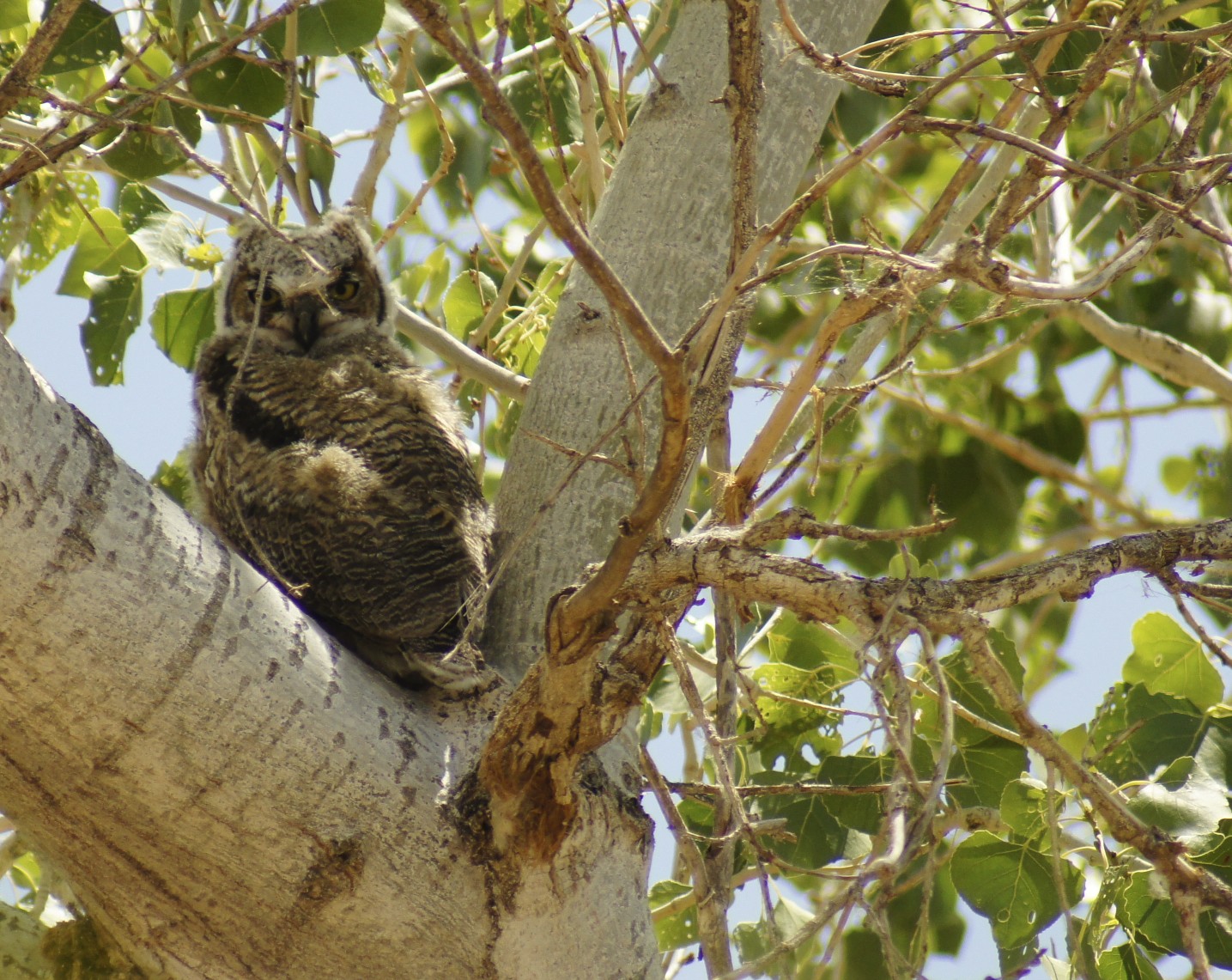
Bald Eagles, Peregrine Falcons, Harris's Hawks, Kestrels, and Cooper's Hawks can all turn up in the canopies, and there are often surprises too. About three weeks ago I came across this pair of Great Horned Owl chicks. They were each sitting in separate cottonwoods, neither of which had a nest nearby. They didn't move while I was around, so they still trusted in their camouflage better than their flying skills. 


This second chick weirded me out a little bit. Look hard at his face. His beak looks more like a koala bear nose, and some of the feathers on his face form a creepy little smile. He looked like he was contemplating all the different and delicious ways he would capture and eat me when he gets a little bit bigger.

I feel like I left a little piece of my soul lying somewhere, out there in the wilderness where I looked into this evil owl's eyes. We take great risks as birders, greater than any lion-tamer or shark-wrestler or active volcano-bungee jumper that I've ever met.


This past Friday I returned to Tres Rios with Pops and we saw three different Great Horned Owls flying around. At first I thought one was a Short-Eared Owl, since it's tufts were very small and it wasn't big enough to be a full-sized Great Horned. Soon we realized that these smaller Owls were the fledglings, now spreading their wings and beginning to terrorize the terrestrial population.


Like any successful restaurant, bar, or birding site, Tres Rios has its regulars, and plenty of them. However, its reputation extends pretty far, and lots of other summer residents and migratory birds come in for a visit during the spring. The regular birds are a foundation for great birding, but the excitement of migrants and other unusual visitors really keeps the birders coming back.

Let me know if I'm off here, but I'm pretty sure this super yellow nine inch bird is a Brown-Crested Flycatcher. (*Editor's note* Apparently I was way off here, and this is, in fact, also a Dusky-Capped Flycatcher) When I arrived at this spot, his perch was first being used by a Dusky-capped Flycatcher. As soon as the Dusky-capped flew off this Brown-Crsted flew in, as if he had been waiting his turn for some time. He must've been disappointed, because he only stayed for a minute and then also departed. His spot was immediately taken by a Mourning Dove, and at that point we moved on.


This spring I've also seen Tropical Kingbirds, Western Kingbirds, Willow Flycatchers, Cordilleran, Pacific-Slope, and Western Wood Pewees. It's been great to have so many different Flycatchers around, and not just because they keep the insect populations under control.


Other summer residents include Lucy's Warblers, along with Bullock's and Hooded Orioles. It is one of the less discussed phenomena of the birding world that Lucy's Warblers have the ability to make their features blurry, much like Sasquatch. Unlike Sasquatch, they can still be diagnostically identified by the grey body and little plum spots on their head and rump.


Then there are birds like this Indigo Bunting. This was my first confirmed sighting of these magnificent birds, and it was quite a surprise. Lazuli Buntings are a fairly common site at the preserve. Like some of the warblers, they're mostly moving up north. I have no idea what this Indigo Bunting is planning. The bird books don't show them as migrating through or residing in much of Arizona, but that's not a lot to go on these days. The Cornell website shows them as summer residents, but I haven't seen them anywhere else in central Arizona nor heard any other reports--and this bird is a real head-turner. Whatever he decides to do, it doesn't matter to me. When you look this good, you do whatever you want.


Unusual birds like the Indigo Bunting still make for an easy identification, but Pops and I have had a few mystery sightings at Tres Rios too. The swampy scrub grass draws in a lot of the little brown jobs. Song Sparrows are always in concert, and Lark, Lincoln, Vesper, and Brewer's Sparrows often join the cacophony. Soon after seeing the owl fledglings on Friday, Pops and I heard the distinct song of a Cassin's Sparrow somewhere in the ruff. We couldn't get a clear visual, but there were a few other Sparrows around--not necessarily the ones singing--that weren't easily identifiable either.

Here is the ambiguous culprit of the Cassin's song. This is a rare, rufous-morph of Cassin's Sparrow, which is already an unusual bird to find in the Phoenix area. It's a drab bird but still a pretty exciting find.


I'm pretty set on the ID of this last bird. It's a Pygmy Ostrich yes?


To visit Tres Rios is to treat oneself to a bricolage of birds, a feathered frenzy, a glamourous gallimaufry, a singing smorgasbord, a musical mélange. I highly recommend it. 

Friday, May 25, 2012

Burrower's Row

The Phoenix Metropolitan area is a curious concoction. Phoenix itself is a large city, both in terms of area and population. Surrounding the state capital are ten more small cities: Mesa, Glendale, Scottsdale, Tempe, Avondale, Goodyear, Sun City, Gilbert, Surprise, and Peoria. Stretching out from these locales, neighborhoods and master-planned communities seem to stretch on in all directions. One of my favorite birding sites, the Tres Rios Wetlands, sits near the border between west Phoenix and Avondale. While driving to Tres Rios, you'll pass through the cookie-cutter houses of the master-planned communities, neighborhoods where the pursuit of maximized square-footage was once the highest good (priorities and fashions have since changed). You'll also pass through lots of open, odiferous farmland. If you turn and head west just before you reach the Tres Rios site, and follow a dirt road along the farmland canal, you'll find another little planned community. Between the northern borders of the Tres Rios preserve and Farmington Glen sits Burrower's Row.

There are no signs announcing that, "You have now entered Burrower's Row," but there are still markers, of sorts, so you know when you're in the right spot:


Despite the somewhat slovenly appearance of this particular Owl, the residents of Burrower's Row are a very strict bunch. There is always a sentinel at the eastern-most point of entry, perched high on the telephone lines and supervising the little town's security.


The houses (burrows) are arranged in neat rows along the farmland. At the moment, there appears to be no more than 2 Owls living in each Burrow, though there are at least 4 different pairs of Owls. They have a strict home-owner's association, and they keep their domiciles very tidy. It's a pretty homogenous group. Crime rates and taxes are all very low, but sometimes they react to outsiders with astonishment and suspicion, even from afar.


In the morning and during the day, the residents of Burrower's Row like to stay down in the fields, away from the elevated dirt road and its dusty heat. During the evening, the descending sun holds everything in a warm embrace, saying goodbye with its last rays of yellow light, and promising to rise again soon. The Owls like to perch along the frontage road during this time. They preen, gossip, and replay the day in their heads--much like the rest of us. It is best to visit Burrower's Row during these quiet, well-lit moments.


The owl shown below may well be the sheriff of Burrower's Row. While all the other Burrowers were enjoying the fading light, he seemed determined to maintain his stern and serious face. I would vote to re-elect this Owl for sheriff if it were up to me, but alas I wouldn't even qualify for citizenship in Burrower's Row (which is probably a good thing for all parties involved).


"Drat! I knew I stepped in something..."


For this third and last photo, I couldn't settle on a caption. I'd like to leave this last photo open to suggestions. Is the Owl solemnly swearing revenge? Is it doing some sort of fist pump celebration? Is it seeing if it's possible to walk with one's eyes closed? You tell me, and try to stop by and visit the wonderful residents of Burrower's Run some time soon.

Wednesday, May 23, 2012

A Wash Before Lunch

This past Saturday my family and I decided to do some morning birding and a picnic lunch at Mesquite Wash, a great little birding spot just northeast of Phoenix. The Mesquite Wash is fed by Sycamore Creek, and while there wasn't a lot of water, there was enough to keep things green and cool.

Mesquite Wash is accessible between miles 207 and 208 off the AZ-87 (beeline) highway. There is a parking area to the west of the AZ-87, which didn't give me a great first impression. There was lots of dust and litter, but even as we pulled in we could hear birds singing from the nearby trees, and we caught glimpses of Western Tanagers and Yellow Warblers while still getting stuff out of the car!


From the parking lot, we made the short walk down towards the creek. Along the way we had good looks at some of the desert chaparral birds, including Black-Throated Sparrows, Lucy's Warblers, and Cardinals (which can also be found everywhere else).


Although it was a short walk to the stream, it was also pretty hot, and the discomfort was exacerbated by dust-stirring motorbikes passing nearby. The sound of trickling water was very welcome, and the sight of running water was a little piece of heaven.

The water at Mesquite Wash sustains the cottonwood and willow trees, which reflected their green off its glassy surface and shaded the bathing Lesser Goldfinches.


The birding was good and the environment was very enjoyable--everything was going according to plan. The big surprise came when we spotted this fatty Gila Monster slinking its way up from the water, trying to make a daring 0.024 mph escape back into the bordering grass.


This is the first Gila Monster I've seen in the wild. I must admit, the lizard's comical proportions and plodding pace largely offset its infamous reputation (it is one of only two venomous lizard species). It was very tempting to try and pet his bumpy hide, but getting bitten would've ruined our outing...prudence can be such a difficult thing.


After about half a mile the wash starts to narrow, and the desert canyons become more prominent. This provided a welcome diversity in habitat and birds. We were able to alternate between viewing Yellow Warblers, Warbling Vireos, Wilson's Warblers in the canopies and the Phainopeplas and Lucy's Warblers in the chaparral.

I will not apologize for this photo because it's my first and only Lucy's picture.


I will not apologize for this picture because Phainopeplas are awesome and should be viewed in any way, in any quality, as often as possible.


We also spent some time checking out this flycatcher. Unfortunately, I couldn't get very close for a better photo, and the bird stayed stubbornly still. It did have a notched tail (so no Western Kingbird, it was also too small and slender) but not enough yellow on the breast to be a Tropical Kingbird. My vote is Dusky-Capped Flycatcher, but I am very open to suggestions.


After checking out the desert scene, we stopped to observe a little holding pond. The stagnant water here was very popular with Red-Winged Blackbirds and lots of insects, including this nifty dragonfly which I will not attempt to identify.


We continued down the wash, knowing that soon it would be time to turn back for lunch, but also wanting to explore the liminal space where the water thinned out and the tall trees transitioned into tall grass. The last few trees played host to some Bronzed Cowbirds, one of the cooler kinds of Cowbirds and a species I do not see very often.


The tall grasses below the trees formed a charming little prairie, and it was there that we found the birding highlights of the day. You need a big beak and a big head to eat these mighty grains. This was Grosbeak territory. This male Blue Grosbeak was a lifer for me, one that I have been hoping to see for a long time.


It was only while reviewing photos later on that I discovered he had a female friend, whom you can see in the background. Birds feeding in tall grass make for great binocular looks but less than great pictures. I cared not a lick; the Blue Grosbeak is "epic," to use the buzzword of these last few years.


This azure all-star ascended to the treetops for a brief surveillance before departing. My jaw hurt from hanging open for so long. While crawling along the wash, trying to keep low and small, I had collected quite a few scrapes and scratches, as well as a lovely collection of gravel and pebbles in my pants.  Birding can be dirty, dusty, even painful business. I often feel like those stingy scrapes and after effects make a first-time sighting all the better. Getting a good look at the bird and having a bit of lingering pain...it's like a good stiff drink right afterwards (obviously, having a few scrapes and a stiff drink right after is best). It makes me feel like I've earned it. Anyone agree? 


The Blue Grosbeak was probably the most beautiful bird in the grass, but coming close is second was the male Black-Headed Grosbeak. He too was enjoying the unlimited buffet, and it was at this point that our grumbling stomachs and satisfactory sightings prompted a return to the cars.


On the way back we found lots and lots of tiny frogs in the wash gravel. They were not there when we first proceeded, so we developed the theory that some of the dirt bikes that had earlier gone roaring through had upturned the gravel and disturbed these tiny amphibians. I must admit, I was pretty irked at the dirt bikers for interrupting the serenity of the Mesquite Wash setting, especially because there was plenty of space for them to ride around that was within their limits. That being said, these frogs were pretty cute, and I'm glad I got to see them. This guy was maybe the size of a dime.


We decided to take out picnic lunch to the nearby Saguaro Lake, where we could eat on ridiculously undersized picnic tables (for me anyway) and enjoy some shade that wasn't in the water. In addition to providing a comfortable setting that went very well with our avocado, turkey, and munster cheese sandwiches (score!), Saguaro Lake had a few cool birds too, including a late Yellow-Rumped Warbler, Wilson's Warblers, and Vermillion Flycatchers:


This teasing jelly-belly wouldn't give me a look at his front, but seeing a Vermillion is undoubtedly a great way to end a birding trip, even if it's playing hard-to-get. I'm planning a return to Mesquite Wash later this summer. It was a great birding site by all accounts, and is supposed to be a good location to find Yellow-Billed Cuckoos, another one of my 2012 target birds. The summer is just starting to heat up!