Friday, March 2, 2012

Hey Buddy, You're Lookin' Kinda Ruddy

It's getting the be that time of year (No, not Christmas). The Avocets and Gadwalls are getting their rusty heads. The Quail are starting to flirt and the Verdins are already building nests. It was an added bit of excitement this weekend to see some Ruddy Ducks changing into their breeding plumage. In addition to the lovely scab-red coloration in the males, the Ducks develop a beautiful, eye-catching blue on their beaks, which attracts people as well as mates.


I've spent all winter looking at these little cuties from across the water. They've always been in their muted, eclipse plumage, and almost always had their heads tucked away, biding their time until spring. There were some Ruddy Ducks down at Patagonia last weekend, and they were not in their breeding plumage yet, so maybe these four down in Gilbert are a bit early. What will their parents say!?

A fine new coat like his must be kept slim and trim. This male spent a little bit of time preening, making sure he looked quite fabulous before his afternoon date.


When he was good and ready, he tried to get some attention. "Hey guys, over here!"


After he had his stretch and knew that all eyes were on him, the Ruddy Duck started running/flying from one side of the pond to the other. He'd get going full speed, but just when it seemed like he was ready to lift off, he'd splash back down into the water.


Back and forth he went, moving with no particular grace or fluency, but with great energy nonetheless. It was a lot of fun to watch, and I'm sure that if I were a female Ruddy, I'd be very attracted.

Thursday, March 1, 2012

Springing Forward

It's been weird winter here in Phoenix. But now signs of spring, like this Avocet's rusting head, are starting to pop up over the valley, and I fear we may lose our winter visitors pretty soon.


The Green-Winged Teal seem to be amassing at the Gilbert Water Ranch. Maybe they're going to fly north in a big convoy, I know that's how I would do it.


The Long-Billed Dowitchers are also gathering into larger flocks, and are starting to pick up just a hint of their brown breeding plumage. Like the Flamingos that get their lovely pink pigmentation from their crustaceous diet, the Dowitchers switch to a strict regimen of mud, dirt, and gunk to get their brown coloration during breeding season. (not really)


The Anna's Hummingbirds are all over the place. You can hear their buzzing and chirping around most of the parks, and you'll find dozens of them at the Water Ranch and Desert Botanical Gardens. I entreated this handsome fellow: "Will you please turn you head just slightly and look at me without the branch in the way, so we can see that fully lit shield?"


Hmph. No.


What a tease.

Wednesday, February 29, 2012

Puddle Ducks

Ok, so the Papago Ponds aren't exactly puddles, but they're pretty small. The Desert Botanical Gardens in Phoenix do a great job of drawing in desert specialist species, hummingbirds, and some migrants. The Papago Ponds, just a block down the street, take care of the waterfowl.
It's nice to have these popular and smaller water features. They've allowed me to get some nice and close photos of Shovelers, Pintails, Ring-Necked Ducks, and Coots. It seems like there's always something interesting floating in these ponds; they're definitely worth visiting by if you're in the neighborhood.

The star this time was this single male Canvasback. This is only the second Canvasback I've seen this winter, and the first full-plumage male. Of course, he was the only duck that kept well away from the shore. Canvasbacks are the largest and longest of the diving ducks, and are pretty handsome even from far away.


They dive to the bottom of the ponds and pull up the roots and tubers of aquatic plants. Sometimes when they resurface they'll be quite muddy.


These diving ducks are tricky to photograph, but they're a lot of fun to watch.


Then there's the Pied-Billed Grebe, which can be found on most of the ponds throughout Phoenix and is content to float close to the shore unless he's feeling embarrassed about something, in which case he'll dive out of sight.


This grumpy Ring-Necked Duck really seemed like he was looking for a fight.


This mild-mannered Gadwall did not want to fight at all. I can't blame him, he's got his nice breeding plumage coming in on his head; I wouldn't want to get that hairdo messed up either.


The biggest curiosity of the day was this Black-Necked Stilt. The Stilts themselves are a common enough sight at the waterworks around town, but I've never seen them floating in the water before. I've only ever seen them in the shallows, and never in more than a few inches of water. They have very long skinny toothpick legs and non-palmated feet, so swimming can't be easy for them.

However, a nearby man with his young daughters was tossing bread in the water and this Stilt decided it was worth the risk, so in he went! He acquitted himself admirably, but definitely avoided any rough stuff with the competitive Coots nearby.

Tuesday, February 28, 2012

Northern Rough-Winged Swallows

Capturing in-flight Swallow shots seems to be one of photography's greater challenges. I'm still not up to it, but I did manage to get some regular Swallow pictures. I picked a nice spot near a dead tree at McCormick Ranch where I figured  some of the Rough-Wings might eventually land, and as luck would have it one dainty female decided to stop off for a little preening and a good scratch.

I've always been very impressed by the Swallows' dexterity in the air. They dip and dive and turn on a dime, able to accelerate and stop with incredible quickness. Although it makes photography very difficult, I especially like how erratic their flight patterns are, as if they also do not know when or where they'll next  change course.


It was a worrisome start to this little photo shoot when this female Rough-Winged promptly hid her head. I gather she was just trying to scratch or preen in those hard to reach spots on the back. Come to think of it, I wish I could do that...


Swallows have to keep their feathers in prime working order; they exert a lot of force on them as they dip and turn in the air at high speed. We take our cars in for a tune-up every so often. I wonder how many miles the average Swallow puts on their feathers each year.


This is my favorite pose. It's a very nice, very flattering imitation of the skulking vultures from Jungle Book. The head is just a bit too feathered to quite pull off the look.


Here's the quintessential bird-on-a-stick profile. The Northern Rough Wing isn't the most colorful Swallow, but it's handsome in its own right. The solid wings and tail give her a nice cape here. I daresay she evens looks a bit like a bat. Looking at those tiny feet, it's clear she's doesn't spend much time on the ground.


Birding is fun. Here are some additional Rough-Winged photos.


Sunday, February 26, 2012

Borrow Your Burrow?

Burrowing Owls are probably one the top five cutest birds of all time. They're small, they live in prairie dogs burrows (and other excavations), they've got owl proportions, and they've got attitude. Somehow I managed to live in Arizona for 18 years without seeing them in the wild, though to be fair I've only been seriously birding for the last couple. I finally got proactive and went out to the Rio Salado preserve in south central Phoenix. There were reported owl sites near an old gravel pit, and the rumors did not disappoint.


A couple of these bold sentinels stood guard above their burrows and watched the setting sun. There is a railed walkway that guides the spectator parallel with the dirt ridge where the owls make their homes, keeping about thirty feet distance between the owl ridge and any onlookers. It was too bad that the evening sun was somewhat behind the birds. But on the other hand, I like this negative lighting. Maybe this is stretching it a bit to say, but there seems to be something very western about that bright setting sun and the silhouettes its leaves, and there's something western about the Burrowing Owls. After all, the sun sets in the west...


There are also communities of Burrowing Owls around the Scottsdale Community College, so I went there in the hopes of getting some closer, albeit less scenic shots. Driving around the campus, I wasn't exactly sure where the owls were supposed to be, but then I had to slam on the breaks! There, standing next to a little drainage hole in the curb of the parking lot sidewalk, was Mr. Owl.


Well, you can't always pick your spot. I was thrilled to see the bird so close, but his position and the lighting did necessitate that I get on the school-side of the parking lot, which meant that the owl's lower half was mostly hidden from the camera. 


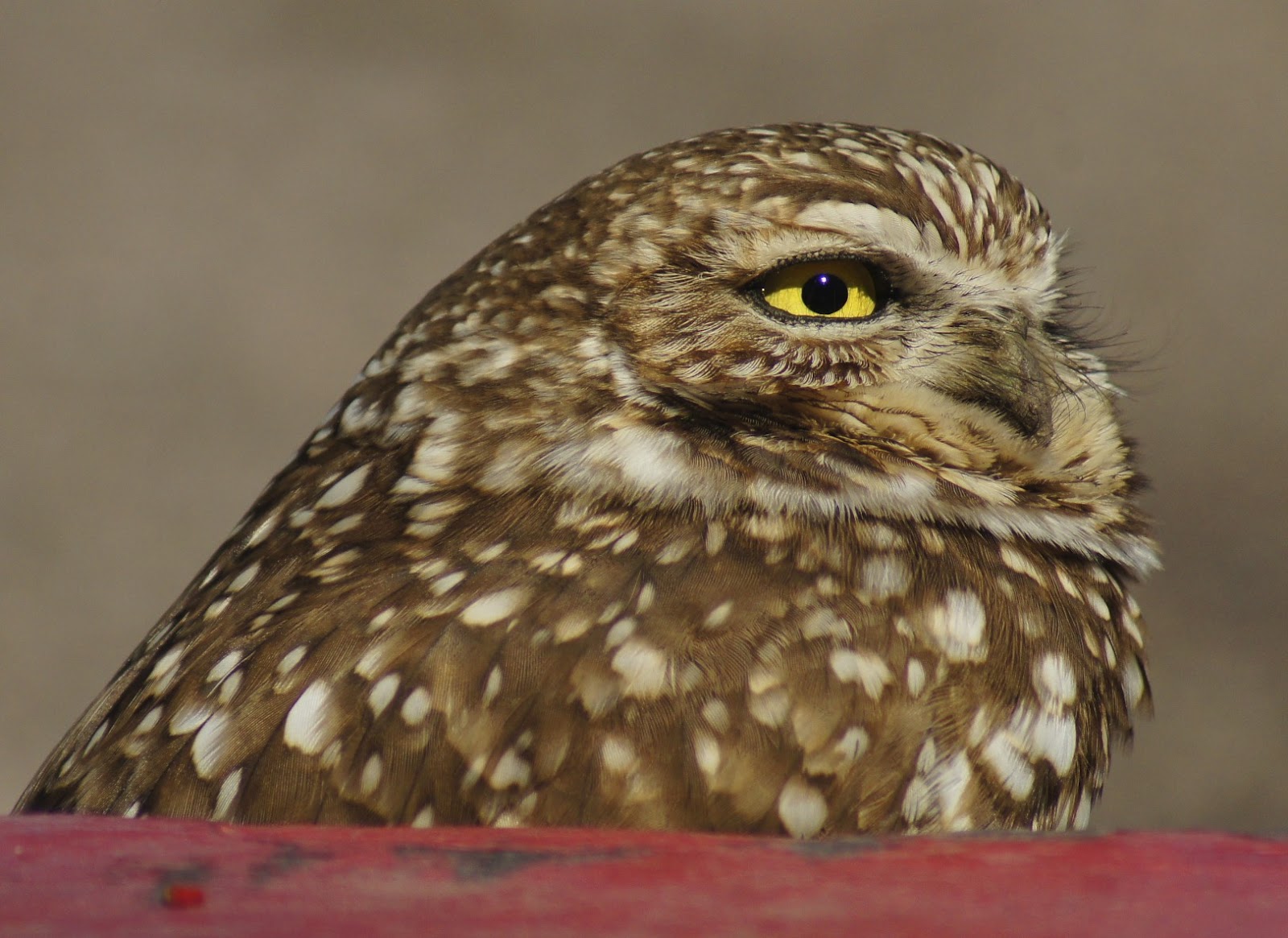
As you can see from the red stripe, this Burrowing Owl had made his home, quite illegally, in a No Parking Zone! He seemed quite unconcerned, and spent most of his time looking skywards, though I did not see any hawks or other birds myself.


Here's a quick look at the nictitating membrane, as well as his blurry nostrils.


I really couldn't figure out what he was staring out. Now I think maybe he was just prognosticating, you know, looking into the future? Given this expression, he must have seen something quite shocking. I like how the pupil in the left eye is smaller than the right. Behold, the symbol of WISDOM!


I had a blast with the Burrowing Owls this week. They're beautiful in their whites and browns, and they will give you more expressions in fifteen seconds than any other bird, and probably more than most people.

What're you lookin' at, punk!?


I discovered a family of 4 Burrowing Owls near some farmland just north of the Tres Rios site in west Phoenix on 05/17/2012. The first Owl I spotted was actually perched atop telephone wire (the highest I've ever seen a Burrowing Owl perch). The next three were all sitting atop little marker posts on the edge of the field, watching the sun go down to bring up the night. 

Saturday, February 25, 2012

Meanwhile, back on the Ranch

I went to McCormick Ranch on Friday to see who was hanging around the ponds. A few weeks ago the place was swarming with Great Egrets, dozens and dozens of them all jostling for space. On Friday there were none, but there were some of Northern Rough-Winged Swallows and Herons, along with the normal Sparrow regimen one expects around the ponds.

There was also this solitary Red-Winged Blackbird, who seemed a little out of it.


The second fun sighting was this awkward Great Blue Heron. It picked a rather cumbersome perch and then tried to make it work for a good fifteen seconds before giving up and flying to another.

Impressive wingspan!

There were some House Finches and Mockingbirds adorning the palo verde trees, and I had to stop and photograph this unusually confident Mourning Dove. It's nice to pause and remind myself what pretty birds they really are.


A little troop of Least Sandpipers was a somewhat unusual sighting for the ponds. These birds are really putting all of their eggs in the "The meek shall inherit the earth" basket. They're so much smaller than other common waterbirds (barely reaching 6 inches), and they spend most of their time with their faces stuck in the mud.


But, if we imagine for a second that the world is shrunk to their size, a troop of feeding Least Sandpipers can become quite the terror! This ferocious gang devastated the local filth deposits and engulfed tiny invertebrates by the score. With their battle cry of "Peeeeeep," they scoured the shoreline and gobbled everything in their path, taking no prisoners and leaving no trace of their conquest. 


 I kinda dig the perspective happening here. It looks like this last Sandpiper's legs are way out of whack with its body. Behold the merciless stare of an omnivorous automaton!


This is probably the last thing you'll ever see if you're a pond fungus, insect larva, or anything else that can fit down the Least Sandpiper's maw.

Friday, February 24, 2012

Hammond's Flycatcher

This lovely bird makes for a very challenging identification. The Hammond's and the Dusky Flycatcher are nearly indistinguishable apart from their breeding range and their call. When I saw this bird near Patagonia Lake where the species' range overlaps, it was in February, and the bird was silent...


Luckily it was also seen by some birders far more expert than I. After a few days of review they decided it was not a Dusky Flycatcher, as first thought, but was in fact a Hammond's. For my two cents, the Hammond's do seem to be a bit more yellow than the Duskies, but that's something I can only tell from reviewing lots of photographs, not from field-obersvations alone.


The soft grays and yellows make for a beautiful and soft composition, one that seems unique to the Empidonax flycatchers (Warblers and Kingbirds being a stronger yellow). This Hammond's was another one of my favorite sightings on the BiF Tucson trip this February.

Thursday, February 23, 2012

Bewick's Wren

The Bewick's Wren is a rather small brown bird with a fondness for underbrush and scrubby foliage. Given these physical aspects of the bird, one might not expect much in way of personality. However, their incessant calling and singing and active bouncing is as bold as the bird's strong white eyestripe.


They flit about their business, gleaning insects and other teeny edibles. They're industrious little birds, and they fill the air with their constant chatter, no doubt complimenting and criticizing their fellow birds with equal energy.


They may not be an aesthetic feast for the eye, at least compared to some of the finches, nuthatches, and seedeaters with which they sometimes keep company, but they're lots of fun. Like all birds they manifest a certain beauty in their precise form and functioning as a species. One may not look at the Bewick's Wren and think, "Wow what a stunner!"But there is something undeniably beautiful about watching the camouflaged Wren running and bobbing about, using its tail to keep balance while it forages for food with its decurved beak. That's something everyone can appreciate.

Wednesday, February 22, 2012

Broad-Billed Hummingbird

It's true. They do have exceptionally broad bills for a Hummingbird. It's not the most striking feature in my opinion, but to be fair I'm not really sure what is. The bird's shimmering beauty is a composite of the iridescent green, blue throat, and prominent red beak.

This specimen was another jewel in the treasure chest that is southeastern Arizona birding.


These birds were photographed at the Beatty feeders in Miller Canyon, Az, on 07/02/2012


Tuesday, February 21, 2012

The Rufous-Capped Warbler

There have been persistent reports of a group of Rufous-Capped Warblers in the Florida Canyon in the Santa Rita Mountains since December of 2011. This unusual visitor from Mexico turns up every few years, but this year they seem to be pretty established in the canyon. They were one of the prime targets of the BiF road trip to southeastern Arizona, and were also among the first and most beautiful birds we saw.

They began their morning foraging with first light. While they did not seem to mind our presence at all. they didn't stay put for very long. Their flighty behavior combined with the dim lighting to make photography tricky, but it did make for a great sighting.


I haven't seen that many Warblers yet, but I imagine that when I die at the ripe old age of 165, having seen every bird in the world, these Rufous-Capped Warblers will still be among the most visually captivating birds I've observed.