Saturday, September 14, 2013

Make it a Pair! The other Arizona Booby


A Booby on a buoy...in a way, it's a cliche pose. If one is lucky enough to see one of these birds inland, this will likely be the situation, but of course seeing one at all is not a likely situation. Seeing a Code 4 Blue-footed Booby in Patagonia one weekend and then heading west for a Code 3 Brown Booby in Havasu the next weekend is very most totally probably extremely unlikely, and yet it happened. 


After a fantastic trip down to southeastern Arizona for the Blue-footed, birding friends Tommy DeBardeleben and Magill Weber and I headed west last Saturday to make it a pair for the state. The tropical storms in the Gulf of California have made for some incredible finds these last several weeks, and knowing it may be another five years or so before we'd have an opportunity to get two Boobies in Arizona, the 2:30am departure time and the pessimistic weather forecast were no sort of deterrent.


We were also buoyed with confidence, knowing that the David Van Der Pluym and Lauren Harter, original discoverers of the Brown Booby and many other incredible finds in west Arizona, were able and willing to meet up and relocate the bird.
After an initially unsuccessful scan from Pittsburgh point at Lake Havasu, we were joined by David and Lauren. With their spotting scopes also trained across the lake, the Booby was soon located, and we were then able to relocate to Windsor Beach for the looks and photos shown here.


The overcast weather meant that photography was pretty limited, but it also kept the Havasu temperatures blessedly low. Since we were still treated to a great show of plunge-diving by the Booby, I was glad to have the cloud cover.
Without the wider context of this post, I'm not sure a lot of people could tell what they're looking at here. Obviously, it's a Brown Booby hitting the water face first, or maybe it's the Loch Ness Monster.


Tommy DeBardeleben, Magill Weber, and Lauren Harter are great birding buddies to have. Not only do they possess an encyclopedic knowledge of Arizona's avifauna (and most of North America's as well), but they all have nice spotting scopes, and they're nice enough to share, which meant the amount of extra equipment I had to drag around was pretty minimal.


The views of the Booby were pretty close if not crystal clear, and the lake itself looked very nice from our vantage point. You know it's a good day when you start off with an ABA Code 3 lifer and still have the rest of the day to explore the surrounding area.


Here's what a bunch of dorks look like while staring at a rare Booby, dorks with impressive Year lists that is!


I think we ended on 95 or 96 species for the day, of which this Year Bird Common Tern was another highlight. California and Ring-billed Gulls crowded along the Havasu shore, while the crack team of scoper snipers also picked out Common and Pacific Loons as well as a Year Bird Red-necked Grebe.


A fledgling Clark's Grebe was preening near the Windsor Beach shoreline too, apparently abandoned or maybe just trying to run away from its parents to teach them a lesson. We've all been there. 


We swung by Rotary Park in Havasu and the Bill Williams Lookout on our way back towards Phoenix, picking up some waterfowl and many other migrant songbirds, while always holding out hope for a Yellow-billed Loon (which was, of course, pretty loony of us).
Driving back through Parker, a small town southeast of Havasu, Tommy, Magill, and I also swung by the Ahakhav Tribal Preserve. With its adjoining rows of cottonwoods and willows, this park was an absolute blow out for Flycatchers, which meant I was in paradise.

I've tried time and again to articulate why I feel this burning love for Flycatchers, why this fairly dull Willow Flycatcher on a stick hold such fascination and allure. Words fall short, but the Ahakhav Preserve did not and we had seemingly dozens of Willows, Pacific-slopes, Phoebes, Vermilions, Pewees, and Gray Flycatchers. 


The clouds finally put their money where their mouth had been all day and precipitated, but that did not deter us anymore than it did the birds, evidenced here by this boldly colored and boldly perching Vermilion.


We're halfway through September now, and even though it's still plenty hot outside, I can't pretend it's still summer. I had some massive, grandiose birding plans at the start, most of which were scuppered by some unexpected health setbacks, but having picked up many year birds and some fantastic lifers, including two Boobies, I can say it was still a great summer's birding.

Sunday, September 8, 2013

Hold the Door! A Late Summer Rarity Chase in Patagonia and the Santa Ritas

These last few weeks have brought some crazy birding in Arizona. The end of August saw a dead Hawaiian Petrel in Yuma--only the third record for the lower forty-eight states--a Brown Booby in Havasu, a Blue-footed Booby in Patagonia, Berylline, White-eared, Plain-capped Starthroat, and Lucifer Hummingbirds, Buff-collared Nightjars, Black-capped Gnatcatchers, Painted Buntings, and now, most recently, a Sinaloa Wren in the Huachucas. There are so many hotspots in Arizona already, and the end of August is prime time for migrants and vagrants. I was having a nice enough time shore birding in Phoenix (yes, it is possible!), but the allure of some of these rarities was too much. 

Several of my birding acquaintances were able to get down to Patagonia for the Booby, and they also picked up some great Hummingbirds, along with the August seasonal sparrows, Buntings, and so much other good stuff. Check out their tales and photos here and here.
I missed the first trip but was aching to get down there for the seasonal birds and any lingering vagrants. I was fortunate to get the time then last weekend and also fortunate to have some company from a co-worker who wanted to explore the beautiful terrain of southeast AZ. I knew I wouldn't get anywhere near the fabulous haul of birds and photos that my predecessors had, but it could be another ten years before a Blue-footed Booby shows up in Arizona!

The plan was to hit Patagonia Lake early--which meant leaving really early--and then the surrounding countryside, including the San Rafael Grasslands, before stopping by Madera Canyon and doing some feeder-watching before heading north back towards Phoenix.


Upon arriving at Patagonia Lake around 6am, we had singing Cassin's and Botteri's Sparrows in the grasslands, but the first birds we really saw were Vultures, prodigious amounts of Vultures. Perhaps because of their disgusting behaviors, repugnant appearance, and unscrupulous feeding habits Vultures are regarded as ill omens in many cultures and literature. Was our trip doomed from the beginning? Would this effort be the death of us?
Eh, probably not, and admiring the Vultures from a distance wasn't too bad either.

We walked around the Patagonia Lake visitor center, listening to Ash-throated Flycatchers and Sparrows going about their morning business. Some fly-by Cormorants gave us palpitations as we staked out the Patagonia shore, before we finally saw a large, brown and white bird over the tree line.


Yes!!! ABA Code 4 Blue-footed Booby.
It's a juvenile; its feet aren't even that blue, and it's tail primaries look like they're in terrible shape, but none of that diminished the sighting. We watched the young and hopelessly lost Booby plunge-dive several times, while I tried to snap photos as it made determined passes along the lake.
We arrived none too soon either, as it seems the Booby reports have dried up since last Sunday. The jokes to be made with this bird's name are legion, so I won't indulge, but suffice it to say this was one of the breast sightings I've had in Arizona this year.


After ogling the Booby, we spent some time exploring the mesquite bosque around Patagonia Lake. We had several calling Northern Beardless Tyrannulets in the mesquite, North America's smallest Flycatcher and one of the longest-named. They weren't exactly cooperative, but any Flycatcher will hold my attention and fascination as long as it's in view.


With all the recent, above average rainfall, much of the Patagonia lowlands and riparian area was flooded and inaccessible to tennis shoe-wearing dorks such as myself. We walked the ever-lovely Sycamore Creek trail a little ways, enjoying Vermillion Flycatcher and Bridled Titmice, along with a couple of Sora and Wilson's Warblers, but soon we ran out of dry ground.


As the sun climbed higher in the sky, we next headed to Harshaw Canyon and the San Rafael Grasslands, stopping at the famous Patagonia rest stop along the way for Thick-billed Kingbirds, and collecting Cassin's, Western, and Tropical on telephone wires in between. A female Painted Bunting in the creek behind the Paton House was also a treat. Unfortunately, I was having some camera issues and couldn't get my focus operating for the Kingbirds, but knowing they'd be around next year, I checked my list and headed on to the next larger target for the day.

Although the drive through Harshaw Canyon can be pretty treacherous after inclement weather, our trek to the San Rafael Grasslands was very pleasant, as were the handful of Eastern Bluebirds--another state bird, like the Painted Bunting--that we spied along the way.
Google Maps directions underestimate the distance of the Harshaw Canyon drive, and things aren't exactly clearly signed. But just as the tiniest hint of worry started to set in, Harshaw Canyon finally opened to this:


There are so many fabulous, diverse habitats in Arizona, but one of my favorites is grassland. It's not the most productive birding territory, nor even the most grand (like, say, the Grand Canyon), but the sheer expanses of grass and hills totally transport you, taking you to a tremendously quiet, gentle place, and leaving all anxieties behind. Walking around the grasslands, listening to the occasional trill of Grasshopper Sparrows and seeing nothing, other than mountains, in every direction, was incredibly peaceful. I felt like Julia Roberts in the Sound of Music, or a horse with a lot of cool grass in front of it.


Conveniently enough, Grasshoppers Sparrows were also one of my primary targets for the trip, a species I've been wanting to photograph for a while. The adults weren't overly accommodating, given my pains in getting there, but the ratty, juvenile bird below fortunately forgot how to 'sparrow' for a moment, and stayed perched in the open while I fired away.


After visiting the beautiful expanses of San Rafael, it was time to go see more beautiful birds. Madera Canyon, in the Santa Rita Mountains, is about as good a place for that as any in the nation. Feeders outside the Santa Rita Lodge and Chuparosa Inn have been especially productive with Hummingbird this year, and I was both optimistic and anxious to get a lifer Lucifer's or Berylline Hummingbird.


It's funny how jaded one can become with the riches of Hummingbirds in southeast AZ. We didn't have to wait too long for the Lucifer's Hummingbird to show, but in the meantime I pensively sat and took for granted the Broad-billed, Broad-tailed, Black-chinned, Magnificent, and Rufous Hummers that were warming around the Lodge. They are all great bird too, of course, but they can't hold a candle to the Lucifer's Hummingbird (pun points!).


On the way out of Madera Canyon, the last stop for the day was the Proctor Road loop. Chittering Sparrows and Buntings, along with Orioles and empids, made for nice winding down before the drive back to Phoenix. I was also surprised to see a pair of Yellow-billed Cuckoos in the Mesquite bosque, both because it seemed kind of late in the year (which, it turns out, isn't really the case), and because I almost never see them.


Spending a day down in southeast AZ is always fulfilling, and even while I feel the urge to chase birds less than I did a year ago, the pursuits in Patagonia and Madera were very rewarding.The Brown Booby is still over at Lake Havasu too, so there might just be one more late summer chase. Or two, or three...

Sunday, September 1, 2013

Humdinger--A Fond Farewell

Spending time in the White Mountains in July turned up some great hits and misses. I was able to add some much-coveted Life and State birds to my list, and also come away with some satisfying photos. On my second and last day in the White Mountains, the afternoon thunderstorms forced us down from the mountain trails of the Grouse and Gray Jays, back towards Greer, where we decided to spend our last hour or two chasing and photographing some of the less reclusive high elevation species. Tommy had already turned up Northern Pygmy Owls and we had heard Gray Catbirds--a very solid find in Arizona--in the Greer area. Just walking down the middle of Greer, we had Cordilleran Flycatcher, Band-tailed Pigeon, Swallows, and Williamson's Sapsuckers. The last target group, one which I was aching for and one we were saving for last, was the high altitude Hummingbird gang.


Broad-tailed Hummingbirds were the most numerous up in the White Mountains, filling the role that Anna's Hummingbirds play in the lower valleys of Arizona, but they were only the tip of the...uhh...Hummingbird iceberg.
Many of the lodges and restaurants in Greer have well-attended hummingbird feeders hanging out for the mutual enjoyment of bird and person alike. Hoping to get looks and shots of Calliope and Rufous Hummingbirds, we had a stake out at the Molly Butler Lodge for our temperamental quarry. 


We were able to find males and females of every expected Hummingbird species in the area, though photographing them was another challenge altogether, and since we were up in the rustic mountains, it didn't feel quite right to only plunder lots of shots of perched hummingbirds on feeders, which meant the above photo was as good as I could do with the intriguing and majestic Calliope.

Around the Molly Butler Lodge, we also had the pleasure of observing some nesting Cordilleran Flycatchers, a pesky member of the dreaded empidomax mafia. IDing these empids was no problem in the White Mountains though, as their vocalizing and high altitude presence ruled out the look-alike Pacific-slope Flycatcher from any empid-related ambiguities.


Even with all the gorgeous Hummingbirds buzzing around at arm's length, I spent a fair amount of time watching this Cordilleran catch insects and bring them to a nest in the underside of an eave on the back of the Lodge. I don't have a favorite species, but the Flycatchers are certainly, overall, my favorite group of birds.


Somewhat embarrassingly, the Calliope was a Life bird for me, but seeing and photographing that special, streak-necked Hummingbird was not my main goal for our photo stomp. 
With its fiery coloration and personality, the Rufous Hummingbird, along with the American Dipper (totally opposite personality and coloration) was the main photographic target for my trip. These feisty, irascible little buggers are immensely entertaining, unless of course one is a mild-mannered Hummingbird just trying to get a drink in Rufous territory.


Perhaps you've had the experience with a college friend, or going out to a bar or having a night on the town, or even at a family reunion, where there's just some jerk who seems to want to pick a fight or start an argument with every single person that makes eye contact with him. There's no pressing reason, he's just a territorial turd who can't relate to anybody except by being competitive or pugnacious.

Now picture that jerk being only half the size and weight or everybody else around the bar or wherever, and picture the jerk with an absolutely fabulous, flamboyant orange beard, over a white corsage and an orange suit. That's the Rufous Hummingbird. He's totally obnoxious, and totally gorgeous.


I left the White Mountains feeling tremendously satisfied with my photos and sightings. The scenery and weather alone was worth the trip, and with so many specialties up there too, I will have to add it to a yearly birding repertoire in the summer months.

Monday, August 26, 2013

Where there is a Nemesis, there must also be a Hero

When flocks of bird nerds get together, they fill the air with stories and tails, discussions of past sightings, future sightings, ornithological taxonomical distinctions and splits, migrations, and all manner of other things that involve the esoteric jargon that comes with any serious past time. One of the more common idioms, one with which even the most casual or greenhorn birders are familiar, is the dreaded "Nemesis Bird." Some of the best birding stories, even the best birding blogs, have to do with the big misses relating to a Nemesis Bird, a bird one has repeatedly tried and failed to see. In many cases birders have multiple Nemesis Birds, and they may spend many years and dollars trying to find them. The Nemesis Bird weighs heavily on a birder's mind, influencing trips and confidence, determining whether or not one has a successful outing even quite apart from any other birds that are seen.


Of course, every good story needs some sort of adversary, some sort of challenge, and the Nemesis Bird, as a concept, holds a high place in the birding lexicon and identity. Inversely, I want to posit that there is another bird, the protagonist, who may often be under-appreciated, who is less often mentioned in the stories or put on the pedestal.
Enter the Hero Bird, the stoic, tragic characters(s) in many birders' lives, who saves one birding outing after another and may never get the full credit it is due--certainly none of the attention and hype that Nemesis Bird receives.

The Hero Bird is more difficult to define. It's the bird that makes the trip when the lifers or nemeses don't show. It's not so common that it's boring or blasé, but it's still a reliable and delightful find when it judiciously reveals itself. Deciding on one's Hero Bird is tricky, because the rarity if the birds must be taken into consideration as well as the other circumstances and frequency of the sightings.


For example, Cardinals are always a pleasure to see, but I doubt many people would identify a Cardinal as their Hero Bird because in most locales where they're seen, they're so common that they don't serve as a singular, standout sighting. The Hero Bird must allow great looks, better perhaps than one might expect, or better than one has heard of other birders having. The Hero Bird makes an otherwise mediocre trip, one without lifers or super sightings, into a fulfilling adventure. The Hero Bird is not necessarily rare, nor necessarily common, but it feels like a blessing every time it's seen. Like a comic book superhero, the Hero Bird doesn't appear all the time and save the day, but it shows up often enough, or in the most desperate of circumstances.


Trying to think of my own Hero Birds, at first I speculated it may be the Le Conte's Thrasher. This is an uncommon bird, one not widely distributed, and I've been able to find it every time I've tried, including several trips with out-of-state birders who've gotten in touch specifically to find that bird.
It's not a guaranteed sighting and it's a local specialty, but I've always had luck with the Le Conte's. However, I've never seen this Thrasher anywhere but in the little Thrasher spot out in Buckeye. While it's a reliable sighting, it will never show up to save the day, or at least it never has, when I've been birding elsewhere in Arizona. Le Conte's Thrasher, you are a great bird, but you are not my Hero.


As I thought about it more, I realized that I probably don't have the greatest Hero Birds, in part because I'm not a great birder and haven't gone on lots of great birding trips. Then, on further meditation, I realized that my two probably Hero Birds are indeed great. Bird names never lie or mislead, after all.
My two Hero Birds are the Great Horned Owl, and the Greater Roadrunner.


These birds are big and badass, but that alone doesn't seal the deal. Neither the Greater Roadrunner nor the Great Horned Owl are rarities, but I don't see them every time I go birding either--it's vitally important that a Hero Bird isn't overly available, or else all the mystique is lost. But when I see them, I tend to get very close up views and good photos.
I walked under this Great Horned Owl after spending hours trying to turn up a rare reported sparrow at the DBG. I had no luck with the rare bird, nor did anyone else I talked too, but the Great Horned made the trip absolutely worth it. This isn't the only time a GHO has shown up and saved a failed chase. Owls already have a lot going for them, and a visual always has a big impact. I'd venture that many people could find the Great Horned to be one of their Hero Birds. They combine awe and availability almost perfectly.


The Greater Roadrunner also happens to be one of my favorite birds. I feel satisfied with my photo collection of it, and have had some amazingly crushing views, including when a Roadrunner ran across my feet on a trail in east Phoenix, and also massacred a Mourning Dove chick mere feet away at the DBG (pictured below). Roadrunners aren't regarded as particularly skittish, but many is the birder I've spoken too who bemoans their lack of good, prolonged Roadrunner sightings. I've got 99 bird problems, but quality time with the Greater Roadrunner ain't one of them.


So, do you have a Hero Bird. What bird has given you almost undue, face-melting looks, on multiple occasions? What bird has shown up, time and again, when it seemed the morning was  over, the afternoon doldrums were setting in, and the birding trip was a bust?
For many birders, finding and conquering our Nemeses Birds are some of the most defining and memorable moments. Let us also recognize the Heroes.

Thursday, August 22, 2013

To the Highlands: Sunrise Campground and Greens Peak

We secured the Dipper pretty early into our day, and so with everything going according to plan on Mt. Baldy, we then moved locations--stopping to bird whenever possible--so that we could chase Gray Jays, Clark's Nutcrackers, and Dusky Grouse. These species can also be seen higher up Mt. Baldy, but with so many good birding spots close together and the different sites having high probabilities, we added some variation. 

The next stop was Sunrise Lake Campground and Gray Jays were the primary target. Gray Jays are very hardy birds, having annual populations and even raising broods in the middle of winter in the far northern reaches of Canada. They also live comfortably near people, being opportunists, and as such a high elevation campground is just about the perfect habitat for them. That being said, this area around the White Mountains is about the only place in Arizona where Gray Jays will turn up, so we were still counting on our luck.

There were squirrels and chipmunks maintaining a constant buzz around Sunrise, but the birding was also good, though bird calls were more difficult to differentiate for me. Tommy spotted a Downy Woodpecker--always a solid find in Arizona, even in the higher elevations--, and it was soon joined by a buddy. Although this wasn't a state or even a year bird, it was still one of the rarer finds for the day.


The Downies foraged quite contentedly, not really minding our proximity but not being particularly photogenic either. One of the birds discovered some sort of fungus or something up in this aspen tree, which kept it occupied for a goodly while.


The Downy Woodpecker sighting transitioned into further luck as we followed the foraging birds away from the main road.  We waited and watched the woodpeckers, and while we were so occupied a mixed flock formed up around us. Soon Golden-crowned Kinglets, Mountain Chickadees, and Nuthatches were all contributing to the scene.


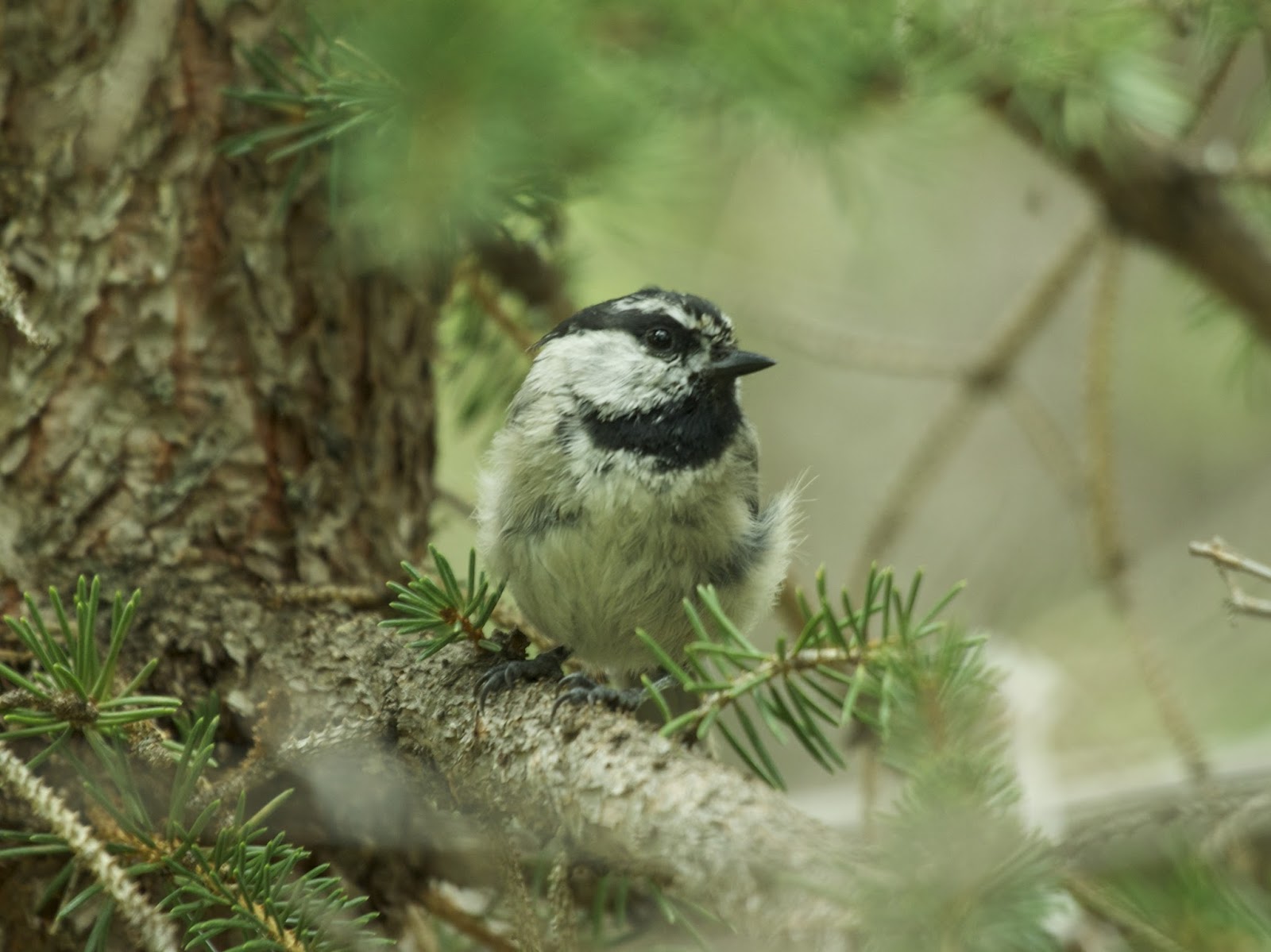
Mountain Chickadees, like just about every other Chickadee (except for Mexican) are pretty common in their locale, but I hadn't had a nice photo stomp with them before. I was very pleased to remedy my paucity of Chickadee photos, because I don't know when next I'll be able to get up into the mountains, nor when next a Chickadee will hold still.


The itinerant echoes of squirrel chatter were very frustrating at times. A squirrel or chipmunk trill doesn't really sound like a Jay or Nutcracker, but when there are enough other distortions and distractions, it's just enough to give one continual false hope about what's ahead, or what's behind. Too often it's just one of these smug little rodents sitting on its little throne.


The Gray Jays were not a guaranteed or even common sighting by any means, but I still felt a bit unlucky to miss them entirely, much less come away without any photos. Still, some of the views around the Sunrise grounds were worth the trip, as were the other birds.


We didn't leave empty-handed either, though we weren't holding a lot. This lone, calling Clark's Nutcracker provided a state bird for the site. Of course he picked the tallest, most backlit tree he could find. Maybe he could sense I was unlucky, and didn't want to get too close.


From the campground we travelled up to Greens Peak, which provided outstanding views of the surrounding countryside and also the impending thunderstorm that was coming to cut our birding short.


The main attraction on Greens Peak was the possibility of seeing Dusky Grouse, a secretive but confiding bird if one is lucky. To this day, I have not seen a single member of the Grouse/Ptarmigan family, which is almost too embarrassing to admit in public.
We hiked up and down Greens peak, getting some serious exercise and enjoying the scenery. We had butterflies and frogs, as well as my best American three-toed Woodpecker sighting of the trip.


We also had Kinglets and the occasional Robin, but all in all the encroaching weather and later afternoon timeframe seemed to be keeping the bird activity muted. To take a rest from our hiking, Tommy played a Red-breasted Nuthatch call, knowing they respond well and we'd then at least get some photos for our trouble.
It took a couple of minutes for any response, but soon we were swarmed, with near a dozen of the ruddy little buggers chittering all around us. Plenty of the birds showed signs of immaturity, both in their sense of humor and behavior as well as their patchy breasts. It's not a Dusky Grouse, but it's got feathers.


The Grouse stayed hidden during our tour on Greens Peak, and to be honest I was pretty bummed to miss them and the Gray Jays. In the moment, the misses felt heavier than the hits (Dipper, Williamson's Sapsucker, Three-toed Woodpecker), but in retrospect it certainly was time well spent, and the trip was outstandingly productive overall.

We're not as spoiled in the west as they are in the east with their Thrushes, but hearing a Hermit Thrush singing in the woods is still a very soothing sound, one that was very needed and welcome as the rain started to fall, and the Grouse dream began to dissipate. 


With the time for my departure back to Phoenix approaching, we decided to head back into Greer for some concentrated photo sessions. It was hard to leave the mountain, but it was also a felicitous decision with a full downpour in effect and the need to photograph high-altitude Hummingbirds still nagging at me.