Friday, February 17, 2012

Birding Synchronicity

It strikes again! You can go for years without seeing a bird, or never see it at all. Then, as the British say, you finally break your duck (an awkward expression for birders, to be sure) and the sightings come left and right. It was just a few days ago that I was perusing through some old blurry photos and I realized I had a new bird on my hands, the Vesper Sparrow. This weekend I'm on a trip down to some of the fantastic Tucson birding hotspots with BiF  Editor Robert Mortensen and BiF Author Jeremy Medina, and one of the first birds Robert and I saw on the drive down was, of course, the Vesper Sparrow!


You can find Sparrows in a variety of habitats, and that's part of their appeal. But I think one of my favorite things about the Sparrows is how they can really enliven and transform a landscape. We can be observing a simple arid dirt lot on the side of the road, much like this one. All of the sudden we notice movement, dare we say a little bit of color. It's not a barren strip of land after all. There are intricately patterned and determined wee birds flitting all over. The Sparrows bring liveliness to these desolate places, and where there is life there is beauty.


This was only the beginning of some excellent birding Robert and I fit in on the way down to Tucson. Soon after the Vesper Sparrows we found Chipping Sparrows, Western Meadowlarks, and the first Lifer of the trip, a flock of Lark Buntings!


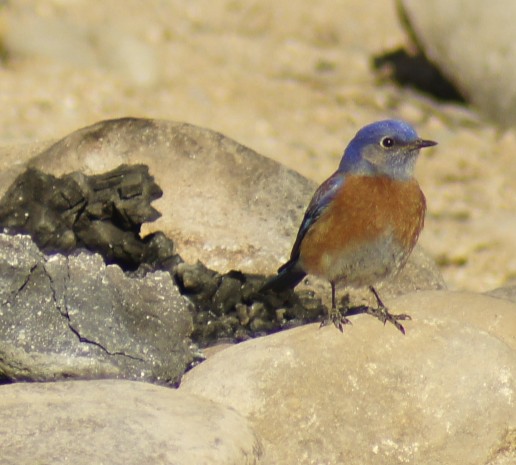
We stopped around the Picacho Peak area to scan for some Crested Caracaras. While these regal buzzards were nowhere to be found, the Red-Tailed Hawks and Loggerhead Shrikes were out in force. We also came across Western Bluebirds, Yellow-Rumped Warblers, and some lovely Lark Sparrows.

But best of all, the best birding is yet to come.

Thursday, February 16, 2012

Just Another Day After The Office

I had some time after work to go birding by the McCormick Ponds near Scottsdale. Although the bird populations have skyrocketed since I visited in the fall, there was a certain dearth of color on display. Gadwalls, Cormorants, Mallards, Coots, and Great Egrets were the birds of the day, and the green headed Mallards, no doubt glad to be free of migratory duck competition, felt like undisputed prom queens (kings?). The Vermillion Flycatchers, which had been consistently visible last year, were no where to be found, so I set out to practice my in-flight photography.


We're reading Peter Pan, among other books, in my 4th grade class right now. In the story, the children delightedly discover that with a happy little thought and some pixie dust, they can fly. Birds have it even easier. They can fly happily, or in a state of fear, hunger, mindless habit, etc. And they don't need any contaminating pixie dust like those moths and butterflies either. If only a happy thought and a spritz of dust were enough to generate nice in-flight photography...
It's a work in progress, I guess what they call a labor of love.

The Mallards were reveling in the ponds, probably content in knowing that they were the most beautiful birds to be seen, an unusual if somewhat unfair recognition for them.


Although Gadwalls are still very pretty and intricately plumed ducks, it says something about their style that the black beak is perhaps their most striking feature. Why is it that the Mandarins and Wood Ducks have developed such extensive plumage to attract a mate, and yet the Gadwalls remain in their stately grays and browns?


I'm really bad with the shorebirds, but I believe this is a non-breeding Spotted Sandpiper. He didn't look too sure of himself either as he skulked along the water's edge. It's kinda far away but I like his pose here and the concentric water ripples behind him.


Even the little peeps get moving pretty quickly, and I didn't quite get the right focus before he was gone.


It was kind of a brown bird day, but that's just as well. It was some good photo practice and got me geared up for this weekend's trip down to southeast Arizona, where the birds and colors abound.

Vesper Sparrow

These are some older photos, taken back in late July of 2011. At the time, I thought I was observing some adolescent Sparrow something or others. Since the photos were kind of blurry I largely ignored them and moved on. Upon review though, I think I'm looking at some Vesper Sparrows, which I've never recorded before! This is better than finding 5 dollars in the back pocket of those pants you haven't worn for 2 years...


Wednesday, February 15, 2012

Wednesdays with Audubon, Chapter 11

We left a soggy and stagnant Audubon stuck for 5 days without a favorable wind as he travelled through the Labrador Islands. I can only imagine the excruciating frustration of heading out on an epic, expensive trip of Summer birding, and having to spend 5 days inside a cramped boat. Salvation came the morning of June 29th and they set off towards American Harbor (I'm not really sure what or where that is).

Along the way they passed many small and rocky islands, almost all of which were dominated by a single nesting species, be it the Common Puffin, Razorbilled Auk, or Cormorants. They travelled some 50 miles in choppy seas before dropping anchor. Tired of his forced drawing for nearly the last week (forced in the sense that there was nothing else to do), Audubon was quickly off the boat and exploring this new, more diminutive portion of the Labrador coastline. He collected a few specimens, including the "Shore Lark (Horned Lark) and spent the afternoon pondering the identity of a dead, starved, and semi-frozen "snowbird" that he had never seen nor heard of before.


They spent the next few days mostly collecting the eggs of the Common Cormorant and American Ring Plover that nested near the shore. I wonder at times why they wanted so many eggs. What does one do with several hundred dozen cormorant eggs, other than drink eggnog while eating omelets topped with scrambled eggs and a small side of poached eggs.

Anyway, Audubon's painting of the Cormorants is beautiful.


On July 2nd Audubon took several men to begin a more thorough exploration of Labrador, which captivated Audubon with it's peculiar and specialized landscape: "The country, so wild and grand, is of itself enough to interest any one in its wonderful dreariness. Its mossy, gray-clother rocks, heaped and thrown together as if by chance, in the most fantastical groups imaginable, huge masses hanging on minor ones as if about to roll themselves down from their double-looking situation into the depths of the sea beneath. Bays without end dot the landscape, sprinkled with rocky islands where in every fissure some bird or another retreats to secure its brood."


The focus for July 4th and 5th was on the Great Northern Diver and Red-Necked Diver with Audubon acquiring his first specimens of these Loons as well as some unexpected Ptarmigan, which one of the more impertinent sailors tried to sneakily eat in the night, for which he was soundly beaten in the morning.


On July 5th Audubon also made an interesting observation about the breeding and molting birds up in Labrador: "The Scoter Ducks, of which I have seen many this day, were partially molted, and could fly only a short distance, and must be either barren or the young bachelors, as I find parents in full plumage, convincing me that these former molt earlier than the breeding Ducks. I have observed this strange fact so often now that I shall say no more about it; I have found it in nearly all the species of the birds here. I do not know of any writer on the history of birds having observed this curious fact before. I have now my hands full of work, and go to bed delighted..."

I wonder. Is this really the case with Scoters and other breeding waterfowl? Do the young or non-mating birds molt at a different time than the parent birds? Interesting stuff either way.

Sunday, February 12, 2012

Recharging in Glendale

Pops and I headed down to the Glendale Recharge Ponds today, with no particular aims or goals beyond having a nice morning full of birds (one of the best sorts of mornings). The ponds have been very low the last few times I visited, but today they were quite full and teaming with waterfowl.

Although the ducks were far out on the ponds and very shy, there was an excellent array of species. We saw Wigeons, all three Teal, Shovelers, Ring-Necks, Pintails, Eared Grebes, and my first Buffleheads. Some Canada Geese stopped by later in the morning, and they had several Snow Geese tagging along, or so we thought.

The ponds are all enclosed by canals and spillways, and it was along some adjacent telephone wires that my first photographic quarry made its appearance. This Belted Kingfisher was sitting rather contentedly with a crawfish in her beak. She seemed determined not to try and swallow it until after we had gone. Since we were determined to wait and see, she eventually took off in search of a more private dining area.


There were many waders along the pond shorelines. The Greater Yellowlegs and Least Sandpipers were the most abundant, but there were also Black-Necked Stilts, Egrets, Dowitchers, and a few Great Blue Herons. We also stumbled across a homicide scene of sorts, where scattered feathers of increasing size and blueness led us to some grisly remains.


We set up our police tape and began to investigate, wondering if this was the same perpetrator as in the infamous Wellington Massacre in Florida last year (in fact, some of the similarities, like seeing a Kingfisher just before, were uncanny!). Coyote tracks led down the muddy shoreline, and we followed until the identity of the victim was certain.


But it was not an afternoon to be dominated by the macabre. The Canada Geese and Snow Geese had drifted into camera range, so we took the rare opportunity to better examine the Glendale waterfowl. Good thing too, for that group of Snow Geese had among them two Ross's Geese, another new bird for the Butler team!


The Canada Geese tried their best to shield their conspicuous companions, but when two of the white geese swam side by side they made for a very nice, if still distant, comparison.

Although its plumage is nearly indistinguishable from the Snow Goose, the Ross's Goose is noticeably smaller and lacks the black lips (for lack of the proper word) along the beak. I doubt I could pick a Ross's out of a whole flock of Snow Geese, so it was very fortunate to have such a nice control group, as it were. 


With the sun rising high and winter still refusing to happen, Pops and I returned to the car and headed back into Phoenix proper, stopping by Grenada Park to see if the Redhead drake was still around. 


He was indeed, and what was a new bird for me on Wednesday became a new bird for Pops on Saturday. It's been a wonderful winter for ducks, and this is definitely one of the most beautiful I've seen so far.


Another first for Grenada Park was this female Lesser Scaup. As I've mentioned before, the Lesser Scaup are not nearly as common in Phoenix as many other migrants, and she brought the total number of different waterfowl species at Grenada to seven--pretty good for a pond that's about the size of a large swimming pool.

Some frolicking, off-screen Mallards provided the fun little splash in this picture, and if you enlarge the image you can see the Scaup has her nictating membrane shielding her eyes.

Thursday, February 9, 2012

Redhead

There are many birds with confusing or even misleading names. The Redhead is not one of them. This mighty handsome duck was one of the few holdouts I had still not seen this winter, and was one of the ducks I have been wanting to see the most. It seems to have a similar body and beak coloration to the Ring-Necked Duck and Lesser Scaup, and but it's sighted less frequently than its other diving-duck relatives.


There were several reports of Redheads throughout Phoenix these last couple months, and yet I continued to strike out in my search for this handsome bird. The most recent report mentioned a solitary duck at the Kiwanis Park in Tempe, AZ. I stopped by after work and could not find the fowl, which made me 0 for 3 in my specific attempts at a Redhead this year.

I took a detour to Grenada Park after work on Wednesday,  and for some reason that I can't quite explain, I was feeling lucky. Maybe it was some residual fillip from the Phainopepla sightings last weekend. It may have been the sense that Redheads were somewhere in the area, and since I hadn't visited Grenada in a while they might've creeped in. Whatever the reason, I felt good about my prospects, and sure enough there was this sleepy male floating all by his lonesome.


This is the first Redhead I've seen and, needless to say, the only one that I've seen or heard of at Grenada Park. In fact, I've never seen other migrants but Ring-Necks and Wigeons (the two most common) at the Park, so this was a great bit of fortune.

As I sat down to get on a better level with the duck, it actually perked up and started to head over my way--a probable indicator that he has been at Grenada long enough to learn about people coming by and feeding the birds.


I had to disappoint Mr. Redhead in that regard, but he did not disappoint me (which is not to say that I ate him)! They're such striking birds in all of the pictures and field guides. Even with the cloudy skies and murky pond water, the definition and color on the Redhead were outstanding.


The Redhead is stunning, especially with the vivid orange eye. I'd never before noticed the black detail on the beak. There's a nice outline at the base of the bill, and a curious black stripe though the nostrils. I'll definitely have to try back for some more time with this beautiful bird.


**Here are some more recent photos, taken on 02/11/2012


Wednesday, February 8, 2012

Wednesdays with Audubon, Chapter 10

John James Audubon spent all of June 18th aboard the boat, arranging and drawing his specimens as best he could while observing many different gulls from the boat. It is interesting to read that, for a while, he continued to misidentify the Herring Gulls as immature Greater Black-Backed. Audubon though to himself, "knowing the tyrannical disposition of the L. marinus (Black-Backed), I am sure they would not suffer a species almost as powerful as themselves in their immediate neighborhood. They fly together, but the white ones do not alight on the rocks where the marinus has its nest."
 Even the great ones have trouble with Gull identification!


 Audubon continued to catch up on his drawings of Guillemots and Gulls throughout the next few days, even as the weather improved such that they were getting some 18 hours of sunlight each day at 55 degrees fahrenheit (perfect!). His men continued to explore the surrounding rocky islands, having little luck collecting specimens of the Eider and Terns that were breeding, but nonetheless collecting many varieties of eggs, some of which Audubon notes as being delicious, and some as not.

It's interesting to juxtapose Audubon's naturalist intentions with his very direct and fatal approach to collecting his specimens. Of course back then there were few endangered species, and preserving some of these wild populations was of little concern to either Audubon or the general public. Despite his apparent callousness, Audubon was very aware of the delicate balance. With a clear disdain, he comments on some evidence he and his men found of "egging" expeditions: "The eggers (people who would take and sell large quantities of the eggs in the southern towns) confiscate or destroy all of the eggs that are sat upon, to force the birds to lay again, and by robbing them regularly, they lay till nature is exhausted, and few young are raised. In less than half a century these wonderful nurseries will be entirely destroyed, unless some kind government will interfere to stop the destruction."


For the next five days Audubon and his men sat at harbor rather despondently, waiting for a favorable wind to carry them on to new adventures. They had naught but a few Gulls and the eternally noisy seals for company, who seemed to relish and taunt the sailors' immobility. Audubon did meet with some luck on the shore, where he shot and collected his first Canada Jays (Gray Jay) and Ruby-Crowned Kinglets for the year.


Hopefully when we return to JJ Audubon next week, he will finally receive that fortunate wind, and keep the birds coming.

The 2011 Butler Bird of the Year

Well it took about a month and a half to decide, but the jury has finally reached a verdict on the best Butler Bird of the Year (also know as the B-BOY award, only slightly less famous than the Oscars). With close competition from Phainopeplas, a Townsends Warbler, and an inner city Lewis's Woodpecker, the award goes to...the Elf Owl!


This was certainly the most surprising sighting of the year, both because of the relatively uncommon and inconspicuous nature of the bird. I'm never really expecting to see Owls, which maybe explains why this and the Great Horned are the only two I've ever seen in the wild.


These tiny birds were hanging out at the Desert Botanical Gardens in September, and provided one of the best all-round birding experiences of my 2011 birding year. I'm definitely hoping to get some more owls this year, but I don't know if any of them will match this super fun sighting. Here's hoping!

See the full Elf Owl adventure recorded here

Sunday, February 5, 2012

Finding Some Pep at the Rio Verde

This morning I went out to the Box Bar wildlife-and-walkin'-around area at the Rio Verde, a nice little river running down the east side of Phoenix. The drive out through Pima was pretty nice too. It's that time of year when the rustic desert foliage is also joined by the green grass and wildflowers to create a very impressive collage of color. I met up with the family near the river, and we enjoyed each other's company as well as a quiet and cool mid-morning of birding.

We saw some Western Bluebirds, plenty of Yellow-Rumped Warblers, plenty of Black Phoebes, some Herons, some Red-Tails, and a possible pair of Hooded Mergansers (which took off immediately).


The main goal was to see a Phainopepla, a peculiar dark species of flycatcher that prefers the arid Southwest and can be found in pockets throughout the southern half  of Arizona. In rather unceremonious fashion, my first sighting came off of a telephone wire while I was still several miles from the hiking area. As I got nearer to the Rio Verde turn-off the sightings began to increase, and eventually I pulled over and began some highway-side photography because the desert just seemed to be bursting with Phainopepla activity, and you've gotta take what you can get. It was awesome!

This was the fourth Phainopepla I saw, and the first I was able to photograph. They're in their own group of silky flycatchers (I suspect they have some tropical cousins that also share the group), which must in part refer to their glossy shine and elongated anatomy. I love how slap-dash the crests are on these birds. It's clearly a crest, but it looks like it's losing the war with bed-head.


It was difficult to catch the male's ruby-red eye at times, but boy when it got some sun that thing could really radiate!


While I was calling and whistling to this male (for no good reason really, it's just fun to imitate), this lovely female came by to investigate. It was probably not my calling that brought her in... in fact I'm sure it wasn't. What is apparent from this first picture is that she felt nature calling, and she discretely deposited her morning meal before flying over to her beaux.


I was geeking out pretty badly at this point, you know with the whole talking to yourself and exclaiming "Woah! No Way!" inhaling only to realize you haven't taken a breath for like the last 3 minutes. It was only a half-hope to see them in the first place, and now I had multiple Phainopeplas within camera-shot. With her solid grey, white wingbars, and striking eye, the female is a visual feast just as well as the male.


That being said, some angles flatter the birds more than others. From straight on the Phainopepla crest gives the bird a very rectangular head shape, one that reminded me a little bit of Frankenstein's monster.


After a little bit of flirting and playing hard-to-get, the female joined the obsidian male in his tree, where he continued to serenade and impress her with his silky-smooth moves.


I like to think that I brought them together. In all likelihood though, my presence was keeping them apart. I left them to their romance, myself feeling very satisfied and simply in awe. As I continued the drive down to Box Bar I saw some 7 or 8 more Peplas living it up in the morning sun. What a great way to start the birding day!


Friday, February 3, 2012

Some Power Birding

I snuck in a quick bit of birding this evening after work. I have been trying to relocate a Common Yellowthroat I saw a while back (a current photographic nemesis) at the Tres Rios preserve in south-central Phoenix. While I was again unsuccessful in that regard, it was a nice walk around with plenty of other fun and common birds.

This Great Blue Heron was hanging out on the water's edge in those nasty red vine things. I don't know what they are, and I'm sure they're a biologically impressive species, but they remind me of the vein-like things that the aliens use to digest the earth in War of the Worlds. The Heron was cool though; he didn't seem to mind. By the way, should we call a female Great Blue a Heroine?


I've been trying to improve my in-flight photography (when the bird is in flight, not myself). Slowly but surely I'm learning things about better settings and when/how to anticipate take-offs. It's a good challenge, and the big lumbering herons make pretty easy subjects for beginners such as myself.


I still haven't glimpsed that ruby crown, but otherwise the Kinglets have been great this year. They're hanging out around Phoenix in large numbers and with very little shyness. Now, taking their picture without obstructing twigs is another matter entirely.


The Verdin is one of the signature species of the arid southwest. Like the Kinglets, they're pretty personable and pretty good-looking. I'm been having warbler envy this winter, but the Kinglets and Verdins and Yellow-Rumps are doing their industrious best to keep me satisfied. Thanks guys.