
Wednesday, July 20, 2011
Dark-Eyed Junco/Oregon-Race
There are fives subspecies comprising the junco hyemalis group. The Oregon-Race is the most widespread in the West, and sports a dark hood with its buffy back, yellow beak, white-streaked tail, and dark eye. Slate colored juncos are uniformly darker while the pink-sided juncos have a rosy tint to their sides. These Oregon-Race juncos prefer the undergrowth, and are very charming companions on a woodland walk.


California Gull
A normal-looking gull in most respects, the California Gull is set apart by its red eye, which the Glaucous-Winged Gull lacks, and its black wingtips, which the Herring Gull lacks. I have no idea what other Gull chicks look like, but apparently the California Gulls favor a leopard-like disguise for their young.


Tuesday, July 19, 2011
Wilson's Warbler
I've had repeated run-ins with this Warbler now in Arizona as well as California. I still have been unable to get a better picture, even though this bird is common during migratory periods and is not overly shy. For the moment, the Wilson's Warbler is my official nemesis. Every Ahab needs his White Whale (or little yellow bird).

This is the closest I've come. I actually had the bird in focus, but of course there's a heavy shadow obscuring the face.

House Wren
Wrens are tidy little birds, and always seem to have some great task at hand. The House wren is the most widespread, but is still an uncooperative subject for the greenhorn photographer (myself).


California Quail
Quail = just really great birds. They have beautiful plumage, little Renaissance caps, are the cutest chicks, insist on running when flying would be far better, and are delicious. The California species are more scaled than their cousins, but have a very similar and very ornate face.


Oak Titmouse
The Oak Titmouse is, like, totally, only in California, bro. Apart from its white eye-ring and semi-pointed tuft, it's fairly non-descript. They can be found, predictably enough, hanging around in oak trees. They lack the black forehead and rusty/rosy sides of the tufted titmouse, and instead have a lighter gray mask.


Western Bluebird
Although it closely resembles the better known Eastern Bluebird, the Western Bluebird has a comparatively smaller range, but does sport a little more blue on the chin. The rufus belly extends up to the bottom of the beak on the Eastern variety. They're a funny bird in that they seem to have very inconsistent behavior by region. When I saw them in San Jose, CA, they were very tame and stayed very low to the ground (unfortunately those were the pre-camera days). Now when I see them in Arizona they prefer the highest canopies of the cottonwood and willow woodlands along the Arizona rivers. Very rarely they'll come down, still keeping a safe distance, and allow for some brief photography.


House Finch
House Finches are everywhere all year round, but with their red rumps, ruddy faces, and cheerful behavior, they're some of the more welcome of the family extremely common. They pose well too.


Black Phoebe
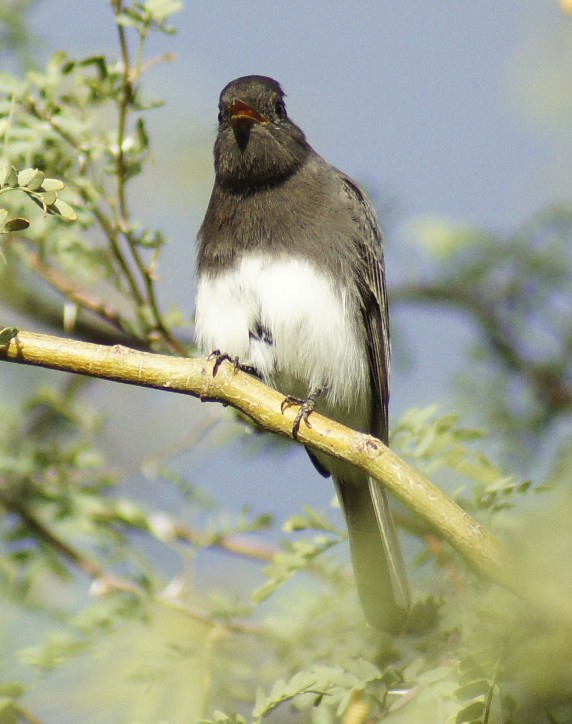
The only black-breasted flycatcher in North America, the black phoebe is perhaps the most conspicuous of the larger flycatchers (although it is not itself very large). Their range is restricted to the American southwest, California, and Mexico, though they inhabit this area year-round. They tend to hang out near water and are not averse to man-made environments, but in my experiences they're still pretty shy.



Nuttall's Woodpecker
Nuttall's Woodpeckers are some of the smaller members of the Picidae Family, and their range is limited exclusively to California. They have the sort of black and white zebra striping all over their back and wings, and are the only such woodpeckers to be found West of the Sierra Nevadas. Some bird books show the red spot located towards the back of the head, but other pictures confirm it to be on the forehead, as was my observation here:


Subscribe to:
Posts (Atom)