Wednesday, May 23, 2012

A Wash Before Lunch

This past Saturday my family and I decided to do some morning birding and a picnic lunch at Mesquite Wash, a great little birding spot just northeast of Phoenix. The Mesquite Wash is fed by Sycamore Creek, and while there wasn't a lot of water, there was enough to keep things green and cool.

Mesquite Wash is accessible between miles 207 and 208 off the AZ-87 (beeline) highway. There is a parking area to the west of the AZ-87, which didn't give me a great first impression. There was lots of dust and litter, but even as we pulled in we could hear birds singing from the nearby trees, and we caught glimpses of Western Tanagers and Yellow Warblers while still getting stuff out of the car!


From the parking lot, we made the short walk down towards the creek. Along the way we had good looks at some of the desert chaparral birds, including Black-Throated Sparrows, Lucy's Warblers, and Cardinals (which can also be found everywhere else).


Although it was a short walk to the stream, it was also pretty hot, and the discomfort was exacerbated by dust-stirring motorbikes passing nearby. The sound of trickling water was very welcome, and the sight of running water was a little piece of heaven.

The water at Mesquite Wash sustains the cottonwood and willow trees, which reflected their green off its glassy surface and shaded the bathing Lesser Goldfinches.


The birding was good and the environment was very enjoyable--everything was going according to plan. The big surprise came when we spotted this fatty Gila Monster slinking its way up from the water, trying to make a daring 0.024 mph escape back into the bordering grass.


This is the first Gila Monster I've seen in the wild. I must admit, the lizard's comical proportions and plodding pace largely offset its infamous reputation (it is one of only two venomous lizard species). It was very tempting to try and pet his bumpy hide, but getting bitten would've ruined our outing...prudence can be such a difficult thing.


After about half a mile the wash starts to narrow, and the desert canyons become more prominent. This provided a welcome diversity in habitat and birds. We were able to alternate between viewing Yellow Warblers, Warbling Vireos, Wilson's Warblers in the canopies and the Phainopeplas and Lucy's Warblers in the chaparral.

I will not apologize for this photo because it's my first and only Lucy's picture.


I will not apologize for this picture because Phainopeplas are awesome and should be viewed in any way, in any quality, as often as possible.


We also spent some time checking out this flycatcher. Unfortunately, I couldn't get very close for a better photo, and the bird stayed stubbornly still. It did have a notched tail (so no Western Kingbird, it was also too small and slender) but not enough yellow on the breast to be a Tropical Kingbird. My vote is Dusky-Capped Flycatcher, but I am very open to suggestions.


After checking out the desert scene, we stopped to observe a little holding pond. The stagnant water here was very popular with Red-Winged Blackbirds and lots of insects, including this nifty dragonfly which I will not attempt to identify.


We continued down the wash, knowing that soon it would be time to turn back for lunch, but also wanting to explore the liminal space where the water thinned out and the tall trees transitioned into tall grass. The last few trees played host to some Bronzed Cowbirds, one of the cooler kinds of Cowbirds and a species I do not see very often.


The tall grasses below the trees formed a charming little prairie, and it was there that we found the birding highlights of the day. You need a big beak and a big head to eat these mighty grains. This was Grosbeak territory. This male Blue Grosbeak was a lifer for me, one that I have been hoping to see for a long time.


It was only while reviewing photos later on that I discovered he had a female friend, whom you can see in the background. Birds feeding in tall grass make for great binocular looks but less than great pictures. I cared not a lick; the Blue Grosbeak is "epic," to use the buzzword of these last few years.


This azure all-star ascended to the treetops for a brief surveillance before departing. My jaw hurt from hanging open for so long. While crawling along the wash, trying to keep low and small, I had collected quite a few scrapes and scratches, as well as a lovely collection of gravel and pebbles in my pants.  Birding can be dirty, dusty, even painful business. I often feel like those stingy scrapes and after effects make a first-time sighting all the better. Getting a good look at the bird and having a bit of lingering pain...it's like a good stiff drink right afterwards (obviously, having a few scrapes and a stiff drink right after is best). It makes me feel like I've earned it. Anyone agree? 


The Blue Grosbeak was probably the most beautiful bird in the grass, but coming close is second was the male Black-Headed Grosbeak. He too was enjoying the unlimited buffet, and it was at this point that our grumbling stomachs and satisfactory sightings prompted a return to the cars.


On the way back we found lots and lots of tiny frogs in the wash gravel. They were not there when we first proceeded, so we developed the theory that some of the dirt bikes that had earlier gone roaring through had upturned the gravel and disturbed these tiny amphibians. I must admit, I was pretty irked at the dirt bikers for interrupting the serenity of the Mesquite Wash setting, especially because there was plenty of space for them to ride around that was within their limits. That being said, these frogs were pretty cute, and I'm glad I got to see them. This guy was maybe the size of a dime.


We decided to take out picnic lunch to the nearby Saguaro Lake, where we could eat on ridiculously undersized picnic tables (for me anyway) and enjoy some shade that wasn't in the water. In addition to providing a comfortable setting that went very well with our avocado, turkey, and munster cheese sandwiches (score!), Saguaro Lake had a few cool birds too, including a late Yellow-Rumped Warbler, Wilson's Warblers, and Vermillion Flycatchers:


This teasing jelly-belly wouldn't give me a look at his front, but seeing a Vermillion is undoubtedly a great way to end a birding trip, even if it's playing hard-to-get. I'm planning a return to Mesquite Wash later this summer. It was a great birding site by all accounts, and is supposed to be a good location to find Yellow-Billed Cuckoos, another one of my 2012 target birds. The summer is just starting to heat up!

Monday, May 21, 2012

Edward Scissortail

No doubt one of the coolest Flycatchers in our galaxy, the Scissor-Tailed took Tim Burton's bleak plot device (Edward Scissorhands) and said, "You know what, I'll do that with my tail, and I'll make it look good." Let it be not said that the Scissor-Tailed is not a Flycatcher of its word, for it does indeed have scissor-tail, and it does indeed look very, very good.

Scissor-Tails were my favorite birds when I lived in Dallas, and one of my main goals while visiting last weekend was to get some suitable pictures of these daredevil flycatchers. The rainy conditions made photography difficult at first, but with a bit of luck and perseverance my birding buddy Taylor Butler Posey and I found a cooperative pair of Scissor-Tails at Cedar Hill Lake.

This male, told by his exceedingly long plumes (which, with some straining, you can see extend all the way to the left border of this photograph), took a break from his hunting to stare out at the lake.


We pulled into some parking spaces behind him. While the car helped to shield us from the bird and prevented a total retreat, he did relocate to a bush further down the rail. Unfortunately the tail is obscured, but this did give us the opportunity to see the ruby-red armpits, something few adventurers glimpse and live to tell the tale.


Safe and secure atop his new perch, the male struck a few poses, scratched his shoulders, and just generally enjoyed being the most awesome bird in town.


Here you can see the four primaries on the tail, as well as the red epaulet. These features are much less exaggerated on the female, and the male seemed willing to show off.


The female Scissor-Tailed Flycatcher was very comfortable swinging back and forth on her willow perch. Her tail is not as long as the males, neither in overall length nor relative to her body length, and her epaulets are less red. That being the case, she picked a prettier perch than the male and one with more light. I contend that she is thus the photographically superior specimen!


These were the only two Scissor-Tails I saw in Dallas, so I consider myself lucky to have come away with some photos. We got the soul-satisfying view and I am so glad. It would've felt like a failure to leave Dallas without revisiting these graceful birds.

Sunday, May 20, 2012

King of the West: Western Kingbird

Western Kingbirds are big, yellow, and ornery, much like Big Bird from Sesame Street. Unlike Big Bird from Sesame Street, they're aesthetically pleasing and can fly really well. What's not to like?

Western Kingbirds can be found throughout most of the western half of the U.S. in the spring and summer months, but they seem to be especially populous in Texas. While on a trip to Dallas last weekend, I had the pleasure of observing these feisty flycatchers once more.

Though I saw lots of them during my morning birding trip to Cedar Hill State Park, I hadn't gotten good pictures yet. I was being driven into downtown Dallas by two excellent and accommodating friends, when I spied a Kingbird perched atop a sign. Upon hearing my panicked cries, they swung the car around and we all transitioned perfectly into safari birding mode--it was marvelous. The Kingbird flew across the street to a new perch, but using great teamwork we all got in the right position to get some shots. Well done team!


He adopted a rusted iron cable for as his perch of terror. From this lofty throne, his majesty would descend to terrorize the fire ant minions living on the ground below, claiming the sacrifices one at a time.


Another reason to love Kingbirds: They massacre fire ants--truly, a King worthy of adulation and praise.

Friday, May 18, 2012

A Dilly-Dally in Dallas

I spent this past weekend in Dallas, Texas. While the express purpose of this trip was not birding, I was certainly hoping to fit some in on Saturday. I had all my gear together and my routes planned out and my extra pair of socks and then...I remembered to check the weather. Dallas weather has a love-hate relationship with me, in that it loves to make me hate it. I was pretty dismayed to check the weather and see that Dallas would be getting it's Thor on, with thunderstorms predicted for most of Saturday. Even so, I grabbed an old buddy from college, Taylor Butler (how appropriate) Posey, and made him drive me out to Cedar Hill State Park for some overcast observing.

I logged seven new bird species for my life list, though to be fair most of the species were birds I had previously observed--Common Grackles, Chimney Swifts, American Crows, Ruby-Throated Hummingbirds--stuff that, statistically, I must've seen, but wasn't recording at the time. These common birds were just the tip of the iceberg, and even though we were forced back into the car during a typical twenty-minute Dallas downpour, we had a lot of other great sightings.

The trip down to Cedar Hill State Park is a nifty drive, and along the Hwy 408 roadside we encountered one of the first signs that we weren't in Arizona anymore (other than the gratuitous rain). There were three cattle grazing in an adjacent field, and three Cattle Egrets grazing next to them. I'd seen Cattle Egrets in Texas before, but never next to cattle. It's great when a bird lives up to its namesake. I was hoping one would perch on the cow, but that would've been too much.


We didn't prepare much of a bird list for this trip, but Painted Buntings were definitely at the forefront. That being said, I wasn't very optimistic about our chances. I was mostly hoping just to get some good looks at the old Dallas regulars, but the Buntings were always at the back of my mind. Before heading into the state park, we parked at the Cedar Hill Audubon Center and walked the quick loop outside the building. The very first bird we saw, singing atop a soggy tree, was this lovely male.


With the heavy cloud cover, the bird's shyness, and their preference for staying high and singing or hiding in the thick hedges, the photographic opportunities were poor, but we did see near a dozen Buntings throughout the day. Success! What a preposterously colored bird! Who do they think they are, bringing tropical style colorations into the Texas plains!? The binocular looks were much better than the photos indicate. These birds are stunning.


After checking out the Audubon center we drove down to the nearby Cedar Hill Lake. The recent rain had really filled out the foliage. There were Cardinals all over, and we also had good looks at Carolina Wrens, Carolina Chickadees, Blue Jays, and Titmice. There were more Painted Buntings too, and we chased after these bodacious beauties with reckless abandon. Alas, the viscous Dallas clay was really starting to accumulate on our shoes, and as the rain came down with gusto.

Trying to walk with this thick, congealing mud is like walking in scuba flippers: comical but ineffective. We scraped off as best we could and headed back to the car.

Even my birding buddy Taylor, a rugged mountain man by all accounts, was in awe of the energetic earth.

Luckily for us, Cedar Hill Park has a paved road running a loop around the trails and the lake. We were able to clean off our shoes, grab some Sonic lunch, and then go into safari mode, getting some excellent birding done from the car. Birds weren't the only thing on display either. This Texas Brown Tarantula (?? let me know if not) was taking its time to cross the street.

Getting out of the car to take its picture, I faced certain death from ol' shelob. Luckily, I had a little crystal bottle full of illuminating elf water that kept the spider at bay. That's good photography fundamentals 101: always have mythical creature repellent available on your person. 

As we continued our loop, stopping to observe some Spotted Sandpipers and Red-Winged Blackbirds, a single Ring-Billed Gull showing off its fishings skills.


There were lots of Franklin's Gulls and Mallards floating on the lake, but only this Ring-Billed Gull dared to fly in the adverse conditions. It was rewarded for its bravery, as were we. From afar, we watched it catch fish after fish. It didn't have quite the grace or power of an Eagle or Osprey, but hey ya can't argue with the results.


To put some icing on this seagull fish cake (eww!) this was a new bird for me. They turn up in Arizona from time to time, but it was great to add another new bird in Dallas. From the small and colorful Painted Buntings in their bramble bushes to the large and dull Ring-Billed Gull out over the water, we saw both ends of the birding spectrum.


The most iconic Texas bird for me, and one of my all-time favorites, is the Scissor-Tailed Flycatcher. This was the bird I longed to see the most. This was the bird that holds the fondest memories of Texas birding for me. Though not as numerous as the Kingbirds, they're still a fairly common sight in Dallas during spring. One of my main goals from this birding escapade was to come away with some good photos that did these awesome birds justice. I was bummed about the overcast conditions and then by the birds' initial shyness. Any sort of approach seemed to startle them away. : ::sniffle:: : it was like they didn't even recognize me. Calls of, "Hey guys! It's me, Laurence!!" didn't help at all.


But perseverance is the name of the game. While birding in 'safari mode' (from the car), we spotted a mated pair of Flycatchers near one of the fenced pull-outs by the lake's south shore. The grey weather put these usually-vivacious birds in a melancholy mood, but they were mercifully accommodating as we pulled in for a photo shoot.


Yep, his tail is pretty long. I snuck this male's picture while he stared forlornly out into the lake, perhaps with a wistful wish that his tail could actually slice things. This is just the beginning of my Scissor-Tail shots, most of which I'll save for a further post.


Logging new birds is always exciting, but the best part of this birding trip was reacquainting myself with old Texas regulars. Western Kingbirds can be commonly found anywhere west of the Mississippi, and Phoenix is no exception. In Dallas, I became very familiar with these birds in the spring time. They would adorn the trees and posts around soccer fields, parks--any open space with a bit of green--and were much more brazen than the Kingbirds in Arizona. I have more shots of the Kingbirds that I'm saving for a separate post. These regal ravagers-of-the-bugs share posts with no one...

Wednesday, May 16, 2012

Pretty Birds, Opposite Attitudes

The Verdin is a southwestern specialty and is a wonderful creature by all accounts. They make great nests, they're colorful, they're playful, and they're easy to find. They're first identified by their yellow heads, but their constant chirping and acrobatic feeding makes them stand out as recognizable songsters that can be found throughout the year.

"Hey guys...yeah I'm just hanging out." 

If they're lucky, Verdin will grow to be four and a half inches. Despite their small stature, their wily antics guarantee they'll be one of the first birds you see while perusing the desert scrub.


Always cheerful, always on the move, they're the Warblers of the southwest. At least, the southwest makes do with them until the Warblers arrive.


The Verdin is a little bird with a brilliant yellow head and an outgoing attitude to match. The Lazuli Bunting is another small bird with a beautifully colored head. They can be found in Arizona during the spring, but in my experiences they are far from outgoing. Their bold plumage makes them easy to pick out, but getting them to pose for a picture is another story.


The tall grass makes for a pleasant setting, but only if you can see the bird in it! The Lazuli Bunting doesn't have the people skills of the Verdin, but their shyness makes them all the more exciting and satisfying to find.


Lazuli Buntings and Verdins are two birds at different ends of the social spectrum, even the color spectrum. Both are totally stunning in their element, even if the Buntings really make you feel unappreciated...

Monday, May 14, 2012

Birding the Arizona Beach

It seems like spring only lasted for a couple weeks, and now we're already into summer. Perhaps that explains the recent beach posts on lots of birding websites. As the sun climbs higher and stays longer in the sky, we start to pine for the breezy shores and salty air. Chris Rohrer over at Las Aventuras, Gordon Karre over at Birding Adventures, and Seagull Steve at BB&B have all had some excellent recent posts revolving around beach birding, and they've got me yearning for the shore. Alas, central Phoenix is a far cry from the Pacific Ocean, but to try and keep myself sane these last few weeks, I shall endeavor to deceive!

These accounts and photos are from the Glendale Recharge Ponds, a bleak, ugly place in northwest Phoenix that offers surprisingly good birding around the holding lakes. This is my place for shoreline birding. So take a whiff of saltwater, hold some seashells to your ears, close your eyes, and pretend you're now at the beach (don't really close your eyes; then you wouldn't be able to read the post).....


So, here we are at the beach. It must be low tide, for there are no waves and the water is rather shallow. Thinking little of the low water level in the ocean or the faint smell of distant sewage, we unfold our rickety beach chairs, stick an umbrella in the ground, and soak in the scenery.


Upon closer inspection, we see that the shoreline is dotted with Semi-palmated Plovers, an uncommon bird in Arizona but a predictable sighting for us here on the Pacific coast...


While the Plovers scurry around the tide pools, we notice some shadows from above. Looking up, we see some Cliff Swallows catching bugs with exceeding delight.


They dip and turn and bank with impressive agility. Clearly, this a bird designed to fly and fly, to spend its life in the sky.


A larger, lumpier shadow moves across the beach. Again looking up, we see an American Avocet coming in to land. Beautiful and graceful though these birds are, they do not look so comfortable in the air. The upturned beak makes perfect sense for skimming through the shallow mud and muck, but now makes the Avocet look like it crashed into a window.


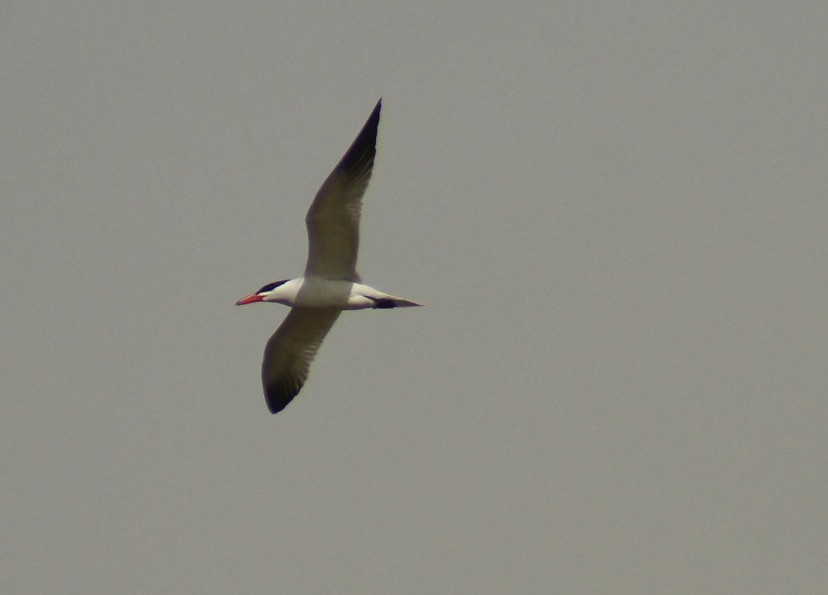
There's a lot of traffic in the sky today. Several Caspian Terns fly overhead, reveling in the knowledge that they're one of the largest and sleekest aviators in these skies.


This too, would be an unusual and exciting sighting in Arizona, but since we're on the Pacific Coast we won't get too energized...


We've been studying the sky for a while now and our necks begin to hurt. After reaching for a cool beverage and leaning back in our creaky chairs, we again scan the shoreline for adventurous peeps, such as this Spotted Sandpiper popping in and out along the rocky wharf.


The Spotted Sandpiper seems determined to keep its feet dry, but eventually the allure of tasty treasures draws him into the water. Come to think of it, that sounds pretty good!


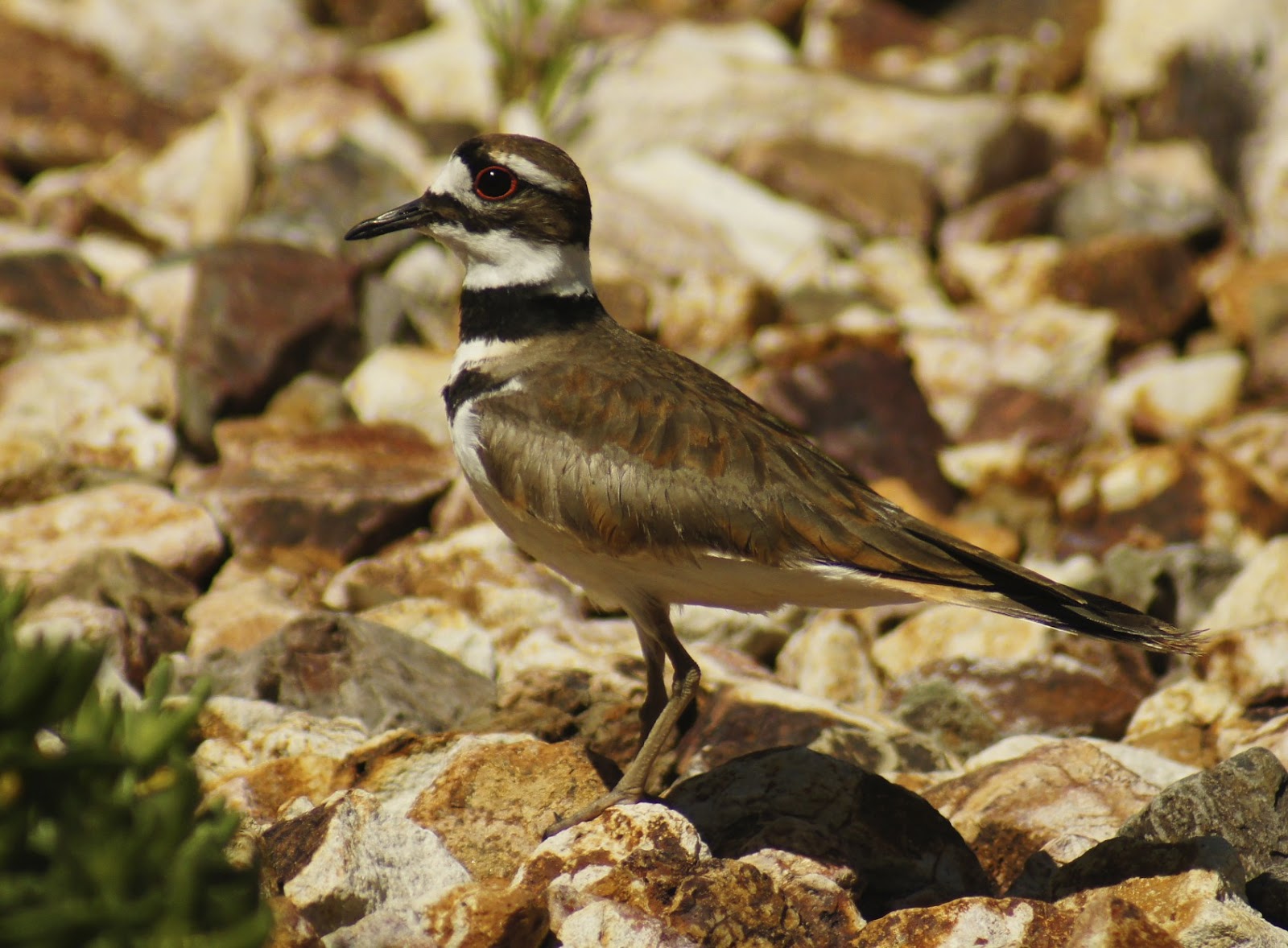
As we make the short walk down the beach, a startling cry echos from the right. Of course! It is a Killdeer, the common and noisy Plover near and dear to our hearts. He's standing along a rocky outcropping, blending in very nicely. Since this is the Pacific beach and not an Arizona sewage pond, we marvel at this unusual and refreshing sighting!


Ahh...a quick dip, some picnic lunching, some more cold beverages and it's time to pass out. What a lovely trip to the beach this was!

Friday, May 11, 2012

Land o' Larks

Lark Bunting, Lark Sparrow, Meadowlark...it seems like the name 'Lark' is often put with birds that aren't even in the family, strictly speaking. The Horned Lark is a true lark--a ground-dwelling bird with long hind-claws and a preference for singing while in flight. They're also really cool looking birds, ones I see fairly often at the Glendale Recharge Ponds in Phoenix but seldom approach.

Even from afar, their distinct plumage and hoppity hop hopping around makes them easily recognizable. I made it a goal last week to get some better pictures of these unique North American Larks, and this required that I venture out into the dry basins they call home.


In my personal experiences, Horned Larks do not tolerate a close proximity to people. But I've also heard of people driving by them on the side of the road, particularly in the midwest, where they'll be feeding in a very casual fashion.

At any rate, my objective was going to require some crawling, slithering (which I don't do very well), scooting and slinking. With this spongy red weed covering lots of the drying mud, it was a neat experience, as if I was exploring an alien planet. The male Lark shown above was always heading away from me, but his female companion decided she liked her spot, and let me get pretty close.


Alas, she lacks the manly mustache of the male Horned Lark, but is still a very pretty bird. She seemed to be feeding on the shoots of grass that managed to poke their way up though the dry soil. She'd bend them down with her Lark feet and then nibble away.


It was really nice to get in close and get some better photos of these cool and delicate birds. It was also really nice to slither away without disturbing them too much. Why is it that people are always disturbed when I slither away from them? I'm just trying to be considerate...
Here's a male I saw while driving around the Santa Cruz Flats in December.