Monday, October 10, 2011

Awesome Bird Monday

After a relatively uneventful morning at the Desert Botanical Garden, I decided to stop by the McCormick Ranch pond were I had yesterday seen the Sora and the Common Yellowthroat. Although the company was very nice at the DBG, and we did see the normal desert quarry one comes to expect at the Gardens, I did not get a single good picture, nor any new birds. That's just the way the cookie crumbles sometime, so I hadn't quite got my fix.
My stomach was communicating to my brain that it was lunch time, but my brain had to explain to my stomach that we just won't be satisfied, even after a meal, with so little to show for our troubles.
I parked farther away from the pond this time and walked along more of the McCormick golf course, and saw nothing along the way other than a few Grackles.
However, as soon as I reached the southern banks of the 'U' shaped pond, I saw that treasure of a bird, the fiery flyer I had been longing to see since I got my camera: the Vermillion Flycatcher.


Photography in noonday lighting is never ideal, especially when you're trying to track a flycatcher that never let's you get closer than 30 feet, only sits still in 3 second increments, and keeps going from shady to sunny perches. I guess I couldn't have it all on my photographical debut with the Vermillion, so when I took off across the pond, I followed in his direction without expecting or needing to see more.
It was a bonus then to see a weather-beaten Harris's Hawk in one of the larger trees on the north side of the pond. He stayed put for a while and seemed content to finish with his preening before moving on.

 At 20-21 inches tall, the Harris's Hawk is about average size for a Hawk, but this specimen seemed especially large to me.
There's no other hawk with the dark head, and dark body offset by the brown shoulders. The tattered end of his tail feathers indicate this hawk has seen the seasons change many times.
 Yes, he is scratching his lower back with his face--no big deal. The white rump here and white tips of the tail (almost worn away) enclose the dark tail, and make for an easy identification when you see a Harris's flying overhead.
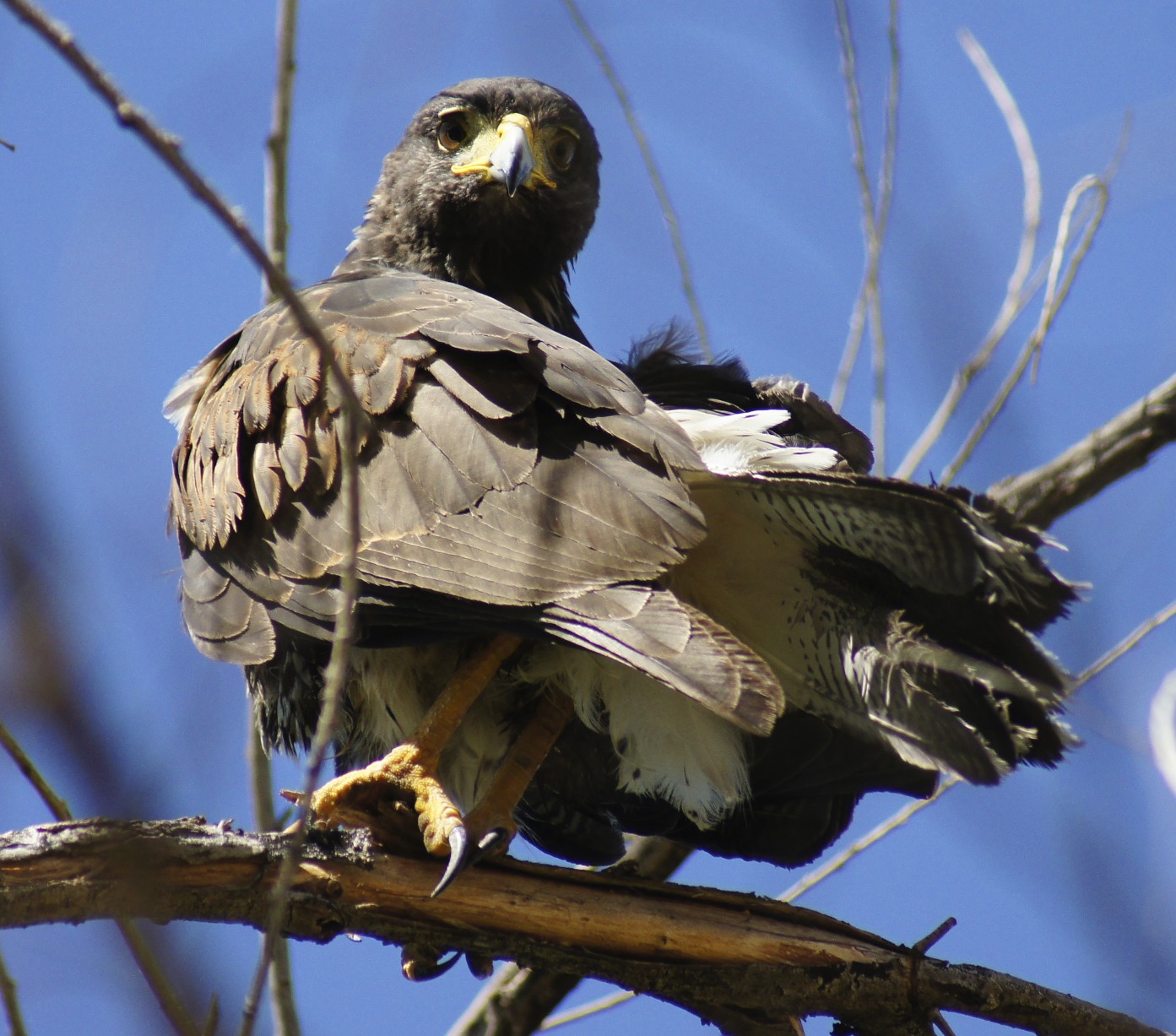
 Is it just me, or does this Harris's have especially prominent eyebrows?
 It was a tiny bit frustrating to never get the clean body shot--a stick always seemed to be in the way.

By time the Harris's Hawk left, I could no longer see the male Vermillion Flycatcher, but I did notice a Black Phoebe arguing with a slightly smaller bird, which turned out to be the lovely female!

 She was even more skittish than the male, but still preferred to stay out in the sunshine. I have to admit, I woefully underestimated how bright it was. I was shooting here at f6.3 and 400 ISO--error.
The female Vermillion Flycatcher has to be one of the prettiest lady birds out there. It was odd though, that the male and female never occupied the same side of the pond. It was almost like they stayed opposite each other on purpose, as if they weren't getting along or didn't want to compete for food.

I made my way back into the bullrushes hoping to stir up some warblers or sparrows. I did get a decent look at a pair of Marsh Wrens, which was a new bird, but never enough for a picture. It was at this point a sympathetic Cooper's Hawk landed in a nearby mesquite tree, paused for a quick shot (again with me underestimating the brightness), and then departed. Two new birds in as many minutes!

Excelsior Accipiter!

This swampy soiree was already hugely successful, and on my way back around the Vermillion male gave me one more look.

 That poor other bird has never felt more dull and drab in its entire life. To be fair, it'll probably never get it's picture taken again either. Vermillion Flycatcher, you're the best!


Dear McCormick Ranch Drainage Pond,

I'm sorry I ever thought you didn't have much to offer. I'm sorry that, even after seeing my first Sora hidden on your reedy banks, I did not think you were the most special pond in Arizona. Thank you for giving me another chance, and for hosting awesome birds today.
I love you, to the extent a man can love a pond, which it turns out is a lot.

Vermillion Flycatcher

More than any other, except maybe for the Rose-Breasted Grosbeak, this is the bird I've been wanting to see again and photograph. Most of my photography has been spent capturing images of birds I had already seen before I got my camera. The camera made re-seeing old birds much more exciting and challenging, and also allowed for me to more generally share my experiences with others.
The last time I saw a Vermillion Flycatcher was in 2009 at the Gilbert Water Ranch in Arizona. I had seen one once before in Harlingen, Texas, and let me tell you every time you see this bird it's just jaw dropping. It's to vivid and sanguine for any birder to ever become jaded, and so seeing it with camera-in-hand was twice the excitement.
That all being said, it's an uncommon bird, and I wasn't fully prepared.


The Vermillion Flycatcher has about the same attention span as a warbler, and tends to alternate between super sunny and super shady perches, so while I'm fiddling with my ISO and f-stop and EV compensation and all other manner of improvised human attempts at capturing nature, the Vermillion Flycatcher has already eaten lunch and moved to the other side of the pond.


It was great to see a female around too. I've never been able to count on a constant Vermillion Flycatcher population, but maybe here nature will take its course and I can return for more...
The pond where these Flycatchers seemed to have set up shop was teeming with other avian activity, but I did get one more pass at the male, and while I can't say I am 100% satisfied with the pictures, I'm ecstatic about the experience!


I don't think the sparrow here has ever felt so dull. 


Even though these birds are very transient, they seem to prefer the liminal space between arid landscape/desert scrub and water, or at least this has held true every time I've seen the Vermillions. 

Cooper's Hawk

I don't know who Cooper is, but I found his Hawk, or rather, it found me. Since the Middle Ages, someone who made or repaired casks and barrels was called a cooper (is that where recuperate comes from?). I doubt there's much correlation here though.
According to the Cornell Ornithology Lab, the Cooper's Hawk is one of the more skillful flyers in the raptor group. Regrettably I didn't get to see any dexterous displays, but it was nice to get such a cool new bird while looking for wrens of all things.
The Cooper's Hawk looks very similar to the Sharp-Shinned Hawk with its rusty marked breast/belly and chin. It also had has the darker wings and banded tail. Despite this potentially tricky identification, the hawk was close enough that I could tell its size (20 inches), which is substantially larger than the 16-17 inch Sharp-Shinned Hawks. The rounded tail is also a helpful clue, since the Sharp-Shinned Hawk's tail has a squared edge.
The Cooper's is an accipiter, which means it has a longer body and longer legs, but shorter and more compact wings, which all serve to help it fly quickly through tree canopies and in wooded country.
The talons on this bird seem to be exceptionally long as well.

A couple of weeks later I saw a juvenile Cooper's at the same location.

Sunday, October 9, 2011

Urban Slog: Seeking Avian Treasures Within City Limits

For today's excursion I decided to explore the drainage channels, canals, run-offs, and various other shallow water networks in the Scottsdale area. With all of the golf courses, parks, and hotels, there is a pretty extensive water-supply network, and I didn't really know what I was getting into.
In the 4 hour trip I'm estimating I covered maybe 5 miles of switch-backs, alleys, canals, waterways, and golf courses, and got to explore the behind-the-scenes lifelines of the Scottsdale greenery.
The trip was not a break-through photographically, but I did get to add a few birds to my List and have an adventure along the way.
I first encountered some Brewer's Sparrows as I descended into the basin of drainage ponds on the south side of the McCormick Ranch golf course.


They provided a better look than I had last week when I saw my first Brewer's Sparrows, and had actually and mistakenly used juvenile Chipping Sparrow pictures in their place.
While tromping around the marshes I saw the normal regimen of fall-feathered warblers (warblers in their ubiquitous yellow that I can't really identify, so I just say they're all Yellow Warblers) but was stunned to flush a Common Yellowthroat. This was only the third time I've seen a Common Yellowthroat, despite their name, and since I again failed to get a picture, I've now struck-out with the Yellowthroat and the Wilson's Warblers.


Here is another Yellow Warbler

I followed the water through an overpass and onto the McCormick golf course, where I was met with rather hostile looks from both the golfers and the resident waterfowl.
As one might expect, I saw both Great Blue Herons and Great Egrets pacing around the ponds, and also spotted an un-spotted Spotted Sandpiper busily running back and forth, as though it couldn't decide which bit of mud it wanted to examine first.


The spots only fill in as a part of the Sandpiper's breeding plumage.

I found a nice shady spot next to a weeping willow tree, which worked both for shade and as a bit of a shield against the wary ducks that stayed well out of camera range. I'm pretty sure there were Teals mixed in with the Mallards and Coots, and I did manage to photograph what may be a pair of female Pintails, since few other female ducks have the solidly gray beaks.


From the hidden vantage point, I also managed to get a good shot of a Chipping Sparrow, which I had 
thus far been unable to photograph before they scampered.


I followed the golf course pods out through another underpass into a sort of shallow irrigation system that seemed to run behind lots of the nicer housing projects, and passed a couple of Flycatchers before entering into a more wooded area--the larger trees sinking their roots into the continuos water supply without fear of golf-course horticulture.

 Black Phoebes and Say's Phoebes were the flycatchers of the day.

The McCormick Ranch waterways linked up to the Chaparral Park and golf courses waterways on a north/south route in between Scottsdale road and Hayden. Since the water syphons off to various communities along the way, the wildlife was much less present here, although I did come across a corn snake (?) and a Green Heron.


Look at him dipping his dainty toes in the water.

By time I hit Indian School Road, a good 3 miles or so south of where I started, it was time to turn around. The pond supply line also seemed ready to loop back, and it created a quaint little island that hosted a singular, massive cottonwood tree that must have entertained over a dozen Gila and Ladder-Backed Woodpeckers.


This neat water feature was running in between two neighborhoods. I don't know who put in the bridge, but it's an ideal picnic getaway now.
Unfortunately, I did not have my lunch with me, so I took the quickest route back to the McCormick Ranch spillway where I had parked. 
I decided to double-check the drainage swamps near my car in case the Common Yellowthroat had returned. While there were no warblers to be found, I did stumble upon a ruffled Greater Roadrunner that was contentedly eating bees. He didn't seem to want to move at all, and I had to proceed through the weeds since he had squatter's rights.

 As any spider will tell you, a most intense focus is required to catch a bee.
Click on the image to enlarge and see the bee-in-mouth action!.

This continued my good record of photographing Roadrunners eating things, but the best was yet to come.
While circling the last pond before my car, I saw some subdues movement among the water weeds. A dark shape, maybe 7 inches long, was stirring about in the tulles. I was expecting a cowbird or a blackbird, but when I approached some sort of Rail flushed and flew across the pond. 
I managed to circumnavigate and position myself behind the bird, and with some semi-satisfactory photos I managed to identify it as a Sora, another new bird!


It was a fun trip with some good moments. I can't say I'll do it again, since all in all I didn't see more birds than I would at some other designated birding area. However I was very happy to see the Sora and get a good picture of the Chipping Sparrow. It's nice to see the birds thriving among the city scapes. Wherever you go, there birds will be around you.

Sora

I assume that, like the Virginia Rail, American Redstart, Magnificent Frigatebird, and Prothonotary Warbler, the Sora is another North American bird that has retained the name given it by the indigenous Americans.
This was a Life-list bird for me, and I found it while slogging around one of the drainage ponds off of the McCormick Ranch golf courses. I first spotted the slight movements and dark coloration in the water weeds and stood by, waiting for a cowbird or blackbird to emerge. To my surprise, it was some sort of Rail that eventually flushed, and then disappeared into some cattails on the other side of the pond. After several more minutes of tedious positioning, I managed to maneuver behind the Sora and get some photos to help with identification. Since it's a life bird and I'm rather proud of myself for finding it, I've presented them here as well.
I don't know if I'll see another Sora since they're pretty secretive and I try not to get my shoes wet, so maybe I'll have to make my peace with these photos in the long run too. Trying to shoot through reeds is never ideal, and I was also in a hurry since I expected the Sora to take off any second. There are many things I'd do differently if given another chance.
 The white-ish face and underbelly indicate that this Sora is just a bit immature. The striping on the sides isn't visible yet, but the brown and black back with speckled white, along with the yellow beak and red eye, all confirm the species.
 Since there is black on the top of the head and a bit in front of the eyes, but little filling in on the throat, I'm thinking this is a female.
 Here the yellow beak is clearly visible, which eliminated any possibility that this was a Black Rail, the only other possibility for this region, given the size.
You can just see the ventral stripes coming in.

Chipping Sparrow

This sharply defined Sparrow can be found in Arizona year-round, throughout most of North America in the Summer. I think of chipping Sparrows as bring the quintessential Sparrow because they seem to combine many elements of the different Sparrows into a sort of general template.


The rufous cap is found on many different Sparrows, and you'll often find the white supercilium on others, and a dark eye-stripe on still more. But only the Chipping Sparrow brings it all together, making it a straightforward and handsome bird to identify.

Say's Phoebe

The Say's Phoebe is a fairly common, rusty-bellied flycatcher found throughout the western half of North America. They have a unique personality and are pretty unmistakable. With some many similar looking flycatchers, I really appreciate the unique, straightforward, and yet subtle coloring on the Phoebe. It's beautiful.


Saturday, October 8, 2011

Costa's Hummingbird

A pretty petite hummingbird with lovely purple coloration, the Costa's is another arid desert specialist, although they tend to move a bit more north during the summer.
I have not seen them very often nor observed their behavior, though I imagine they're prone to the same competitiveness and bad temperament as many other hummingbirds.
The day after I was first able to photograph a Costa's, I saw another hanging out by my herb garden, where I'd never seen one before. Perhaps this is a bit of synchronicity.
Like the juvenile photographed yesterday (picture below), this Costa's did not have his mature plumage yet, but he was farther along.

A Good Day for Pictures

I made my first evening trip to the Desert Botanical Gardens today, and I almost didn't see a single new bird! As I was leaving I did notice a Rufous-Capped sparrow, so the List still grows on.
What was really special though was the setting. The sunlight was picking up and reflecting off of the granite and sandstone hills that surround the DBG and a soft orange light filled the area. The birds were occupied in their evening foraging and were especially photogenic. Even though I did not see many new birds (and yes, I realize the day will come when I will not see any new birds at all), I did get a lot of great pictures of familiar birds, and virtually all of them provided better and updated photos for their respective entries. It was one of the best all-round photographical experiences I've had thus far.
I have not reproduced all of the photos here, but have filed them into each species' entry, which will be linked below.
All images can be enlarged by clicking on them.
 This fluffy Mourning Dove was the first to greet me at the DBG.
 An Anna's Hummingbird delicately sips her drink. It was after 5 pm after all. This is a female Anna's, courtesy of the connected eye-stripe to the forehead. I especially like all of the pollen that's stuck to her beak.
 Of all the places to find a Cactus Wren...
 This Curve-Billed Thrasher was either eating prickly pear fruits for his dinner, or is a cannibal--pretty stark contrast.
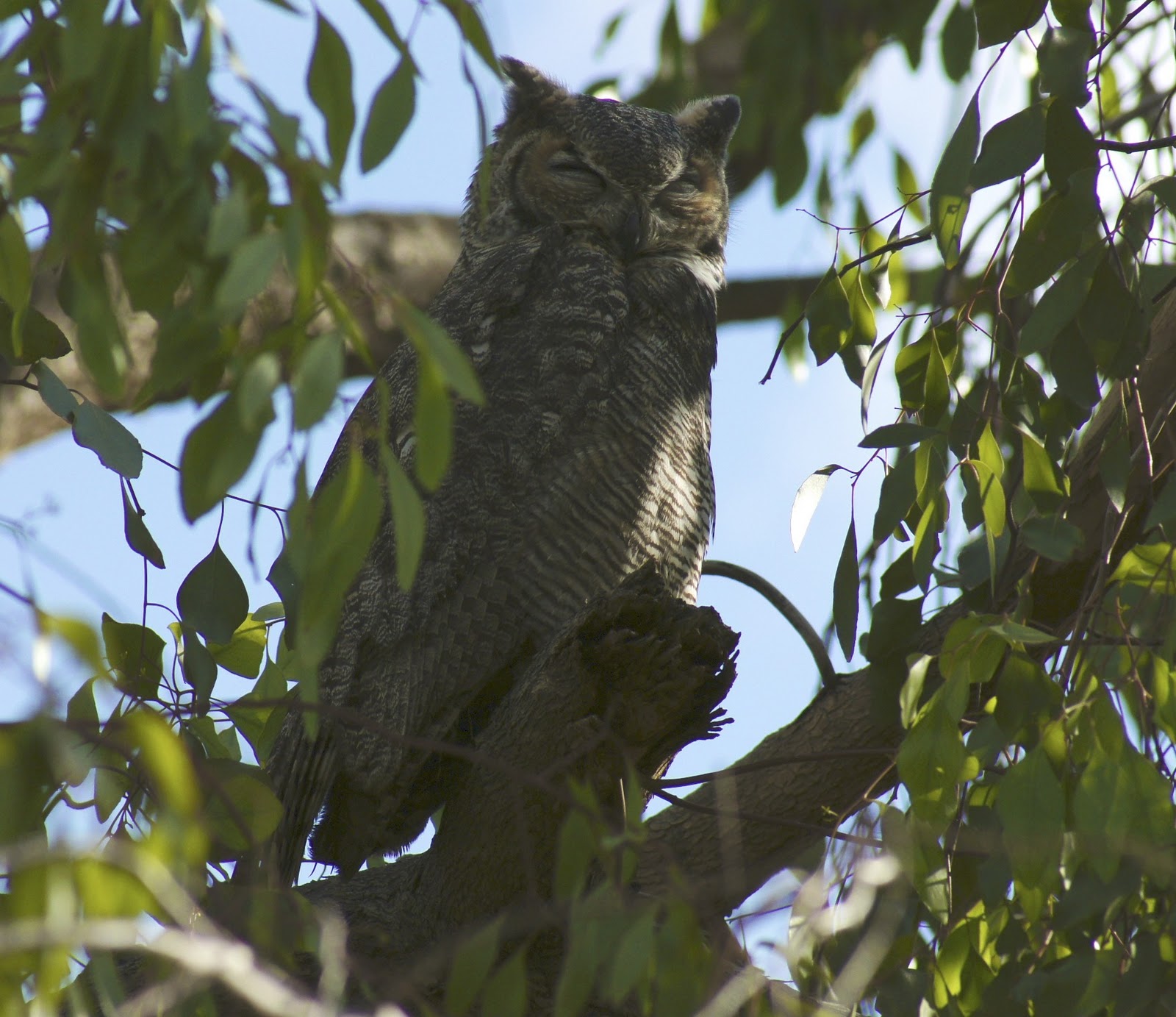
 Great Horned Owl: Lord of this Land. Mighty in Wisdom, Great in Sleepiness. 
 The House Sparrows even seemed to be especially pretty. I mean, they usually are kind of interesting because of their intricate coloring, but the right lighting and cool weather (finally!) just makes everything seem more photo-worthy. 
 I have still not been able to get the right shot of a Gambel's Quail. I don't know what it is. There are more Quail at the DBG than any other bird, but I just can't make it work.
 The debate rages on at the DBG as to whether this is the Pacific-Slope or the Cordilleran Flycather. I've thrown my lot in with the Cordillerans, but I don't know if it will ever be settled. There appears to be a stick poking into this handsome Cordilleran here. I wonder if he felt it?
 Verdins are great. They're colorful, energetic, and not overly shy, but they also don't give it all away up front. This lovely specimen was in the mood for lantana berries.

Not the most flattering angle, though I guess it was rude to watch her eat in the first place.
 Success! One of the last ripe berries.
 You know, looking at that beak and that berry, I'm not sure it'll all fit.
 This female Northern Flicker was digging for ants, which as I found out is a fairly common practice among Flickers. I guess it's easier than pecking wood. I really like her polka-dots.
 I really appreciate that this Cactus Wren posed among the purple for me. I'll vote for him to be my state bird any day!
 The Green-Tailed Towhees seem to be at the DBG in force now with Autumn setting in. 
 This Rufous-Crowned Sparrow was the sole new bird on this trip, and it figures that I couldn't get a decent picture. There's always next time Mr. Sparrow...I know where you live.
Even the Abert's Towhee, drabbest of birds, was looking good this evening. This specimen seemed to feel it as well. Standing tall and out in the open? Hardly the normal behavior for the humble Abert's.