Sometimes you just have to eek out the birding where you can. With everything else going on this past weekend, I did not have specific birding opportunities. My eBird checklists were embarrassingly "Incidental." The 10 month-old certainly has the right sleeping habits for birding--down by 6:30pm and up at 5:30am, but his needing a first nap by 8:30, plus still being rather demanding of attention, limits how far I can take him afield. Some kids are happy for hours in the stroller or hiking pack. He is not one of them; there's too much to taste out there.
Lately I have been taking BB Jr. to Granada Park, a decent sized urban park with a couple duck ponds, some transplant pine trees, and desert scrub. It's served as a stop-off spot before for winterfowl, notably during a 5-MR challenge a couple years back. Having recently become very opinionated about small city parks, I now choose it as our family park of choice because of its comparative birding potential and water fountains that don't smell like pee.
BB Jr. likes it too but he's pretty easy to please if he can get down and move around.

(He got un-stuck eventually)
There's an old mesquite tree near the playground/sandbox area, and last Saturday it was quite the little hot spot for migrants. The blooming mesquite attracted bees and many other insects, which in turn attracted Yellow, Black-throated Gray, Townsend's, Wilson's, and Hermit Warblers, plus the usual residents and the largest Warbling Vireo I have ever seen. Returning the next morning with my crusher, I was disappointed to observe almost no activity in the same spot--such is the caprice of migration I suppose.
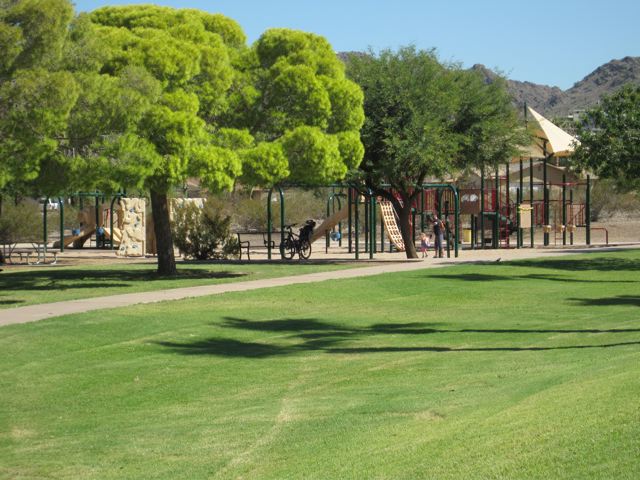
Photo courtesy of Playmapped.blogspot.com
However, B's Bs is made of sterner stuff and does not give in to despair, at least not for like 15 minutes or so of sustained adversity. Granada Park is also one of the best places to see Rosy-faced Lovebirds...as I have often relayed to out-of-town emailers getting in touch with amusing nervousness about when and where they'll be able to see these birds. They nest in the palms at Granada in large family groups, and they will also forage in lower bushes, sometimes even on the ground.

This was the first time I had seen them feeding in/on the fuzzy white creosote seed capsules. Tough birds eating a tough plant...there is great continuity here (though purists may point out that creosote is a hearty native and Lovebirds are a hearty invasive). Presumably the Lovebirds do the creosote a solid by way of pollination and seed distribution, and the creosote does the Lovebirds a solid by being eaten by them. This would seem a less one-sided relationship than that of gators and Egret chicks. Most of the carnage I see at Granada Park has to do with some dog-walker's poop-scooping glove malfunctioning (not pictured).


Sunday afternoon we celebrated a tri-generational Mother's Day, which was well and good, especially because perfectly cooked beef tenderloin was involved and the sides I contributed didn't suck.
Also cool was finding a Cactus Wren chick, recently out of the nest but not yet fully fledged. It was skulking and scurrying along the planters while parents supervised. They all blew a gasket when I approached the bird of course, but after I got to live out my 'bird-in-the-hand' field biologist fantasy all was quickly restored.

I will be finishing out my last week of work and its aftermath through this weekend, finishing out a 7-year tour of duty in AZ education. Although there is plenty yet to do for the move, there will be more than incidental birding in the couple weeks to follow. There must be, or I shall explode.


