Showing posts with label Spotted Sandpiper. Show all posts

Tuesday, April 28, 2026

April Appraisals

It has been lovely of late in East NC. We have enjoyed many of those clean clear spring days that bring everyone outside, the kind that reveal neighbors you didn't even know you had. Clean is maybe an exaggeration...there's more pollen, by mass, in the air than there is water vapor right now. But who can be grumpy at flowers?? Plants just want to party too. 

Given these precious and pulchritudinous spring days, I really have not been birding as much as I should. Work called us away for one whole weekend, but afterwards we got the crew bumbling down to Cliffs of the Neuse S.P. It's a funny thing; I want my kids to get into birding and nature time, but having them in tow really restricts the time of arrival and time of departure : /

Like most of the state, Wayne Co. is experiencing drought right now. The river levels are low even if the banks are lush. So let's add drought and drought-related crop issues and sky-high fertilizer and fuel costs to the list of bad-to-worse that 2026 is coughing up. 

Most nobody likes a drought, just like most nobody appreciates rising fuel and energy costs (except CEOs of Duke Energy, Exxon Mobile, etc). However, these Skinks seem to be holding up fairly well. The Anhingas deemed the river too low to bother with despite there being no shortage of river debris for them to manakin upon.

On the Spanish Moss trail, we were peppered with a strange and spastic sentry cry. It was nothing with feathers nor a stepped-upon frog...clearly a distressed rodent of perhaps a distressed rodent-sized dog. What would make a squirrel freeze in place and vibrate out a DefCon 1 alarm?? 

Surely they weren't upset about...me!? I walk amongst the woods and leaves with the silent feet of a ballerina cat, with the grace and poise of a swan that went to French finishing school, with care and compassion for all creatures like an ecumenical Disney prince, why so distes...OH I get it...


This time of year is prime time for Barred Owl. Everyone's favorite dark-eyed, river-of-the-woods-loving murder machine. The FB groups doth overfloweth with photos. Everyone loves their company. So why is it embarrassing to take a Barred Owl out to dinner???

...Because it always asks to see the chef (see what I did there!?)

We also clocked several more FOY birds for the county list, including Louisiana Waterthrush and Prothonotary Warbler, on the far side of the river. The Yellow-rumped Warbler numbers have thinned considerably, but those late bloomers lingering behind are starting to bloom nicely indeed. 


Also there were Chipping Sparrows. I miss the better winter sparrow variety. I just don't like Chipping Sparrows very much. I know I know...should love all birds etc.
I don't wish them ill, but if they were a channel on Sparrow TV, it would be like the QVC channel. I would change it every time. 
For more information concerning strong and unsolicited opinions about sparrows, please read HERE


By and large, having kids in tow on a hike is ok. Having kids in tow on a bird-centered hike often is not. Every once in awhile it can be a little magical.  


Cliffs of the Neuse is probably the best place in Wayne Co. to go for a scenic hike, and it has a respectable banister of birds throughout the seasons. However, if you are looking for lots of great visuals, especially on migrant passerines, it is less than stellar. There are very few places that afford one steady, near-level views of the canopies, unlike say the ridge-line hikes abounding in the Blue Ridge.
Residential breeders are pretty apparent, but I have never had much luck here tagging birds that are just passing through. Like anyone else on a lay-over, they're just eager to use the bathroom and cram some junk food between flights, and aren't looking to make friends along the way. 

The b*tch of it is if you're doing some kind of birding competition, even if nobody asked you too (yo!), picking up migrants is essential, and I am not able to contravene a $150 Million government plane w/  to do so (though at least I haven't been fired either).
On an annual basis, one can be fairly confident in picking up all the residential (breeding or wintering) species with enough attempts in the right habitat (though public access to said habitat is not something to be taken for granted in Wayne Co). Migrant traps are the difference maker, areas that offer suitable habitat but condensed and scaled down for rapid scanning by avian twitchers. 
If the passerine migrants are 50 feet in the air and largely silent amongst dense canopy, your odds of randomly looking up at the right time and spotting that Cape May Warbler are paltry.
Or maybe I am just bitter and under-developed because I cut my teeth birding the low scrub and wadis of Arizona. Sometimes things can be two things.

At any rate, the wastewater treatment plant trades in the vertical space for horizontal space, albeit with more open views and habitat variety. Not too many spots can boast Green Heron and Turkey as neighbors.


It is also about the only public land you can find waterfowl of a species type that doesn't rhyme with "scormorcant." There were multiple clutches of Wood Duck this past week, complete with protective mothers doing their injury-imitating flap swim like an aqueous Killdeer. It did not fool me...but neither did I eat all her ducklings, so as far as she is concerned, it worked.


By category, shorebirds are the best way to add some bulk to a species list, if not so much to the Crush List. The GWWTP was good for Least Sandpiper, Solitary Sandpiper, Spotted Sandpiper, and the two Yellowlegs cousins. Poking along the Neuse shoreline I was pleasantly surprised to find Solitary and Spotted sandpipers again. Mudflats and tidal areas are precious hard to come by here. If you came to this blog hoping to see distant, grainy, barely-diagnostic shots of expected waders and peeps, you have come to the right place!


I have a soft spot for Spotted Sandpipers, a spot on my heart, you might say. They're readily recognizable by size, habit, and plumage throughout the year, and they turn up in odd areas. They're the least snobby for habitat of their type, (except for Killdeer of course) and they like to get down. Females will lay multiple egg clutches and leave different males to do the incubating. This polyandry is the secret to their success, that and being cute.


This would have been a really nice shot of some random bamboo shoots if that pesky blurry FOY Blue Grosbeak and Eastern Bluebird weren't ruining it : ::sigh:: : C'est la vie.


Not usually, but sometimes Parulas act like Cuckoos. Why do they trill like insects when other Warblers warbled? I would be curious to read up theories on the auditory divergence and evolution of these types of birds. Did the early Parula ancestors just spend lots of time with Cicadas during their formative years? 


Hooded and Prothonotary (which autocorrect likes to change to 'Probationary,' by the way) Warblers are now fairly common in the right habitats. I have never turned up Swainson's or Worm-eating at the Cliffs, but have found Kentucky on occasion. Bet we can land those others as well. Maybe the problem is my eyes are dilated from spending too much time with yonder swamp candles.


A lay-up counts the same as a slam dunk; a 2 yard TD scramble the same as an 80-yard hail mary. In competitive birding, as in sports, a tick for a cool bird counts the same as a House Sparrow. The species count has definitely swelled in the last few weeks. There were calling FOY Yellow-billed Cuckoo and the warm-weather Vireos sp. with their various colored eyes. No flycatchers and thrushes yet but good ol' Eastern Phoebe is here. All Phoebes are good Phoebe's, but Eastern is the most boring by far.


Given other plans and obligations, it will probably be more than a month before returning the Cliffs of the Neuse. Growing that Wayne list will require targeted missions for specific species - nocturnals, liminal grasslands species, daring daylight raids of the local emu farm, etc. It's just tough because knowing Proths are around, and then not coming home after crushing some Proths...it feels like a wasted day.


On the podium! Place your Kalshi and Polymarket bets now.


Wednesday, January 4, 2017

Quality over Quantity

As you have probably noticed, or perhaps noticed like 6 months ago and stopped caring about 4 months ago, there hasn't been much quality or quantity on this site in a while. Understandably, you have probably moved on elsewhere due to my inattentiveness and lack of affection. You've started seeing other websites that have more going on, more excitement and rich content like you promised yourself you would have as a young, deserving, impassioned bird-blog reader with so much life and love yet to give. It's only natural and I am not jealous; I just hope we can still be friends as I promise to do a little bit better.
Instead of going into why and how life has been so busy, I'll just skip that--because I would not presume to think that is actually interesting to anybody else except my ever-loving Grandma--and get to the birding.

2016 was a crazy good year, CRAZY GOOD, for Arizona birding. Tropical storms blew Storm-petrels as far inland as Maricopa County, and there were numerous other rarities including Pine and Tufted Flycatcher (nesting 2nd summer in a row) and Lesser Sand-Plover. Of these I only snagged PIFL. Sometimes our own lives and movements do not coincide with the birds.
**Trying for the Maricopa petrel by skipping out from work early, I had a tire blow out on the way, obviously providential.

I did get out a bit towards year's end, first with the O.G. Butler Birder at the Santa Cruz flats between Phoenix and Tucson, and then joining forces again at the Glendale Recharge Ponds to start the New Year.

Pops has been Butler Birding since when TVs were operated with dials and there was only eleven species of Scrub Jay in the Americas.

The Flats have a couple migrant/vagrant traps that have notably produced Black-throated Blue Warbler and Rufous-backed Robin in recent years, both very good-looking and anatomically named birds in their own right. The vagrants are often just particularly sweet icing on the cake, a three-layered bird cake that is the mainstay attraction throughout winter months.


The soy and alfalfa fields around Baumgartner and Greene Reservoir roads are, without doubt, the best areas to view Caracara in Arizona. We logged 18 individuals in one large family group or flock on this day, and I've had high counts near 30 before. Interestingly, I see reports of these or other birds straying into nearby Maricopa or Cochise and Santa Cruz County much less often than I see reports of many Code 3 vagrants.
Whether they're falcons or vultures or something in between, CRCAs are loyal to their turf.


The other two layers of Flats birding cake are certainly less conspicuous by intent and design. Sprague's Pipits were thought to be occasional strays this far north, but they're now found with enough regularity and in large enough numbers in the area to be considered an expected wintering species here. SPPIs are also known colloquially as "5-inch Bitterns of the Barrens." Elegant skulkers.


Lastly, the mighty Mountain Plover, a bird perhaps with more affinity for dry crackly grass and furrows than even SPPI. Counts for this species in the area vary from a few individuals to 40+ in a given day. Much of this can be attributed to their camouflage and typically skittish behavior, as well as the relative inaccessibility of their location. Mostly I attribute it to the fact that they, unlike other birds, walk single file to hide their numbers.


Winter holidays were enjoyed in Carolina this year, where I spent time reestablishing my eternal legend as Wayne County, NC's ultimate top eBirder, but that is another post. Coinciding with my absence, a Long-tailed Duck was reported at the Glendale Recharge Ponds. This spot yields great water-birding (not illegal or unethical) and great rarities throughout the year. Typically the site itself is pretty ugly though, unless you catch it at sunrise.


The Long-tailed Duck was reported and confirmed on a remarkable day when, if memory serves, 2 or 3 others were also found across AZ. Mercifully and unusually, the bird stuck around for two weeks, and Pops and I set out early to nab it before heading in to our respective places of work. It was cool, peaceful, and pulchritudinous, except for the Least Sandpipers who were pretty certain we were going to eat them. It's unbecoming when other peeps have the startability of Killdeer.


We didn't have a large window in which to see the LTDU, nor particularly favorable conditions, but it was still pretty cool even without extra long butt feathers.


We happened to spot the bird just before direct sun-up, as it was transitioning from its tucked-away roosting spot and heading to deeper diving areas. The LTDU was chill on its own, but panicky Shovelers brought it to flight as well. Damn.


By time we had relocated the duck and cycled around Basin 3 the clouds had burned off a bit, but back-lighting is a merciless adversary. Once it gets going with its diving routine, LTDU does not let up! I was disappointed not to get better shots of the bird, but the behavior was pretty great to observe. We watched for another 30 minutes or so and in that time it would stay under for 20-30 second spells and never stay above water for more than 12 second at a time. Very go-getter. 


The Cornell Ornithology website is very enthusiastic about Spotted Sandpipers, and this is unsurprising given the lobbying powers this particular peeps species has. SPSAs are known to have at least 4 congressman in their collective pockets. Credit where it's due, they are one of few shorebirds with a breeding population n Arizona, though you have to hit up the alpine lakes to find them. Winter birds are closer by, but keeping with the theme of quality over quantity, they don't have the same dapper action.


Welcome back to you and to me and to the NSA and whoever else is here again! I am hopeful and optimistic that 2017 will have more birding and posting than 2016, despite the fact that Butler's Birds will be adding on another generation of its own this summer.
First bird of 2017? Dead Red-naped Sapsucker. An omen? Absolutely. Good or bad? Rain check.

Monday, May 14, 2012

Birding the Arizona Beach

It seems like spring only lasted for a couple weeks, and now we're already into summer. Perhaps that explains the recent beach posts on lots of birding websites. As the sun climbs higher and stays longer in the sky, we start to pine for the breezy shores and salty air. Chris Rohrer over at Las Aventuras, Gordon Karre over at Birding Adventures, and Seagull Steve at BB&B have all had some excellent recent posts revolving around beach birding, and they've got me yearning for the shore. Alas, central Phoenix is a far cry from the Pacific Ocean, but to try and keep myself sane these last few weeks, I shall endeavor to deceive!

These accounts and photos are from the Glendale Recharge Ponds, a bleak, ugly place in northwest Phoenix that offers surprisingly good birding around the holding lakes. This is my place for shoreline birding. So take a whiff of saltwater, hold some seashells to your ears, close your eyes, and pretend you're now at the beach (don't really close your eyes; then you wouldn't be able to read the post).....


So, here we are at the beach. It must be low tide, for there are no waves and the water is rather shallow. Thinking little of the low water level in the ocean or the faint smell of distant sewage, we unfold our rickety beach chairs, stick an umbrella in the ground, and soak in the scenery.


Upon closer inspection, we see that the shoreline is dotted with Semi-palmated Plovers, an uncommon bird in Arizona but a predictable sighting for us here on the Pacific coast...


While the Plovers scurry around the tide pools, we notice some shadows from above. Looking up, we see some Cliff Swallows catching bugs with exceeding delight.


They dip and turn and bank with impressive agility. Clearly, this a bird designed to fly and fly, to spend its life in the sky.


A larger, lumpier shadow moves across the beach. Again looking up, we see an American Avocet coming in to land. Beautiful and graceful though these birds are, they do not look so comfortable in the air. The upturned beak makes perfect sense for skimming through the shallow mud and muck, but now makes the Avocet look like it crashed into a window.


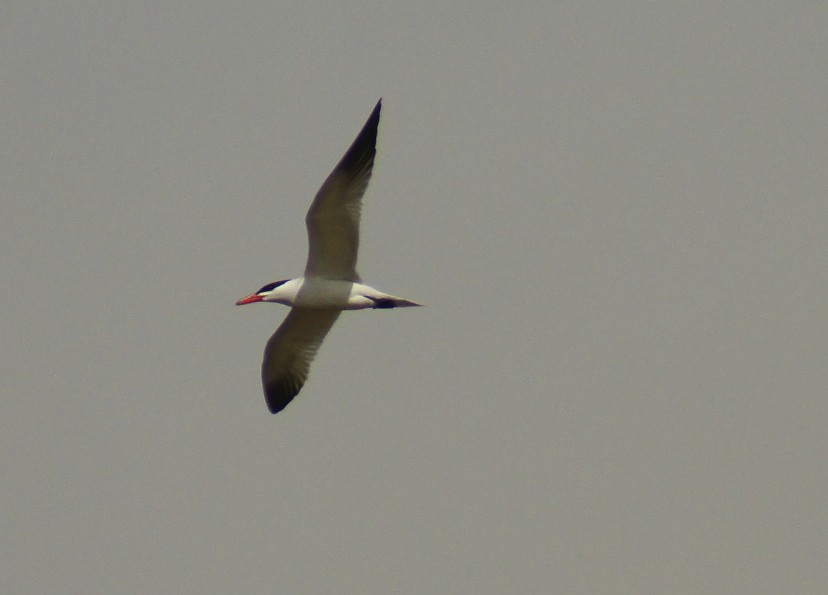
There's a lot of traffic in the sky today. Several Caspian Terns fly overhead, reveling in the knowledge that they're one of the largest and sleekest aviators in these skies.


This too, would be an unusual and exciting sighting in Arizona, but since we're on the Pacific Coast we won't get too energized...


We've been studying the sky for a while now and our necks begin to hurt. After reaching for a cool beverage and leaning back in our creaky chairs, we again scan the shoreline for adventurous peeps, such as this Spotted Sandpiper popping in and out along the rocky wharf.


The Spotted Sandpiper seems determined to keep its feet dry, but eventually the allure of tasty treasures draws him into the water. Come to think of it, that sounds pretty good!


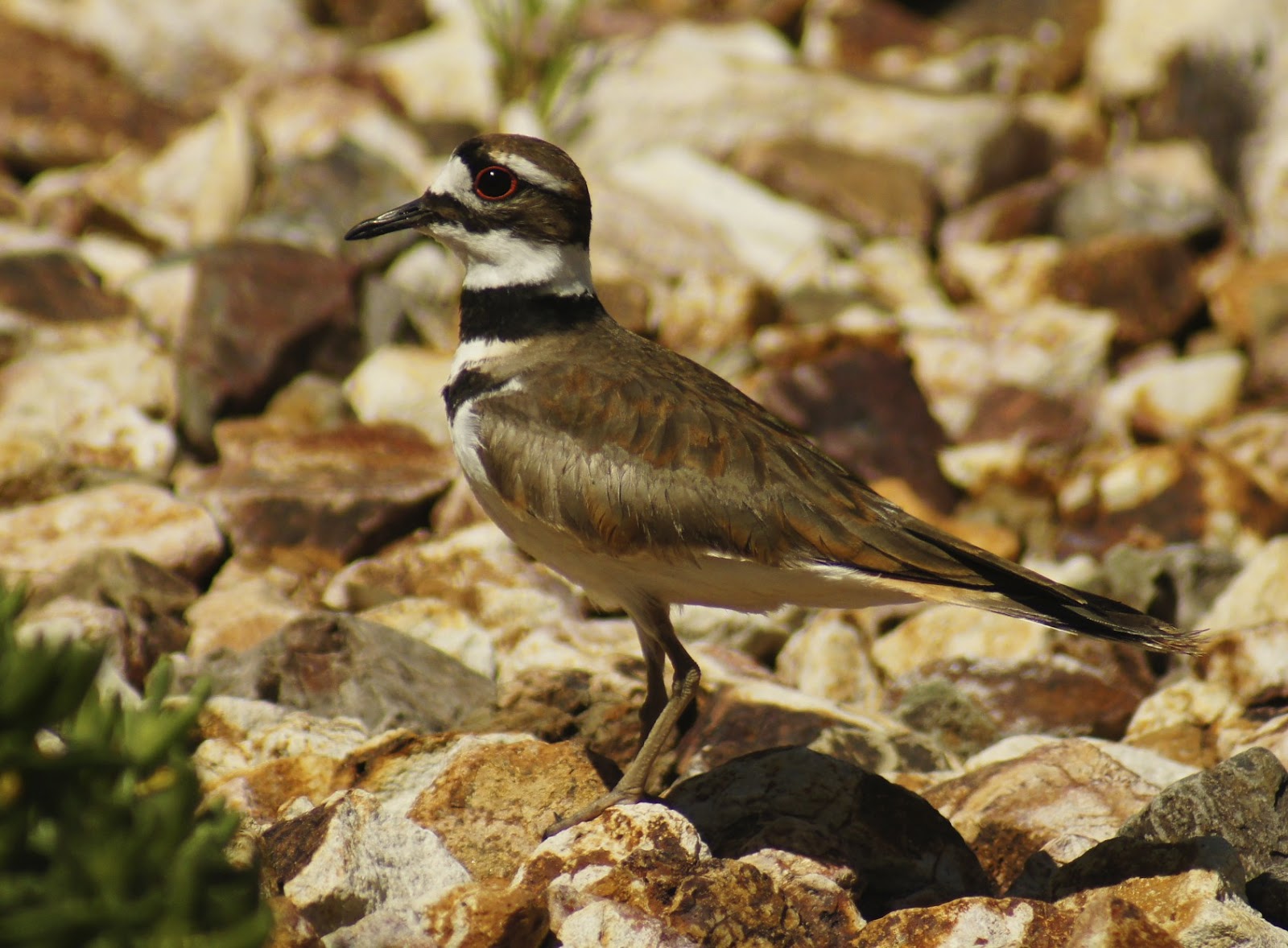
As we make the short walk down the beach, a startling cry echos from the right. Of course! It is a Killdeer, the common and noisy Plover near and dear to our hearts. He's standing along a rocky outcropping, blending in very nicely. Since this is the Pacific beach and not an Arizona sewage pond, we marvel at this unusual and refreshing sighting!


Ahh...a quick dip, some picnic lunching, some more cold beverages and it's time to pass out. What a lovely trip to the beach this was!