Showing posts with label Pyrrhuloxia. Show all posts

Thursday, April 17, 2014

A Rookie Mistake: Dial Plan B (For Birding)

Last weekend it was all planned out...kind sorta somewhat perhaps. It wasn't going to be a full-on epic bird day, but it was supposed to be pretty good. I was going to scour the Sierra Vista hillsides, chasing down leads on Montezuma Quail, and then spend a few hours in Ramsey and Huachuca Canyon. It was going to be crisp, efficient, and potentially a 3-Quail day. But I have a serious short coming as a birder (several, I am sure). Being from Phoenix, I grew up with a nasty, nasty habit. No no it's not smoking, which is of course scientifically proven to strengthen respiration as the tar helps oxygen stick to one's lungs. No it is because in Phoenix we have about 358 days of sunshine each year, so when we're making weekend plans, weekday plans...any kind of plans, there's never need to check the weather. 
Of course with birding, weather is key, and I totally dropped the ball on checking the Sierra Vista weather before heading out from under Phoenix's clear skies at 3:30am. 
It was heavily overcast, rainy in some places, and exceedingly windy. The first couple of hours in the area were almost devoid of bird activity, except for a few sympathetic Lark Sparrows, and so I sulked (snoozed) in the car instead of seeing glorious Quail, who were all wisely keeping their heads down.


By 10am or so the weather still hadn't cleared. I spent some time in Ramsey Canyon, trying to get away from the wind, where I was very pleased to find all three species of Goldfinch in the sycamores around the AZ Folklore compound. Apart from the finches and some FOY Scott's Orioles it was pretty dead.
By 11am the sun had risen high enough that it occasionally broke through the heavy cloud cover, though the terminally heavy wind kept most of the birds down low.

Rufous-crowned Sparrows were good sports about it all, still vocalizing when they had the chance and giving some life to the Sierra Vista grasslands. I would prefer Five-striped, naturally, but to each their proper time and place.


A pair of Pyrrhuloxias in Ramsey canyon also made for a nice sighting. This is a bird I don't see or photograph nearly enough, given their relative rarity in Maricopa County, and this is especially distressing as they're way more rad than Northern Cardinals.


Although there were a few nice sightings, for all the driving and time killed it was a pretty disastrous start to the morning. I decided to head farther north back toward the Tucson area to pursue some birds where the elements were more cooperative. I learned a lesson, learned it well and good. The question was if Plan B could redeem something of my Saturday. 

The next site was Christopher Columbus Park, a pre-fabricated suburban watering hole with uncomfortably blue-colored water that, nonetheless, has highly visible Wood Ducks.
It doesn't even have great habitat for them, but whatever the reason a Wood Duck drake has been here all winter, and this was a species I had not been able to photograph up close, having formerly flushed them at Tres Rios or seen them at a distance in Prescott. It's not a rare Quail, but it's a gorgeous thing.


Wood Ducks weren't the only offerings at the park. Though not as cool as the Thick-billed Kingbirds for which I'll be traveling through Patagonia in a month, or even the taller, darker, handsomer Cassin's, I also had some really nice sightings of Western Kingbird around the park's grassland. They're common and conspicuous, and also pretty cool. But usually they're up on the telephone wires and what not, and although their bellies are a lovely yellow, it doesn't make for great repeated viewing. Seeing them at eye level was tops.


By 1pm or so, the sun was out over Tucson, which is a bit over an hour northwest of Sierra Vista, enough so that birds were taking shelter from its midday wrath. It was too late to head southeast again, where the weather was likely still inclement anyway, but the few birds at Christopher Columbus offered some great sightings as a consolation.


In addition to the earlier mentioned Wood Duck sightings/dynamics, I've also seen them, distantly in Pennsylvania, but this unwholesome pond in Tucson, by far, offered the best looks I've had in the last few years, and hey even a nifty Wood Duck vs. Mallard size comparison (the Mallard looks like a giant). 


Chasing the waterfowl at city parks almost feels like cheating. That's not to detract from the tick or the photos or any of that. In a sense, these ducks are still more wild/less baited than the feeder-fed Hummingbirds in Madera or Miller Canyon, or at the Paton House, but it just feels very removed from nature, from the proper context of when and where one should be seeing these cool species.
That being said, the when and where for Wood Ducks in Arizona isn't exactly easy access, so I can't complain. I can only berate myself, and check the weather.

Sunday, November 10, 2013

The Greeny on St. Gerdie

With the 2013 Birding Year now drawing to a close, Saturday brought another tense, high-octaine no-holds-barred rarity chase. It was a day of destiny and disappointment, of fortune and failure. In other words, it was a solid day of birding. 
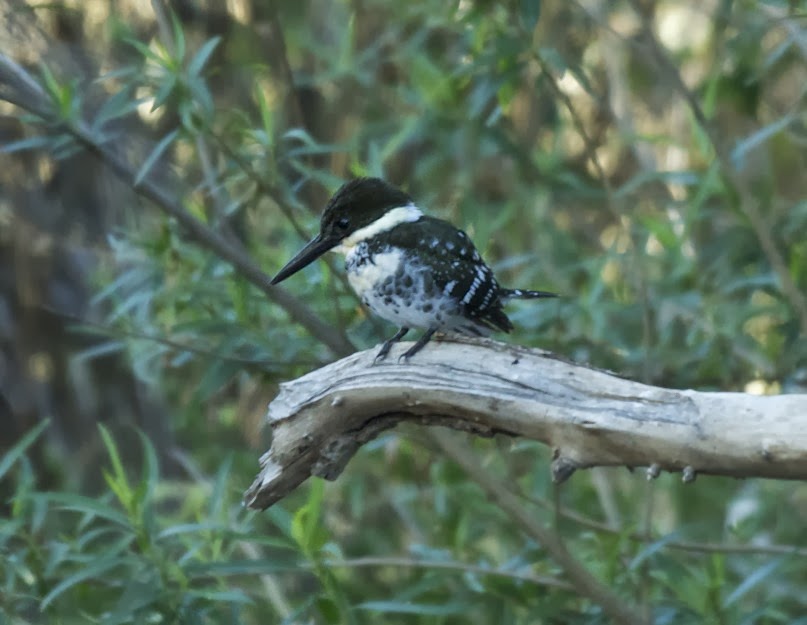
At 6:30am Tommy DeBardeleben and I returned to the Tubac/Santa Gertrudis Lane on the De Anza Trail, off the I-19 and about 30 miles north of Nogales, to look for a persisting Green Kingfisher. This would be a much-desired lifer for me, though it had not been seen at all during the previous couple of days, and we also needed to find it quickly so we could take plenty of time in Madera Canyon searching for an Eared Quetzal. 

Parking off of the I-19 Frontage Road, we walked down Santa Gertrudis Lane, checking in the massive pyracantha hedges and mesquites for wintering Sparrows and potential vagrants. Such goodies as Aztec  and Varied Thrush have turned up here before, though our best birds to start were a secretive Pyrrhuloxia and a few Rufous-winged Sparrows.


It's a short walk down the lane before the Santa Cruz "river" (it's a beautiful wash, but calling it a river is a bit grandiose), and here is where the birding gets really good. No sooner had we reached the bank than Tommy exclaimed that he heard a metallic clicking, a Green Kingfishery type of metallic clicking.
Almost immediately a small bird came darting by the stream, perhaps flushed by our initial intrusion.
The sun was not yet high enough to illuminate the wash, and the low-perching, seven-inch Kingfisher was tricky to pick out, but once we had a bead on the emerald beauty we were transfixed for the next hour.


We kept a respectful distance as she flew back and forth along the Santa Cruz creek, perching on various outcroppings and remnants of a barbed wire fence. The quietude and coolness of the early morning and the lush riparian setting brought a sense of great solace and solemnity. This rare and beautiful bird was perfectly in her element, and, somewhat unusually (at least for me) I didn't feel like I was intruding on that element at all, but was able to fully, neutrally observe it.


There were dozens of Lincoln's, Song, and Lark Sparrows also foraging along the banks, and a family of Black Phoebes constantly endeavored to out-perform the Kingfisher with their own displays.


Eventually Ms. Kingfisher chose a perch nearer the two of us, though she was always careful to keep the sun behind here and stay on the far side of the water. We never had the satisfaction of catching the morning sunlight directly on her, nor could we get sufficient light for sharp photos (much less in flight), but watching the plump bird daintily belly flop into the chilly water and pull out minnows was the sweetest of treats.


It was certainly a good omen--we found our first target in about five minutes and had spectacular views. We were able to point a few other birders in the right direction as we returned to the car, now with more time and morale for a treacherous trek in upper Madera Canyon.

Monday, January 28, 2013

Floored with birds at Florida Canyon

It's not really a secret anymore, but nestled just a little bit away from the world-renowned Madera Canyon in the Santa Rita Mountains is one of the must-see winter destinations in the Arizona birder's travel log. Florida Canyon doesn't pull in quite as many spring and summer attractions as Madera Canyon or those old guard canyons in the Huachuca Mountains, but for the last two winters now it's hosted Rufous-capped Warbler, an exceedingly rare and beautiful vagrant from Mexico that does as much to give the canyon its namesake (meaning, 'flowered' in Spanish) as any of the flora. And there are lots of other great birds hanging out too.


I was fortunate to see Florida Canyon's main event last February while on tour with Birding Is Fun's Robert Mortensen and Jeremy Medina, but I was forever nagged by my unsatisfactory photos, and Pops still had to log this jaw-dropping bird to his ABA list. What more of an excuse is needed?
Truth be told though, I was feeling anything but confident when we arrived at the base of Florida Canyon. It was bitterly cold outside (in the 20s) and in from 7:30am to 9:30am we saw maybe seven actual birds and only four or five different species. With the canyon slopes keeping out the early morning sun, it was simply too cold and dark. The birds were much wiser than we were.

We ambled up and down the lower canyon, staying within a half mile or so of the old dam that used as a checkpoint for the Warbler location. The sun would occasionally burst through the clouds and we'd get small doses of activity, but with snow all over the ground and the weather so uninviting, I had a hard time imagining what would keep tropical Mexican warblers in this far north of their normal range.  
For a while we had to content ourselves with some of the braver local birds, and sightings of the chromatically opposed Pyrrhuloxias and Mexican Jays, along with the sweet serenades of Canyon Wrens, kept our morale high enough. 


By 10am the sun finally got its act together and the birds started to make up for lost time. The canyon started to echo with more and more chatter. Rogue groups of Lesser Goldfinches and Kinglets began their daring daylights raids and then, all at once we felt as though we were being swept off our feet! A massive mixed flock made it's way down the canyon, gathering birds and noise like a tropical storm. Dozens of Black-chinned Sparrows joined with Bridled Titmice and the Finches to form a feathery gallimaufry that conglomerated with Lincoln's and Song Sparrows along the creek to obliterate every exposed seed and insect in their path. 

I was particularly jazzed to get so many nice views of the Black-chinned Sparrows, an uncommon emberizid I'd seen only once, and fleetingly, before. Of course, being camouflaged Sparrows with an affinity for low-lying scrub brush and an constant motion, they weren't the best photo subjects, but I wasn't complaining. These birds alone made me feel the trip was worth it, and there weren't even any Warblers (including Yellow-rumped!) in sight.  


We followed the big mixed flocks down the Canyon, with great delight. After the first two hours of frigid birding we had scarcely logged a dozen species, but in the span of fifteen minutes it shot up near forty, as the Bridled Titmice and Bushtits met with the other foragers and caused a sensory overload. In all the madness we even managed to see (and hear) fives Wren species. The Canyon, Rock, Cactus, Bewick's, and House Wrens all made appearances--my first and only five-Wren day, and this was, again, all within a very short span of time. Thinking back on it now, the Wrennaissance was perhaps the most remarkable experience of the trip... obviously I didn't get any photos to prove it.


After half and hour or so of mixing with the mixed flock, Pops and I felt like we were finally starting to get a lid on everything. Ladder-backed and Acorn Woodpeckers were starting to pop in at points along the canyon, and jealous Jays were always squawking in the background. Some larger, pointy-headed Finches caught our attention as they made their way down the grassy canyon slope (west side), with their noises and coloration seeming very good for Cassin's. While trying to snatch a photo of these fleeting Finches, a different flash of color cut across the west-side path and stopped me dead in my tracks. I had almost forgotten we were after this bird!


From the grassy cover on the west side of the trail, a single Rufous-capped Warbler darted to the base of a scrub oak. After much shivering and scheming, it had finally worked out! Though the bird only stayed close for a minute, Pops and I both got beautiful up-close looks of this well-traveled bird--for all I know the exact same one I saw last year. We watched it forage down on the ground, mostly obscured from any clear shots. I was happy enough just seeing it again and knowing that Pops could add this incredible critter to his list. But the Rufous-capped Warbler did me one better. With no apparent aim other than to check us out and let us know that he was made of sterner stuff, he ascended the tree and perched right at eye level, first showing his fuzzy fanny...

 Behold! One of the rarer butts in North America

 ...and then about-facing for just a moment of eye contact, before bolting farther up the canyon.


We were on cloud-nine (one of the few clouds I like while out birding) as we descended the Canyon, picking up Spotted and Canyon Towhees on the way, along with Arizona Woodpeckers and a Roadrunner. It's been three weeks and I still feel buzzed thinking about this sighting. The remarkable turn-around from six species to forty in about thirty minutes, is thus far one of my best birding experiences. I've dipped on Mt. Lemmon and the Estrella Mountains this winter, but Florida Canyon has too much good stuff to dip, and this worked out to be one of those days when we just about hit it all (ok, to be fair, we didn't see any Montezuma Quail, but most scientists now believe those birds died out with the Aztecs two hundred years ago).