Showing posts with label Downy Woodpecker. Show all posts

Thursday, August 22, 2013

To the Highlands: Sunrise Campground and Greens Peak

We secured the Dipper pretty early into our day, and so with everything going according to plan on Mt. Baldy, we then moved locations--stopping to bird whenever possible--so that we could chase Gray Jays, Clark's Nutcrackers, and Dusky Grouse. These species can also be seen higher up Mt. Baldy, but with so many good birding spots close together and the different sites having high probabilities, we added some variation. 

The next stop was Sunrise Lake Campground and Gray Jays were the primary target. Gray Jays are very hardy birds, having annual populations and even raising broods in the middle of winter in the far northern reaches of Canada. They also live comfortably near people, being opportunists, and as such a high elevation campground is just about the perfect habitat for them. That being said, this area around the White Mountains is about the only place in Arizona where Gray Jays will turn up, so we were still counting on our luck.

There were squirrels and chipmunks maintaining a constant buzz around Sunrise, but the birding was also good, though bird calls were more difficult to differentiate for me. Tommy spotted a Downy Woodpecker--always a solid find in Arizona, even in the higher elevations--, and it was soon joined by a buddy. Although this wasn't a state or even a year bird, it was still one of the rarer finds for the day.


The Downies foraged quite contentedly, not really minding our proximity but not being particularly photogenic either. One of the birds discovered some sort of fungus or something up in this aspen tree, which kept it occupied for a goodly while.


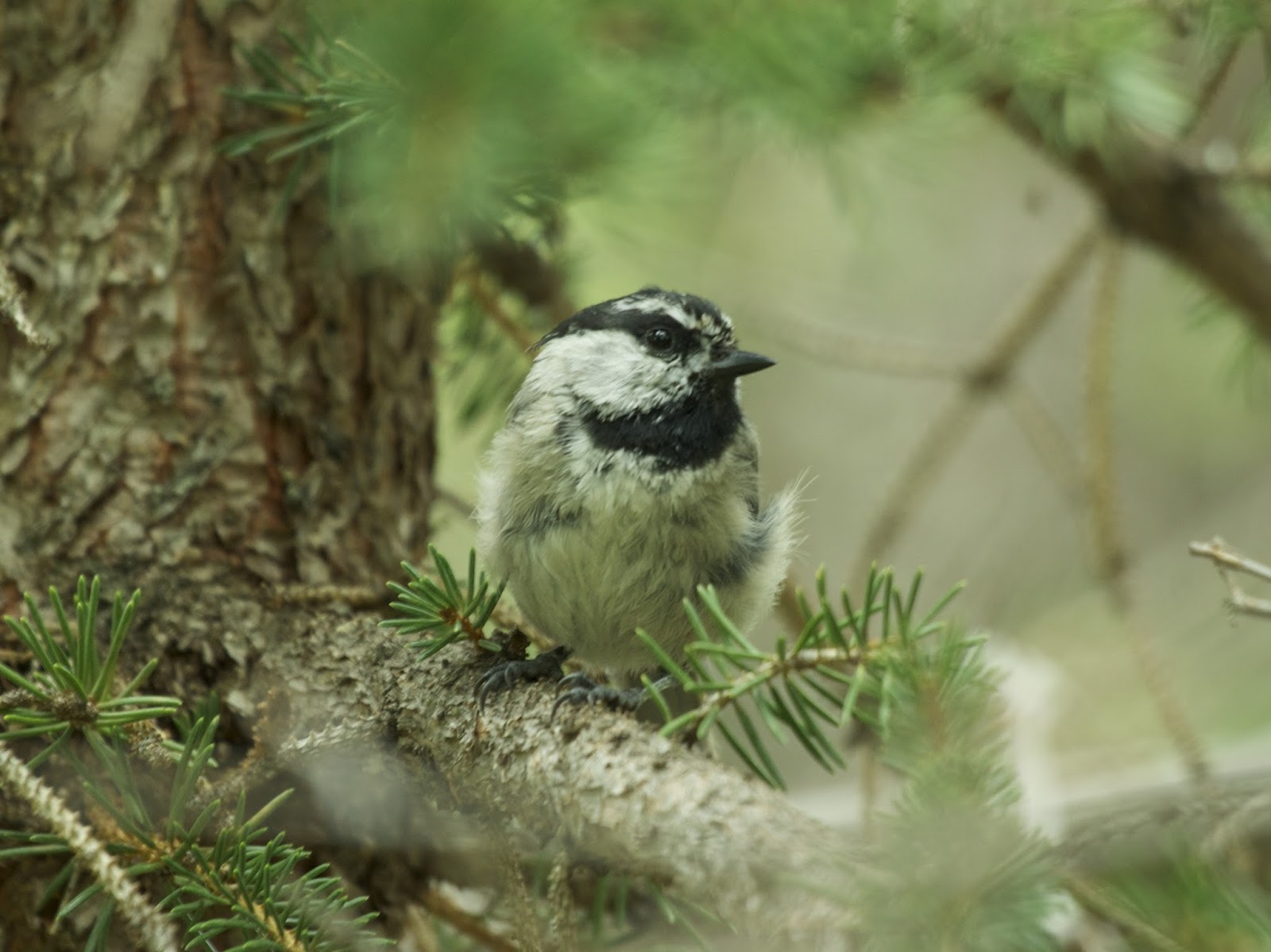
The Downy Woodpecker sighting transitioned into further luck as we followed the foraging birds away from the main road.  We waited and watched the woodpeckers, and while we were so occupied a mixed flock formed up around us. Soon Golden-crowned Kinglets, Mountain Chickadees, and Nuthatches were all contributing to the scene.


Mountain Chickadees, like just about every other Chickadee (except for Mexican) are pretty common in their locale, but I hadn't had a nice photo stomp with them before. I was very pleased to remedy my paucity of Chickadee photos, because I don't know when next I'll be able to get up into the mountains, nor when next a Chickadee will hold still.


The itinerant echoes of squirrel chatter were very frustrating at times. A squirrel or chipmunk trill doesn't really sound like a Jay or Nutcracker, but when there are enough other distortions and distractions, it's just enough to give one continual false hope about what's ahead, or what's behind. Too often it's just one of these smug little rodents sitting on its little throne.


The Gray Jays were not a guaranteed or even common sighting by any means, but I still felt a bit unlucky to miss them entirely, much less come away without any photos. Still, some of the views around the Sunrise grounds were worth the trip, as were the other birds.


We didn't leave empty-handed either, though we weren't holding a lot. This lone, calling Clark's Nutcracker provided a state bird for the site. Of course he picked the tallest, most backlit tree he could find. Maybe he could sense I was unlucky, and didn't want to get too close.


From the campground we travelled up to Greens Peak, which provided outstanding views of the surrounding countryside and also the impending thunderstorm that was coming to cut our birding short.


The main attraction on Greens Peak was the possibility of seeing Dusky Grouse, a secretive but confiding bird if one is lucky. To this day, I have not seen a single member of the Grouse/Ptarmigan family, which is almost too embarrassing to admit in public.
We hiked up and down Greens peak, getting some serious exercise and enjoying the scenery. We had butterflies and frogs, as well as my best American three-toed Woodpecker sighting of the trip.


We also had Kinglets and the occasional Robin, but all in all the encroaching weather and later afternoon timeframe seemed to be keeping the bird activity muted. To take a rest from our hiking, Tommy played a Red-breasted Nuthatch call, knowing they respond well and we'd then at least get some photos for our trouble.
It took a couple of minutes for any response, but soon we were swarmed, with near a dozen of the ruddy little buggers chittering all around us. Plenty of the birds showed signs of immaturity, both in their sense of humor and behavior as well as their patchy breasts. It's not a Dusky Grouse, but it's got feathers.


The Grouse stayed hidden during our tour on Greens Peak, and to be honest I was pretty bummed to miss them and the Gray Jays. In the moment, the misses felt heavier than the hits (Dipper, Williamson's Sapsucker, Three-toed Woodpecker), but in retrospect it certainly was time well spent, and the trip was outstandingly productive overall.

We're not as spoiled in the west as they are in the east with their Thrushes, but hearing a Hermit Thrush singing in the woods is still a very soothing sound, one that was very needed and welcome as the rain started to fall, and the Grouse dream began to dissipate. 


With the time for my departure back to Phoenix approaching, we decided to head back into Greer for some concentrated photo sessions. It was hard to leave the mountain, but it was also a felicitous decision with a full downpour in effect and the need to photograph high-altitude Hummingbirds still nagging at me. 

Saturday, January 19, 2013

But which Winter Bird is Best???

There are people in this world, people who spend lots of time preparing and fussing over their outfits and their hair. They walk, talk, and flaunt a certain way. Why do people do this? So that the rest of us can give them our attention, judge them, compare them, talk about them, etc. It's a time-hallowed tradition now done most notably and prodigiously at shopping malls and outside of movie theaters. Although their appearance is less in their control, birds have a propensity for these displays too, especially when potential mates are around. They want to be the loudest, the most magnificent, or the most established.  


As our feeders and fields, along with the blogosphere, are flooded with those essential regional winter birds, it is only appropriate then, even necessary, to host a discussion exploring which of the iconic winter wanderers is the BEST winter bird. Not all of the birds hosted here have a full range across the nation, but they're all recognizable and form a good basis. While spending a week of my winter break in Pennsylvania, a state with great birding diversity, I was able to see these winter staples and weigh their characteristics with the cynical judgment that can only be honed over years of people-watching at awkward social scenes. 
To be fair, there's a heavy eastern bias here, but also to be fair, the east coast hosts the traditional winter tropes more than we do in the west. So, White-crowned Sparrows, you won't make the list...

It seems fair to first address not only one of the most conspicuous winter birds, but one of the most well-known and loved throughout the country throughout the year. Also known as the Red Bandit and the Prayerful Passerine, ladies and gentlemen...The Northern Cardinal.


No winter is complete without at least one Christmas card showing one of these birds perched on a  snowy branch, and no feeder is properly christened until the Cardinal has visited. Their stunning, rich red captivates the eyes and burns itself into the memory. With good reason, the Northern Cardinal has a reputation as one of the most beautiful birds in North America. However, they also suffer from over-exposure, as they have their brand bandied about on logos and decorations and greeting cards such that we're so saturated in Cardinals, they lose their luster sometimes. Even so, what a great bird.

Opposite the Cardinal in its red is the Eastern Bluebird in its vibrant blue. True enough, this bird is not as widespread as the Cardinal, and their counterpart Western Bluebirds do not have the same winter feel to them. But Eastern Bluebirds pose so nicely and often for their pictures in hallmark winter settings. Their rusty sides and rusty chin, along with the white belly, also makes for a more complex color palette, and there aren't many birds much cuter... 


Though the Black-capped Chickadee is probably one such cutey. These gregarious, garrulous go-getters are maybe the only birds that can compete with the Cardinal's popularity and recognition even outside of the birder circles. Although they have handsome plumage, they must make up for the shortfall in color with their rambunctious behavior, which they do quite well. 
In a lot of ways thought, the Chickadee suffers from the same over-saturation as the Cardinal. Namely, they're great birds, but choosing them as the BEST winter bird seems cheap, when their are other cool birds whose lower profile makes them more interesting.


Golden-crowned Kinglets benefit from being Kinglets, which is a great thing to be. Additionally and unlike their Ruby-crowned counterparts, they've always got some sort of crown on display, even if it's not the full monty. Overall, I guess there's not enough to really consider them for BEST winter bird, but I do enjoy seeing them and it wouldn't quite be the winter birding experience without them bouncing around, as if no one told them its cold outside. 


Though only found in the eastern half of the U.S., and also found year round, The Carolina Wren still feels like a quintessential winter bird to me. Maybe it's because there are fewer other birds around and their high-power songs stand out all the clearer. Like the Golden-crowned Kinglet, it couldn't be BEST winter bird, but it resonates with me as another essential to any good day of winter birding.


Like the Carolina Wren, the Downy Woodpecker really comes to the fore in winter due in part to the absence of other birds in the area. They're dexterous, tough little buggers and are some of the few birds one will see on the suet feeders through January and February. Plus, this bird has nice winter coloration. But BEST winter bird? Probably not.


Until someone convinces me otherwise, I'm throwing my vote for BEST winter bird to the White-throated Sparrow. Not content to just be White-crowned, they also sport the white, Santa Claus winter beards and some of the yellowest lores you'll see in North America. 


They descend on a fair portion of North America and in great numbers, but only for half of the year (give or take). As such, they're not over exposed, but they're not so overbearing as to be cheapened (at least, not for a visiting westerner like me). Plus, they're just Fabulous!


What do you think? Have I misrepresented all of these wintery birds? Am I missing some (absolutely!)? Who would you nominate for BEST winter bird?