Wednesday, May 14, 2014

Birding to the Brink: Huachuca Lowlands and Sierra Vista

It's the middle of May, and needless to say this past weekend was one of Heavy Birding. I logged about 12 hours of sleep over the course of the weekend, including Sunday night, picked up 3 lifers, took two birds off the 'heard-only' portion of my list, and logged about 700 miles. It started early Saturday with the 370mile round trip chase for the Sharp-tailed Sandpiper in Cameron, AZ, and continued through the Huachuca Mountains on Sunday and the Santa Ritas on Monday. Perhaps the most remarkable sighting was one I missed--the first breeding record of breeding N. Saw-Whet Owls in Maricopa County, which is as simultaneously awesome and tragic as it is predictable (In this sense that I'd have to miss something amazing). There were plenty of fantastic birds over the weekend, most of which were not adequately photographed, and suffice it to say enduring the last couple weeks of the school year will be very difficult now. 
Early Sunday I joined up with the Texas birdwatching machine Nate McGowan in Tucson, where he had bravely roosted at a shady Red Roof Inn and had his pick up high quality Tucsonian narcotics. For my part I discovered the only known McDonald's in NOrth American that doesn't open until 6am right when I needed a restroom.  It could only get better, then, as we headed down the I-90 towards the Huachucas.  

With a primordial dawn and a fair amount of wind, we first stopped near the Maricopa picnic area to try for the Sinaloa Wren seen a few days previous. Birding in that immediate area turned up plenty of birds, but no SIWR. We had Bewick's and House, plus all three western Tanager species in fair numbers, Grosbeaks, a couple Lazuli Buntings, Plumbeous and Cassin's Vireo, Bushtit and Bridled Titmice...the list goes on and we had most of these species, with vocalizations, all in the dense vegetation in the SIWR area. Some stakeouts are really boring but this area was distractingly good. The SIWR had not been seen on Saturday nor that morning, but maybe our miss was due, in part to the other birdies. 


Rufous-crowned Sparrows were singing relatively high in the trees--an usual sight for scrub dwellers--and there were several very vocal Dusky-capped Flycatchers around. This myiarchus was a photo-target and I was very glad to get on with the crushing as the sun made its way over the mountains. Of course, they turned out to be some of the most common birds on our trip.


Since we had such good birding so early on the Huachuca Trail and we were holding out for the wren, we didn't press much farther down. The possibility of early Buff-breasted, Sulphur-bellied and Other-Stomach-Named Flycatcher farther down was intriguing, but I figured we'd have these species later on (mistaken assumption, but a seemingly safe bet at the time). 
Around 6:30am we were joined by some additional birders at our stakeout. The added eyes did not turn up the Code 5 rarity, though one energetic and defensive lady in a long jean skirt swore a Bewick's Wren to be our target. As the sun rose higher into the sky a few more melodies, or more accurately, noises, joined the chorus.


A little late to rise, I guess, the Western Wood-Pewees now filled the area with their raucous call and impressive fly catching. They don't have the color of Buff-breasted or Sulphur-bellied, of course, but Flycatchers are probably the best group of birds, so even the comparatively dull Wood-Pewee is a welcome attendant to a crush-party.


With so many sites on our itinerary we couldn't stay too long at the Sinaloa haunt, but the Maricopa Camp area was absolutely teeming with birds. I'm still ruing the missed Flycatchers further up the trail, and will definitely swing by again in July when Berylline Hummingbird hopefully shows up.
Tanagers are a group of birds I have not at all properly crushed, but this certainly is a place for it; there's potential, and I think we had over three dozen species or so in this acre of space in an hour and a half.
It was one of those moments of pure pleasure birding, birding so good you feel hedonistic, almost guilty--almost. Hiking and 'sploring are enjoyable aspects of the birding regimen, and sometimes they're straight necessary to see some species, but often times picking a single spot and practicing patience pays the biggest dividends. While we didn't pick up rarities, the birds-per-branch ratio in Huachuca Canyon is absurd. The hardest point of access is navigating through the military base to get there; its streets are more confusing than the turnpikes and culture of Boston.


The largest stop on Sunday was Miller Canyon, but along the way we perused to Sierra Vista pull offs, checking the grassy hillsides in rocky areas for elusive Montezuma Quail. We didn't want this to be a a long stop, so I quickly broke down and played some tapes. In pretty short order we were rewarded with the shrill whistle of the male MOQU, but couldn't get visuals. This bird is tough to see, but I underestimated exactly how difficult, despite failing in the past. After an unsuccessful period searching for the birds we started walking back to the car only to flush three of them--2 females and a male--that had been sitting maybe ten feet away from us.
It was über embarrassing. I was expecting the birds to be farther away, and thus wasn't looking close to my feet. Their hurried, vibrato take off was startling enough in the chilly, silent morning, and the stinging humiliation of knowing the crushing opportunity was so close if I had only noticed the proximal birds was a bit hard to stomach. The three adults flushed far away into the tall grass and were not seen or heard further. Again we started walking to the car, and AGAIN we flushed more quail!


This time it was two chicks, and once more they were almost underfoot before they flew, far closer to us than where we were scanning. The chicks landed close enough that I could get diagnostic photos, but the 'what-if' scenario was excrutiating. These gorgeous and secretive birds all held still until we were maybe ten feet away. That means if I'd only seen them at 11 feet, they could've been destroyed by the crushinator (*which does not actually harm the birds). Oh well. Much like Ft. Huachuca, this will be another stop next time I'm in the area.


Miller Canyon is probably one of the top 5 birding sites in Arizona and thus deserves its own post. The start to the morning was filled with some pedestrian conquests of common flycatchers, and some fancy-pants failures with the rarer stuff. Sierra Vista was almost a Pyrrhic victory, such do I covet a covey of these Quail. Enough whining though. There were many more birds to see.

Saturday, May 10, 2014

Veni, Vidi, Twitchy!

The unbelievable happened! And I'm not just referring to a potential 5th state record for Sharp-tailed Sandpiper; I'm referring to the fact that this rare Eurasian vagrant, first reported Wednesday afternoon by Jason Wilder at the Rimmy Jim Tanks 185 miles northeast of Phoenix, stayed put. At this pleasant little unassuming mudflat--a run-off basin for cattle--it stayed through Wednesday. I watched and read with great anxiety and little hope as it stayed through Thursday. With double portions of stress and hope then I held vigil around the listservs and AZ Birding pages through all of Friday. When Jason Wilder, currently the favorite birder of Arizona, reported the bird still present Friday evening, that sealed the deal. Without compromising work or other important obligations, the chase was on. I left Phoenix at 2am and beat the sunrise to Rimmy Jim Tanks, where the far-flung shorebird was still foraging, as if it had all the time in the world.


Noticeably bulkier and not as twitchy as the Spotted Sandpipers, this bird stuck out even from a distance, before the scope was trained. After much waiting and wondering, it was now so straightforward, so easy, and beautiful.


When this bird does stray into the U.S., it's usually detected in the fall and is thus in its typically drab non-breeding plumage. For it to stray so far inland, into northern Arizona, is very unusual. For it to do so in May is nothing short of bizarre, and for it to stay in the same spot for at least 4 days now means that, in order for the natural universe to balance out, somewhere in New York City a whole flock of House Sparrows are deciding to migrate southeast to Tanzania.


It was exceptionally lucky for me that this bird stuck around. I was also helped with great directions from its discoverer, and constant updating on the Arizona Birding facebook page, and on that note thank you to everyone who contributed (all I really contributed were some nebulous and incorrect ID possibilities, when STSA wasn't even on my AZ radar). It's also very lucky to see this bird molting into its breeding plumage, with the rufous cap, bold chevrons, and pinkish hue on the belly all developing seemingly by the day.


I was also lucky enough to discover that this well-endowed bird is a male, tehehe.
And yowzaa! Look at how sharp that tail is!


When first seeing photos of this bird, the yellow beak and yellow legs seemed to rule out everything but Pectoral Sandpiper. Being unable to tell the size from the first shots, even a Least Sandpiper seemed, to my untrained eye, a possibility, as the beak was mostly covered in mud, looking only slightly yellow, and the breast coloration had not filled in as heavily.
Getting to study the bird, its habits, it motions, its colors and anatomy, was an enjoyable exercise in delineating its attributes from all the other shorebirds I've seen so far (an unimpressive list).


After an hour, I had to head back to Phoenix for Saturday brunch. Bird hard and brunch harder, that is a Saturday plan! This bird was certainly worth a boast and a toast. It was strange to meet up with people afterwards. I had this satisfaction, this private fulfillment in knowing that I had been up since 2am already and seen something very cool and very rare, while everyone else was still sleeping. 


Perhaps the best part is that a relaxing Saturday aside, this is only the beginning of my birding weekend, with two days down southeast starting tomorrow. 
As I was packing it up I was joined by  one more birder. We relocated the Sandpiper and she picked up her lifer too. It was a bit surprising not too have more birder traffic on a Saturday, but that's the consequence of these nerve-wracking twitches. The STSA stayed for several days already, bucking every expected trend, so why shouldn't it stay another week? On the other hand, it could leave at any second and disappear forever, and that would be a long, lonely drive back home. Luckily it wasn't this time. 

Thursday, May 8, 2014

A Twitcher's Diaried Thought Process

Wednesday, 05/07/2014

12:31pm: Notice an interesting post to the Arizona Birding group page. Bird has yellow legs and yellow on beak, but doesn't look quite right for Pectoral or Least Sandpiper, which means it's something really good. Patiently await further opinions, try not to embarrass oneself. Become tense.

12:42pm: Try not to start grunting and panting at work when the ID of Sharp-tailed Sandpiper becomes consensus. Wipe sweat off of brow and trace elements of spittle off of chin. Become twitchy.

1:03pm: Start thinking about scheduling. Family time and girlfriend's birthday, heavy work load, Mother's Day...yeah yeah nothing that can't be skipped, or won't be there next year same time. BUT A SHARP-TAILED SANDPIPER IN ARIZONA!?!? Fifth state record. Become excited!

1:07pm: Finally look up Rimmy Jim Tanks on a map. Discover that it is 2hrs. 45min. north of you, and this bird seldom stays put for very long, especially when it is so far from the coast. Become depressed.

2:04pm: Receive confirming texts from birder friends already chasing towards the bird. Become envious and depressed.

3:19pm: New hope: begin contemplating leaving at 3:00am to get bird at 5:15am, then drive back and show up for work at 7:45am to teach children math and history and science and responsibility. Wear slacks the whole time and dark wool socks that can pass as dress socks--yeah yeah save time that's friggin' brilliant! Become cautiously optimistic.

3:21pm: Realize ridiculousness of earlier plan. Become depressed.

3:22pm: But it's a SHARP-TAILED SANDPIPER! Reassess earlier plan, tread water for a bit, and decide it's feasible. Become reinvigorated.

3:45-5:30pm: Continue dwelling on the possibilities of the chase and receiving updating texts from other twitchers. Become distant, distracted, and prickly to everyone else around you.

5:31pm: Reveal to others what you're thinking of doing. Become surprised at the supportive reaction of everyone. Realize that life is good, Short-tailed Sandpiper or not. Become content with not chasing this bird, at least not until the weekend. There will be others, some day, and you wouldn't even have time to enjoy it. Become resigned to the fact that it will probably be gone soon anyway.

Thursday, 05/08/2014

6:31am: The bird is still present. Forget about yesterday evening's pleasant contentment! Begin thinking about an absurdly early Friday morning chase. Become a gross combination of distracted, optimistic, pessimistic, sharp, dull, and probably a little bit gassy.

6:45am: Get dressed for work. Put underwear on wrong side of pants.

7:00am-8:00pm: Closely monitor all reports without realizing how much of your life and happiness is now dictated by the capricious whims of a peregrinating little shorebird. Become a zombie.

          9:22am: Bird still present...trying to focus on other things...

Courtesy of theoatmeal.com

Monday, May 5, 2014

Re-Runs and Hidden Gems

It's time for another exciting installment of everyone's favorite Buckeye/West Phoenix show, Terrible Photos of Terrific Birds! As is often the case, this episode takes place in the Trasher Spot, 50 miles west of Phoenix. I toured the sagely site a visiting Puerto Rican birder who was looking for a little Sonoran fix and some of Buckeye's famous chalky-white desert ghosts, the Le Conte's Thrasher (which is french for The Butt-Pain Thrasher). 

This is one of my favorite sites in central Arizona, in fact the whole state, for a couple of reasons. In the first place, this plain of low-lying desert sage and scrub is easily navigable. There are no tall trees with neck-pain, bird-concealing inducing canopies. Furthermore, it can produce up to 5 different Thrasher species (one of the best genera of birds), depending on time of year, and both species of the recently split Sage Sparrow. Best of all, this site hosts Le Conte's Thrashers, which can be very difficult to track down as they tend to have very localized populations within their uninviting desert ranges, and this is one of very few birds to which southeastern Arizona cannot also lay claim. That's right, there is a good bird in the central part of the state that CAN'T also be found in the Santa Rita or Chiricahua Mountains!


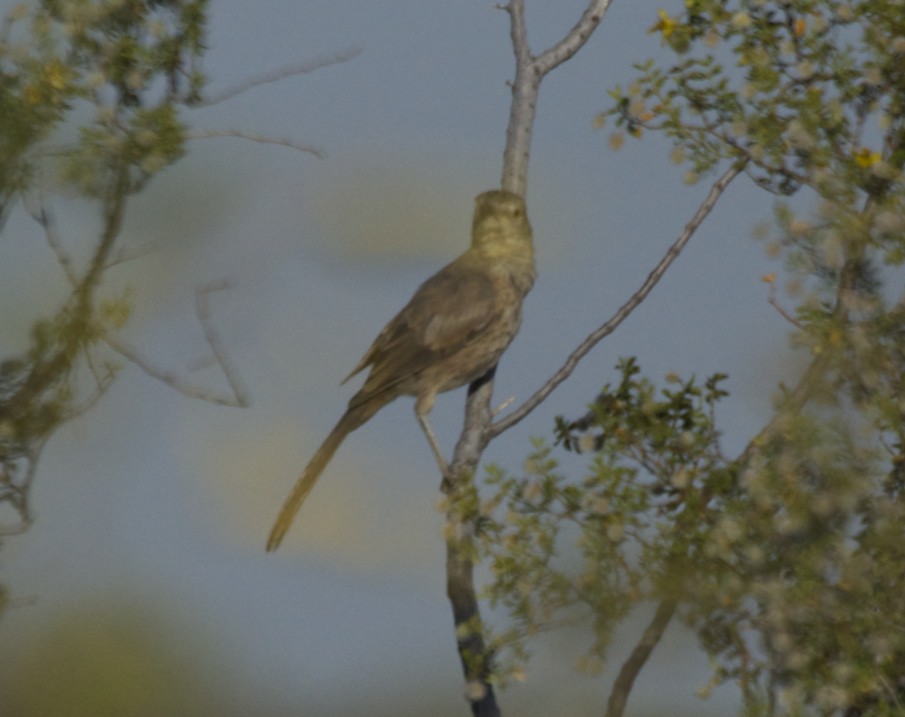
Unfortunately that good bird is a real pain for photography despite being a personal favorite. The Sage Sparrows have long gone and the Sage Thrashers have already moved through, but the Thrasher Spot was still very productive with its Big 3. We had 6 Le Conte's, in two groups of three, a pair of Crissal Thrashers, and 5 Bendire's all in about an hour and a half, and this was without vocalizations (they've all since shut up after this most early of springs). Some day, I will make a camouflage blind, go out into this desert, and mercilessly crush the Le Conte's Thrasher. In the mean time, I have to make do with such injustices, which I post both to my own degradation and to blearily illustrate my point:


It wasn't just the Le Conte's today. The cost of seeing all the birds is often paid in some other way. Here's a nicely posing Bendire's, obscured by proximal creosote branches. It was going to be one of those mornings. 


Here's a heavily cropped Crissal Thasher, which I must shamefully admit is my best photo of the species. I'm serious about that blind. I'm going to make it this summer. It will be spacious, have nice panoramic views, have room for snacks, and be highly mobile, maybe situated one 4 of those rumba robots that drive around and vaccuum floors.
**If anyone has any spare rumbas they'd like to donate, please email me privately.


After a productive hour and a half at the Thrasher spot, which also turned up some lifer Brewer's Sparrow for my birding pal, we headed east through the Palo Verde agr. land for the daily dose of Burrowing Owls. If one ever ventures into the west Phoenix farmosphere and returns without roadside Burrowing Owl photos, one has not lived up to one's potential. This species is perhaps the greatest ambassador between birds and people, less filthy than Gulls or Pigeons and much wiser than Finches. This fellow was hanging out near a drainage ditch by someone's driveway, and another was perched on the roof.


Inevitably, our west-Phoenix tour ended at Tres Rios, the absurdly birdy wetlands that combine three riparian channels with desert chaparral and small sections of grassland. At the right time of year, skilled and dedicated birders can pull 100+ species here in several hours.
The only remaining waterfowl when we went were Ruddy Ducks and Mallards, and even with few attenuating raptors we still finished in about 2.5 hours with 81 species, and that was starting around 8:30am. That tally up is not a boast of birding ability so much as the capacity of this site.


It was late enough in the morning that the Osprey were already finishing up breakfast and contemplating lunch.

However, the key to Tres Rios' diversity--it's sprawling, well-watered, and wild habitat--also makes it a pitfall of sorts for photographers going after some really close-up, crushing shots. The birds here typically, though not always, perch high and flush easily. It's quite the catch-22, a catch-23, if you will.


I do not bring this up to solicit sympathy nor profess false modesty, but merely as a preface for another realization I had about my peculiarly adjusted behavior at this, or any other oft-frequented site. 
There are many nifty birds I see every time at Tres Rios. 
They're not really crushable either, but I could consistently take decent, blog-complimentary images of American White Pelicans, Egrets and Herons, two species of Blackbird, etc. But because I see these birds constantly, I don't bother. Instead, I take mediocre images of the Gila Woodpecker above, or the Spotted Sandpiper below, because these birds don't present themselves as frequently. In the moment, I have a greater attraction to the opportunity presented by these birds because that opportunity comes around less often. This also means I lower standards sometimes. If the picture below were of a Least or Western Sandpiper it would've been chucked immediately, but Spotties are kinda hard to crush (in fact, upon further rumination, I don't recall seeing them crushed much ever at all on the blogosphere). It's not the first time I've pictured the species, but this relatively crumby sighting was more significant than the 1,000 Blackbirds (take it, Wallace Stevens) who were much more aesthetically pleasing subjects. Few people would argue this in-range, in-season Spotted Sandpiper is cooler than flying-in-formation Pelicans, but after enough Pelican sightings, that's how it registers. 


Which would be the better subject? Really I should just shoot both, shoot everything I can, shoot until the barrel overheats and melts shut, mwuahahaha! 
Nah, that obnoxious soliloquy was just a personal chastisement for being snooty at the expense of my photography. Anyway, one Tres Rios sighting of particular note was this Lesser Nighthawk, parallel-perching in a dead cotton-willow and generally winning at hide-and-seek. Finding nightjars in the day time has to be the highlight of almost any trip, even if these would be a dime-a-dozen after 7pm.


We had several other FOY birds at Tres Rios and finished the half day with 92 species. It was a pretty solid Phoenix birding run, a reminder of the excellent birding to be had closer to home before I head southeast next weekend to be spoiled once again, and maybe forever.

Tuesday, April 29, 2014

One Hand Empty, One Shaking Fist

The lesser weather god whose jurisdiction reigns over Phoenix has a cruel sense of humor. With temperatures in the mid 90s through the last two weeks, we sends merciful reprieve only on the weekends--the last 3 weekends in a row--with heavy clouds, slight rain and plenty of wind. It's gloriously comfortable, encouraging weather for just about everything...except for birding.

Knowing that this weekend would be another struggle, I decided to try for some late-night owling on Saturday, when the weather wouldn't matter so much, and maybe pick something up at the Papago Ponds on Friday after work. I never did find the confiding Sora I was hoping for at Papago, nor get visual (or photos) on the nocturnal targets, so both of those pursuits will carry over into next week. So, instead of cool stuff, here's some boring stuff from a local city park near you. 

Cooler than Coots but not as cool as Purple Gallinules, the widely distributed Common Gallinule occupies an existentially aggravating level of the gallinaceous waterbird hierarchy. This is, most likely, why they vocalize so often and with such angst in their voice.

I've been reaching a slow realization through my park/canal birding over the last several months. In any given Gulp (that's the real term) of Cormorants, it's now 95% Neotropic (this is a percentage I just made up). I hardly ever see Double-crested around town any more, and the big colony at Tres Rios is predominantly Neotropic too. I have no idea of these two similar species are competitive nesters, if the Double-cresteds just wander continually farther inland and the Neotropic come in their wake, like large-family farmers moving west after the pioneer mountain men. Anyway, I'd be curious for any other Phoenix-area birder's thoughts or observations on this. What's happening to the Double-crested, once the famous rebel of the Cormorant group, raider of the inland waterways, scourer of countrysides?

The longer tail, mottled brown, pale (non-yellow) lores, white border on the chin, behind the lower mandible, all indicate that this bird is yet another Neotropic. Behold the vacant, dead-eye stare of a monumental usurper.

Perhaps as a side effect of the humidity and wind in recent weeks, there are some pretty bold algal blooms in many of the city ponds right now. The prematurely warm temperatures this winter pushed most of the waterfowl north several weeks ago, but the resident birds are making the most of it.

Pied-billed Grebes do not mind Algae. Pied-billed Grebes do not mind anything.

Many American Coots, being good Americans, have lots of big fat babies roaming the ponds now too. I do enjoy when the spontaneous Coot fights break out--this species seems to have a greater propensity for violence than most other birds--and how embarrassingly long it takes them to get airborne.


Coot chicks...these flame-kissed bald headed things are somewhere between hideous and endearing, both of which are stronger reactions than often invoked by an adult Coot. Science has no know explanation for why they look the way they do. Too unappealing to eat?


Part of the American Coot's key to success is that it's a very unscrupulous eater. It's not an om-nom-nomnivore or anything, but they eat lowest common denominator stuff, such as algae and pond slime. With this recent algae bloom around town the Coots, no doubt, are feasting well. This adult was diving to bring up big swaths of the gunk for its chicks. In the photo below of the submerging birds you can see how green the disturbed water is, showing the super algae saturation in the ponds right now.


Most of the chicks waited helplessly for their meal, feigning ignorance and/or inability. But some chicks are straight up precocious, like this man-child here. 


And now I must apologize--but not too much--because I'm about to run a series of Great-tailed Grackle images. I don't feel too badly about this for a couple of reasons:
1) Great-tailed Grackles are cool birds for east-coast visitors.
2) Great-tailed Grackles are hardy, cool birds in general, as long as they're not too urbanized such that they've lost their glossy iridescent sheen.
3) Great-tailed Grackles have a glossy, iridescent sheen.


This dude was being all Green Herony near one of the run-off points where I was waiting for a Sora to reveal itself. 

Whenever one gets a chance to capture nictitating membranes in action, it's also worth sharing. I don't know what all this fellow was fishing for: garbage, algae, minnows, larvae...he probably didn't care.


Did you ever have that one friend in high school who was really shameless, dirty, irresponsible, crafty, guileful, and affecting all at once, probably an Italian? He was abrasive and obnoxious, but every once in a while you had to stand back and just admire his incredible good looks and admirable success, even despite how bothersome he was?
Yeah, I didn't have a friend like that either; I don't even think that's a sterotype. But if it were a real thing, it might fit the Great-tailed Grackle pretty well.

"I'm my own stereotype, a really cool one, way better than any you can think of because of your narrow life experience, punk."

Alright then, I solemnly swear on the little dust pile that's left of my birding and bird blogging reputation never to post Great-tailed Grackle again, even if I see one riding a tiny motorcycle through a ring of fire. Step lightly; step boldly. Drink Bulleit bourbon. This grackle does.

Monday, April 28, 2014

We Shall Flight Them on the Beaches!

So there aren't really beaches in Phoenix and it's not too much of a fight, except to get photos at the Glendale Recharge Ponds, but at any rate there's some decent migration type stuff happening around the sewage basins these days, plenty of year birds and sexy breeding plumage birds and some awkward in-between birds. Since Sunday afternoon was still holding the blessed effects of a rainy Saturday (I barely got sweaty!) it was the perfect time to see who was passing through and what all was going on where my waste, and others', ended up.


This Western Sandpiper above is in-between boring and sexy pluamge. Not terrible, but not as good looking as some of the other Westerns around, like Flashdance Western Sandpiper below. 


Most of the Long-billed Dowitchers are well into their breeding plumage. They would be better appreciated for their intricate, subtle good looks if they weren't common and always occurring in groups of 6 or more. The LBDO is not an ambitious bird. It keeps its nose to the grindstone.


Of course, the Killdeer population has once again doubled in size, and now there are these disgusting adolescents running around only 2/3 the size of an adult Killdeer and half as vividly colored, so from a distance they give the excitement of something bigger than a Least or Western Sandpiper that's not a Killdeer or Dowitcher...but actually is. Little turds.


The center of the basins are still holding enough water to retain some of the Phoenix winterfowl. All three species of Teal were still present, as well as some Wigeons, and they were joined by two transient Franklin's Gulls, a gorgeous gull that I still always wish was something else.


Both species of Yellowlegs were present in small numbers, as well as a solitary Solitary Sandpiper. Some were feeding actively, while others stood to watch the sun set.


Perhaps the most exemplary displays of breeding plumage are exhibited by the numerous American Avocets right now. Not only are they big and conspicuous with their rusty heads, but they lumber awkwardly through the air squeaking and squawking with left over pent up sexual frustration. Nice.


Avocets look pretty out of their element in flight, at least most of the time. They're pretty specifically adapted for a life of picking through mud and reed flats, but every once in a while they turn on the dazzle and simply walk through the air like the secret badasses they really are.


Many of the birds still have some ripening to do, but that hasn't stopped a lot of them from going at it already, or at least just practicing their balance.


The main draw at the Glendale Basins, at least for this trip, was not the Avocets or other common migrants, but a pair of Dunlin that had been over-wintering. I had forgotten that these birds were around, or rather had assumed they moved on at some point. A recent listserv post mentioned they were still at the ponds, which meant that by now they'd be well into their breeding molt.


Such is the paucity of shore birding in Phoenix that I've never actually seen Dunlin in breeding plumage, only as larger droopy-nose Western Sandpipers in late autumn, so there was some special intrigue and excitement here. Of course, the Glendale Basins didn't really afford great photo opportunities, but I could appreciate the colors through a scope, and the continual strafing runs of Killdeer with my ears.


Alright well they're not the the most color birds, even in breeding plumage, plus they're the most common shorebird in North America (even over Least Sandpiper?) and they're named after the color gray (Dun), but all in all I appreciated this new look: Magnum.


The Glendale listserv posts mentioned Forster's Terns and a Least. In addition to these sleek sternidae, there were Caspian Terns circling and eventually plunge-diving in the deepest (southeast) basin.


It's funny how the landscape changes food-chain dynamics. In the absence of Osprey, the Caspian Terns were the largest, meanest, most intimidating birds around the ponds, but near the coasts, where they'd more be in their element, they would be very mediocre. That being the case, I don't blame them for coming inland and strutting their stuff to the shock and awe of Phoenix's awedience.