Tuesday, March 25, 2014

Superior Birding: Oak Flats

What's that they say, without ups and downs in life, you're dead? Well, sometimes Flat or Flats is good, especially if the Flats are covered in oak scrub. 
Superior, AZ, located about an hour east of Phoenix on the Hwy 60, is well known for its gorgeous, oaken canyons and the Boyce Thompson Arboretum, the site of many an exciting avian and botanical find. A little farther east the mountains are broken down into boulder and oak-strewn foothills where campers, off-road vehicle enthusiasts, and naturalists can all find plenty to do, if not necessarily all at the same time...


In many ways this habitat is similar to that recently visited near Prescott and also leading up to Mt. Ord in east Maricopa. As far as AZ habitats go, it's a favorite of mine for several reasons. It's relatively lush (not as hot/desiccated as Sonoran Desert stuff), it's cooler in temperature, and the scrub oak and manzanita, which make up the bulk of the vegetation, don't get to be very tall, so this allows for much better looks at and photos of birds that might otherwise be high canopy dwellers.
Case in point, I was unable to get a good photo of this skittish Scrub Jay not because it was high in a ponderosa or something, but because it was just too wise to let me get near. Oak Flats...err hem...levels the playing field.


Jays are a funny bird. Generally speaking they're pretty wary of people and always have sentries on the look out, but in certain areas where they're used to us hominids they're incredibly resourceful and comfortable (the head-perching Florida Scrub Jays coming quickly to mind).
Ash-throated Flycatchers, on the other hand, are loud, lovely, conspicuous, and usually pretty accomodating. They're common, but I like these birds quite a bit, and miss them during the winter.


My target bird for the Oak Flats, one seen and photographed very well only a couple of weeks before by Gordon "Wizard Staff" Karre. This little butt of a bird has been a photo-nemesis for me for some time now. It's still early in the year and their numbers will grow in these areas, but there will also be bigger game to chase in later April and May, so taking care of business here in relatively slower March would have been most efficacious to efficient birding. It's tougher to make the early morning call to spend one's Saturday chasing GRVIs in May, when they're easier, when there's better all-round birding to be had elsewhere.
It's not glamorous, but going Gray Vireo hunting does have a positive externality in that they inhabit the same scrubby stuff as many the beloved emberizid, so the backdrop to this search would be continued sparrow-crushing.


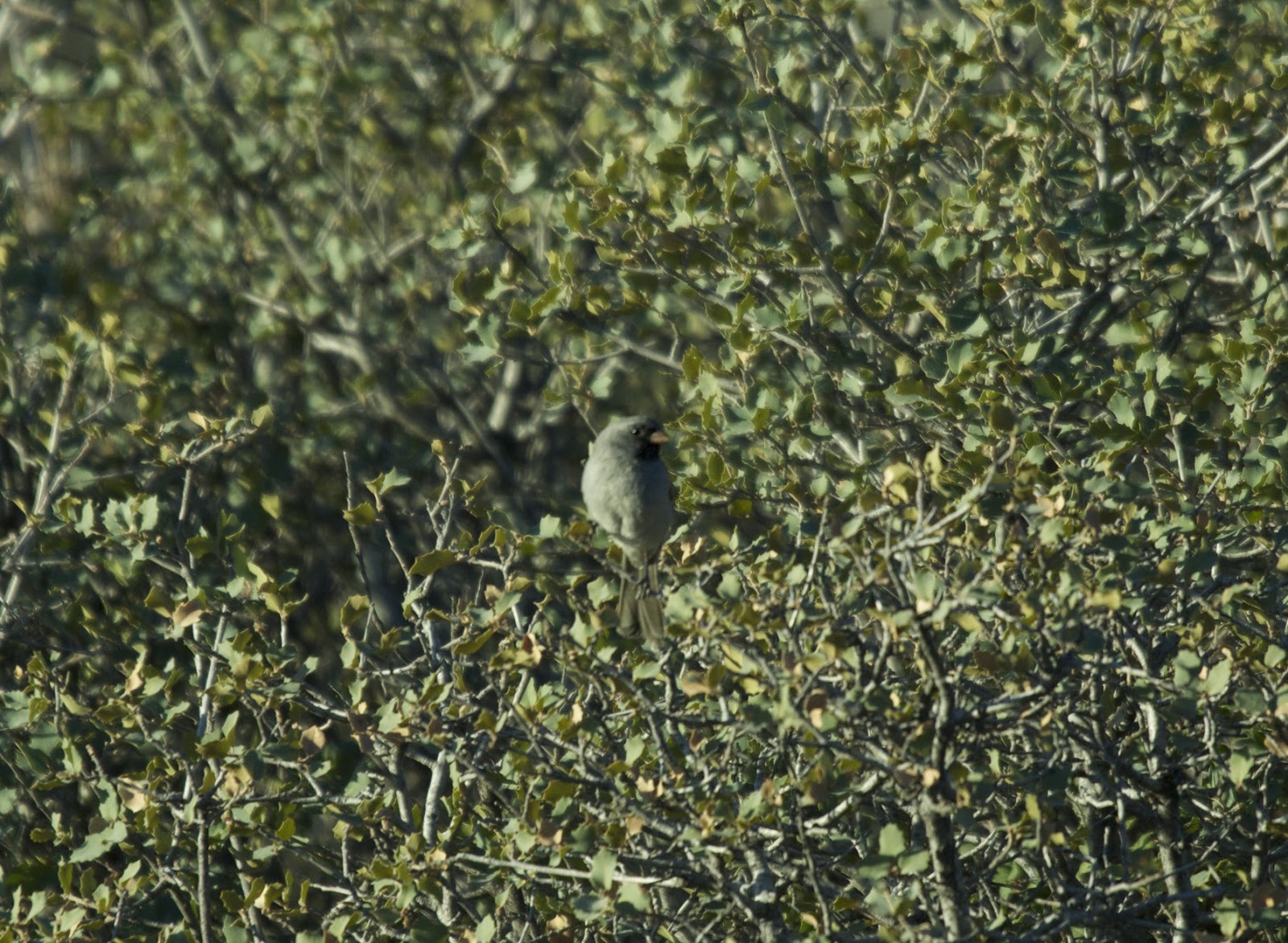
Black-chinned...black-eye, black-and-blue after such crushing...These birds have a great call too, one that rings through the scrubby hillsides this time of year.


The scrub oak habitat is not just a favorite of mine and the Black-chins; it's also populated with many other vocal species. Early morning in March is a truly symphonic time, or maybe cacophonous...anyway it's great practice for audio birding, a serious weakness of my birding repertoire.

Bewick's Wrens are among the loudest and most persistent chatterbugs. They also have a myriad of calls, both those immediately recognizable to the species and all kinds of other half-assed chips and chirps and even some imitations of other birds. They're terrible gossips. 


Townsend's Soliatire's, by contrast, are not very vocal, but are not above messianic posing atop their perches. Townsend's Redeemer wouldn't be a bad sobriquet for this fellow. Another couple of weeks and the Solitaire's will be clearing out of the oak/juniper scrub and heading back to higher elevations.


Naturally, scraggily perches and their panoramic vantage points attract more than Solitaires and ASFLs. Vermilion Flycatchers (in this case, female) and the tragically bland (when perched near VEFLs) Say's Phoebe's meticulously watch from the surrounding scraggily stuff.


Male Vermilions are staking out territory now and pairing up. I was able to witness and snap a couple blurry shots of this guy's distended belly territorial/impress-the-ladies display. It was pretty good.


After a couple hours' searching and listening, and even helping some campers find their lost kid, the birding gods still withheld the Gray Vireo photo op from me. As the sun rose higher in the sky while simultaneously chased by ever-encroaching clouds, I had the option of continuing the thus far fruitless pursuit or pushing out into other habitat that would hold new birds for the day but no GRVIs. 


The enchanting calls of Black-throated Sparrows and their face-melting handsomeness, as always, was far too much for me to resist. Have I gushed enough about how good-looking this bird is in recent weeks? It's the Derek Zoolander of Sparrows.
Old Legend has it that one of the Medici Popes commissioned Michelangelo to try and paint this bird and he refused, saying he could not complete the task satisfactorily and it would be sacrilege even to try (lucky we have cameras now and mustn't resort to impression).


I want to consume them...take their gorgeousness into me. Don't pretend like you other weirdos out there haven't thought this way too about handsome birds, people, etc...


You know that feeling you get about two and a half hours into a chase when your morale drops to thinking that your sighting just isn't gonna happen? We've all hit that nadir, when things start to get more quiet, when birds aren't calling much any more. 
It's that time when one has to bring in the contingency plan, which in this case was another little gray bird, one I'd seen only a few weeks before but also never photographed. 


Of course, I didn't see or hear any Juniper Titmice when patrolling the juniper bushes for Vireos and Solitaires. No no, I found the shy little bugger in an oak tree. See, Plain Titmouse, this is why people just don't know what to do with you! If you're named for a tree, you better stick to that tree, and not the one your otherwise identical cousin is named for!
Without knowledge of where this bird was seen, could it be anything other than Oak Titmouse? Life is confusing, and full of disappointment, and exaggeration, and lists, and run-on sentences.


The Titmouse was happily inhabiting the understory of the oak tree while other little gray birds chittered up top. Bushtits are another new species to grace the pages of Butler's Birds, a common enough sight and sound once you gain a couple thousands feet, but not so commonly photogenic. 


Oak Flats is popular not just for its oaks but for its flats, making it a great camping and go-karting spot. A bit further away from this heavily foot-printed site the landscape gets very bizarre and equally cool.  The heavily weathered rock piles look almost otherworldly, an aesthetic enhanced by the near-silence broken only by one's echoing footsteps. 


A bit southwest from the Oak Flats site is a little pond--I'll call it Magma Shaft Pond, after the nearby road. The water feature was itself unimpressive though a pleasant discovery, but it allowed me to add Redhead, Ring-necked Duck, American Coot, and Wilson's Snipe to my Pinal County list.


The Gray Vireo still needs crushing, but Oak Flats is a fabulous spot, one of my favorites within an hour or so of Phoenix, and it's definitely one I'd recommend to anyone in the area, especially if looking for scrub species. Combining a trip back here in a month for GRVIs and then spending time at the Boyce Thompson would be the way to go. Stay tuned!

Friday, March 21, 2014

Heard it through the Grapevine

The Prescott area, about an hour and a half northwest of Phoenix, is home to some diverse birding habitat situated between 2,000 to 6,000 feet. The higher elevation draws in plenty of birds that are far less common in Maricopa County, and it also offers a general reprieve from Phoenix birding which can, like anywhere, get repetitive. On Friday I went chasing up Grapevine Creek in the Bradshaw Mountains after an annual AZ vagrant, the Varied Thrush. I have dipped on this bird three times before, so it's becoming a bit of a nemesis for me and a beautiful one at that. 


The sparse mountainside habitats may not look like ideal habitat--and truth be told they aren't for Varied Thrush--but the the real treasure offered at Grapevine creek is the shady riparian wash nuzzled in between the hills, with water, shade, juniper, and fir trees.
The dirt road up towards the creek becomes inaccessible by vehicle a good mile or so from the creek trailhead, which forces the intrepid birder to traipse through elevated desert chaparral. This unique habitat, comprised of desert holly, saltbrush, scrub oak, juniper, and manzanita, offers up its own birding delights, and this was just as well since--spoiler alert--the Varied Thrush remains an inchoate nemesis. 

The morning walk along Grapevine road, though very chilly, was filled with emberizid noises. Black-chinned Sparrows were the main culprits, but White-crowned, Rufous-crowned, and Black-throated also made their contributions, as did a plethora of Spotted Towhees.
A little pishing and a little playback can get all kinds of things stirred up in these bushy surroundings. The whole neighborhood was buzzing and among all the Sparrow happenings I almost missed a pair of Crissal Thrashers (not photographed, of course) gathering food for a nest.


I picked up my first 2014 Black-chinned Sparrows just last week near Mt. Ord, but during a time crunch. While waiting for the sun to crest the mountains and illuminate the creek trail I was able to crush them more properly along Grapevine road, much to my satisfaction.


The Black-chinned below (not crushed, just circumstantial) is perched on one of my favorite chaparral scrub bushes, manzanita. What? You don't have your own favorite chaparral bush? Lame.


The manzanita have rich verdancy in their evergreen leaves and a smooth, reddish bark running along their gnarled branches. They show resilience, color, and texture in a remarkable way, especially amidst the predominantly homogenous, grayish-green backdrop of their surroundings.

Nearer the creek and in the shaded valley between the Bradshaws, ponderosa pine and juniper come to dominate the scene, with scrub oak and the occasional fir trees, as well as cottonwoods also growing nearer the water. From looking down into the bushes one must look up into the busier canopy. Bushtits and Kinglets bounce from limb to limb, creating a false impression of how numerous they are with their raucous, kinetic behavior. They make up the basis of solid mixed flocks that Goldfinches, Chickadees, Titmice, and Vireos also join, while White-breasted Nuthatches and Brown Creepers lurk on the periphery and wallflower Hairy Woodpeckers wait for an invitation (or not).


Hutton's Vireos are kind of a dull bird, but they have my undying appreciation in the month of March for being something admittedly kingletty that is not a Kinglett. They were very vocal in the scrub oak along the creek trail, showing more personality than their generic appearance otherwise indicates. 


The Varied Thrush was seen a fair way up the Grapevine trail, about 4 miles of hiking total, around a white fir grove. Due to a combined ignorance of this trail and what constitutes a white fir grove, I am not satisfied that I was searching in the right places. I was further impeded by my own clumsiness, which resulted in me dropping some equipment in the creek and having to greatly expedite my search so I could get home and stick it in rice.

As such, the Varied Thrush chase did not get underway to full satisfaction, but Grapevine Creek has some great potential as a birding spot. The changing habitats alone provided me with 40+ species in about three and a half hours, and the creek itself offers the right settings for an uncommon and delightful little bird.


Big tangles and brush piles along the water aren't just appealing to rodents. All the while walking the creek I had eyes and ears pealed, eventually picking up that anticipated call note of a Pacific Wren, the little bird with a big chip on its shoulder, struggling to forge a separate identity from Winter.


These Wrens can be as amazingly gregarious and they are amazingly small. It almost flew up and landed on my foot when I was pishing, which resulted, rather cruelly, in me being unable to properly focus on the oddly proximal bird before it again vanished into its twiggy labyrinth.


Grapevine Creek isn't the most easily accessible hike--several miles of choppy dirt road and some occasionally steep/loose hiking, but it certainly is birdy. That's also true of many other trails in the Prescott area, even though this site is closer to anyone heading north from Phoenix. 
No luck, again, with the Varied Thrush. I'll just have to quit being lazy and go find my own some time.

Thursday, March 20, 2014

Dealing with Doldrums?

What better way to weather those fallow times of year, when you're bored of Kinglets and anxiously ticking off the days, chewing your nails, until the Warblers and Tanagers arrive?

Bourbon and cards with fellow nerds is a pretty good solution, when you're not pouring over field guides or the latest and greatest in bird blogging.

Here's a kickstarter campaign link to Emmanuel Jose's work. This New York based artists is trying to complete mass production of a really sharp, clever, and cute bird-themed playing cards. The artwork alone in impressive, and these will make great gifts for yourself and for friends and family.

Check out the project HERE


Sunday, March 16, 2014

No Ordinary Sparrows in the Shadow of Mt. Ord

The excellent winter sparrowing continued through the weekend, this time out in east Maricopa County where an immature Harris's Sparrow was kicking up at Mesquite Wash, not too far away from Sunflower (famous for its Black and Zone-tailed Hawks later in the year) and Mt. Ord (famous as the best high elevation birding in Maricopa Co.). Harris's Sparrow is annual in Arizona but tends to turn up farther south more often and, at any rate, was a lifer for me. 

So with the Superstition Mountains and Four Peaks marking my horizon, I drove out east early in the morning looking forward to one of my favorite birding exercises: Sparrow Sleuthing! Truly, there is no more virtuous or worthy a pastime known to philosophy or the annals of love than sparrowing. 


The young Harris's Sparrow, expectedly, was seen hanging around with very mobile White-crowned flocks. I met up at Mesquite Wash with Tommy DeBardeleben and Dominic Sherony and after appreciating some early Lucy's Warblers we set to work chasing around the Sparrow packs. The first few groups of White-crowns yielded little but turned up one of my favorite emberizids.


Black-throated Sparrows are absurdly good-looking birds, even if they lack the plumage complexities of some of the more secretive Sparrows, such as Le Conte's. They're like part Old Blood Spanish Nobleman, part wizard (the eyebrows), and part Edward Teach. So maybe I'm over-thinking it, but it's a pretty sharp Sparrow.


We spent about an hour with decent birding but little luck relating to Harris's Sparrow before running into another well-reputed Phoenix birder, Pierre Deviche, who had followed the White-crowned flocks past the mesquite wash and into the surrounding chaparral hillsides, which were now blooming nicely after recent rain. This was farther away than anyone had found the Sparrow in the previous week, but we stuck to our guns and were finally able to turn it up when it took to the bushes briefly. It even gave a few single call notes, something unexpected for this sort of vagrant.


I got a decent look at the bird but no photos before it disappeared over another cactus-ridden hill with its adopted friends. With everyone operating on a pretty tight schedule, we decided to head further down Highway 87 and up to Mt. Ord. The climb up to FR 1688 (elevation 6,000ft) winds on a treacherous dirt road through scrub oak and mesquite chaparral. We were too early for Gray Vireo, but the hills were alive, sound of music style, with the trills of Black-chinned Sparrows.


I didn't come away with any crushingly good photos but the sightings were pretty close and very enjoyable. There's no better place in central Arizona to find these guys, and they combined with the Song, Lincoln's, White-crowned, Black-throated, and Spotted Towhees (also very numerous) to make for an exceedingly emberizidish day.


It was a beautiful day atop Mt. Ord, and even though time constraints prevented us from properly dawdling and we couldn't turn up Pygmy Owls we still had some very nice sightings, including Juniper Titmouse and the first Painted Redstart of 2014 (for North America). 


We had a pair of boisterous Hutton's Vireos, as well as Bushtits foraging near us at one point, all of which I managed to substantially miss photographically speaking. The autofocus on my camera has been broken for nigh on a year now, and after one more birding trip this week I think it's finally time to bite the bullet and send it in for fixing. The soul can only endure so many missed opportunities for crushing birds without being torn asunder.


Atop Mt. Ord and down at Sunflower the Violet-green Swallows are already setting up shop. Doesn't he look cheerful? Hopefully I can get just a bit more mileage out of the camera before sending it in to repairs.

"Howdy Howdy how's it going?"

The east Maricopa birding was pretty rad, and picking up lifers in AZ, especially central state, is becoming an increasingly challenging proposition, so it was a great day indeed.
It's either SoCal for Wrentit, CA Thrasher and Gnatcatcher, and Tri-colored Blackbird, or else the Huachucas for that persistent Sinaloa Wren that I, and I alone, still have not seen. Stay tuned!

Wednesday, March 12, 2014

Twilight Gatherings in the face of Desolation

The sun-scorched earth...nothing can grow, nothing can live...much less survive. The stoic Ibis stretches from one forsaken spot to another, the only shade being provided by rocks even more lifeless than the desiccated soil itself. Truly, this may be the spitting image of the last bit of life on earth, when that day comes...until that fragile little flame dies out amidst the all encompassing black of the universe.


Or it's just suggestive cropping in a particularly poor-looking area. On the other side of this little dirt road there was much more going on, and there always is, if one swings by in the last hour of daylight. These photos were all taken around the Broadway dairy farms, which are, quite in contrast to atmosphere of the beginning photo, teeming with activity.


Cattle Egrets have the namesake and reputation for bovine association, but out in west Phoenix where Cattle Egrets are few and far between anyway, the Yellow-headed Blackbird is, by far, the species seen most closely socializing and living with the cows.


They roost in the thousands at the protected Tres Rios wetlands just a mile south, and spend their days and evenings chittering, chattering, and making bizarre metallic sounds with their cow buddies.
It's a rip-snorting good time. Everyone gets plenty to eat, has plenty of gossip, and wallows in their own feces. When everyone's a party pooper, the party don't stop!


The Yellow-heads aren't the only birds to come out in large numbers in the evening light. Bulkier, quieter Eurasian Collared-Doves, the awkward wallflower or any semi-urban get-together, line the corrals. They know they're a good looking dove, but also that no one really likes them very much or wants them to be there.


Adjacent to the masses of unscrupulous farmyard birds, Burrowing Owls also become readily conspicuous as the evening wears on. They must remain diligent in looking out for Red-tails and Cooper's Hawks, but that won't stop them from imitating those wire-perching birds either.


Two look-outs are better than one; these fellows had the panorama covered well. They didn't mind my presence either, perhaps thinking that the large gangly creature would further deter any raptors from swooping in and ruining their evening porch time.


I'm hoping to try for a Maricopa rarity Harris's Sparrow this weekend and get some good photo ops at the Oak Flats campground in Superior, AZ. It's nice to have some direction and plans going into the weekend. It's also very nice to have some reliable spots, like those shown here, where fun and fine-looking birds can always be found. They sometimes have a gruff (or in the case of yellow-heads, cacophonous) demeanor, but they don't mind visitors in the evening, just don't stay too late.