Wednesday, March 12, 2014

Twilight Gatherings in the face of Desolation

The sun-scorched earth...nothing can grow, nothing can live...much less survive. The stoic Ibis stretches from one forsaken spot to another, the only shade being provided by rocks even more lifeless than the desiccated soil itself. Truly, this may be the spitting image of the last bit of life on earth, when that day comes...until that fragile little flame dies out amidst the all encompassing black of the universe.


Or it's just suggestive cropping in a particularly poor-looking area. On the other side of this little dirt road there was much more going on, and there always is, if one swings by in the last hour of daylight. These photos were all taken around the Broadway dairy farms, which are, quite in contrast to atmosphere of the beginning photo, teeming with activity.


Cattle Egrets have the namesake and reputation for bovine association, but out in west Phoenix where Cattle Egrets are few and far between anyway, the Yellow-headed Blackbird is, by far, the species seen most closely socializing and living with the cows.


They roost in the thousands at the protected Tres Rios wetlands just a mile south, and spend their days and evenings chittering, chattering, and making bizarre metallic sounds with their cow buddies.
It's a rip-snorting good time. Everyone gets plenty to eat, has plenty of gossip, and wallows in their own feces. When everyone's a party pooper, the party don't stop!


The Yellow-heads aren't the only birds to come out in large numbers in the evening light. Bulkier, quieter Eurasian Collared-Doves, the awkward wallflower or any semi-urban get-together, line the corrals. They know they're a good looking dove, but also that no one really likes them very much or wants them to be there.


Adjacent to the masses of unscrupulous farmyard birds, Burrowing Owls also become readily conspicuous as the evening wears on. They must remain diligent in looking out for Red-tails and Cooper's Hawks, but that won't stop them from imitating those wire-perching birds either.


Two look-outs are better than one; these fellows had the panorama covered well. They didn't mind my presence either, perhaps thinking that the large gangly creature would further deter any raptors from swooping in and ruining their evening porch time.


I'm hoping to try for a Maricopa rarity Harris's Sparrow this weekend and get some good photo ops at the Oak Flats campground in Superior, AZ. It's nice to have some direction and plans going into the weekend. It's also very nice to have some reliable spots, like those shown here, where fun and fine-looking birds can always be found. They sometimes have a gruff (or in the case of yellow-heads, cacophonous) demeanor, but they don't mind visitors in the evening, just don't stay too late. 

Sunday, March 9, 2014

What's the Secret?

It has been a grossly long time since I've been able to post, with weekends being full of other considerations and, more recently, heavy rain (which I really shouldn't grumble about). Recent car hiccups and expensive gas discouraged too far of a trip this weekend, but the Hassayampa River preserve offers some precious riparian junk at only an hour away, and a nice reprieve from the somewhat repetitive central phoenix birding. At least, that was part of the reason for heading to Hassayampa. Truth be told, there are more species to see at Tres Rios and the surrounding farmland. 

These Mallards met at dawn along a non subterranean portion of the Hassayampa River, presumably to duel to the death for the lady's honor.

Hassayampa is a smaller area than Tres Rios, so in a sense it's easier to bird and relocate sightings, and it has also been a hotbed for great Maricopa County finds. Grey Catbird, Rufous-backed Robin, Downy Woodpecker, Gray Hawk, and Green Kingfisher, Winter Wren, and  Magnolia Warblers have all turned up here in the last couple of years. It's a lush strip of riparian in the middle of an arid fly-way, the perfect vagrant/migrant trap.


And yet...I dunno, I just can't get this place to work for me. Whenever I bird Hassayampa it is pretty lackluster. I find the expected stuff, maybe a few uncommon birds, and never the big rarities. I haven't found the key quite yet, haven't unlocked the full potential of this place, which is maybe why I bird the closer Tres Rios much more often.
It's a beautiful place and time at Hassayampa is never poorly spent, but looking at the all-important good birds vs. time spent finding them ratio, my ratings there are pretty poor.

There's still something to be said though for a place where Vermilion Flycatchers are a common, expected sighting, something to be said like, "Wow, Butler, what are you complaining about?"

With this unseasonably warm weather in Phoenix weirdly early migrations are already underway. I decided to hit up Hassyampa for any nifty migrants and then peruse Tres Rios is later on. Some notably early finds were Lucy's Warblers as well as Bell's, Hutton's, and Plumbeous Vireo.

Lesser Goldfinches were some of the most numerous and vocal birds. I find their chirps to be very pleasant on the ears, and that their flocks also attract other nice birds.

The best find at Hassayampa, more so than the early birds, was a pair of Lawrence's Goldfinches gathering nesting material. This is only the third or fourth time I've seen these birds--Hassayampa is definitely the best place for LAGOs in central AZ) in the last few years, so naturally I took no decent photographs.


Anna's were already on the nest when not busy berating one another or other unassuming flycatchers and the like. Winter definitely got skipped down here.


In addition to wanting to turn up my own rarity at Hassayampa, I also went for another pride-based reason, which is that I have absolutely no photos of Cedar Waxwings. 


One assumes that by my age you'd have have at least one lovely, intimate photographic experience with Waxwings. I mean, I saw them often enough, heard their calls, appreciated them from afar but...it just never happened for me. As time goes on, it becomes more and more difficult; there's more and more pressure, and pretty soon I just stopped trying...

Actually that's not so true. They just tend to perch pretty high around Arizona, not being forced to come down lower to forage as in snowier places, so there aren't as many opportunities for photograph them well here, especially not around Phoenix. The Seven Springs site in Cave Creek, with its many juniper bushes, is the only exception I can think of.


Hassayampa has some the most clean-cut examples of the southwest subspecies of Song Sparrow. Many of the SOSPs around Phoenix are much darker intergrades, but at Hassayampa they're predominantly light and chestnutty, as southwestern Darwin intended.


There are always plenty of Robins to see too, not a common/widely distributed bird elsewhere in Maricopa, and this time of year the Robin flocks hold a bit of extra intrigue because of what it might conceal.


Alas, the dozen or so examples were all Non Rufous-backed Robins, the lesser known cousin.

Do you have any spots like that, a spot's reported on listservs as having all kinds of awesome stuff, and then when you arrive it's like the party ended just before?

There were plenty of year birds and some nice sightings, but I'm still feeling I haven't unlocked the potential here, and it's a bit too far to bird often with many excellent options only half the distance. 

Sometimes you have to pick your battles, and this is one gorgeous site I'll recommend to anybody, but probably wait to visit again myself until I hear something reported. In the meant time, I'll stick to places I know well, or else try to find some that are totally new.

Sunday, February 23, 2014

Bottom of the Barrel Birding

Sitting here on a pleasant Sunday evening, I'm wondering where the weekend went. For what reason or to what purpose I cannot say, but a combination of general enervation, carry over from the work week, less than ideal weather, and some continuing car problems kept me from my cathartic weekend birding outings. By evening time I was finally able to go out for an hour or two, but there is probably no worse time to go birding in the central Phoenix area than on a Sunday afternoon with pleasant temperatures. 
I tried Papago Park, the Botanical Garden, and Tempe Town Lake, only to be repulsed from all three by the overwhelming numbers of people who beat me to it, fishing poles, strollers, and novelty flying discs in hand. Of course, it is a great thing that so many people are out enjoying all the parks, but for my purposes it was somewhat bothersome.
I should've known the short-span birding would be pretty terrible when the first non-columbid bird I found was a this floater:

Judging from the long tail, I'd say a Neotropic Cormorant. I especially like the grisly algae growths covering one of the feet. It must've taken a while for those growths, which means this fella has been floating for a while. Even the normal aquatic carrion feeders were being lazy, or else there is no fouler meet than Cormorant.

 It wasn't just that the birds themselves were being withholding--although they were--the Tempe Lake pedestrian bridge was being patrolled back and forth by a ferocious gang of segway riders, each of whom was more ferocious and intimidating than the last. The last two guys in this line don't even have to stand up straight to ride so, you know, they're pretty good.


The heavy foot and segway traffic drove me down into wash west of the floating dams, where there is little water, little soil, and little birding to be done--a somewhat disappointing circumstance seeing as the area itself is pleasant.


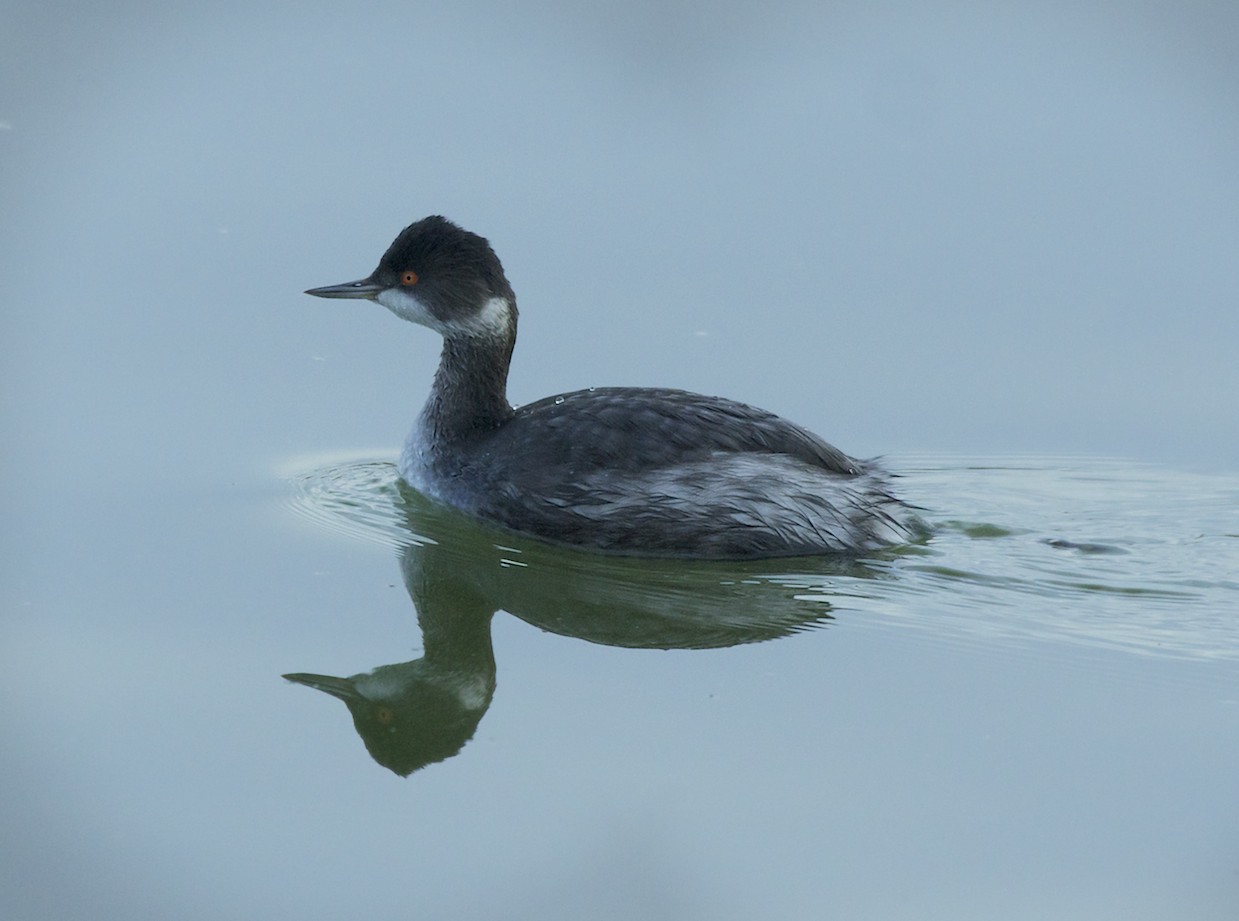
A Black Phoebe and some Killdeer where stretching out their vocals in the gloam, and a single Eared Grebe, perhaps equally put-off by all the people up higher, and retreated to these surprisingly shallow waters.


I'm doubly motivated to get some higher altitude Prescott birding in next weekend so, and then it'll be a push to mid-March spring break and some time, between writing evaluations, to head back down south. Hopefully that Sinaloa Wren is still around...
In the mean time, can the new work patch make it up to 30 species??? Odds are 7 to 1 against, but taking all bets!

Thursday, February 20, 2014

Cling Well Drill Well Sap Well Stay Well

It was a rip roaring Thursday afternoon at the new work patch as I added no less than five new birds to the patch list, bringing the total up to a staggering 26 species! Yes indeed, with clutch finds of Eurasian Collared Dove, House Finch, and Northern Mockingbird, I pushed solidly past two dozen. This is more than likely about as far as I'll get until some more Swallows, Nighthawks, and WW Doves show up along the canal in a month.


Too much sarcasm, or even irony, like too many Blackbirds, if off putting though; I did return to the the work patch for other reasons than pursuing a few overstated, cheap ticks. I had a small but lingering desire to give the SRP Falls and Herberger Park a quick going over for a couple of months, ever since taking an AMSP/FOAL break there with another employee before a summit meeting. 

While we were unscrupulously indulging in good ol' fashioned American vices in the afternoon, I noticed firstly that there were plenty of pine trees at the park--not a given around Phoenician parks and a favorite of some birds--and that many of the Australian bottle trees were absolutely riddled with holes.


There are only but one of a few possibilities for how a proud bottle tree such as this could become so porous, and since I didn't see any OCD kids with pellet guns hanging out in the park, I deduced that it must have, in fact, been some sort of Sapsucker. Pretty clever eh? 
Red-naped, of course, would be the only real suspect, but even with that being the only possible (and Yellow-bellied does tend to drift a lot) Sapsucker in Phoenix, it's a decent find for the central city given the small amount of woodlands. Upon returning to Herberger Park on Thursday I soon found the freshest looking sapwells, and soon after found the culprit.

Caught red-handed!...err red-naped!


There were two birds, both males, from what I observed in about thirty minutes. The conspicuous red on the napes immediately ruled out any possibility of Yellow-bellied (also known as the "for lack of any other obvious distinction" Sapsucker), but it's still a pretty gorgeous bird and certainly the most solid find thus far at my dinky little work patch. I dig how the red on the nape is very haphazard, like whoever was designing this bird just gave up towards the end and stopped coloring in the lines.

Apart from the presence (or not) of red on the nape, the black malar border on the RNSA is thinner and doesn't extend all along the red throat to keep it from meeting the white face paint. That black malar border is much more distinct on a Yellow-bellied, which I'll still hold out hope to see here some day.


It was a quick jaunt before I had to be back at work, but on the way to the car I snagged another tick for the patch list as it patrolled the canal. It's up to Prescott this weekend to see who's hanging out where there's some decently cool whether.

Tuesday, February 18, 2014

Working Out a Work Patch

Working a 7am-4pm job can be hard on a fellow's birding, especially when the sun sets early and there's still prep work to be done for the following day's grind. It's often a tight, sweaty squeeze--like to many suits on an elevator--but the weekend outlet isn't always enough, and sometimes you've got to fit in some weekday birding, even if it's just a quick fix, a supplementary high. It doesn't matter if they're mostly trash birds; they've got feathers and they move, so it's still birding. 

Black Phoebe by the parking lot irrigation gate? Hell yeah!!!
Many people have the benefit of yard birding of course, but for us apartment dwellers that doesn't amount to much, so the next option is finding a local patch around home or work, usually a park or something similar. Phoenix has some decent birding parks, like Encanto downtown or Grenada Park more central, but these require a bit too much rush hour driving for me to hit up on a weekday evening. The campus where I work has actually turned up a couple of decent birds for me--American Robin and Peregrine Falcon, and Lark Sparrow, which are uncommon in central Phoenix--but I can't well use my place of work as my work patch; that'd be distracting for me and everyone else there who knows me and sees me walking the grounds with all the gear, plus there's not much water. 

So, I decided to head a few blocks northeast to the SRP Arizona Falls canal spillway, a nice little attempt at a canal filtration/regulation gate with some walking paths and water works. It's very small--easily covered in 10 minutes--and also adjacent to Herberger park, which has some grass and a few pine trees, as well as tamarisks, that have already produced Red-naped Sapsuckers and maybe some migrants in a month.

The spillway itself is a nice little construction, and its various channels provided a nice break up of the monotonous brown trench canal scene. The higher concentration of birds here, like these Mallards seconds that motion.
It's funny how starting a new patch list, especially one for a small patch with little going for it other than location, readjusts expectations. Once again I'm really looking forward to a Kestrel Sighting. Red-naped Sapsuckers were a treat and I haven't even recorded House Finches yet in two tries! Yes indeed, I'm only at 21 species for the lil' place, and the proudest sighting of all is a skittish Spotted Sandpiper, along with an unseasonably early Cliff Swallow (it's also unseasonably warm, friggin' 88 today!).


Like the other park birding scenes in Phoenix, the lessened variety compared to proper nature preserves or refuges is made up for, in small part, by much closer looks at those species that will still abide the heat and noise, and now peeping tom birders, of the city.


At any preserve in Maricopa County, Wigeon are pretty near the bottom of the totem pole in terms of commonality and appearance among waterfowl, but along a canal, man, they're hot commodities!


A Neotropic Cormorant is a bird I will not stop to observe at during my weekend treks at Tres Rios, where they numbers in the 100s as can the site species count on a good day, but it's another solid find for a little patch in central Phoenix.


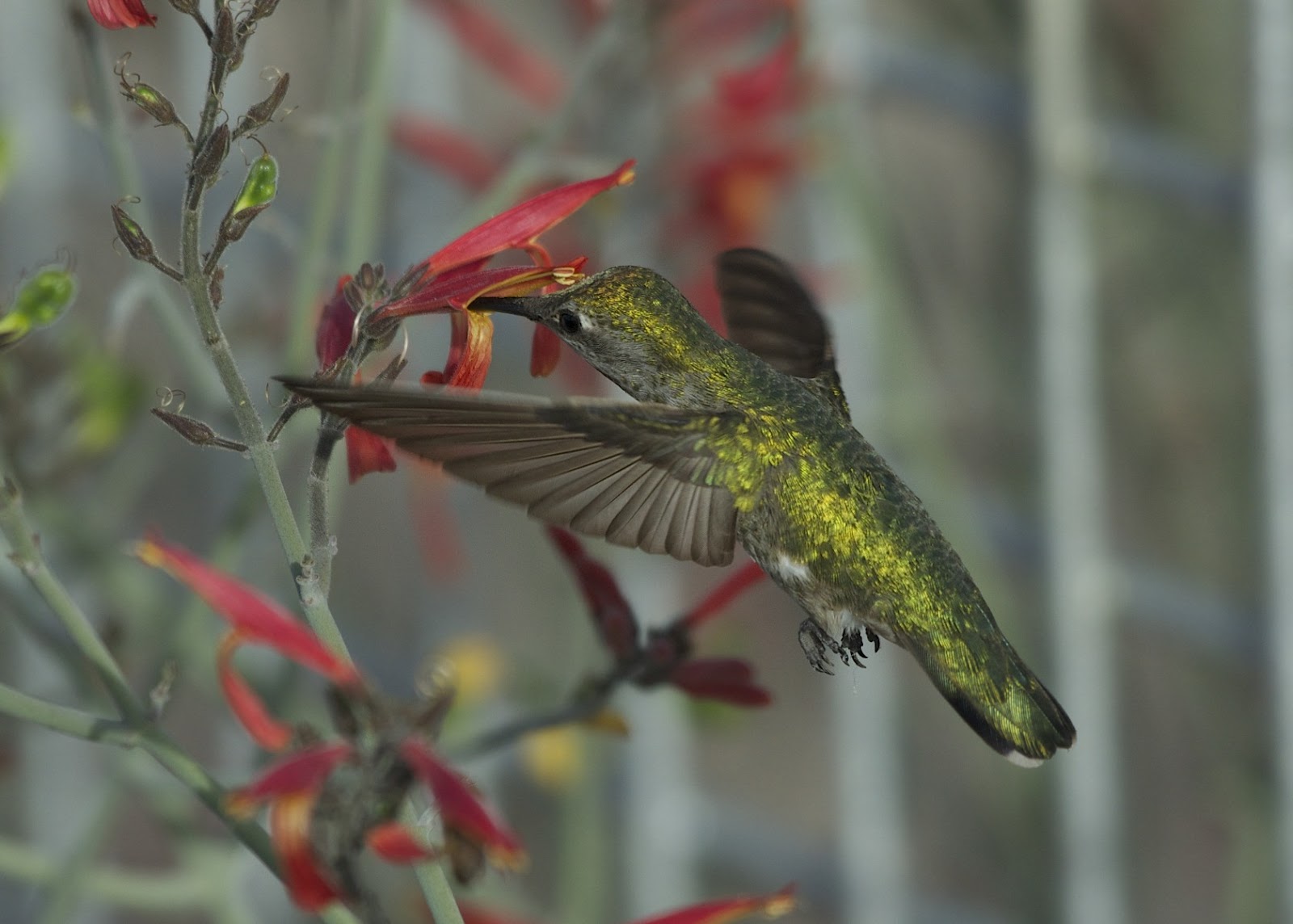
So, finding the little birding patch by work helps not only to satisfy that birding addiction--and really, satisfy is a generous word--it helps to numb expectations and encourage an appreciation of what would be considered lesser or duller birds in more grandiose birding settings. And hey, who knows when something rare will turn up? In the mean time, for even 20 minutes on a Tuesday, being a few feet from a feeding Anna's will do just fine.

Sunday, February 16, 2014

Birding: Bits and Pieces

There was neither method nor madness to this weekend's birding nor this post. With few wintering shorebirds or gulls at which to gaze and limited sparrow access in the central Arizona area, winter birding can be slim pickings once one's gullet is full of the admittedly beautiful winterfowl. Just ask this annoyingly plumaged Red-tail (annoying in that it made me initially hope it was something more).  


As things slow down in winter (and, since it's been in the 80s lately, I use that term loosely), one is forced to confront the troublesome questions of life and birding, questions that can be ignored in spring when the Tanagers arrive and the Warblers start to move, when colorful distractions abound. In the mean time, the universe seems to abandon its usual insouciance and bombard one with just enough concerns to create real difficulties, difficulties and inquiries that are persistent, but never too great as to allow one the eminent, unavoidable, and more relaxing option of good-conscience giving up.
Why is gas so expensive? Why are cars so finicky and prone to breaking? Why do mechanics charge as much as doctors? Why won't doctors also fix my car? Why do we insist that children wear seat belts, unless we put 60 of them all crammed in together on a school bus? 

These are pressing questions for the parsimonious birder, but much less so for a juvenile White-crowned Sparrow who does not yet know the weight of the crown of adulthood. For the young Sparrow, life does not much extend beyond the next seedy clump of grass. Lucky bastard...


Black Phoebes are perhaps more contemplative, or at least that anthropomorphism comes across more so from their perching habits. Even their relatively deep thoughts, probing though they are on these chilly winter mornings when there isn't much else to stimulate, must be interrupted by the the occurrence of nearby damsel flies. What is the Formal Cause of the desire to eat flies? What is the Final Cause? The Black Phoebe is, perhaps, closer to answering these questions of life and motivation than White-crowns, and maybe even (insectivorous) people, but probably not all the way there.


Lofty perching birds, like Say's Phoebes, may thusly entertain likewise thoughts, although their more limited forms of communication may indicate otherwise. Still, they're stately birds.


This Vermillion Flycatcher was too young to think of such things. And let's face it, when he's an adult he'll be like a ferrari among oldsmobiles, so he won't be bothered with questions of essence of existential determinism. He'll be way too busy being gorgeous and picking up/making chicks.


If any species of bird has big answers to big questions, has erudition oozing from its talons, it's got to be an Owl. But even such seemingly eternal and omniscient creatures cannot exist freely of their corporal and temporal needs. In fact, they thrive because they tend to them very well and they do not suffer any intolerable lightness to their being. Case in point, this happy, smug-looking fellow is clearly contemplating such things as evisceration if I were but a bit smaller.


Nothing puts all the other nagging and niggling questions to rest like a flight-or-fight response. Look at those talons, just sneaking out from under his belly.

This, this is called a "murder face." I never knew what high school sports coaches were talking about until now.