Friday, May 10, 2013

Fiery Birds in Ash Canyon

There are several famous sit-n'-spots in southeastern Arizona, where generous landowners and B&B managers maintain numerous feeders and lovely properties to keep the beautiful birds of southeastern Arizona concentrated in certain areas. Of course, this also attracts birders. Many of these sites--Paton House, Batiste B&B, Beatty Guest Ranch--have also established themselves as very reliable places to see some of the southeastern rarities. The Beatty place hosts Spotted Owls in Miller Canyon while the Paton House is visited by a Violet-crowned Hummingbird every day. If a birder is hoping to see these species, there are few places better.

Mary Jo's Ash Canyon B&B is another such establishment. Maintained by the very knowledgable and charitable Mary Jo Ballator, it hosts a Lucifer Hummingbird, along with many other pretty plumaged patrons, through the spring and summer. After our thorough birding in Miller Canyon early in the morning and afternoon two weeks ago, we spent some time at Mary Jo's in the hope that a Lucifer's Hummingbird would show itself. It's always easy to spend some time at these sit-n-spots, because there's a guarantee of plentiful, close-up views of many great birds, even if one misses the actual target (which we did. If you're hoping for Lucifer's photos, turn back now).


Lazuli Buntings occur in riparian areas in Maricopa County later in the spring, in conservative numbers and with a certain amount of trepidation. At Mary Jo's, one can sit only a few feet away as they forage, by the dozens, among her hedges and seed-scattered log piles.
Of course, there's a certain dissatisfaction in photographing of cool birds standing on feeders and artificial bird attractions, but the enterprising birder can find sites around the property where, even though though the birds are still sort of baited, they're not directly partaking in the unnatural attractions.


The roving Lazuli Buntings were joined by chipping and Lark Sparrows, along with the occasional, more uncommon Indigo Bunting. Seeing either one of these species is a great treat in Phoenix. Just a few hours down south they actively mingle and feed together in droves.


Many of the male Lazuli Buntings were not in their full plumage yet, and it was charming to see their patches of brown clinging to their caps like velvet on a young deer's antlers.


With the Lucifer Hummingbird proving to be a no-show, the main attraction around the Ash Canyon B&B property, for me, were the black, orange and white birds. This nifty color combination, in addition to describing Halloween, reaches across a few families of birds and, nicely enough, they're all stunningly beautiful.
Bullock's Orioles have made a big power play in recent years and are now, by far, the most common Oriole I see in Maricopa County. There were several of them in Ash Canyon, and even though they were outsized by some of the other O/B/W birds, they stood up for themselves well, and ultimately carved out a parcel of tree to be Bullock's boulevard.


Black-headed Grosbeaks were by far the most numerous of the O/B/W category. At one point, Mary Jo's seed trays had no less than eleven birds, many immature, clambering for a spot and a mouthful of crunchies. They have this massive beak after all. I believe they have an instinctive feeling of insecurity if they're not constantly crushing nuts. Watch out...


The plumage variations on Grosbeaks is quite amazing. Sure, it doesn't compare to Wood Warblers or waterfowl, but it's cool how there's Blue and Yellow Grosbeak, the ravishing Crimson-collared Grosbeak, and then this guy, who could easily fit in with a flock of Orioles if he just traded in the beak.
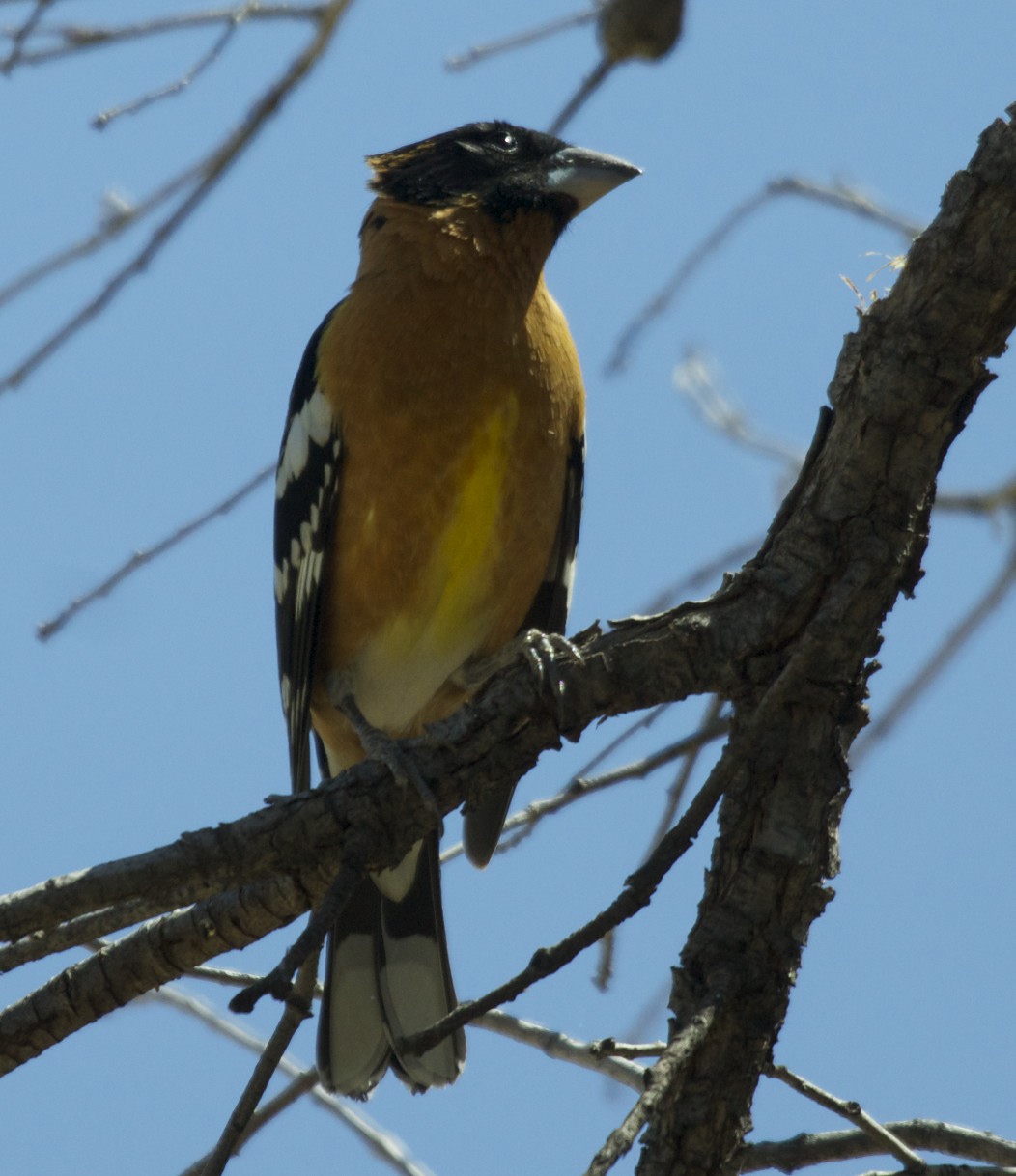

They're not particularly uncommon in the spring and summer months, nor particularly shy, but it's always exciting to see that bulky mass of orange, black, and white barreling through the air, or for that matter, perched in a mesquite.


The most resplendent of the O/B/W birds down south isn't actually orange at all, but a very striking combination of yellow, orange, and white (*editor's note: I'm purposefully neglecting Flame-colored Tanager from this mix, since it is not a mainstay).
Scott's Orioles used to be a regular occurrence in central Arizona, but I have not seen one in central Phoenix for some years now, and one of the few cosistent places to find them in Maricopa County is on the slopes of Mt. Ord. They were much more plentiful down south, not only at Mary Jo's but also in Miller Canyon and other areas around Ash Canyon. This unsatisfactory young bird was the first one which I got a good visual for the day, but there was better to come.


Especially in the desert, lots of birds adopt the 'economy of style' for their wardrobe, and make the most of various browns, grays, olive, and buffy hues to both look handsome and also blend into their arid environment. The whole Oriole group, much like the Tanagers and Grosbeaks, totally torpedos that idea. They're loud to hear and to observe; loud, but certainly not unpleasant.


Their scarcity in central Maricopa made the Scott's Orioles one of the trip highlights for me, though they were not a lifer, year bird, county bird, or even a month bird. We never get tired of looking at beautiful things or listening to beautiful music either right? I can see why Scott wanted to claim this bird to be his, this bird, and no other.

Monday, May 6, 2013

Sierra Vista: A Break in the Grass

Last Weekend I made a trip down to Miller Canyon and the Huachuca Mountains for Crescent-chested Warblers, a pair of which were seen and heard there for two days, only days after a separate report of a CCWA (I have no idea if that's the code) in the Chiricahuas. That Saturday evening ended with a stake out at Ash Canyon B&B, where we waited for a Lucifer Hummingbird, the other potential lifer (along with the CCWAs) on which I dipped for the trip. 

Between 4:00pm and 5:30pm though, there was not a lot of activity in Ash Canyon nor was the Hummingbird expected, so we were faced with a dilemma. We had some time--not a lot--to move to another location and try to buff up our list for the day, or we could just stay put in case it showed early. The Sierra Vista grasslands, lying adjacent to the Huachuca mountains, held the potential for a few more birds and were close enough that we could be there and back by 6:00pm, so we decided to leave our Ash Canyon post and try this new habitat.

There was not a particular site for the grasslands. Nice-looking and not-so-nice-looking neighborhoods spread out in Sierra Vista, and we drove around until we found a promising turn off, one that would put us far enough out into the tall grass and away from any grumpy porch-dwellers who were giving us the evil-eye as we slowly drove by their domiciles. 
Almost immediately upon our foray we were rewarded with a Swainson's Hawk, at that point a new bird for the day and one that's always a pleasure to see.


The real target for the site was Scaled Quail, a tricky bird to turn up and one that would be a state bird for me, as I had only before seen them in Colorado. While driving around Sierra Vista we found a dozen Gambel's Quail, but the Scaled were proving elusive.
At the more promising pull off, next to an industrial warehouse and with plenty of space, three other birders and I spread out and advanced through the grasses, with eyes, ears, cameras, and binoculars at the ready. After about ten minutes, and two Brewer's Sparrow, one of the scaly little plumpers flushed up onto some mesquite snags. What a satisfying sight!


The whole plan to pursue this bird had materialized pretty quickly and spontaneously. With little planning or work, we had turned up a state bird a gotten very nice views. On top of that, Scaled Quail is a handsome subject, big enough and distinct enough to leave a unique impression. Since the ornery Lucifer's Hummingbird never did show that evening anyway, I'm very glad we made this detour.


When the Quail first flushed it seemed pretty anxious, but after a minute to regain its composure, the bird perched comfortably and even called a bit, though nobody answered back. 


On our way back to Ash Canyon, we were then treated to improved views of Swainson's Hawk, with the earlier tree bird now bettered by another, closer specimen brazenly perching on a utility wire. 
We were expecting this bird to flush as we drove back towards the highway, as it was posed right next to the dusty dirt road and we couldn't detour around it. Contrary to our expectations and normal behavior, it stayed put, posing with great confidence. 


Everyone in our party of four was able to get great close-up views of this Swainson's light morph.


After satisfying our needs for close up raptor time, the bird then flew off to satisfy a need of its own. It made a beeline for the other Swainson's, which was still perched in its cottonwood. Without hesitation, the two began copulating in the tree, and we figured it was time to go.


The Scaled Quail was not a lifer, and the day's outing to Miller Canyon, along with a night up on Mt. Lemmon had produced plenty of lifers, but the Scaled Quail was still one of the highlights of the trip. It was a tricky/uncommon enough bird to make the find feel special, we had great views, and the bird itself is super adorable. With all that brigandine, this stout bird is really a Battle Quail, and it will definitely charge you with that Q-tip horn. Great bird.

Thursday, May 2, 2013

Great Scott!

Prescott and Yavapai county...lying only an hour and fifteen minutes to the north, they're the closest non-Maricopa county/region to central Phoenix, and they also have some nice, cooler, high elevation birding spots. One of my birding buddies is a big booster of the Prescott scene, and a few weeks ago I joined him for a half day of exploring around Watson and Willow Lake. These are two of the most well known and visited of Prescott's five central lakes, and in addition to boasting some nice riparian habitats, they also draw in some excellent waterfowl, both of which grabbed my attention.

The first critter of interest at Watson Lake was not a bird though, but this big and beautiful moth hanging out on the bathroom shed.  


It was a cool morning but not chilly, though it had snowed only a week before. While walking through the Watson riparian area, American and Lesser Goldfinches made plenty of noise, and various Vireos vociferously voiced from the treetops. Tree Swallows reveled in the morning light, and the occasional Lazuli Bunting buzz broke out from the dense foliage along the creek.

The Watson Riparian area opens up after a short walk, and while the pathways on both side of the lake were frequented by cyclists, we still had some nice views and nice birding. Four Cassin's Kingbirds all in a row along a telephone line made for a quirky sighting, and this precocious Western Kingbird nipped from fence post to fence post, with a swarm of his breakfast buzzing in the background.


These sightings were a great way to get going, but we also came to Watson lake with some specific targets. The liminal habitat between the riparian washes and the open lake is prime Wood Duck territory, and a recent report of White-winged Scoter also piqued our interest.
The first of our target birds came from the southwest shore, when Tommy spotted a handsome drake Wood Duck in the shallow junk. It was too far for passing photos, but Tommy's spotting scope made for some great views. Apart from an escaped Mandarin, this is the most colorful bird one might find floating in or perched around North American ponds.


Walking a mile up the southwestern shore, we decided to leave the main trail, somewhat on a whim, to explore an inviting little inlet. With a few Redhead couples, it had some waterfowl not yet seen that day. Tommy then spied a large, brownish, generally dull feathery floaty thing. Perfect!
When the bird finally lifted its head, it was indeed the White-winged Scoter.


It's not Wood Duck; it's not even the most colorful Scoter, but White-winged is a solid find anywhere in Arizona, and one I was glad to record for the second time in the last couple of years.


The sleek Franklin's Gulls were another attraction at Watson Lake. These migrators are more numerous in the state now than they were several weeks ago, and even while they were distant, their handsome hoods eye-catching eye rings are always nice to see.


By the time we reached our second destination at Willow Lake, the wind had really intensified. We scoped out some Blue-winged Teal, along with a Lesser Yellowlegs and two Black-necked Stilts (all good finds for the area), along with the expected regimen of waterfowl, but otherwise the whipping wind kept the birding pretty muted.

On the plus side, fancy flyers like the Franklin's Gulls enjoyed the free lift, and we had much closer views than were afforded at Watson Lake.


A pair of California Gulls added some larus diversification to the mix, though they were both uglier and farther away. Hey, a year bird is a year bird.


We were surprised to see a Turkey vulture cutting through the Gull cloud, seemingly spurred with a purpose not as characteristic of the buzzards. As the raptor passed overhead though and the light became more helpful, the white tail bands allowed us to add Zone-tailed Hawk to our list for the day.


The windswept water of Willow Lake was not a deterrent for the Eared Grebes, whose numbers seemed bolstered in the breeze, by comparison, as many other birds sought shoreline inlets for cover. We didn't find the target Red-breasted Merganser here, though I found some at Glendale the next day and thus no hard feelings were felt.
We're cool; you be windy if you want to, Willow Lake.


The Willow Lake shoreline is a very interesting, impressive combination of sandy shale and wind-rounded granitic mounds. My proclivities towards bush crashing and impatience got the best of me; eventually I gave up the Merganser scouting to explore the miniature canyons.

Down in Phoenix, the Yellow-rumped Warbler population has dramatically decreased for the season. It's a shame how that timing in central Arizona works out, because few of the wintering YRWA get into their really sharp plumage before they leave. 
They had bulging numbers in the Prescott area though, and they were pretty to boot. Tommy also had a nice Myrtle subspecies show for him, and I spent time battling this Audubon's variety with my broken autofocus. He ducked, bobbed, and weaved in a manner than would make both professional boxers and squirmy children proud. Magnificent bugger...


It's funny how when wind, rain, or general afternoon doldrums make for sparse birding, something so common can, and will, become a fascination. In part for lack of better birds on which to spy, I followed this yellow-chinned chicken around for a good twenty minutes, never coming away with anything better than the photo below, but nonetheless feeling very satisfied overall. 


Cooper's Hawks aren't such big fans of soaring in the thermals, but I wouldn't have assumed they were big fans of awkward perching atop the tallest boulder by the trail. This weirdo just apparently forgot how to hawk or something, but after a minute's time for his amnesia, plus the realization that people were looking, he departed to find a more accipitery perch.


We recorded somewhere near seventy species for the half day and enjoyed some gorgeous weather, in addition to some gorgeous birds. With the commute to these Prescott locations being only slightly longer than many of the best Maricopa spots, this may well become one of Butler's Birds frequently frequented.

Tuesday, April 30, 2013

Sonoran Saints Preserve Us!

One of Phoenix's main attractions, in addition to the excellent dining scene and cheap, plentiful alcohol, is that there are mountains right in the middle of the city. Sandwiched in between the SR 51 highway and Tatum Boulevard, the Phoenix Mountain Preserve showcases the marvelous combination of urban life and nature-scapes that Phoenix brings together so well. Just a few miles to the east, Camelback Mountain just east is one of the most hiked peaks in America. True enough, it's harder to enjoy these scenes when it's 104 °F in late April (come on!), but when I swung by the Phoenix Mountain Preserve in early April, it was an all round' gorgeous scene. 


This is a nice place for hiking and mountain biking, but it's not normally on my rotation of local birding hotspots. It features great scenery and good birding, but an average day at Papago or the Desert Botanical Gardens will yield more species of the same genre. 
However, in late March and early April, just for a few weeks, the washes in the Phoenix mountains provide temporary housing for migrating Long-eared Owls, a coveted bird anywhere in the U.S., and all the more so in the Sonoran desert. With these Owls in mind, I made several trips into the Preserve, one with fellow birders Tommy D. (who had more success than I) and Dominic Sherony, and another with  a great birder, naturalist, and field guide author Duncan Butchart, from South Africa. 

As far as the secretive Long-eared Owls go, below is my only sighting and only shot of the beasts. Yes, it's the dark, hazy shape in the lower center of the photo, ruining an otherwise lovely shot of some mesquite trees. If you came here for sweet Owl shots, you're in the wrong neighborhood!


The visuals I had on the Owl were better than the photo, enough to ID the bird by its size and flight, but it wasn't the most satisfying of sightings. The treks through the Phoenix Mountain Preserve, on the other hand, were absolutely beautiful, both for the birds and the general desert wildlife.
The Long-eared Owls prefer the dense mesquite and palo verde trees in the many jutting washes of the Phoenix Mountains, and so into these shady, rattlesnake-infested gullies the daring birder must go. The explorer must have a nerve, and socks, of steel, for the cactus spines and dry grass prickers, along with non-stop flash mob rattlesnake attacks, can leave one worse for the wear.

Luckily there are enough feathery gems, like this shady Anna's Hummingbird, to make the misses very, very palatable. I bet if I'd gone searching deliberately for Anna's, I would've found Owls instead.


In between the sandy, brushy declivities preferred by the Owls, flat expanses of scrub grass, cholla cactus, and creosote span all through the mountain range. These desert-specialist plants serve as nifty perches for late migrant Sage Thrashers, as well as Black-throated Sparrows just starting to settle in.


The very thick tangles of brush form impenetrable webs of stickers and misery for any creature that comes to close. Any creature, that is, that's not tiny. Roving clans of Brewer's Sparrows find these bristling brush piles to be irresistible, and in fact they even seem to inspire song.


In the dull color vs. great vocalization ratio, Brewer's Sparrows are tops. Their lengthy song, a combination of chips, whistles, and buzzing vibratos is both recognizable and delightful, even if their preferred habitat must be enjoyed from a distance. 


Ash-throated Flycatchers don't care for the prickly stuff so much, and they, like the numerous Say's Phoebes in the area, will take a clear perch atop a mesquite any day. This, below, may have been the exact view first enjoyed by the ornithologist who named the bird.


With their prickly perches, the Brewer's Sparrows bring some sting to the Sonoran birding flavor. Ash-throated Flycatchers, needless to say, bring some smoke, and the Say's Phoebe's, with their beautiful cinnamon wash and acrobatic, unabashed fly-catching, bring some spicy flavor. Like a nice pork chili verde, these desert birds, seen in their respective microhabitats, produce a dish that's not particularly rare or difficult, but one that is nonetheless a salivating feast, especially when one is starved of Owls!


Speaking of feasts, the Phoenix Mountain Washes did produce some interesting signs of Long-eared interest.  This Western Fence Lizard (correct me if I'm wrong) would make a nice little snack in the twilight hour, and for the main course...


How about a nice, plump ground squirrel? This was left in the middle of one of the washes, no doubt as an intentional warning, from the Owls, against any paparazzi intruders.


Though they tended to dominate the Sonoran soundtrack, the Brewer's Sparrows didn't have a total lockdown on the little brown bird symphony. Rock Wrens and Curve-billed Thrashers chimed their pretty notes too, sometimes even from the same rocky perches, though in this case the Trasher was busy with nesting material. Two's company, but I made it three and that's a crowd.


The birds will always be of primary interest, but there are many other aspects of the Mountain Preserve to enjoy. Especially with the evening lighting, the blooming cactus are absolutely stunning. After more than twenty years of desert romping and roaming, I can (un)safely say that I've been pricked by every possible Arizona cactus in every possible place. Despite them making many tracts of landscape somewhat hostile, and making some yards totally inhospitable to soccer balls for unlucky boys, I wouldn't trade them for the world. 


They can grow for months without water and even, apparently, grow out of solid rocks walls (or out of the tiny dirt margins in between the rocks. Like a fine zinfandel or malbec, the hardship that these plants endure does nothing to vitiate their color (or flavor), and actually seems to maximize their aesthetic.


The cactus also provide homes to legions of desert fauna, and not just the Brewer's Sparrows. Curve-billed Thrashers and Cactus Wrens make their massive, messy nests in the bosom of cholla bunches, while the massive Saguaro cacti house Gila Woodpeckers and Western Screech Owls in their cavities. The hinges of saguaro arms provide solid domestic foundations as well, not only for Mourning Doves but also, as I discovered, for Roadrunners, keeping the young safe and high off the ground, until they are grown and ready to terrorize everything that's smaller than they are. 


As April has worn on, the sun set of my Long-eared Owl opportunities. They will be back again, and so will I. It is comforting that, while it will dry out and brown in the next several months, the rugged beauty of the Phoenix Mountain Preserve will stay a constant. 
 

P.S. I was exaggerating about the rattlesnakes, but look out for nocturnal Sonoran Ground Snakes, which may in fact be the most poisonous animal known to science. They're too polite to ever bite anybody, so that's not the worry. It's their biting sarcasm that hurts the most.

Sunday, April 28, 2013

Saluting the Flag (BIF Repost)

Hello Bird Nerds, Friends, Family, and Web Vagrants,

It was a busy week and a busier weekend. I apologize for the low output of new blogging material this weekend, and hope to get caught up in the next few days. In the mean time, here's some high altitude material from earlier this week at Birding Is Fun.

--Flagstaff that is, or rather, the high elevation environments near Flagstaff that provide wonderful, unique, and existentially essential birding! Yes indeed, Arizona birders love their desert dwellers and their southeastern specialties, but sometimes one just needs chilly mountains and pines to complete the holistic birding experience. If those mountains also happen to have high elevation specialists and other cool-temperature loving birds that aren't easily found elsewhere in the state then, well, so be it.

Western Bluebirds aren't only found up in the mountains, but up in the mountains they're a guarantee.

Several weeks ago, some very intriguing reports trickled their way down from up north. A Eurasian Wigeon on Mormon Lake, twenty miles south of Flagstaff, was complimented by sightings of Red Crossbills and Evening Grosbeaks at the Mormon Lake lodge nearby. Heading up a week later, a birding buddy of mine found something even cooler.  After successfully scanning the grasslands on the other side of Mormon Lake for Rough-legged Hawk, I parked near the lodge and began scanning. Almost immediately Grosbeak sounds started emanating from the nearby ponderosas, but before getting near these trees I had to cross a drainage ditch. 

Like any 2-D video game, these ditches are often treacherous to jump across, and are usually full of dangerous critters. In this case the critters were of some interest, as Chipping Sparrow and Dark-eyed Junco emerged to get the Sparrow count up and running for the day.  


That was to be expected, but an odd sighting at ground level was this Pygmy Nuthatch, which was perhaps given the false affirmation by its parents that when it grew up, it could be anything it wanted. Alas, it was clearly not a Junco, no matter how it tried, but I was still willing to accept it for what it was, even if this bird was not being true to itself. 

There, that's more like it. 

The ground birds were obliging, but all the while I was following them around I couldn't shake the disappointment in how small their beaks were. After all, this trip was about seeing big rude birds with big rude beaks. The calls were still resonating in the ponderosas, and the sighting could be delayed no more. 

About twenty feet or so up the trees, there they were. Thirteen of ABA 2012's Bird of the Year. They perched, they flaunted, they exuded all the style and panache to be expected of a former BOY. It was a terrific shame to have missed them in 2012, and a terrific joy to find them in 2013. 


Bold and brash, these are among the most royal of finches, and with beaks like that, who's going to argue with them? Nobody, that's who.
The unibrow, the yellow, the broad chest...yes yes this truly was a mighty Bird of the Year, one of the top three there's ever been.


Like many birds, the sexual dimorphism of the Grosbeaks is less kind to the females, who have their own unique charm but are somewhat drab by comparison. For that matter, sometimes they're not too charming either. I think she was a little grumpy to have been bumped off her perch by a Nighthawk, and a Common one no less. Lady Macbeth...


While crouched beneath the ponderosa pines, I was visited by another prominently beaked bird. This was the only Red Crossbill on which I laid eyes throughout the day. It flew into the tree and landed only ten feet away. It was a surprisingly abrupt approach, and in fact I think the bird did not see me, for as soon as it turned its head it was off, leaving my with but a single photo and a lovely memory. What a heartbreaker. That Crossbill has to be one of the coolest example of micro-evolution in North America.


The Grosbeaks, Nuthatches, and Bluebirds, along with the obligatory Pine Siskins, were the vociferous and highly visible denizens of the lower crown on the tree.


Higher in the ponderosas there was a different group of birds. Woodpeckers lead a life that only other Woodpeckers understand, and perhaps also heavy metal rockers, and hammers--ok anybody who has to smash their face against something for a living. 
Some Northern Flickers fed on the ground, but the higher reaches of the Trees belonged to the melanerpes and the picoides. Acorn and Hairy Woodpeckers were the most common, but a few Lewis's Woodpeckers added their peculiar mix of color and attitude to the upper canopies as well. 


Someday, I hope to get a Lewis's Woodpecker and Clark's Nutcracker together in a single shot. If someone else has managed that, please come forward for your Lewis and Clark appreciation medal and a $100,000 prize from the government.


Also in the area, rather annoyingly, were several Eurasian Collared Doves. These large and chalky doves normally do not bother me, even though they're and invasive and quickly expanding species. In city limits, they provide a nice diversity with the other common doves and feeder birds.
However, seeing them out in the relative pristine of the Mormon Lake woods felt like a violation of sorts. Surely, not here? Is not place safe from these city-slickers? You're in the wrong context Dove!


Having seen the Doves and now feeling a bit unclean, I left Mormon Lake and headed north to Walnut Canyon, in the hopes of finding Pinyon Jays and Mountain Chickadees. Walnut Canyon is a real beauty, with a small visitor center and some tables making for a nice picnic area.


The Pinyon Jays were elusive to the camera, but Steller's Jays were more than numerous. Bushtits were also abundant, as were Bridled and Juniper Titmouse.


With time starting to run out, I finally got a visual on some Mountain Chickadees as well--of course they were positioned perfectly to have the lighting against them. They were a bit of a hassle but come on, what trip to the mountains is complete without a bird that has Mountain in its name? 


This stately Mountain Bluebird on a cattle guard was a lovely punctuation mark to a great day of birding. Riparian habitats, desert scrub, salt marshes, and grasslands all make for beautiful, teeming birding sites, but there is something particularly invigorating, particularly satisfying about birding in montane forests, and for that I salute the Flagstaff.